-
-
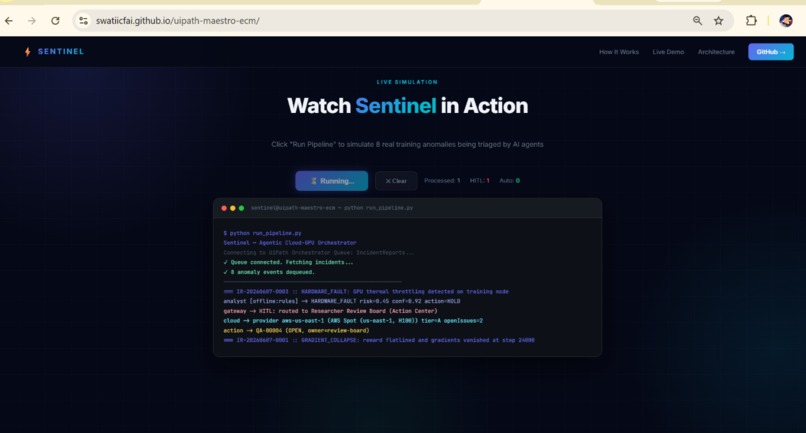
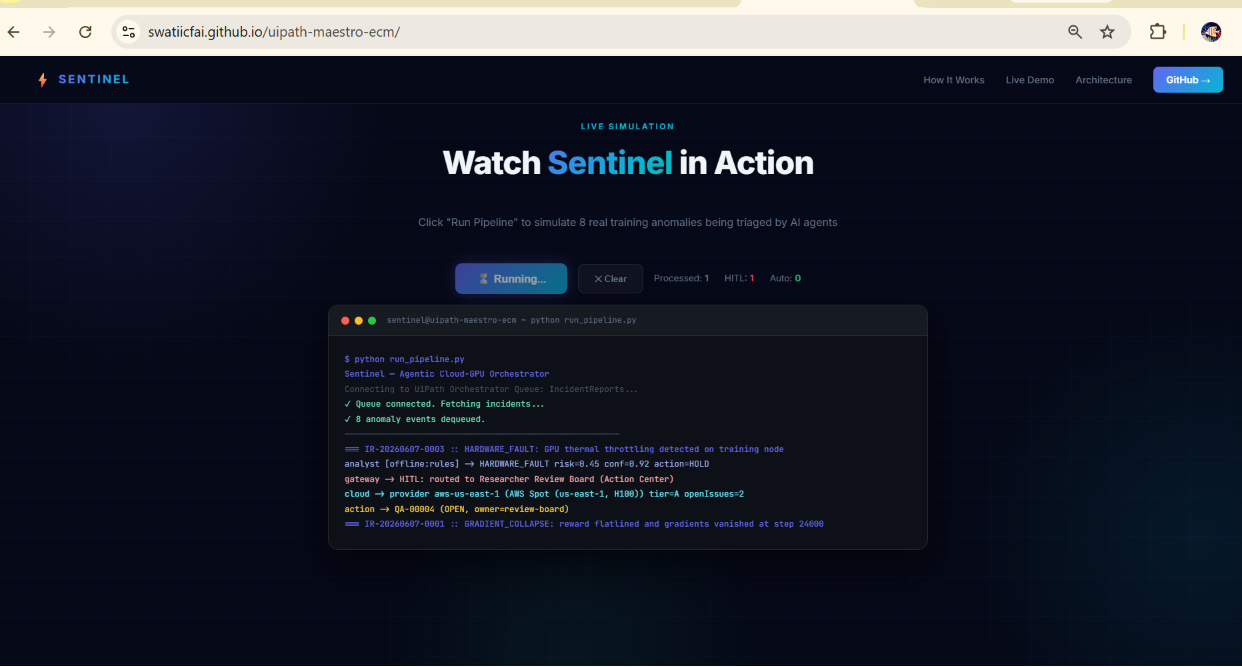
Live pipeline simulation — 8 real training anomalies triaged by AI agents in real-time
-

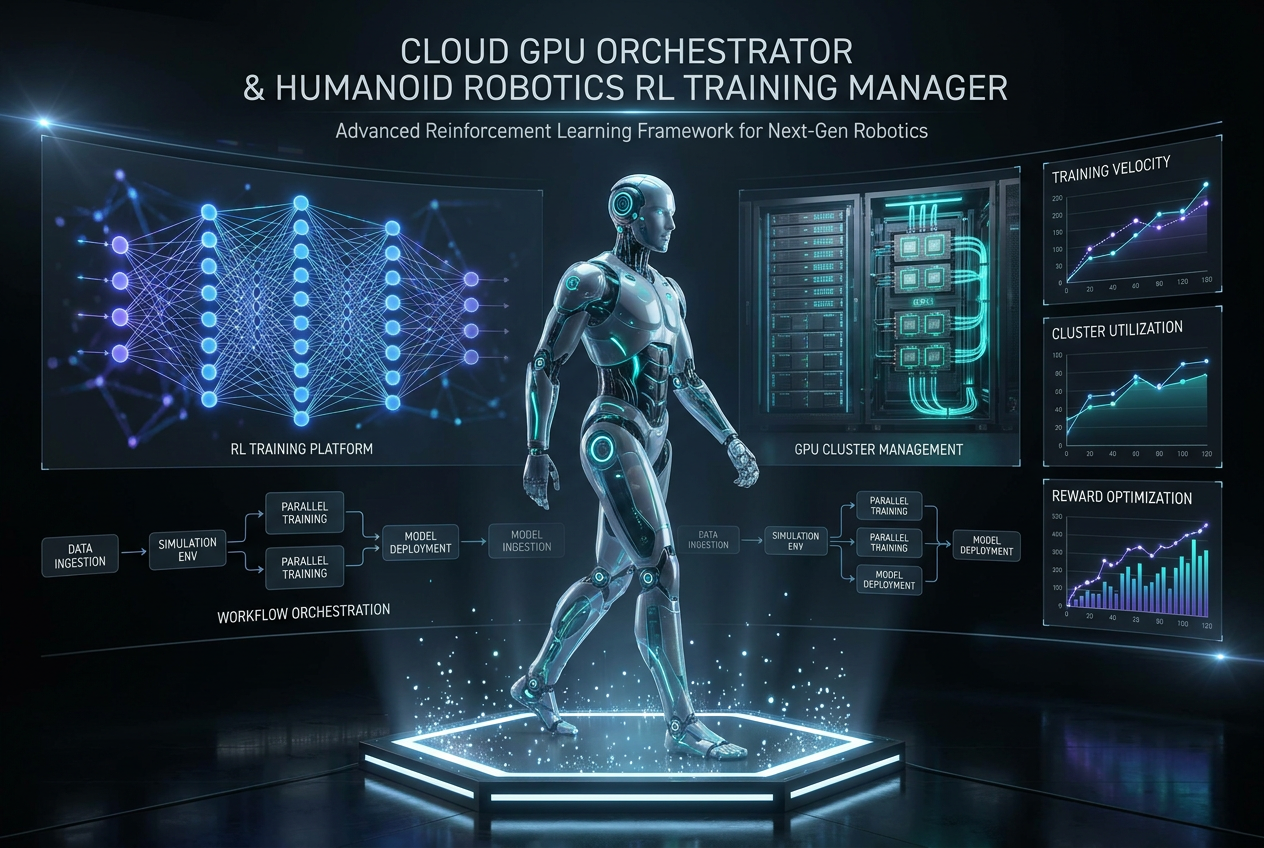
Sentinel — autonomous humanoid RL training fleet manager on UiPath Maestro BPMN
-
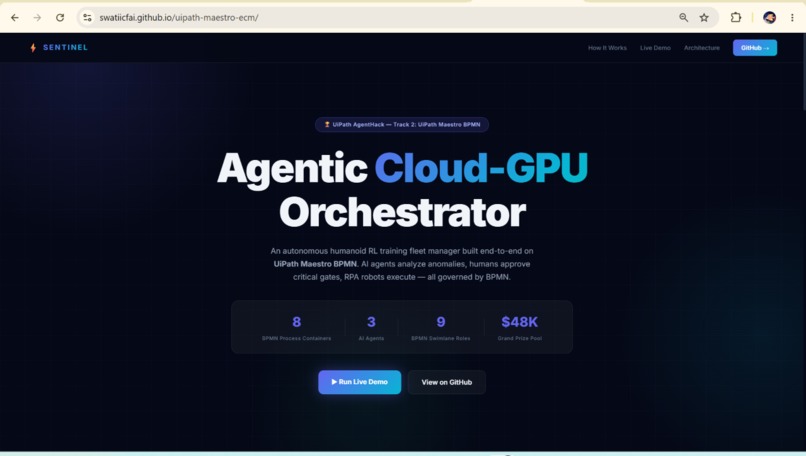
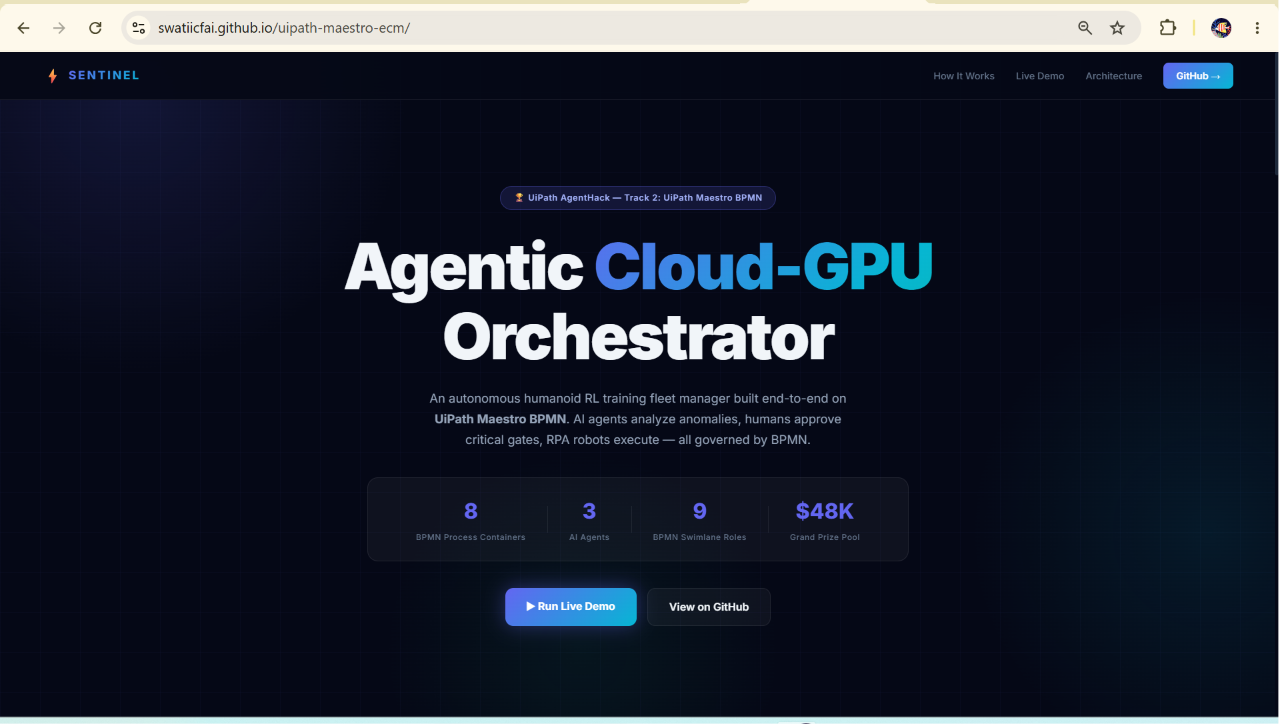
Live site: Agentic Cloud-GPU Orchestrator landing page at swatiicfai.github.io/uipath-maestro-ecm
-
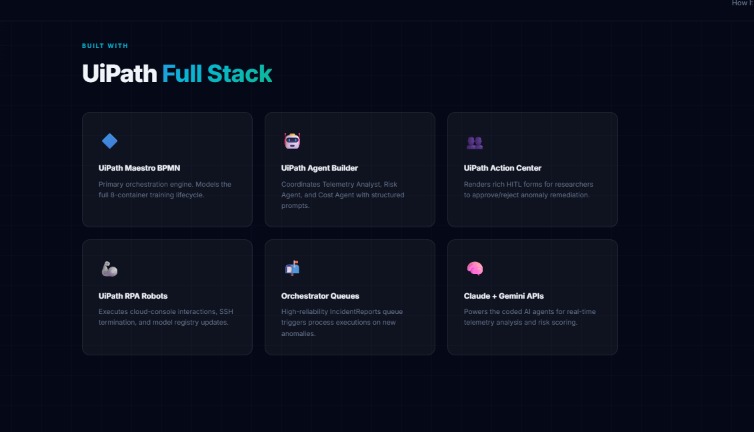
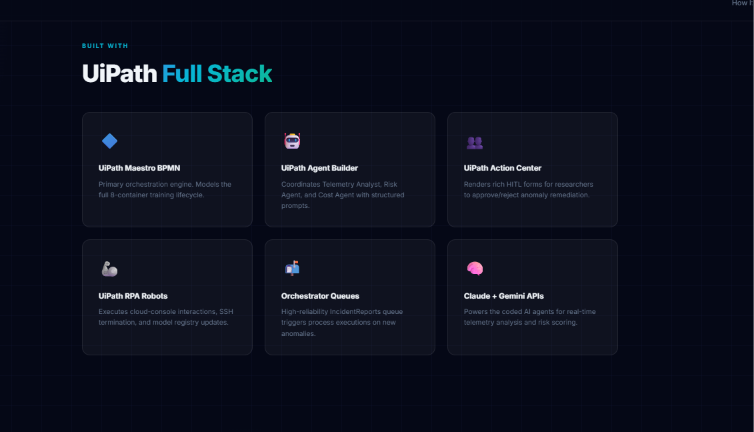
UiPath full stack: Maestro BPMN · Agent Builder · Action Center · RPA Robots · Claude + Gemini APIs
-
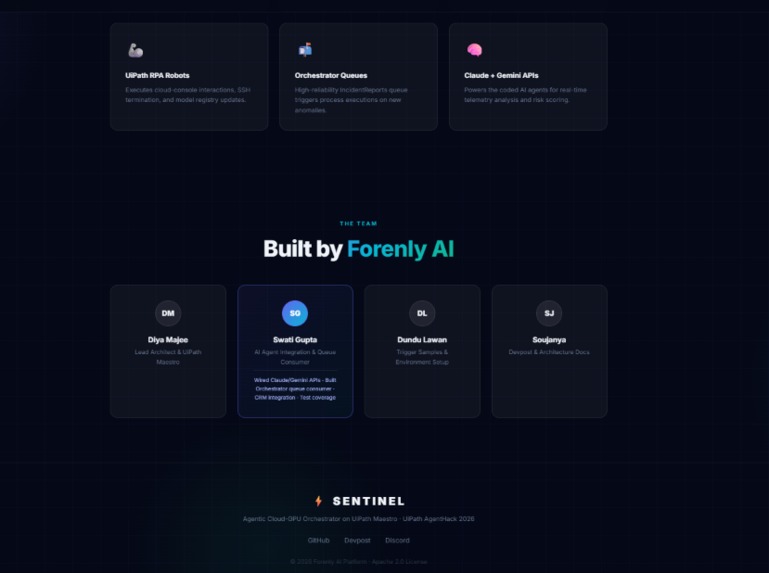
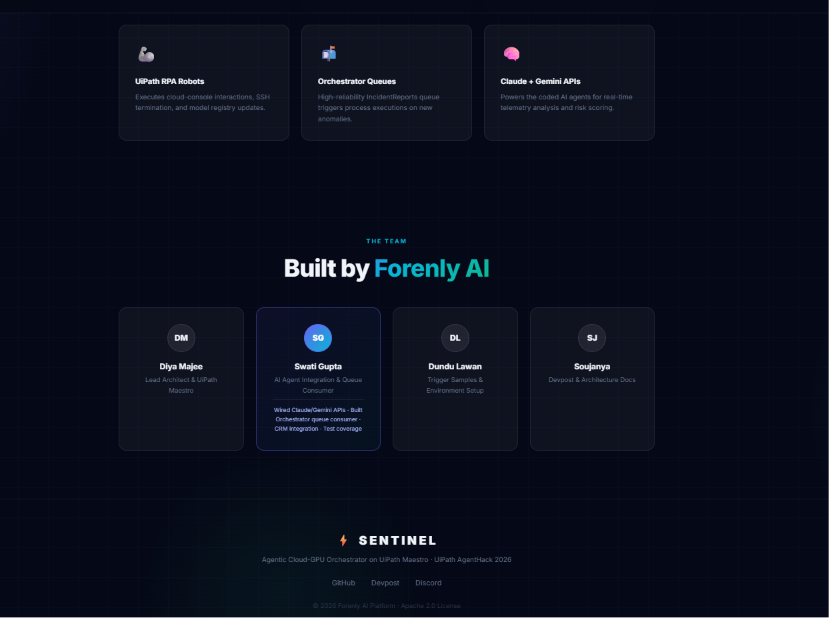
Built by Forenly AI — UiPath AgentHack 2026. Lead: Diya Majee · AI Integration: Swati Gupta
Inspiration Training neural skills (like walking, running, or grasping) for bipedal humanoid robots (e.g., the Unitree G1) in reinforcement-learning simulations is incredibly compute-heavy and expensive. Teams often burn thousands of dollars on cloud GPUs (AWS, GCP, AMD Developer Cloud) that sit idle, or worse, on RL runs that silently diverge or collapse for hours before anyone notices. We were inspired to solve this massive resource drain by orchestrating the entire training lifecycle and putting intelligent guardrails in place to save costs and ensure safety.
What it does Our project is an open-source framework that runs a cloud-GPU orchestrator and humanoid RL training lifecycle manager as an agentic, human-in-the-loop (HITL) orchestration on UiPath Maestro BPMN.
It manages the entire lifecycle:
Intake: A researcher requests a training run, or a monitor flags an anomaly (like gradient collapse or idle spend). Analysis: AI Agents act as Telemetry Analysts to classify anomalies and assign risk scores. Routing: An Anomaly Risk Agent determines if the event can be "Fast Tracked" (auto-remediated) or if it requires a Researcher Review Board (HITL) via UiPath Action Center for critical cost and physics-safety gates. Execution: A UiPath RPA robot executes approved actions into systems lacking clean APIs, such as cloud-provider consoles, billing dashboards, or SSH-driven container controls. How we built it We leaned heavily on two signature strengths of the UiPath platform:
Agentic AI: We used UiPath Agent Builder to coordinate specialized autonomous AI agents (powered by Claude and Gemini via Python/LangChain wrappers). These agents reason over live reward/loss telemetry, container logs, and hardware monitors. RPA & Orchestration: We modeled 8 process containers representing the full training lifecycle as subprocesses in UiPath Maestro BPMN. When an action is approved, UiPath RPA robots and API Workflows handle the heavy lifting of cloud provisioning and registry updates. We also used UiPath Action Center to render interactive forms for researchers to review telemetry and approve/reject actions, and UiPath Orchestrator Queues to manage the event triggers. Challenges we ran into Integrating fast, real-time code-based intelligence (1Hz data processing for gradient collapse detection) with enterprise-grade, low-code BPMN governance was a significant architectural challenge. We had to ensure that the coded agents (Python/LangChain) could connect seamlessly to the UiPath ecosystem via REST APIs and Orchestrator Queues without breaking the closed-loop auditability.
Accomplishments that we're proud of We successfully built a true Hybrid Agent Architecture. We combined the robust routing, queue state transitions, and HITL approvals of UiPath's low-code environment with the high-intelligence reasoning of coded LLM agents. Additionally, we created a system that is fully testable locally (with fallback mock logic) while being completely ready for a live cloud deployment.
What's next for Training | Fleet and Cloud Resource Manager Our next steps include expanding the "Fast Track" auto-remediation playbook to cover more edge cases in reinforcement learning failures, integrating deeper with specialized hardware monitors, and scaling the framework to orchestrate even larger fleets of distributed training clusters!


Log in or sign up for Devpost to join the conversation.