-
-
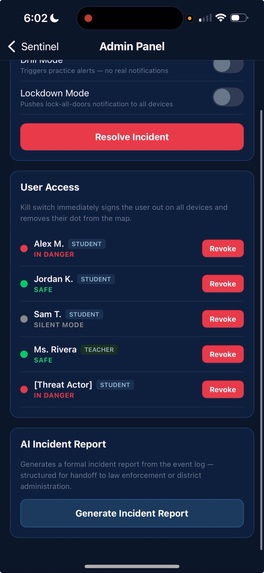
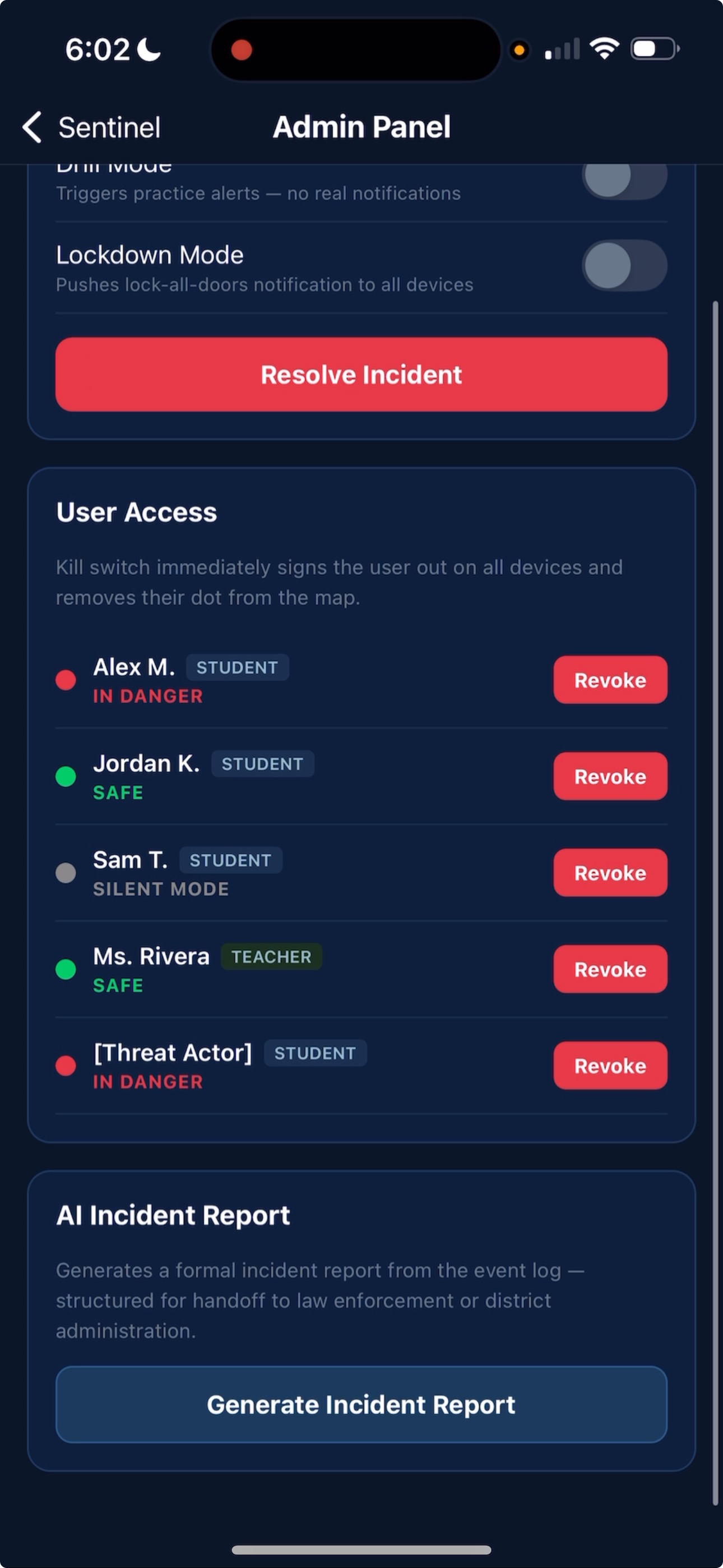
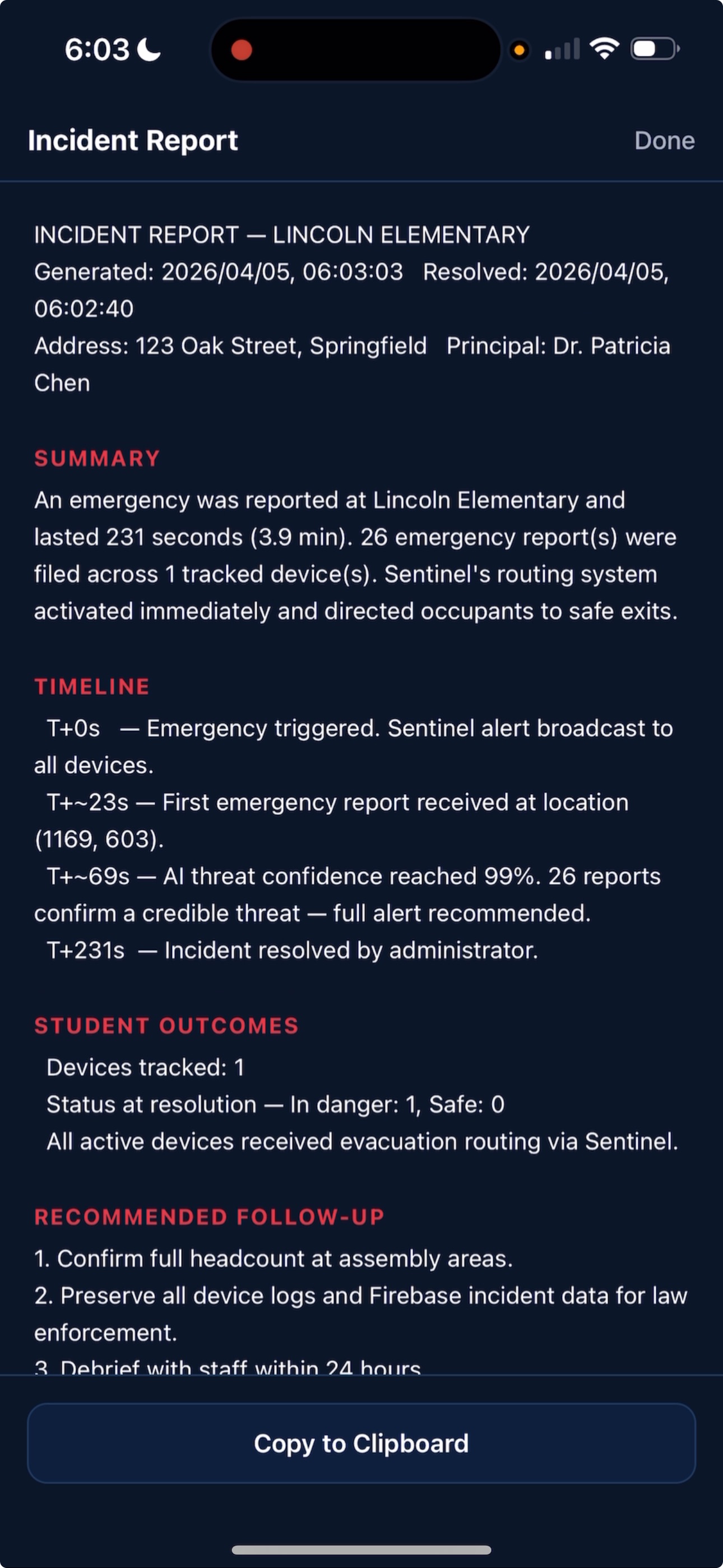
Admin Panel
-
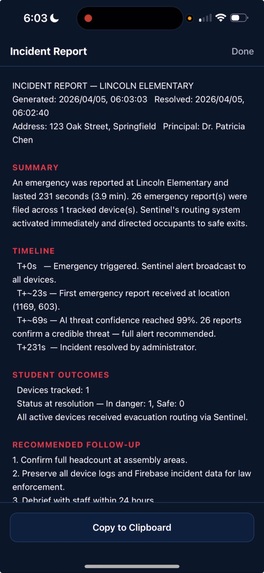
Incident Report
-
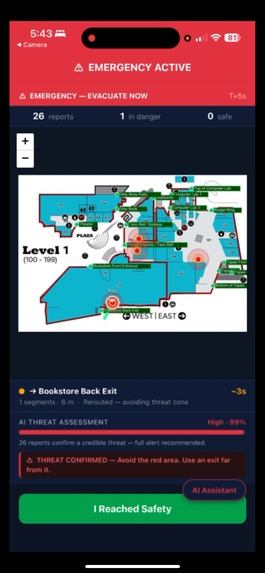
Node Overview
Inspiration
Current emergency protocols rely on static paper maps and "pre-planned" routes that fail to account for real-time threats. Campus shootings, especially, are filled of mayhem and confusion of where the shooter is located. We were inspired to build Sentinel to transform static floor plans into intelligent, data-driven survival tools that adapt as an emergency unfolds and to direct users to safety in an easier and quicker manner.
What it does
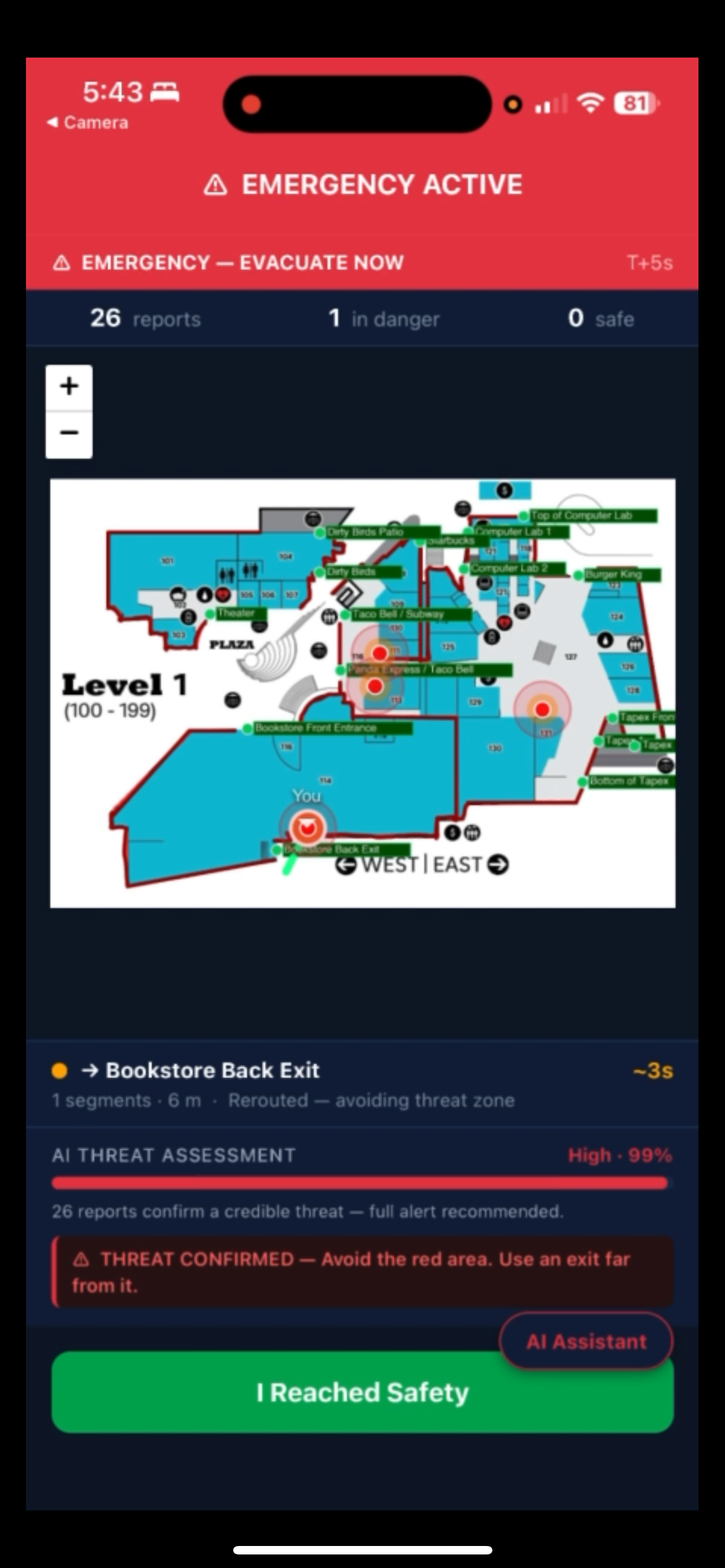
Sentinel is a live emergency navigation system that aggregates real-time danger reports from users to generate a dynamic "threat heatmap." Using this data, it recalculates the safest possible evacuation path for every student in the building, routing them away from danger zones and towards the most viable exit. Users' phones will vibrate in higher frequency if they are running towards the danger, which allows users to solely focus on reaching safety, rather than staring at their phone. If users are in hiding or have more time to find an escape route, an integrated AI chatbot provides calm, site-specific instructions to help users navigate high-stress environments.
How we built it
We built Sentinel as a full-stack React Native application using Expo and Firebase. Path Finding Logic: We implemented a custom routing algorithm to minimize the cost function \(f(n)\) for each node \(n\) :$$f(n) = g(n) + h(n) + \omega(c)$$where \(g(n)\) is physical distance, \(h(n)\) is the heuristic to the exit, and \(\omega(c)\) is a dynamic weight based on real-time danger counts. Backend: Firebase Realtime Database handles the live "danger" stream and coordinate syncing. Frontend: A custom SVG-to-Coordinate mapping system allows our graph nodes to overlay perfectly onto standard building floorplans.
Challenges we ran into
The biggest hurdle was Coordinate Mapping—translating raw pixels on a static PNG into a logical graph of nodes that actually fit within "walkable" hallways. We also faced significant State Synchronization issues, where managing a live Firebase stream while recalculating A* paths every second caused UI lag, which we solved by optimizing our rendering cycles and modularizing our graph data.
Accomplishments that we're proud of
We are incredibly proud of our Dynamic Rerouting Engine. Seeing the app instantly "pivot" a user's path when a new threat was reported on the other side of a hallway felt like a true "aha!" moment. We also successfully managed a complex Git workflow, resolving major architectural merge conflicts under a tight deadline.
What we learned
We gained deep experience in UX for high-stress environments. We realized that in an emergency, every extra tap is a barrier, leading us to design a "one-tap" reporting system. Technically, we mastered React Native dependency management and learned how to build robust data-parsing wrappers to prevent app crashes during rapid development.
What's next for Sentinel
We want to integrate Indoor Positioning Systems (IPS) using Wi-Fi RTT or Bluetooth beacons to provide sub-meter accuracy without relying on GPS. We also plan to scale the AI chatbot to handle multi-language support, ensuring that Sentinel can guide every student to safety, regardless of their native language.
Built With
- firebase
- html
- javascript
- matplotlib
- python

Log in or sign up for Devpost to join the conversation.