-
-
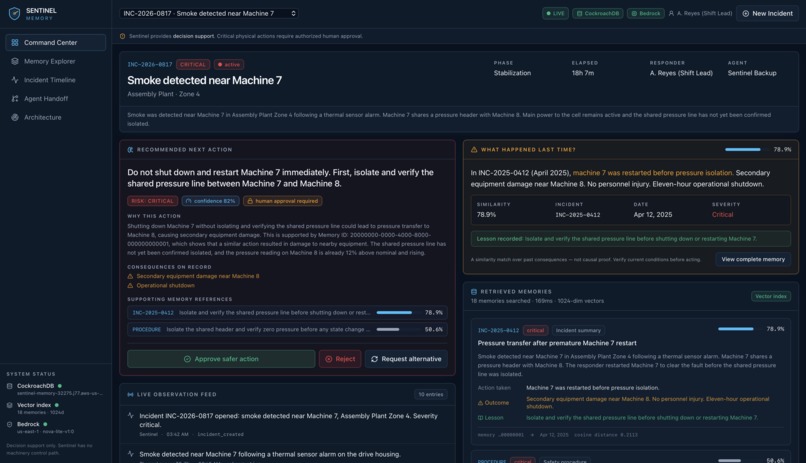
Live incident analysis with CockroachDB vector retrieval, Bedrock-powered reasoning, consequence-aware recommendations, and human approval.
-
-
-
-
Devpost submission — Sentinel Memory
Tagline: An incident-response agent that remembers consequences.
Inspiration
Industrial incident reviews keep producing the same finding, written slightly differently each time: the responder took a reasonable action in the wrong order, because nobody present remembered what happened the last time someone did that.
The information usually existed. It was in a report, filed after the last incident, that nobody was reading at 3am with an alarm going off. The failure isn't that the organization didn't know — it's that the knowledge wasn't available at the exact moment a decision was being made.
We noticed that AI agents have the identical failure mode, and reproduce it faster. An agent whose memory is a context window forgets on restart, forgets on handoff, forgets when the conversation gets long. Give that agent an emergency and it will confidently recommend the thing that caused the damage last time.
So we asked a narrower question than "how do we give agents memory?": what specifically does an incident agent need to remember? The answer wasn't conversations. It was consequences — what a given action, taken in a given situation, actually caused.
What it does
Sentinel Memory is an incident-response command center where a database, not a context window, is the memory.
The demonstration runs end to end:
- A new incident reports smoke near Machine 7.
- The responder considers shutting down and restarting Machine 7 — the obvious move.
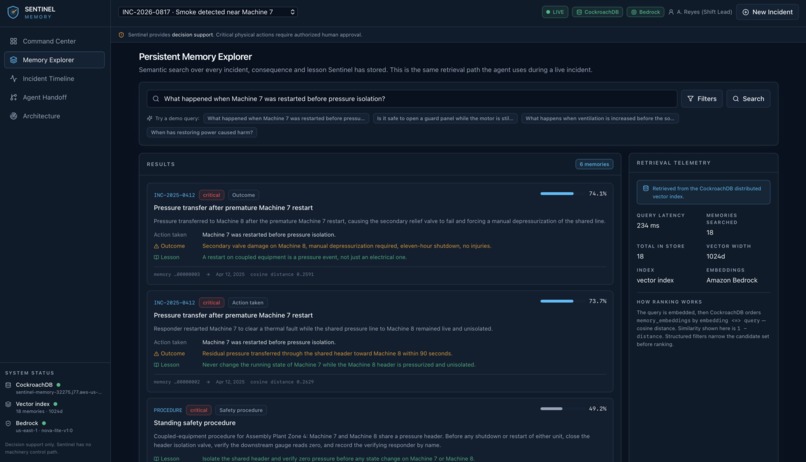
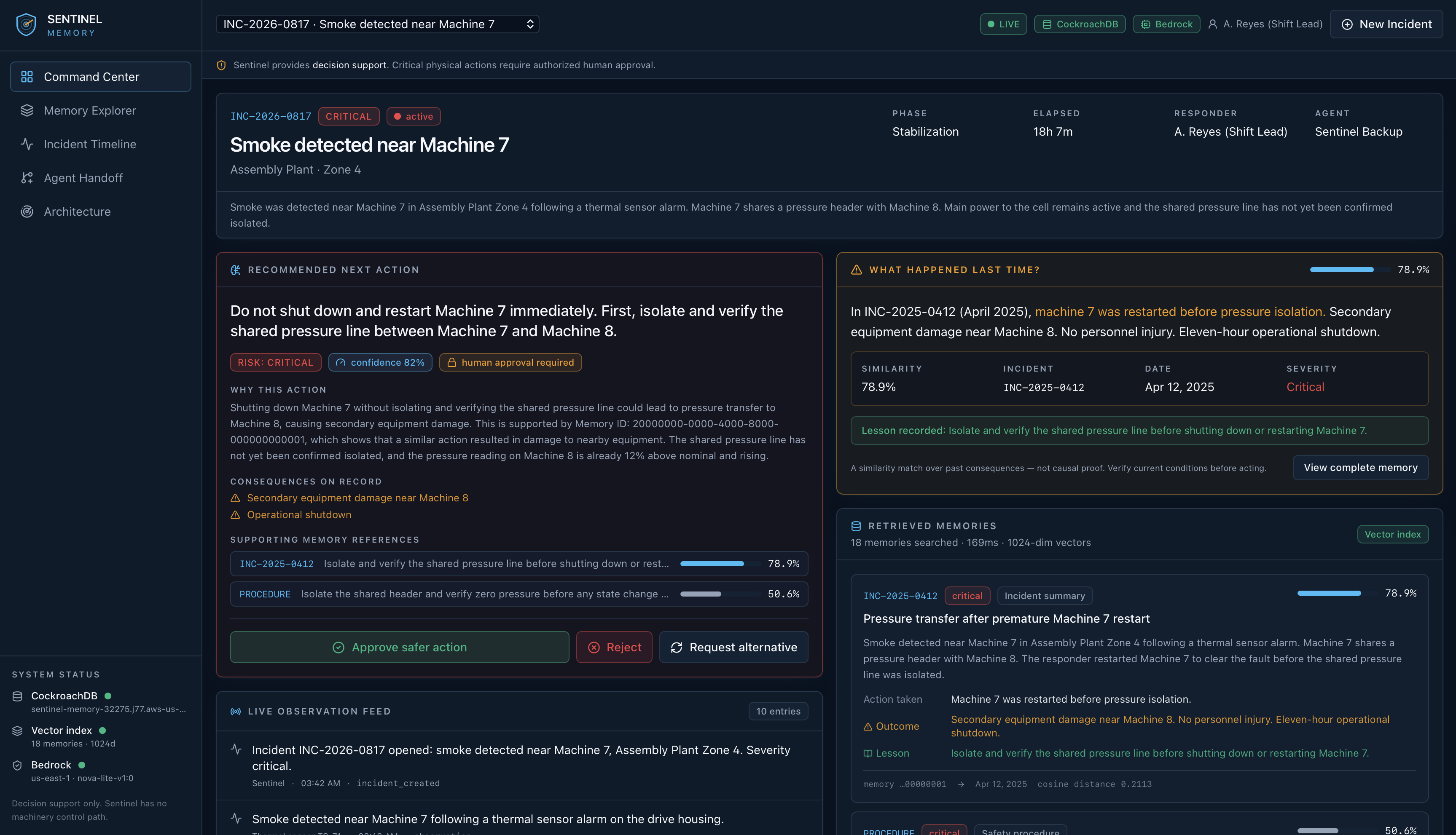
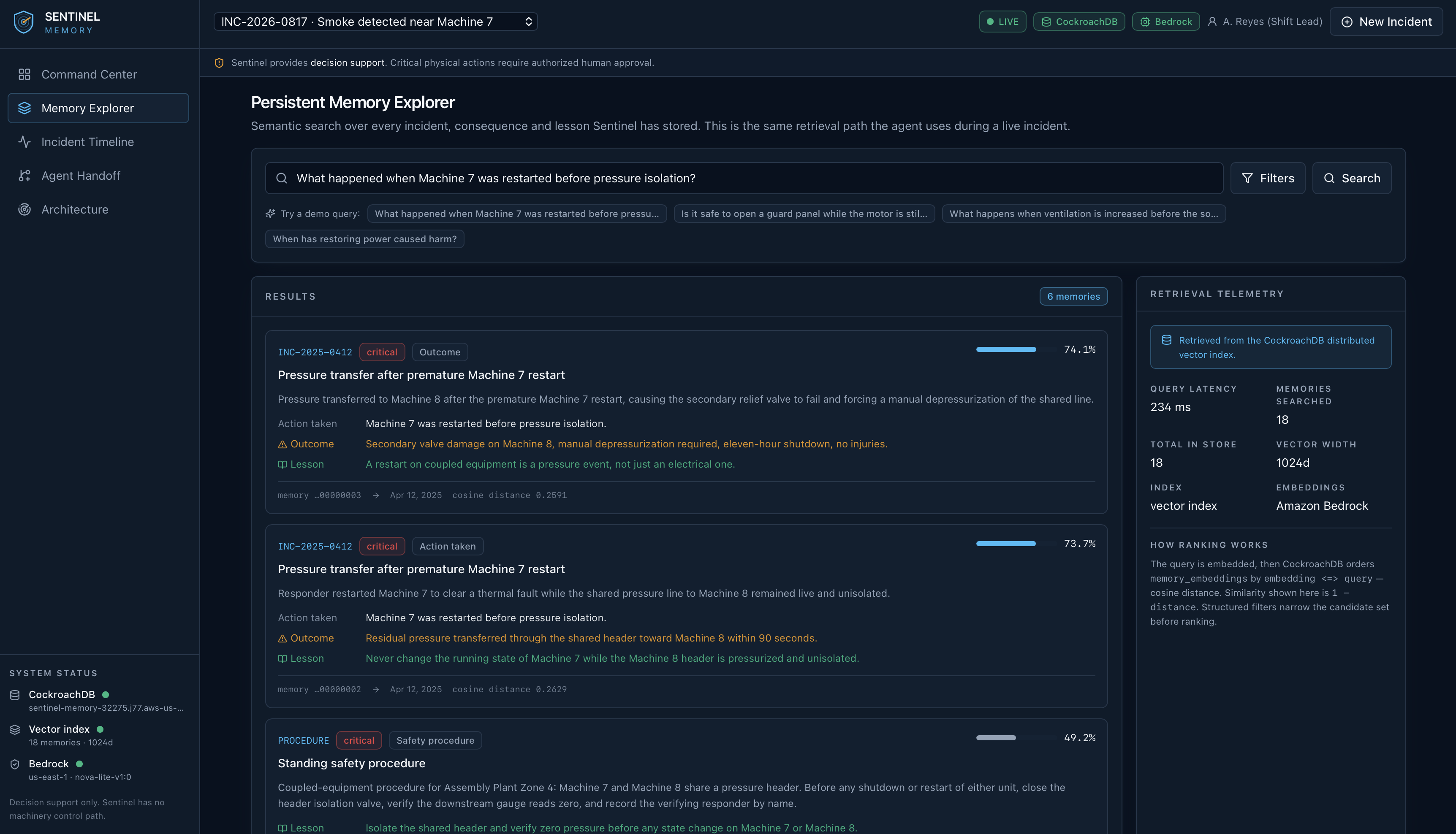
- Sentinel embeds that proposal and searches CockroachDB's distributed vector index.
- It retrieves
INC-2025-0412: the same action, taken before the shared pressure line was isolated, transferred pressure to Machine 8, destroyed a secondary valve, and added eleven hours to the shutdown. - Sentinel surfaces the consequence in a prominent "What happened last time?" card and recommends the safer sequence — isolate and verify the shared pressure line first — citing the memory it drew that from.
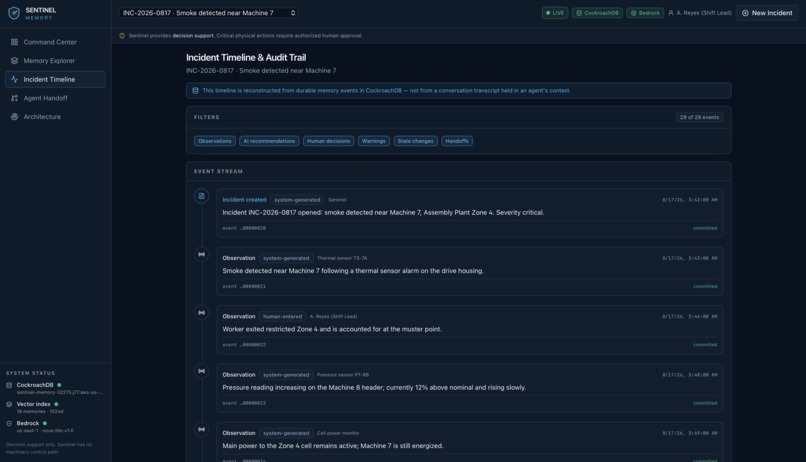
- The responder approves. The approval record, recommendation status, incident state and audit event commit in one transaction.
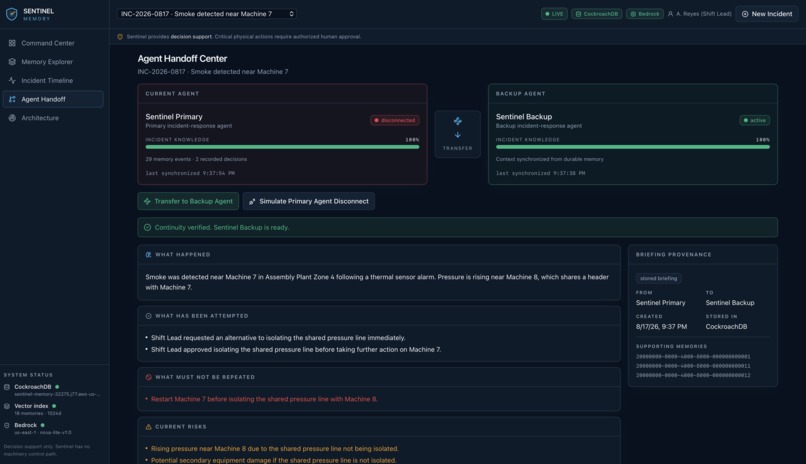
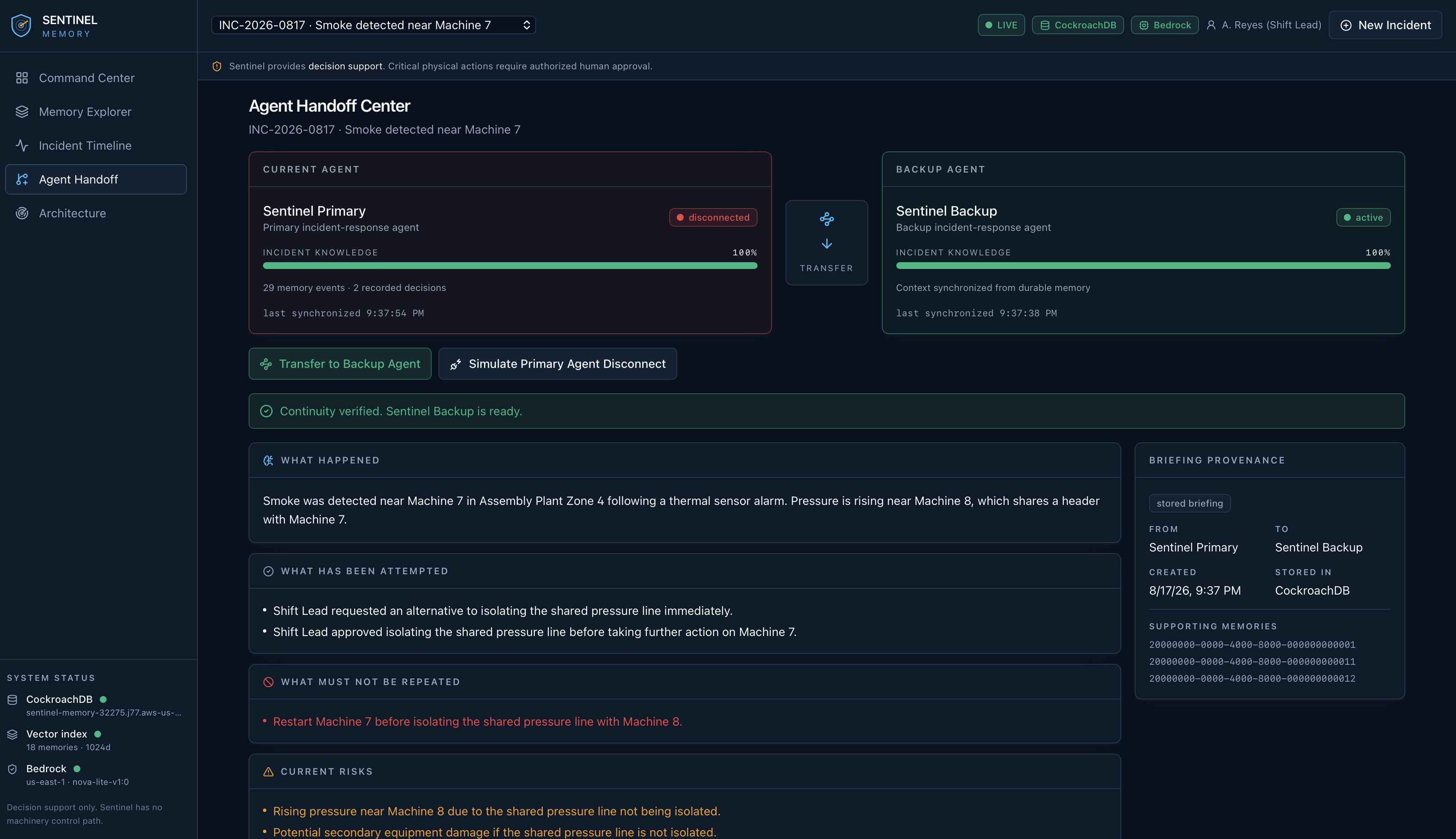
- The primary agent disconnects.
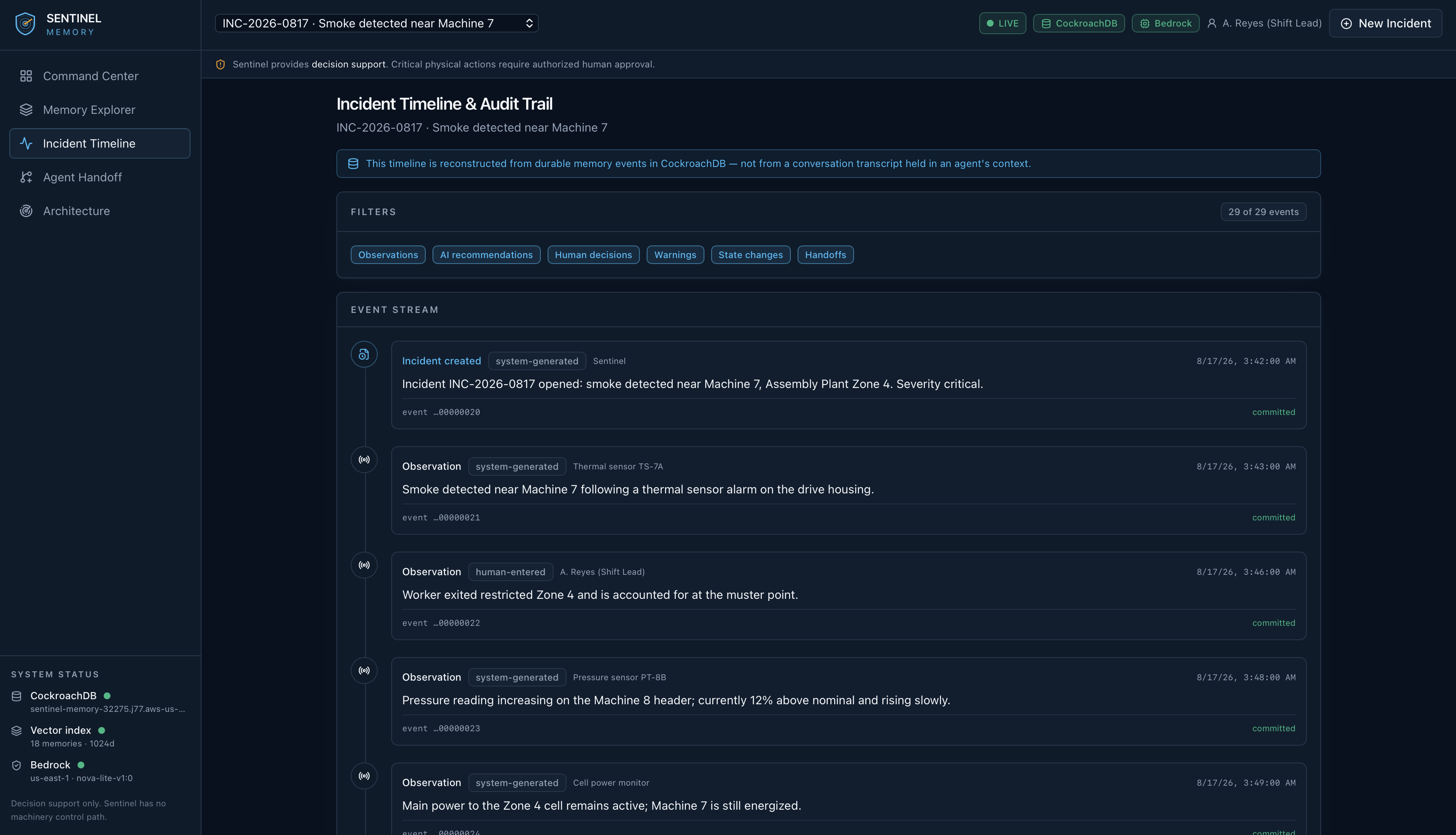
- The backup agent reconstructs the entire incident from CockroachDB — what happened, what was attempted, what must not be repeated, what's still open — and is useful immediately.
Nothing in step 8 comes from a transcript. It all comes out of the database.
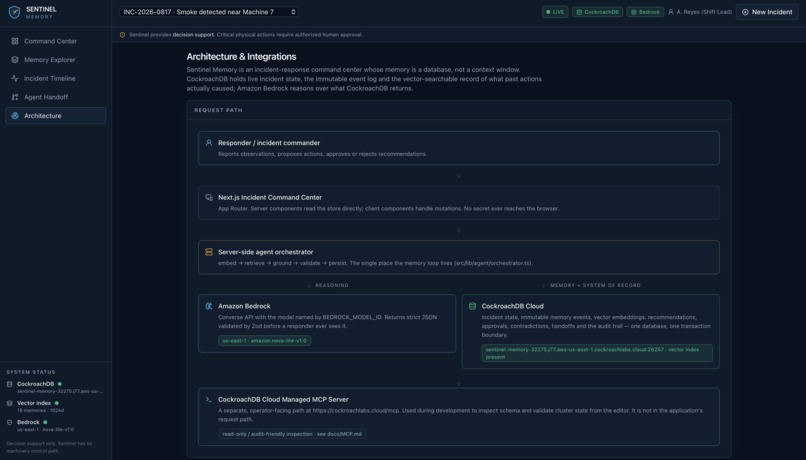
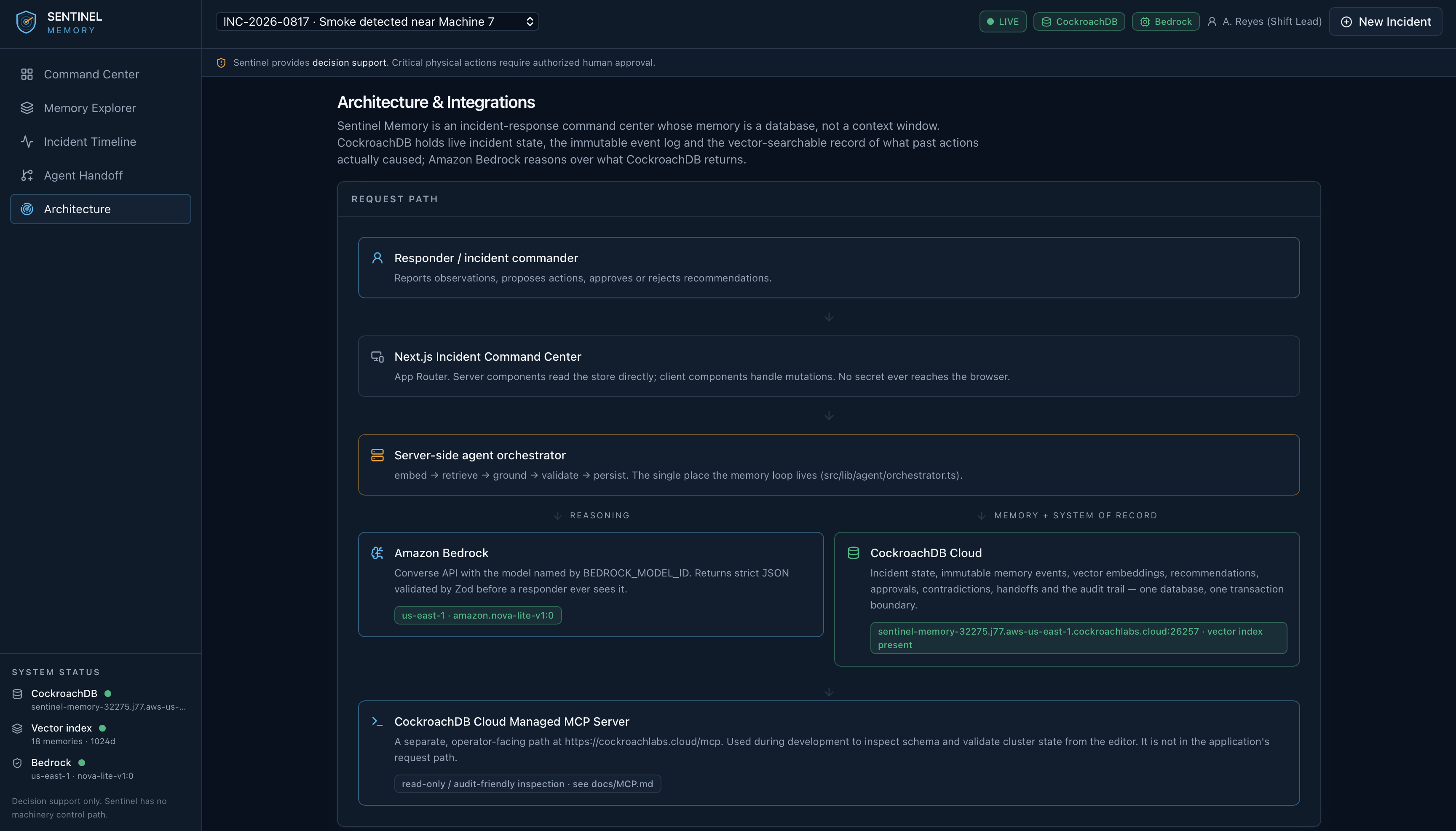
Five routes: Command Center, Memory Explorer, Incident Timeline, Agent Handoff, Architecture.
How we built it
Stack. Next.js 16 (App Router) with React 19 and TypeScript, Tailwind CSS,
Zod, the pg driver, and the AWS SDK for JavaScript. CockroachDB Cloud for
storage, Amazon Bedrock for reasoning. Vitest for tests. No ORM, no vector
database, no queue, no cache layer — the goal was a small surface with a real
spine.
The one architectural decision that mattered was making three things
interfaces rather than integrations: DataStore, EmbeddingProvider and
Reasoner. Each has a real implementation and a clearly-labelled local fallback.
That bought us three things at once — the interface is previewable without any
credentials, the transaction logic is unit-testable without a live cluster, and
the swap requirement in the brief ("if embedding access is unavailable, another
provider should work without changing the architecture") is satisfied by
construction rather than by promise.
The corollary we committed to: the UI always names which implementation
actually ran. The top bar, the safety banner, the sidebar, /api/health and
every API response all report it. Nothing in this project claims to be an
integration it isn't.
The agent loop lives in one file (src/lib/agent/orchestrator.ts):
embed → retrieve from CockroachDB → ground Bedrock on what came back → validate
the structured response with Zod → persist the recommendation with its cited
memory IDs. Every step writes durable memory events, including the retrieval
itself, so the timeline shows that memory was consulted rather than just that an
answer appeared.
The safety model assumes the model will not comply. The prompt states the
rules; enforceSafetyFloor then runs on every response and forces
requiresHumanApproval on any high-risk physical action regardless of what came
back, and filters citations down to memory IDs that were genuinely retrieved so a
hallucinated reference can't reach a responder.
CockroachDB tools used
CockroachDB Cloud is the system of record — live incident state, immutable
memory events, vector memory, recommendations, human decisions, contradictions,
agent handoffs and the audit trail. Ten tables, standard pg driver,
parameterized SQL throughout.
Distributed Vector Indexing. memory_embeddings.embedding is a VECTOR(n)
column with CREATE VECTOR INDEX … (embedding vector_cosine_ops). Retrieval
orders by <=> cosine distance and joins straight to the source incident, so one
query returns the memory and its provenance — incident code, severity, date.
That join is the reason we didn't need a separate vector database: retrieval that
returns a vector without its incident context isn't actionable during an
emergency.
The vector index is version-gated (v25.2 preview behind a cluster setting, GA in
v25.3+), so we isolated it into its own migration. If it can't be created the app
still works via exact scan, /api/health reports vectorIndexPresent: false,
and the UI shows "Exact scan" instead of "Vector index".
Transactions. The approval path is a single transaction with
SELECT … FOR UPDATE on the recommendation and incident rows, and
withTransaction retries SQLSTATE 40001 with exponential backoff and full
jitter — under SERIALIZABLE isolation that retry is the application's job, and
safety-critical writes are exactly the ones that contend.
CockroachDB Cloud Managed MCP Server (https://cockroachlabs.cloud/mcp) as
the operator inspection path, deliberately separate from the runtime path: the
app connects with write credentials, an operator inspects with a read-only
service account. Used to validate the schema after each migration, confirm
whether the vector index actually got created on the running cluster version,
spot-check that seeded memories carry a non-null action/outcome/lesson, and
verify after an approval that one decision produced exactly one decision row, one
audit row and the matching state changes. Config examples for Claude Code and
VS Code/Cursor are in mcp/; no token is committed.
CockroachDB Agent Skills (cockroachlabs/cockroachdb-skills) shaped concrete
decisions, documented skill-by-skill in the README: UUID keys over sequential
integers to avoid hotspotting, index ordering matched to actual access patterns,
application-owned retry for serializable conflicts, a bounded pool sized for
serverless, and the separation of write credentials from read-only inspection
credentials.
AWS services used
Amazon Bedrock — incident analysis, risk summaries, recommended next actions, handoff briefings, contradiction detection, and explanations of why a retrieved memory is relevant.
All calls go through the Converse API, which gives one request shape across
model families and is what lets BEDROCK_MODEL_ID stay a plain configuration
value — there is no hardcoded model ID in the codebase. Credentials come from
explicit environment variables when present, otherwise the default AWS provider
chain, so an IAM role works without code changes.
Bedrock embeddings (Titan or Cohere, via BEDROCK_EMBEDDING_MODEL_ID) produce
the vectors stored in CockroachDB. Both request/response shapes are handled.
Output is a strict JSON contract validated with Zod. A response that fails validation is rejected — HTTP 502, no recommendation recorded — rather than shown to a responder.
Challenges
Making memory visible. Our first version worked and demoed badly: retrieval happened, the answer was good, and you had to take our word that a database did anything. We rebuilt the UI around the retrieval instead of around the answer — similarity scores, cosine distances, query latency, memories searched, and whether the index or an exact scan served it. The counterfactual card now renders server-side on page load, so the product thesis is legible in about five seconds without clicking anything.
Retrieval that returns one story instead of three. Vector search over a corpus where one past incident contributes four memories returns four angles on that incident and crowds out every other precedent. We over-fetch and then cap per-source-incident in application code — one per incident on the Command Center, two in the Memory Explorer where depth matters more than breadth. It's a small function with unit tests, and it changed the demo completely.
Not letting the fallback lie. The local embedder ranks the seeded corpus correctly but its absolute cosine scores land around 0.4–0.65 where a learned model would give 0.85–0.95, simply because bag-of-words similarity between a short query and a long document is bounded. The tempting fix was to rescale the number so it looked impressive. We kept the raw cosine and added a line next to the scores explaining what the fallback measures and that ranking, not the absolute value, is the signal. A judge who checks will find the number is real.
Trusting the model exactly as far as it should be trusted. Prompts asking for
requiresHumanApproval: true on dangerous actions mostly work — mostly isn't
good enough when the failure mode is an unauthorized shutdown. The post-model
safety floor was the fix, and writing it forced us to be precise about which
verbs constitute a high-risk physical action.
Version-gated vector indexes. Support differs between v25.2 (preview, behind a cluster setting) and v25.3+ (GA). Rather than pinning a version we isolated the index migration, attempt the setting, degrade to exact scan with a clear warning, and report the actual state in the health check and the UI.
Accomplishments we're proud of
- The counterfactual moment works. Type a reasonable action, and the system tells you what that exact action cost someone last time, with the incident code, the date and the damage. It's the whole pitch in one screen.
- The approval really is atomic. Four writes, one transaction, with
FOR UPDATElocking,40001retry, and tests proving rollback leaves the store byte-for-byte unchanged. - 94 tests, no live cluster or AWS account required. The store abstraction earned its keep.
- The disconnect demo is not theatre. Nothing is deleted. The backup rebuilds from the database, and "what must not be repeated" contains real rejected actions and real recorded consequences — not invented prohibitions.
- It's honest about itself. Every fallback is labelled in the UI, the health endpoint and the API responses. The limitations section of the README lists what's missing rather than hiding it.
What we learned
Agent memory is two problems, not one. Episodic memory (what happened in this incident, in order) and semantic memory (what past actions caused) have different shapes, different query patterns and different consumers. Conflating them produces a system that can either replay a timeline or find similar text, but can't answer "someone is about to do X — has X hurt us before?"
Keeping both in one database is the actual advantage. Not "one less service to run" — the join. Retrieval returns the memory and its incident code, severity and date in a single query, and the human decision that follows is transactional against the same rows. A separate vector store would have meant two round trips, a sync problem, and a consistency boundary in the middle of a safety-critical path.
Structure the memory around the action. Storing incident summaries and
embedding them gets you "similar incidents". Storing
action_taken → outcome → lesson_learned as distinct fields gets you "this
specific action caused this specific damage" — which is what a responder standing
in front of Machine 7 actually needs.
Constraints beat prompts for safety. The prompt is necessary and not sufficient. Schema CHECK constraints, Zod validation and the post-model safety floor are what make the guarantee real.
Honest degradation is a feature. We expected the fallback labelling to be a compliance chore. It turned out to be the thing that makes the architecture legible: a judge can see exactly which parts are real, which is far more convincing than a demo that claims everything works.
What's next
- Close the learning loop. Sentinel learns from historical incidents but not yet from its own recommendations. Capturing whether an approved action produced the predicted outcome — and writing that back as a new memory — is the obvious next step and the one that would compound.
- Authentication and RBAC. There's none today. The audit trail's
decided_byis only as trustworthy as the identity behind it. - Database-enforced immutability. Revoke UPDATE/DELETE on
memory_eventsandaudit_events, and stream them to an append-only sink via changefeeds. - Real ingestion. SCADA/historian feeds for observations instead of manual entry, and paging integration for escalation.
- Retrieval evaluation. A labelled set with precision@k tracking, plus regression tests on the structured-output contract across model families.
- Multi-region. Regional-by-row for data residency, with Bedrock invoked in-region.
Built With
- amazon-bedrock
- amazon-web-services
- cockroachdb
- mcp
- next.js
- node.js
- postgresql
- react
- sql
- tailwind
- typescript
- vector-search
- vitest
- zod


Log in or sign up for Devpost to join the conversation.