-
-
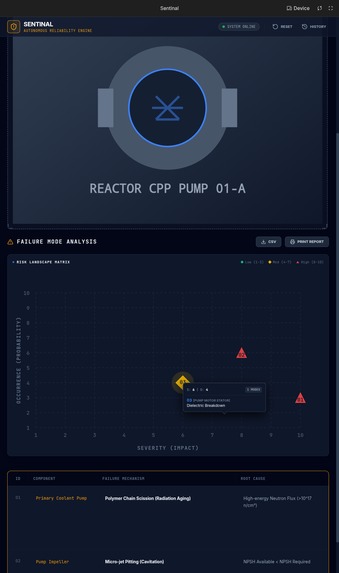
Autonomous Nuclear Audit: Sentinal detects critical 'Coolant Seal Failures' in Class 1 infrastructure
💡 Inspiration: The "Silent Risk"
I am a Power Plant Engineer. In my field, safety isn't a feature; it is the only variable that matters.
Yet, I was shocked to find that in 2026, Failure Mode and Effects Analysis (FMEA)—the bedrock of industrial safety—is still performed manually. Engineers sit in conference rooms for weeks, guessing risks and filling out static spreadsheets. It is slow, prone to "alert fatigue," and dangerously disconnected from the physics of the machine.
I asked: Can AI move beyond summarizing text and start reasoning like a Chief Engineer?
🛡️ What it does
SENTINAL is an Autonomous Reliability Agent. It does not just "see" components; it audits them against strict regulatory codes.
- Multi-Paradigm Reasoning: The system radically shifts its safety logic based on the selected Risk Paradigm.
- In a General Context, a rusty bolt is a maintenance issue (Severity 3).
- In a Nuclear Class 1 Context, Sentinal recognizes it as a containment breach (Severity 10) per NRC Regulation 1.26.
- In a Medical ISO 14971 Context, logic rewrites itself to prioritize patient biocompatibility.
- Physics-Informed Audit: It utilizes Gemini 3 to distinguish between a symptom (e.g., "Pump Vibration") and a physics root cause (e.g., "Micro-jet pitting due to cavitation").
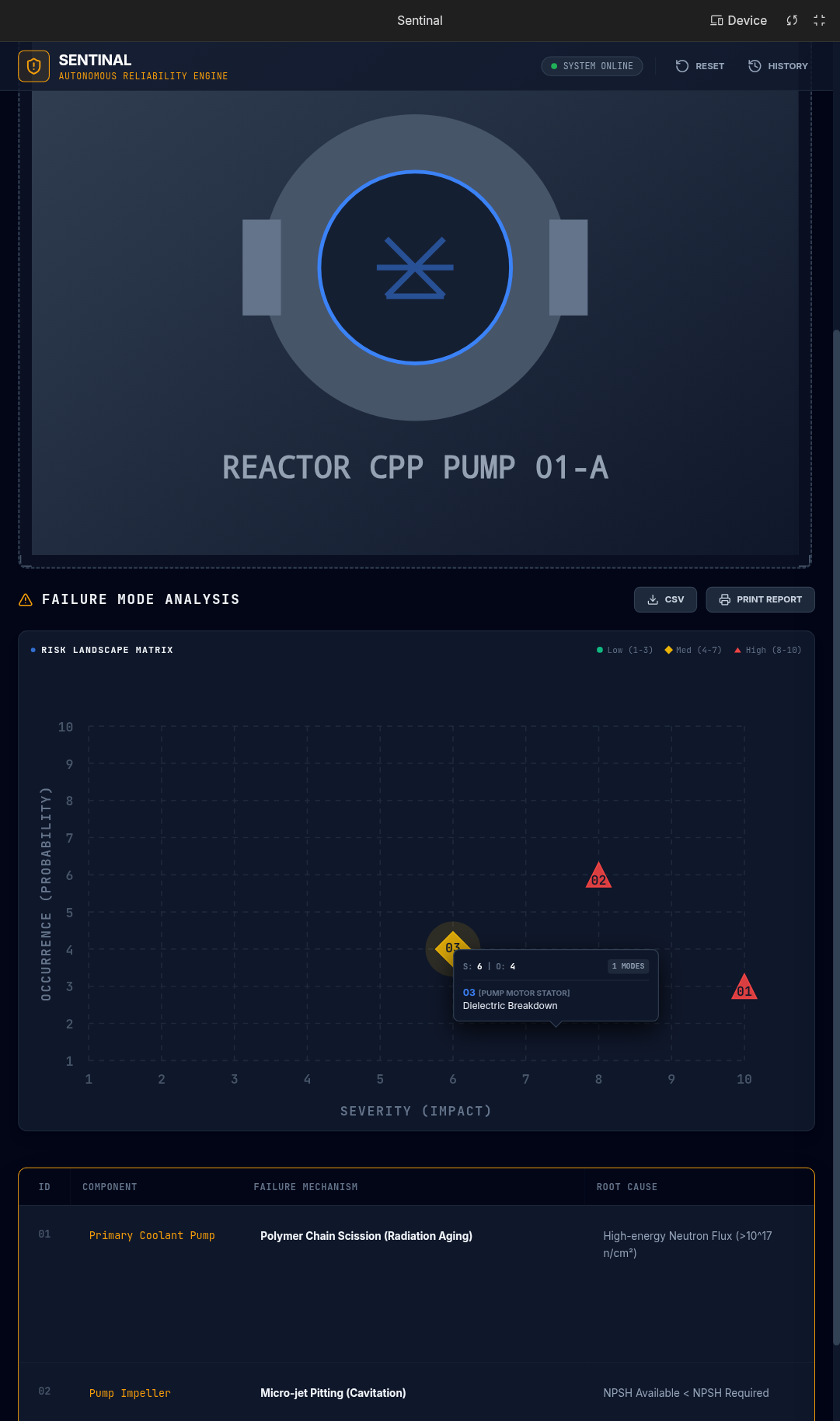
- Simulation (The "Ghost Dot"): It goes beyond detection to solution. Engineers can "Simulate Mitigation," prompting the AI to mathematically predict the Residual Risk if a specific repair is applied. The Risk Matrix updates in real-time to show the path to compliance.
🧠 How we built it (The Innovation)
The project creates a Reactive Intelligence Kernel using Google Gemini 3.
- System 2 Thinking: We leveraged Gemini’s "Thinking Model" to force long-context reasoning. This allowed us to implement a "Forensic Inspector" that cites specific sections of engineering codes (ASME, IEEE, ISO) to justify every severity score.
- The "Reactive Math" Engine: We didn't want a static text response. We built a React state machine that binds Gemini's qualitative output to quantitative risk math (
S * O * D = RPN). If a human engineer overrides a score, the entire dashboard recalculates instantly. - Vibe Coding: The frontend architecture (React + Tailwind + Recharts) was accelerated using Google AI Studio's Build Module, allowing us to implement "Dual-Coded" accessibility visualizations (Shapes + Colors) for the Risk Matrix.
🆕 Why this is a "NEW" Application
Most AI tools are passive—they retrieve information. Sentinal is Active.
It is an application to use Gemini 3 to Simulate Engineering Outcomes. By calculating the delta between "Current Risk" and "Mitigated Risk" (visualized by the dashboard's "Ghost Dot"), it turns the LLM into a probabilistic simulator. It proves that GenAI can handle Deterministic Safety Logic alongside creative tasks.
🎬 Video Production
The submission video was completed using Google Vids (powered by Gemini).
🚀 What's next for Sentinal
- Live Sensor Hook: Integrating IoT vibration sensors (MQTT) to update the "Occurrence" score dynamically.
- Enterprise SSO: Multi-user collaboration for plant-wide audits.
- Automated Report filing: Direct API connection to SAP/Oracle ERP systems for work order generation.
Built With
- gemini-thinking-model
- google-ai-studio
- google-gemini-3
- google-vids
- react
- tailwind
- vibe-coding

Log in or sign up for Devpost to join the conversation.