-
-
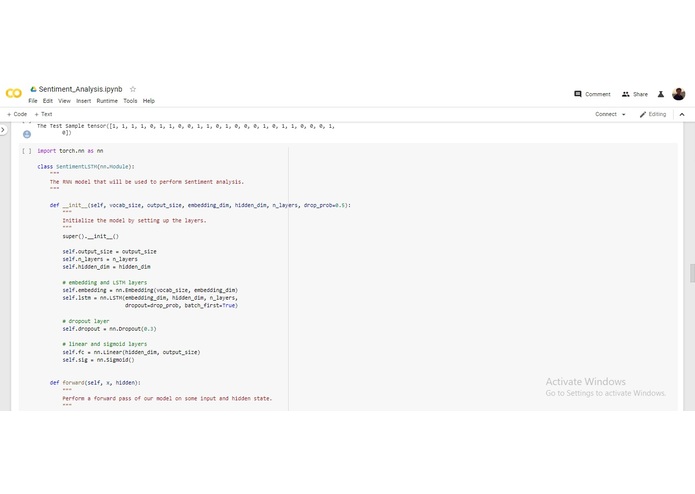
PyTorch LSTM Model 1
-

PyTorch LSTM Model 2
-
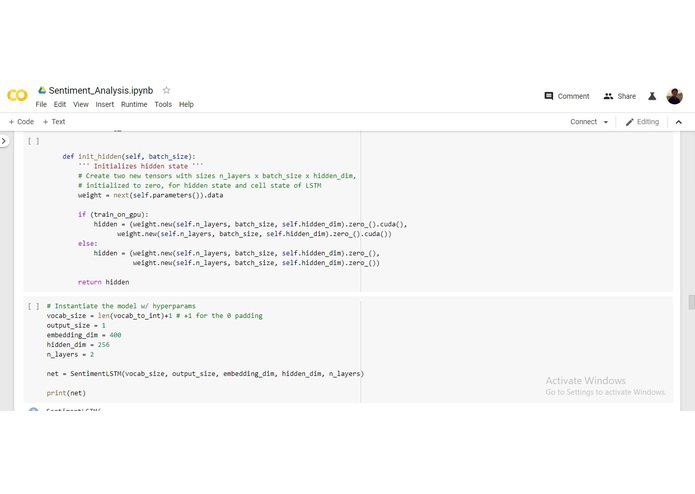
PyTorch LSTM Model 3


Inspiration
As I was doing my internship at Calcutta University, they told me to make a model that can accurately classify sentiments. Now I certainly had to search for a lot of posts to read about it. After reading a lot of articles, at last, I have clearly found out the, I have to implement some machine learning model, that can deal with long term dependencies. SO, I had to use LSTM. I know that PyTorch will be the best in comparison with Tensorflow or Keras, as it is very well in handling data loader and other methods. Before I have used PyTorch to classify Age-related Macular Degeneration.
What it does
I basically learn all the features from the training set and almost accurately classify the sentiment as either positive and negative. We can input the model, and it can tell the sentiment of the text.
How I built it
I built it using PyTorch Long-short Term Memory model. As I told, to cope with long sequences, we need to have that best suits that. LSTM is best. with its memory unit, it can definitely handle this. Now we could use XGboost or Random Forest instead of it, but this is way better in terms of large datasets, and I have seen it. So, clearly LSTM is better.
Challenges I ran into
Most difficult was to decide, where to start. As I had no idea with Sentiment Analysis. I started after reading some research paper, stating the use of Machine Learning to do Sentiment Classification. I found out about LSTM, XGBoost, Random Forest and SVM. LSTM is the best among all of them. Next there, I had to study about PyTorch and how to implement LSTM in it. I was successful to do it, and I made it at last.
Accomplishments that I'm proud of
From a beginner, I have done making this model, that can reach up to 79% percent accuracy in a test dataset to classify positive and negative datasets. Now, even I can tweak the model a bit, and it can reach up to maybe 85% accuracy.
What I learned
I have learned a lot about Long-Short Term Memory and a lot of making sequential machine learning model. I had to learn a little about designing it with PyTorch too. As I did these models with Keras. I read some research papers about Sentiment Analysis too, as it helped a lot with choosing the best model for it.
What's next for Piano Tuner
Nex in this project I am thinking of adding more labels to it. This is 2 labels, can only detect positive or negative sentiments. But, in my next project, I will make it, such that it can detect up to 5 labels like Amazon rating. I can certainly make this project work with these 3 and 5 labels.

Log in or sign up for Devpost to join the conversation.