-
Proposed model
Inspiration
Large Language Models (LLMs) have become powerful tools for sentiment analysis, offering superior contextual understanding and the ability to handle complex language nuances compared to traditional methods. LLMs can analyze text and identify sentiments with greater accuracy, especially in cases involving sarcasm, irony, or subtle emotional cues.
What it does
How LLMs Enhance Sentiment Analysis: Contextual Understanding: LLMs excel at understanding the context in which words are used, which is crucial for accurately identifying sentiment. They can grasp the meaning of phrases and sentences within a larger text, rather than just analyzing individual words. Fine-grained Sentiment Analysis: LLMs can go beyond simple positive, negative, or neutral classifications. They can identify subtle emotions and the intensity of sentiment, like detecting sarcasm, irony, or disappointment. Handling Negation and Intensifiers: LLMs can effectively interpret negation ("not good") and intensifiers ("very bad"), which are essential for accurate sentiment analysis. Transfer Learning: LLMs are pre-trained on vast amounts of text data, allowing them to be fine-tuned for specific sentiment analysis tasks, such as analyzing customer reviews or social media posts. Domain Adaptation: LLMs can be adapted to specific domains (e.g., legal, medical) through fine-tuning on domain-specific datasets. Real-time Analysis: LLMs can be used for real-time sentiment analysis in applications like customer support, enabling quick responses to customer feedback. Prompt Engineering: By using carefully crafted prompts, LLMs can be instructed to perform specific sentiment analysis tasks, leading to more accurate and targeted results.
How we built it
Hugging Face: Hugging Face offers a wide range of pre-trained LLMs for sentiment analysis, allowing users to choose models based on their specific needs. Google's BERT and other models: BERT and similar transformer-based models are frequently used for sentiment analysis due to their strong contextual understanding capabilities. Llama 2: Llama 2 is another popular LLM that can be used for sentiment analysis, as demonstrated in a study that analyzed Amazon product reviews.
Challenges we ran into
How to Use LLMs for Sentiment Analysis:
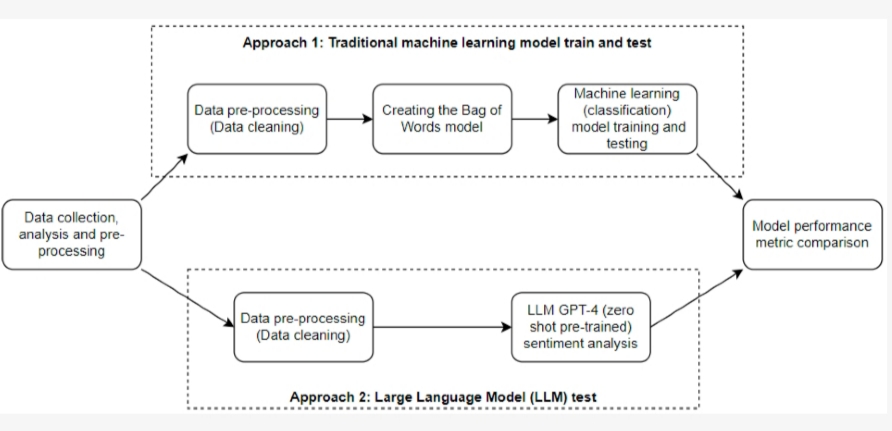
- Data Preparation: Prepare your text data by cleaning and preprocessing it (e.g., tokenization, lowercasing, removing stop words).
- Model Selection: Choose an appropriate LLM based on your needs and available resources. Consider factors like the complexity of the text, the desired level of detail in sentiment analysis, and computational resources.
- Fine-tuning: If necessary, fine-tune the chosen LLM on your specific dataset to improve its performance.
- Evaluation: Evaluate the model's performance using appropriate metrics like accuracy, precision, recall, and F1-score.
- Prompt Engineering: Experiment with different prompts to guide the LLM's sentiment analysis process and optimize its results.
Accomplishments that we're proud of
LLMs have significantly advanced the field of sentiment analysis, providing powerful tools for understanding and interpreting emotions expressed in text data.
What we learned
In conclusion, LLMs have significantly advanced the field of sentiment analysis, providing powerful tools for understanding and interpreting emotions expressed in text data.
What's next for Sentiment analysis using LLM
Advanced Sentiment analysis using AI

Log in or sign up for Devpost to join the conversation.