Inspiration
What it does
Meet the Developers: Building Sentient Retention Engine — Reimagining Customer Retention with AI, Digital Twins, and Autonomous Agents
In today's SaaS economy, customer retention has become just as important as customer acquisition. Companies invest enormous resources into attracting users, yet many still lose customers because warning signs are detected too late or intervention strategies arrive after the damage has already been done.
As student developers passionate about artificial intelligence and intelligent systems, we wondered:
What if AI could predict customer churn, test thousands of possible solutions, and recommend the best course of action before a customer decides to leave?
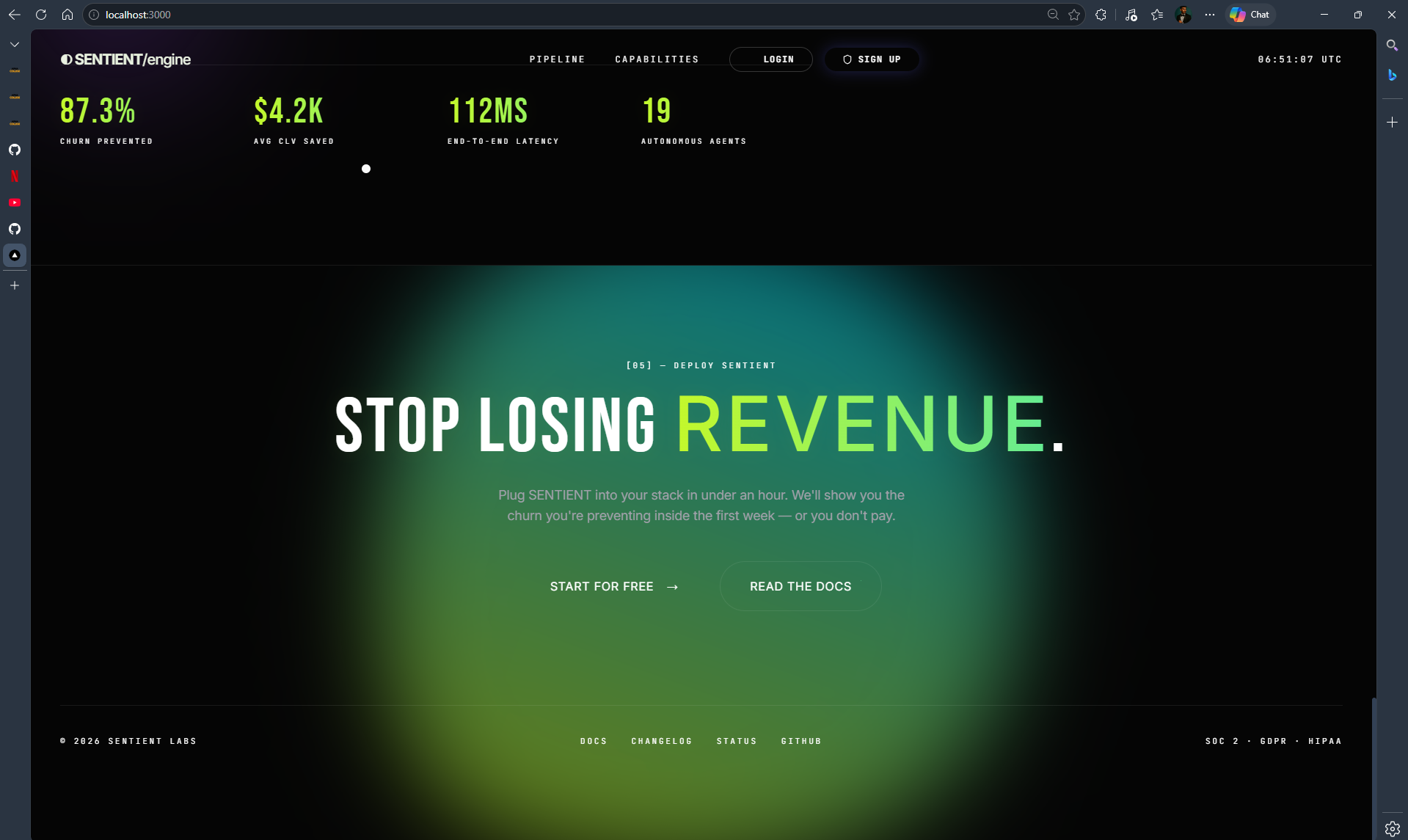
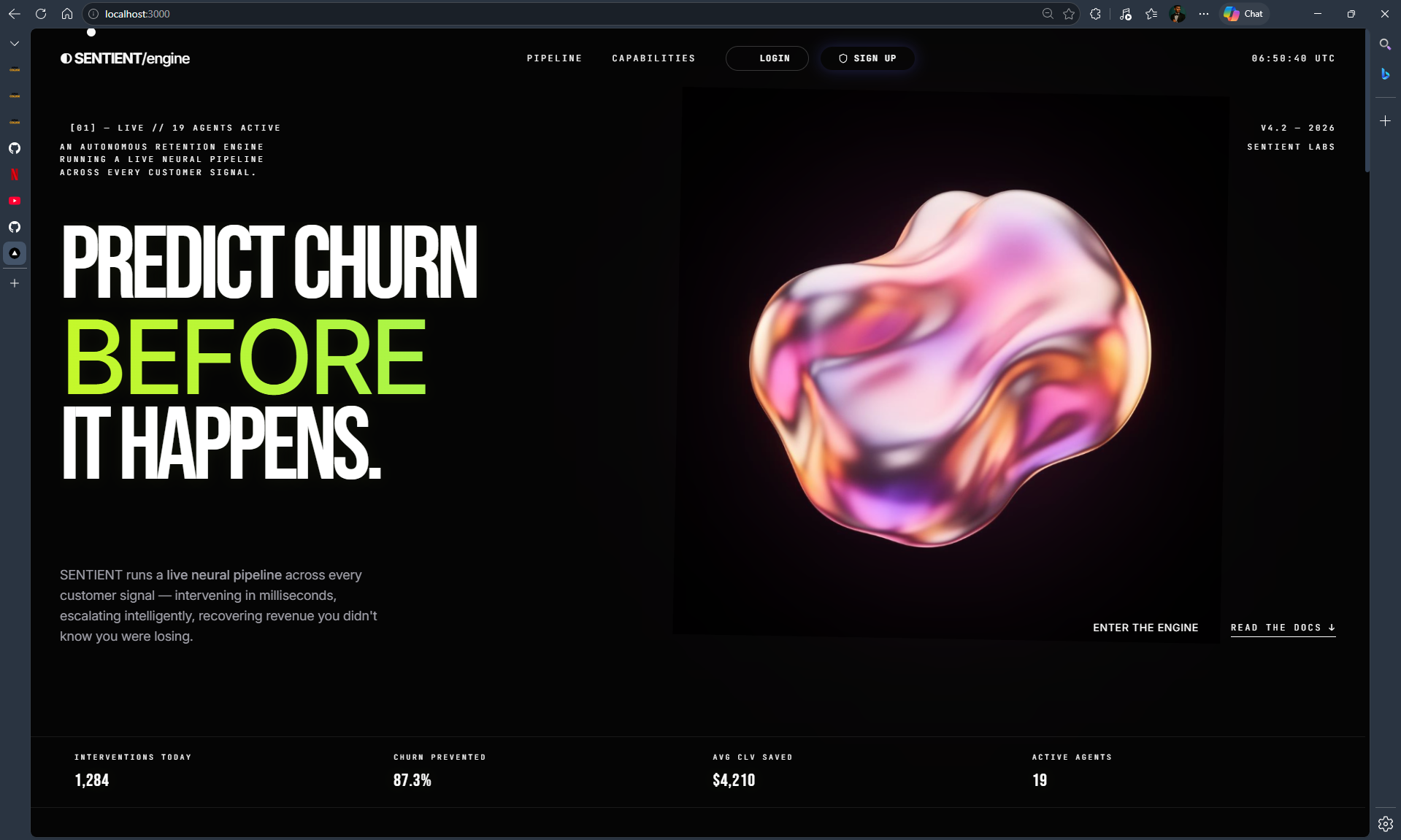
That question became the foundation of the Sentient Retention Engine (SRE)—an autonomous customer retention platform that combines Google's AI ecosystem, multi-agent intelligence, Digital Twin simulations, and governance-first decision-making to help organizations proactively defend against churn.
From a Problem to a Vision
Traditional retention systems are largely reactive.
Customer success teams spend countless hours monitoring dashboards, analyzing reports, and manually designing retention campaigns. By the time action is taken, the opportunity to save the customer may already be gone.
We envisioned a different future.
Instead of simply identifying churn risks, we wanted to create an intelligent system capable of:
- Detecting customer dissatisfaction early.
- Understanding why customers are at risk.
- Simulating potential interventions.
- Measuring expected business impact.
- Recommending the safest and most effective action.
Most importantly, we wanted every recommendation to remain transparent, auditable, and governed.
This vision ultimately evolved into the Sentient Retention Engine.
Building an Autonomous Retention Intelligence Platform
At its core, SRE is a closed-loop decision intelligence system.
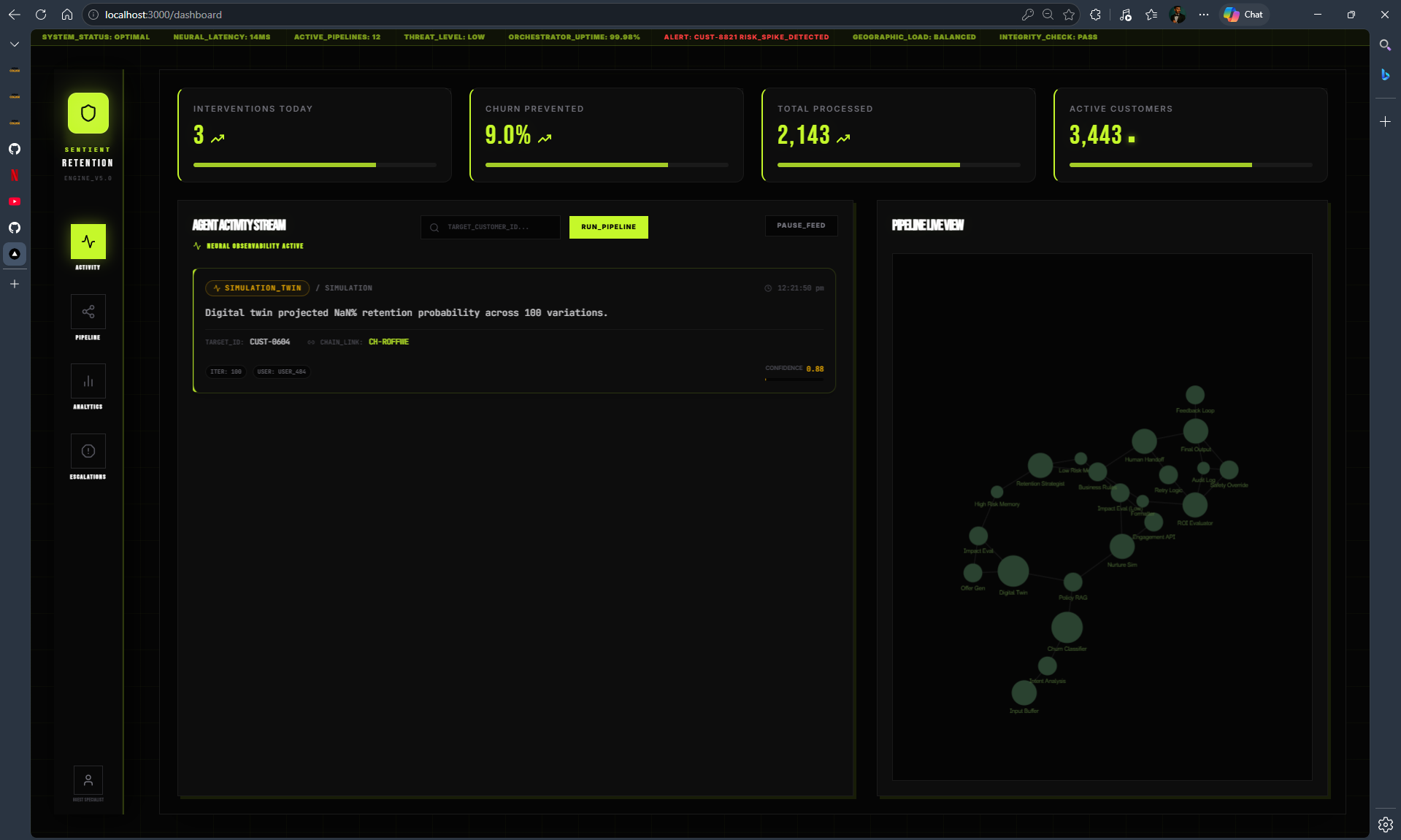
The platform continuously observes customer telemetry, predicts churn probability, analyzes customer behavior, simulates intervention plans, and evaluates financial impact before presenting recommendations.
Rather than relying on a single AI model, SRE uses a coordinated multi-agent architecture powered by LangGraph.
Each agent specializes in a particular responsibility:
- Observation and telemetry analysis
- Risk assessment
- Retention strategy generation
- Financial impact evaluation
- Governance validation
- Recommendation synthesis
Together, these agents collaborate to create retention strategies that are both intelligent and practical.
The result is a system that behaves less like a traditional dashboard and more like an autonomous decision-support team.
Leveraging Google's AI Ecosystem
Google technologies played a central role throughout the development process.
Gemini API
The intelligence layer of SRE is powered by Gemini.
Gemini enables the platform to analyze customer behavior, interpret contextual information, reason about retention strategies, and generate meaningful recommendations.
Its advanced reasoning capabilities made it possible to build workflows that move beyond static analytics and toward contextual business decision-making.
Gemini became the foundation that allowed our agents to think, evaluate, and collaborate.
Google AI Studio
Rapid experimentation was critical during development.
Using Google AI Studio, we tested prompts, refined agent interactions, evaluated outputs, and optimized reasoning workflows.
The ability to quickly prototype and iterate dramatically accelerated our development cycle and helped us validate ideas in real time.
Firebase
Firebase helped us streamline backend development and focus on innovation.
It provided a flexible foundation for authentication, real-time interactions, and rapid application deployment, allowing us to spend more time building intelligence and less time managing infrastructure.
Looking Ahead to Google Cloud
The architecture was designed with future scalability in mind.
As the project evolves, we plan to explore deeper integration with Google Cloud services, including Vertex AI and cloud-native deployment strategies that can support enterprise-scale workloads.
Simulating Reality with Digital Twins
One of the most exciting aspects of SRE is the Digital Twin Sandbox.
Before recommending any retention strategy, the system creates a virtual simulation environment where different interventions can be tested against thousands of possible customer behavior scenarios.
This allows organizations to understand:
- Expected ROI
- Potential risks
- Long-term customer outcomes
- Financial implications
Instead of relying on assumptions, teams can evaluate strategies before implementation.
The Digital Twin approach transforms retention from guesswork into evidence-based decision-making.
Governance Before Automation
As AI systems become increasingly autonomous, trust becomes essential.
We recognized early that organizations would never fully embrace autonomous recommendations without strong governance mechanisms.
To address this challenge, we built a Zero-Trust Governance Engine.
Every recommendation is evaluated against predefined policies, financial thresholds, and compliance requirements.
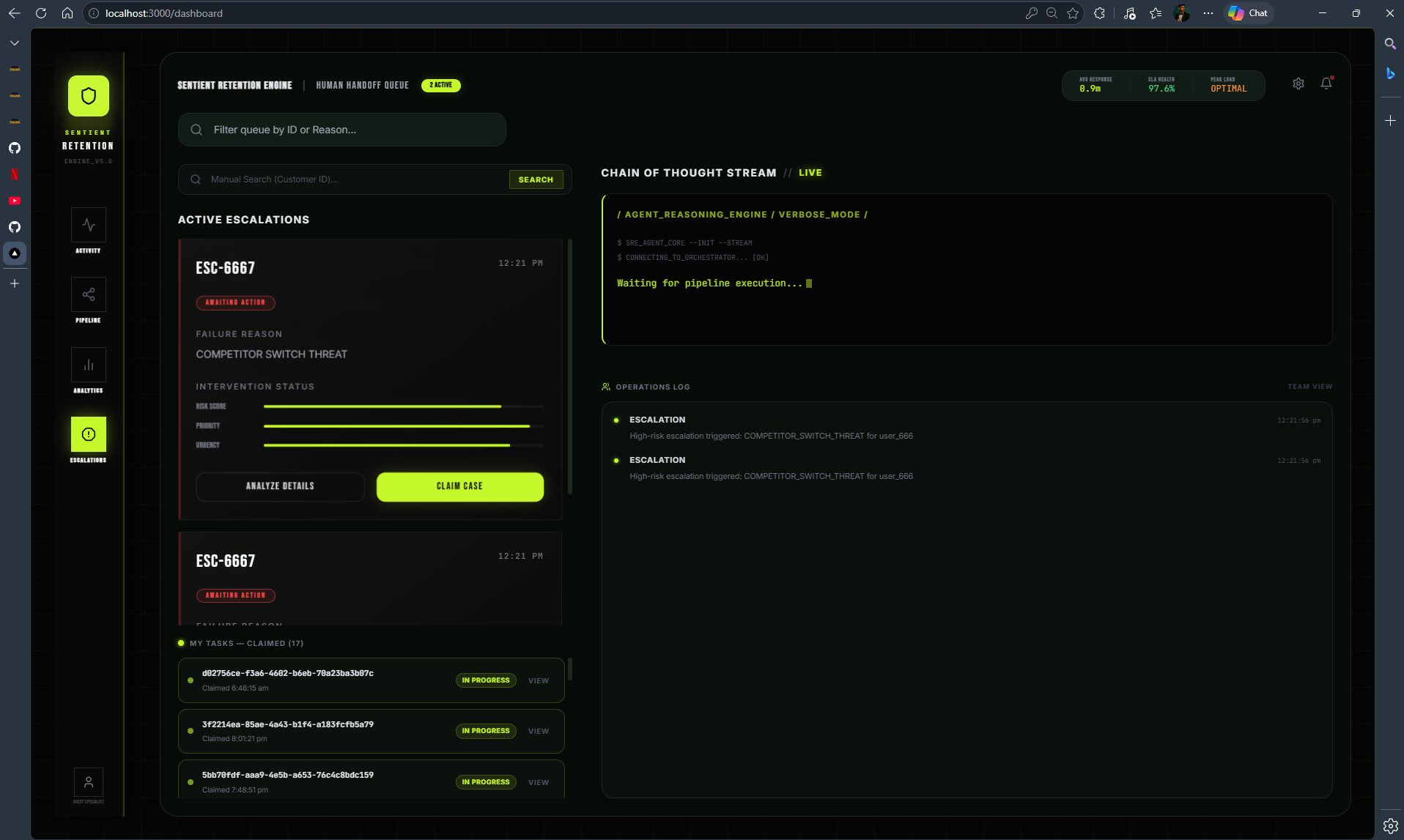
High-impact decisions can be routed to human operators for approval, ensuring that AI remains accountable while still providing intelligent assistance.
This governance-first philosophy became one of the defining principles of the entire project.
Accelerating Development with Antigravity IDE
Turning an ambitious idea into a working prototype required rapid experimentation and iteration.
Throughout development, Antigravity IDE played a significant role in helping us move quickly from concept to implementation.
The platform enabled us to:
- Prototype features faster.
- Generate and refine code efficiently.
- Explore multiple architectural approaches.
- Debug complex workflows.
- Accelerate full-stack development.
By reducing development overhead, Antigravity IDE allowed us to focus on solving the core problem rather than spending valuable time on repetitive implementation tasks.
For a project involving multiple services, AI workflows, governance layers, and simulation systems, this acceleration proved invaluable.
Challenges and Lessons Learned
Building SRE taught us that creating intelligent systems is about much more than integrating AI models.
Some of the most difficult questions involved:
- Determining what makes a recommendation trustworthy.
- Balancing automation with human oversight.
- Designing governance frameworks for AI decisions.
- Simulating realistic customer behavior.
- Building resilient failover systems for AI services.
Every challenge pushed us to think beyond traditional software development and consider the broader implications of autonomous decision-making.
Looking Toward the Future
The Sentient Retention Engine represents only the first step in a larger vision.
Future development plans include:
- Enterprise CRM integrations
- Advanced explainability systems
- Reinforcement learning optimization
- Vertex AI integration
- Expanded Digital Twin capabilities
- Cross-platform retention intelligence
Our long-term goal is to create AI systems that help organizations make better decisions while remaining transparent, safe, and accountable.
Building the Future of Decision Intelligence
SRE began as a simple question about customer retention.
It evolved into an exploration of how AI, simulation, governance, and human oversight can work together to solve complex business problems.
By combining Gemini's reasoning capabilities, Google AI Studio's rapid experimentation environment, Firebase's development ecosystem, and the productivity gains enabled by Antigravity IDE, we built a platform that demonstrates how autonomous AI can move beyond analytics and become a trusted decision-support partner.
The future of AI is not just about generating answers.
It is about helping people make better decisions.
The Sentient Retention Engine is our contribution to that future.
Built With
- css
- dockerfile
- html
- javascript
- powershell
- python

