-
-
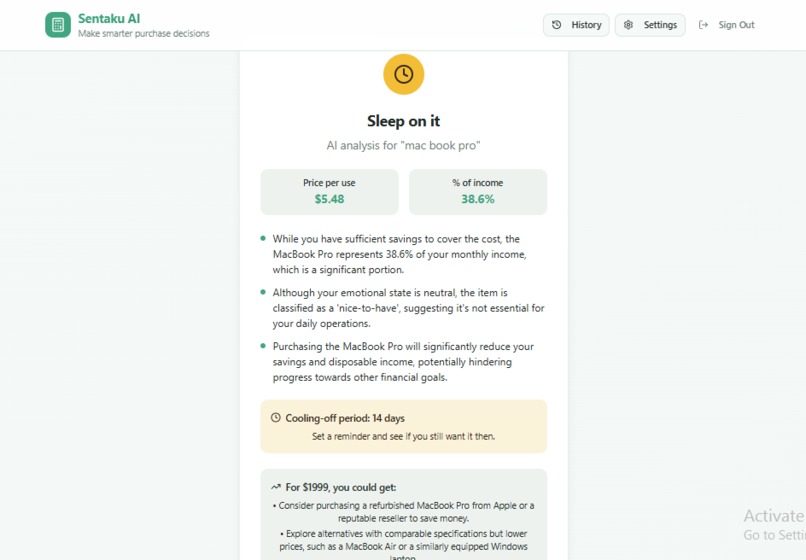
Output Sample On whether to buy a macbook
-
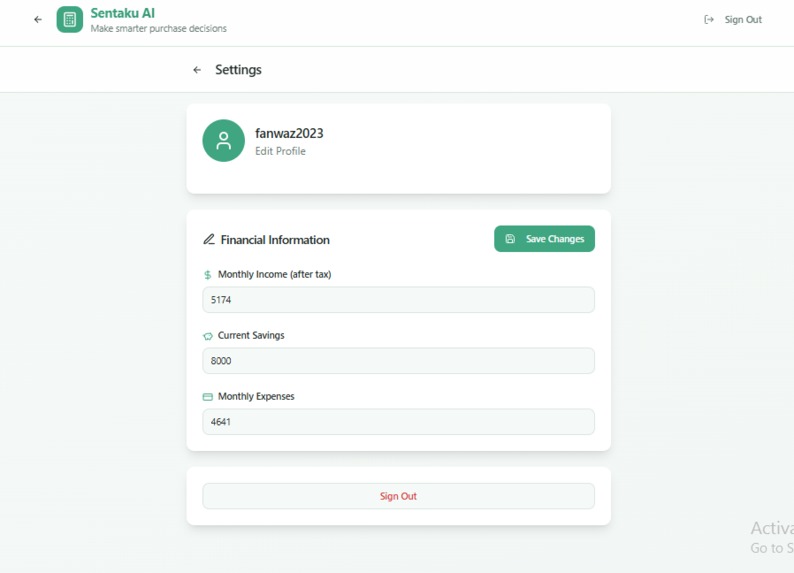
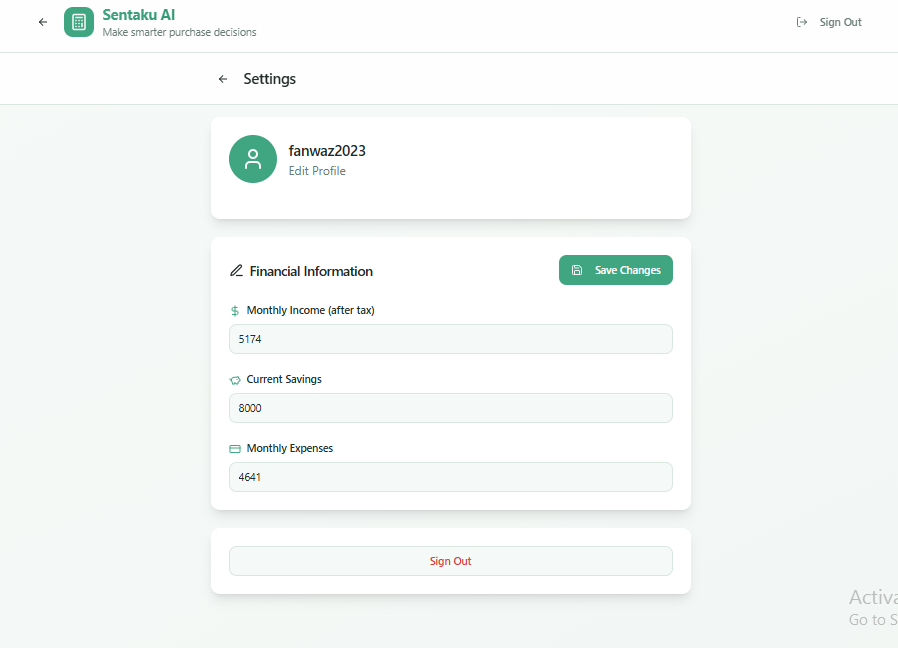
Settings screen for sentaku AI
-
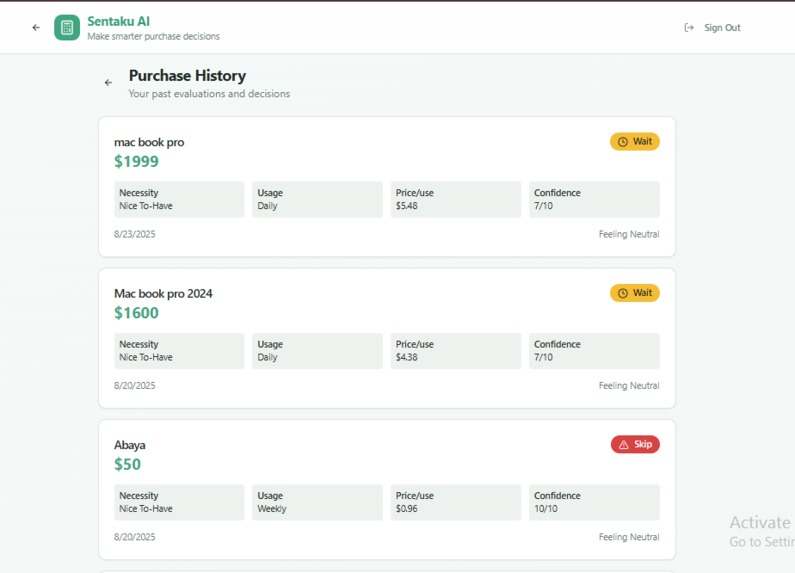
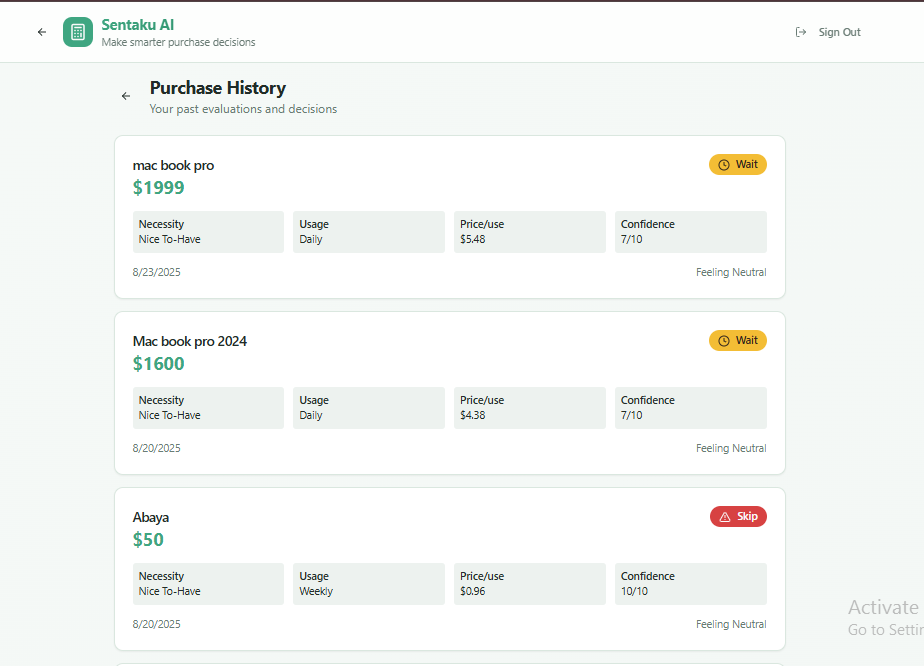
History Screen for sentaku AI
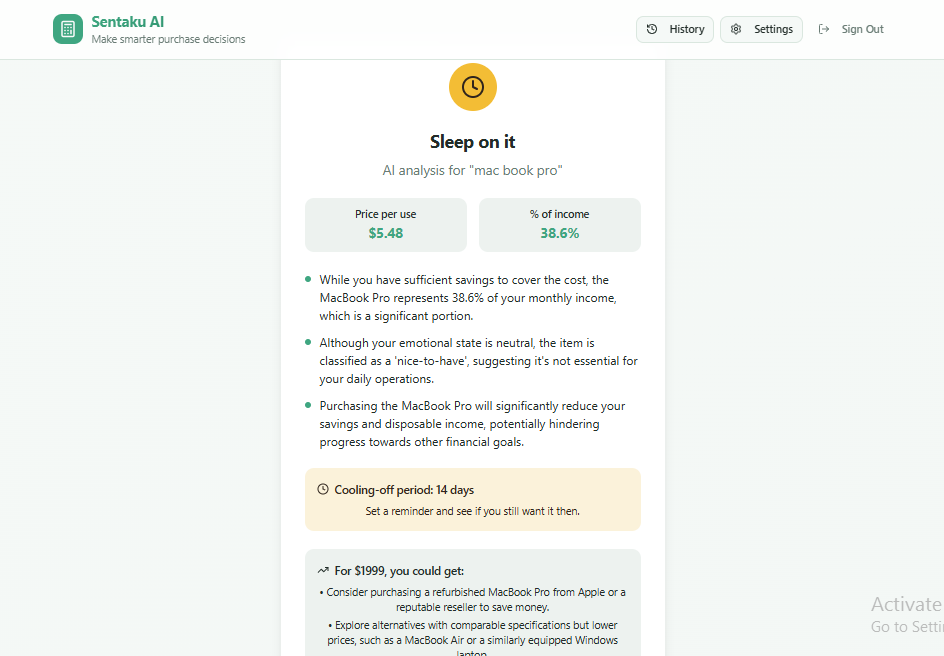
About Sentaku AI
I built Sentaku AI because I wanted to stop impulse buying and stop overthinking every purchase. Late-night carts and “flash deals” were costing me money and mental energy. I needed a tool that asks smarter questions, factors in my real finances, and gives me a straightforward answer: buy it or skip it—with reasons I can trust.
I was inspired by Jia Chen on X. She’s won a lot of hackathons by shipping fast and building things that actually help people. I wanted to do the same: build something practical that helps people make better money decisions—and, yes, try to win while doing it.
What I built
Sentaku AI is a decision assistant for purchases:
- It asks a few thoughtful questions about the item and your context.
- It understands your financial baseline from onboarding (monthly income, savings, expenses) so you don’t retype the same info.
- It analyzes the trade-offs and returns a clear recommendation with a confidence score.
- It keeps a private history so you can reflect on patterns and progress.
The goal is to reduce buyer’s remorse and the mental load around everyday purchases.
How I built it
- Frontend: React (Vite + TypeScript) with Tailwind and shadcn UI for a clean, fast UI.
-** Auth + DB:** Supabase for email/password and Google sign-in, row-level security (RLS), and Postgres tables:
- profiles: stores financial baseline from onboarding
- purchase_history: stores past evaluations and AI recommendations
- Data fetching: TanStack Query for caching and smooth loading states.
- **AI analysis: Google’s generative AI to turn answers into a structured recommendation.
Under the hood, the “should I buy this?” recommendation uses a simple score that blends your budget headroom, necessity, and impulse risk. A simplified version:
Budget headroom: $$H = \text{income}{\text{monthly}} - \text{expenses}{\text{monthly}} - \text{price}$$
Decision score: $$S = \sigma\big(\alpha \cdot \frac{H}{\text{income}_{\text{monthly}}} + \beta \cdot \text{necessity} - \gamma \cdot \text{impulse}\big)$$
Where:
- σ is the sigmoid function
- necessity and impulse are normalized signals derived from your answers
- α, β, γ are weights tuned to keep the model conservative when money is tight
The AI writes a human explanation (pros/cons, trade-offs), but the score gives a numeric backbone to the recommendation.
What I learned
- Authentication UX matters: adding email verification + Google sign-in made onboarding smoother but required careful state handling.
- Row-Level Security in Supabase is powerful. I learned to write precise policies so users can only access their own profiles and history.
- Prompt design: making the AI return consistent, structured output is half engineering, half writing. Small wording changes produce big differences.
- Product > features: removing friction (like re-entering finances each time) changed the feel of the app more than any fancy feature.
Challenges I faced
- Balancing “just enough” AI with predictable logic. I didn’t want pure vibes; adding a transparent score helped.
- Handling edge cases around auth (email confirmation, session states) while keeping the UI snappy.
- Getting consistent JSON back from the model and handling failures gracefully.
- Avoiding feature creep: the hardest part was saying no to extra toggles and keeping it simple.
Why it’s relatable
I built Sentaku AI for the exact moments that trip me up: the 2 a.m. “deal ends in 10 minutes” or the fifth “productivity” gadget of the month. It doesn’t judge; it just shows the trade-offs, reminds me of my real budget, and helps me walk away—or buy with confidence.
What’s next
- Smarter insights from history: trends, categories, “biggest regret savers”
- Budget envelopes and goal tracking
- Multi-currency support and local cost-of-living hints
- PWA mode for quick capture on mobile
Shout out to Jia Chen for the inspiration: ship fast, be useful, and build for real people. That’s the spirit of Sentaku AI.
Built With
- ai
- date-fns
- gemini
- generative
- google-sign-in-(oauth)
- lucide-icons
- postgres-with-rls)
- radix-ui
- react-18
- react-hook-form
- react-router
- recharts
- shadcn/ui
- sonner-(toasts)
- supabase-(auth
- tailwind-css
- tanstack-react-query
- typescript
- vite-(swc)
- zod


Log in or sign up for Devpost to join the conversation.