Inspiration:
Our inspiration comes from the daily challenges faced by those diagnosed with the Autism Spectrum Disorder (ASD), anxiety disorders, and hypersensitivity. Current accommodations like sunglasses or light covers are helpful but lack the ability for the user to tailor their experience and manage their focus. Recognizing the need for a seamless solution, we aim to empower individuals to customize their sensory environment in real-time. A one-size-fits-all approach doesn't cater to the diverse preferences of people with ASD. As per our research, the number of individuals diagnosed with ASD has risen over the decades so we need to devise a user-friendly solution that promotes independence and inclusivity by respecting the unique sensory needs of individuals on the spectrum.
What it does:
SensEasy is an Augmented Reality application that allows users who face challenges due to sensory overstimulation to customize their audio and visual sensory input to alleviate overstimulation. It includes tailoring to the individual’s needs by managing: • Background noise management - we have a slider button that enables the users to adjust their background noise in any real time situation to alleviate any audio overload. • Visual background alteration- A toggle switch that allows the users to focus on the person they are conversing with by diluting everything else in the environment. This enables users to interact with their environment in a way that minimizes stress and anxiety and allows them to feel more connected with society.
How we built it:
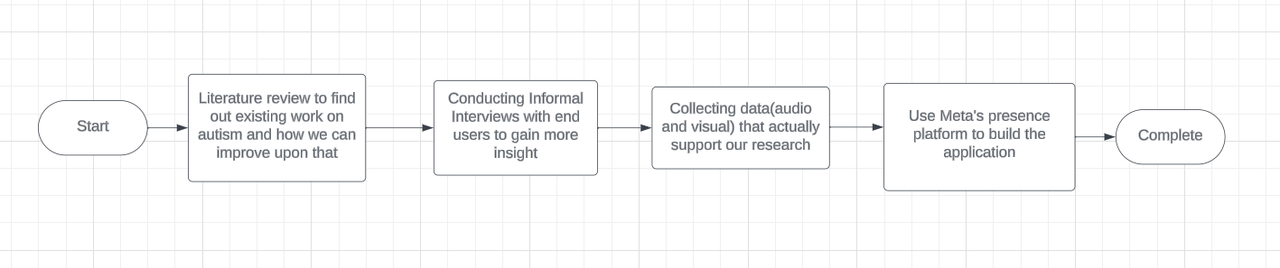 1) We started with the Literature review, to find out existing work on improving user engagement and how we can build something more immersive and useful.
2) Conducted Informal Interviews with end users to gain more insight and to verify if we understood if we were meeting their requirements.
3) Collecting data(audio and visual) that actually support our research and how that data actually is inconvenient to our end users.
4) Use Meta's presence platform to build the AR application.
1) We started with the Literature review, to find out existing work on improving user engagement and how we can build something more immersive and useful.
2) Conducted Informal Interviews with end users to gain more insight and to verify if we understood if we were meeting their requirements.
3) Collecting data(audio and visual) that actually support our research and how that data actually is inconvenient to our end users.
4) Use Meta's presence platform to build the AR application.
Challenges we ran into:
1) Figuring out the most effective way that we could help the autistic community and researching on how audio and visual overstimulation can cause distress and anxiety. 2) To create a customizable experience with our research that can cater to the wide variance in sensory preferences among individuals with ASD. 3) Additionally, ensuring that the tool is a supplement, not a replacement, for professional therapy posed a conceptual challenge.
Accomplishments that we're proud of:
We are proud of being able to contribute to UN's 10th Sustainability Goal- i.e reduce inequality. We aim to provide a connective environment without any discrimination ,developing the Emergency De-Stimulate Feature that provides instant relief in overwhelming scenarios. This tool stands as a testament to our commitment to enhancing the quality of life for individuals who experience difficulties due to sensory overstimulation.
What we learned:
We gained insights into the complexity of sensory processing issues and the importance of flexibility and customization in developing assistive technologies. The feedback loop from potential users was invaluable in shaping the tool's features.
What's next for SensEasy:
Looking ahead, we plan to refine SensEasy by incorporating machine learning to predict and adapt to user needs more effectively in the form of sentiment analysis in order for our user to understand the emotion better. Further research into cognitive-behavioral strategies will inform the development of features that can assist users in managing anxiety and sensory overload proactively.


Log in or sign up for Devpost to join the conversation.