Sensory Scribbles
Inspiration
Most students do not find out they are neurodivergent until a teacher, a counselor, or a breaking point names it in their teens. By then they have spent years thinking they were careless, slow, or too much. The pattern was already in how they drew, how a sentence stopped, and what they returned to when they played.
Parents get report cards. They do not get the creative trace. Sensory Scribbles started from that gap: a daily place where a child practices noticing, writing, and drawing, and where those small acts become a record a parent can actually read.
What It Does
- Daily Sensory Prompts: Every day, a room shares one sensory prompt. Each person answers with one sentence (at most 140 characters) and one continuous stroke that carries those words. The strokes assemble into a shared mosaic.
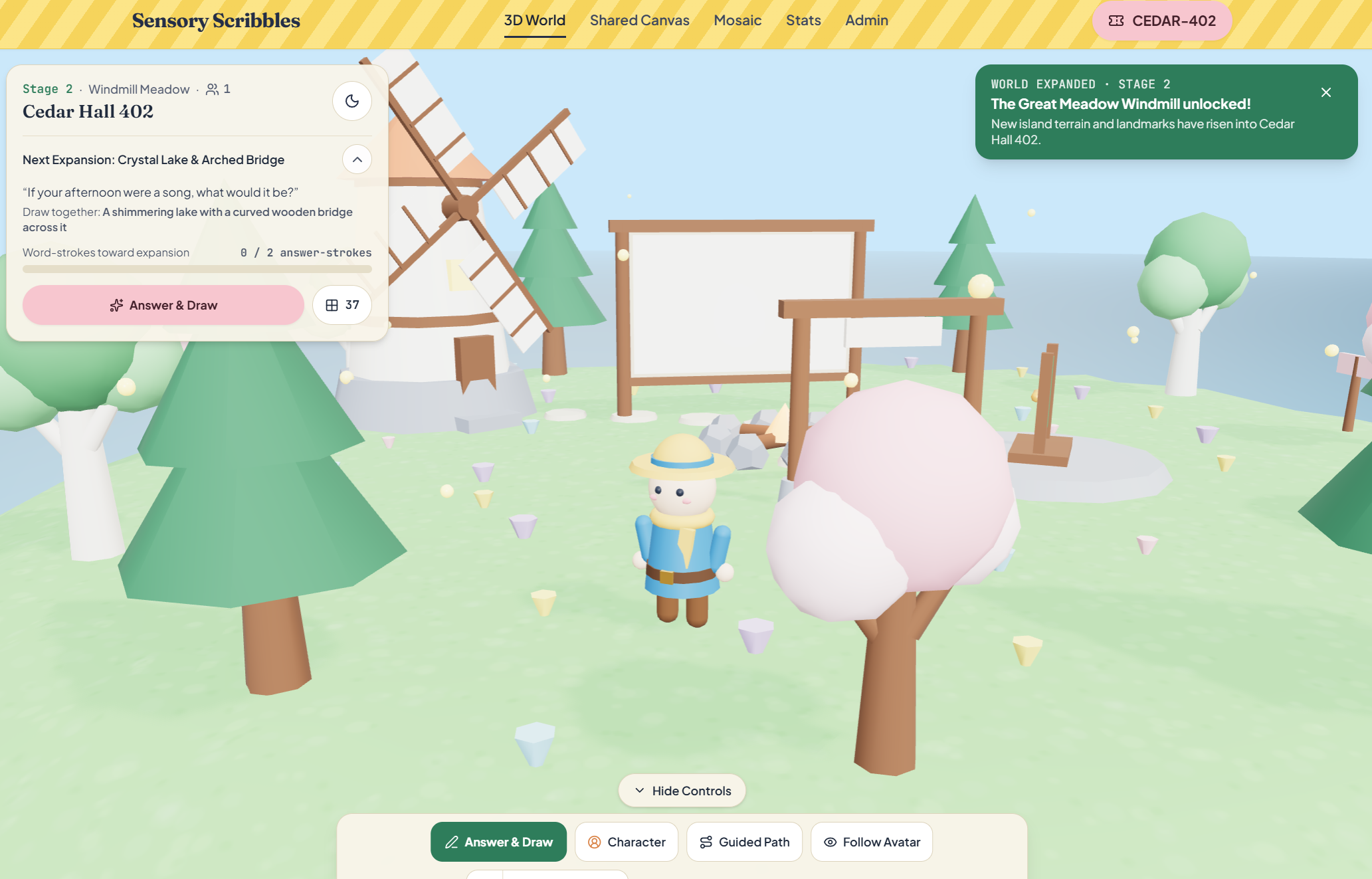
- Walkable 3D Worlds: Gemini reads each sentence and turns it into a walkable outdoor world—a clearing, a cabin, a pond, or a stand of trees. People explore it in first or third person, on desktop or a phone.
- Built-In Play: Guess the Prompt, Whose Is It?, and a 3D matching game ask you to connect a stroke or a place back to the reflection that made it.
- Nightly Summaries & Stats: A nightly workflow writes a two-sentence caption for the day and three grounded minigame questions. A stats view charts minigame accuracy and room activity over time.
- Safety & Privacy First: Before anything is published, Gemini plus a deterministic check blocks slurs, harassment, sexual content, threats, links, and personal information. Rooms join by an invite code, and an admin console flags entries, schedules tomorrow’s prompt, and runs the nightly workflow.
- Flexible Storage & Verification: If a room opts in, Solana Devnet anchors only a hash of the entry and the hour—the sentence, the name, and the room never go on-chain. Run it with no hosted database and it keeps everything in local SQLite; point it at Tiger Data and the same events become time-series history.
How We Built It
- Cursor & Grok Bot: Cursor was our core coding agent, used to build the Express and Vite server, the React word-stroke canvas, the Three.js worlds, the database layer, and the admin console as one TypeScript app. Grok Bot forms the other half of that workflow for the SpaceXSI track. The admin page exposes stable, labeled controls—including
data-testidhooks for flagging, unflagging, saving tomorrow’s prompt, and running the nightly workflow—so Grok Bot can drive moderation and prompt scheduling instead of requiring a person to click through the dashboard. - Gemini (
@google/genai): Performs three core jobs: moderating every sentence before the room sees it, turning accepted sentences into a natural world spec, and drafting the nightly caption and minigame questions. We used it to develop and render our 3D models with 3.js. - Mastra: Runs at night as a four-step workflow (
src/mastra/nightlyWorkflow.ts). It loads the day’s entries, asks Gemini for the caption and questions, and refuses the result if a name leaks, if more than five words are quoted in a row, or if a question points at an entry that does not exist. - Solana (
@solana/web3.js): Opt-in per room. A sponsored Devnet Memo stores a SHA-256 hash of the entry ID and hour bucket, keeping the journal completely private. - Tiger Data & SQLite:
db/timescale_schema.sqlstores entries and minigame events as hypertables and powers weekly charts withtime_bucket(). WithDATABASE_URLunset, the same server falls back to SQLite so a demo runs offline on a laptop. - Vultr: Hosts the production process as one Node server (
npm run build, thennpm start), serving the API and the client together.
Challenges We Ran Into
- Interpretation vs. Restraint: A child’s sentence and a drawn stroke are small, and AI interpretation can easily overreach. The nightly step had to sound like the room without quoting people, naming them, or inventing entries. Our validator fails closed whenever Gemini drifts.
- Balancing Safety and Imagination: The moderation gate must block personal details and harmful text, while the world builder has to stay warm and imaginative enough that a short sensory line still becomes a place someone wants to walk.
- Environment Management & Offline Demos: Secrets do not travel with the repo (
.envis gitignored), meaning local play requires its own.envand a server restart to pick up keys. Additionally, the app had to stay demoable offline—requiring seamless parity between Tiger Data for real time-series storage and SQLite for table demos without a network database.
Accomplishments That We're Proud Of
- One Unified Loop: A sentence and a stroke become a place. The daily prompt, the shared mosaic, the free-draw layer, and the walkable world operate as one continuous loop rather than separate toys.
- Memory Built Into Play: Minigames are scored from real entries, and those scores land in the same history as the journal—the product remembers play instead of throwing it away.
- Structural Privacy: Moderation runs before publish, the nightly caption is checked for names and long quotes, and the Solana anchor stores a hash rather than the writing itself.
- Cohesive Stack Integration: Every tool sits directly on the core loop rather than beside it: Cursor and Grok Bot build and operate it, Gemini reads and guards it, Mastra closes the day, Tiger Data remembers it, Solana seals a proof without exposing it, and Vultr serves it.
What We Learned
Kids will practice writing and drawing when the result is a world, not a worksheet. Parents need the pattern across many of those days, not a single grade. A report card arrives after a child has already decided they are bad at school, whereas a stroke, a sentence, and a walk are early enough to notice pace, focus, and sensory habits while the child still thinks they are just playing.
We also learned to keep the claim smaller than the feeling: the record can show how a child makes things, and it should never pretend to diagnose them.
What's Next for Sensory Scribbles
- Real-World Local Maps: The next world is a real town, starting with Wellesley. A child should open the app and recognize their school, their street, and the path home, then draw and write inside that place until the block changes because they made something. Once one town feels like home, the same map framework scales to the next town.
- A Private Parent Benchmark: Alongside the child's play space, we plan to build a parent view showing a private benchmark of creative learning over weeks—tracking how they draw, how they write, what they repeat, what they avoid, and how that shifts over time. It remains a studio with a memory, never a clinic.
Built With
- cursor
- gemini-api
- grokbot
- mastra
- solana


