SensorTrust — Trust the Data. Verify the History.
The Problem: Environmental Data Is Only Useful When We Can Trust It
Air-quality monitoring helps communities, researchers, and municipalities understand environmental risks. But collecting measurements is only one part of the challenge. Sensor drift, expired calibration, duplicate submissions, sudden spikes, stuck sensors, and changes to historical records can undermine confidence in environmental datasets.
An unusual measurement is not necessarily a false measurement. The real challenge is determining which observations deserve investigation, explaining why they were flagged, recording who made the decision, and verifying that the underlying data has not changed.
Our Solution
SensorTrust is an environmental data-integrity platform designed to make air-quality observations easier to validate, investigate, and audit.
The platform focuses on PM2.5 observations and combines deterministic validation, explainable anomaly screening, accountable human review, and cryptographic record-integrity verification in one workflow.
Instead of automatically declaring suspicious readings fraudulent, SensorTrust surfaces evidence for human reviewers. It also distinguishes the integrity of a digital record from the physical accuracy of the sensor that produced it.
How It Works
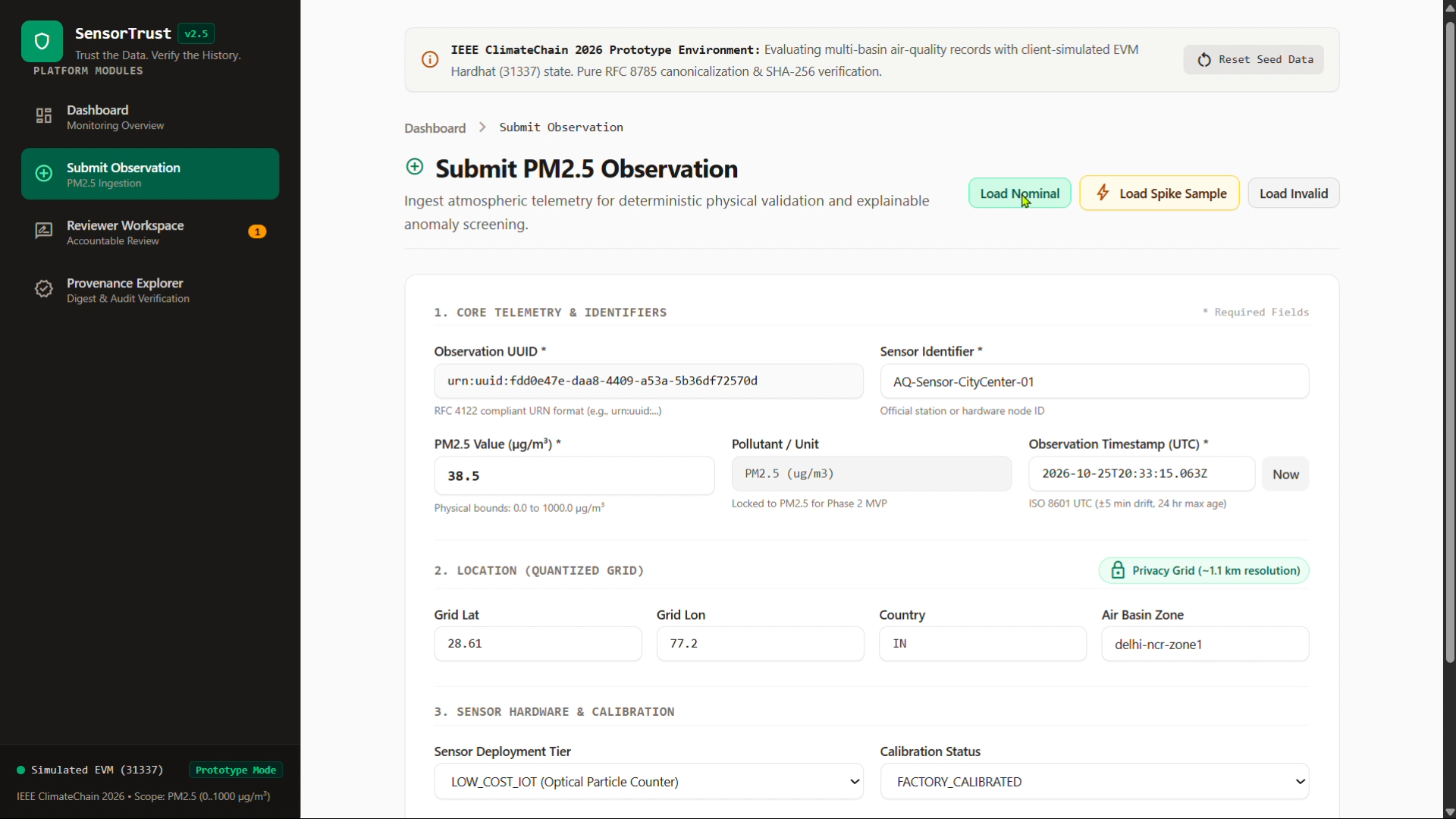
1. Submit and Validate
Users submit an environmental observation containing its measurement, timestamp, sensor information, calibration status, and privacy-quantized location.
Validation checks required fields, physical measurement bounds, timestamp freshness, and duplicate records. Invalid submissions are rejected with actionable feedback.
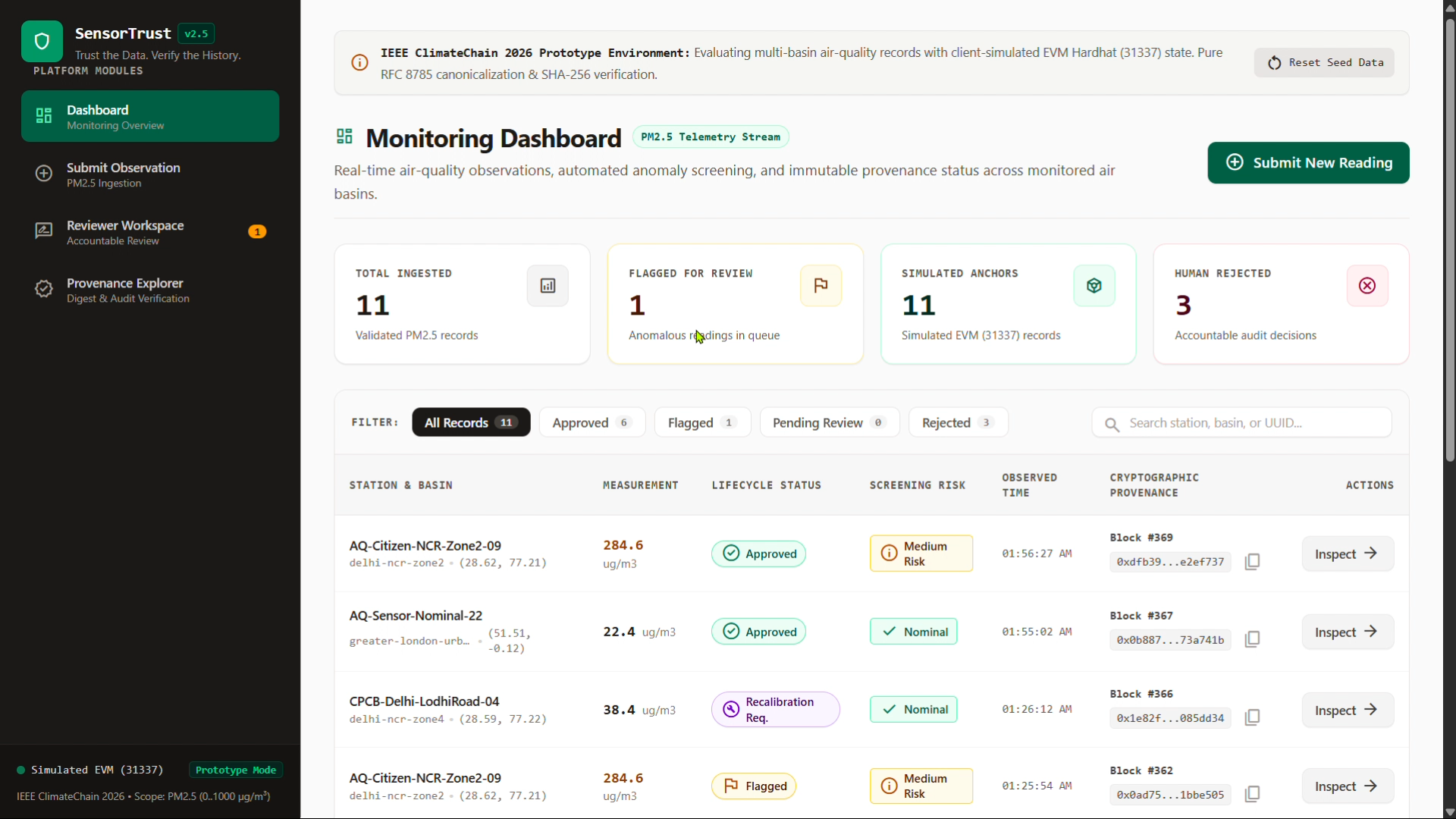
2. Screen for Anomalies
SensorTrust evaluates observations for suspicious patterns, including rapid changes in PM2.5 measurements, repeated identical readings, and unusual values compared with nearby stations when sufficient peer data is available.
Each flag is accompanied by supporting evidence. When contextual data is missing, the platform explicitly identifies insufficient context rather than assuming the observation is normal.
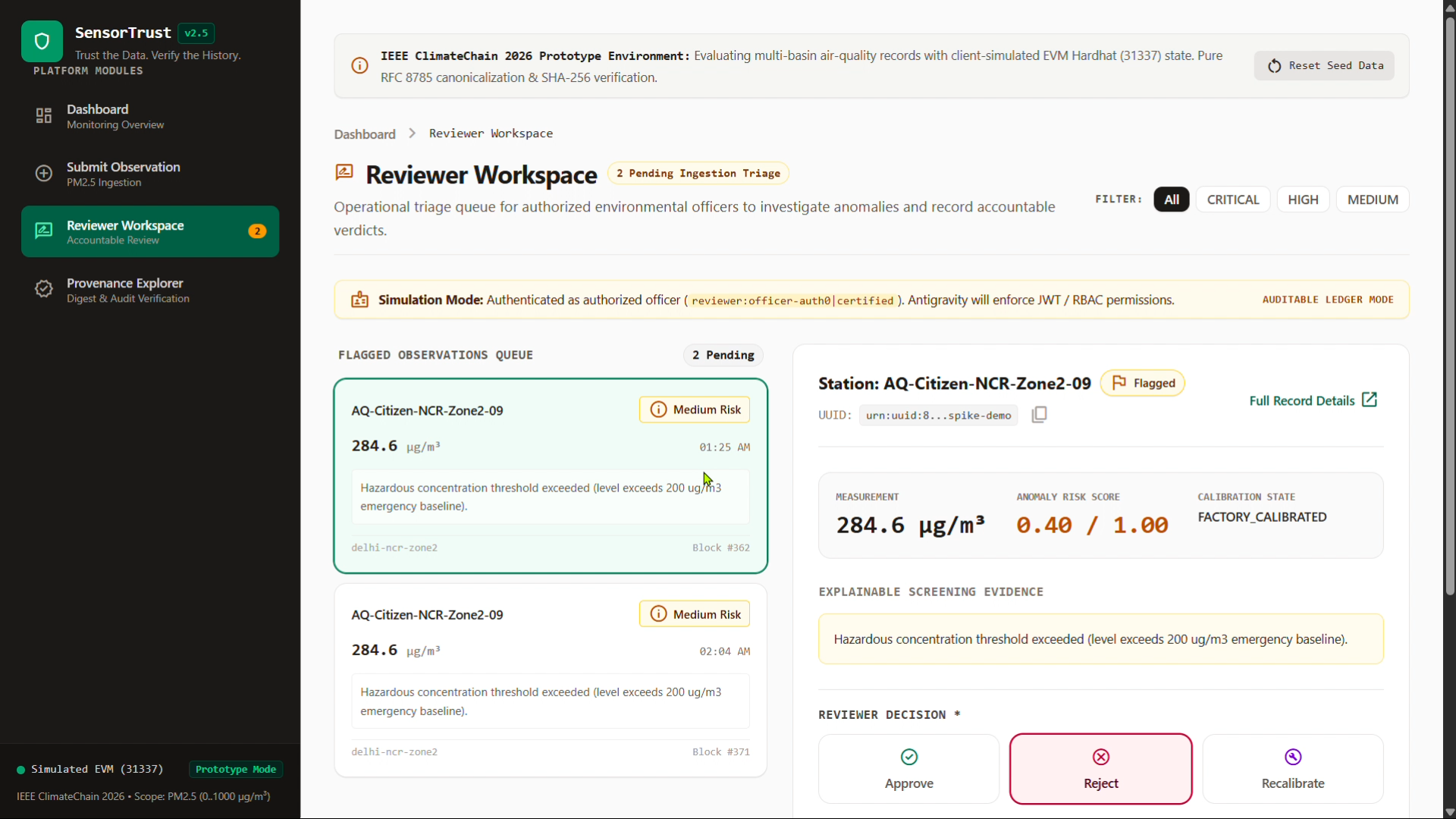
3. Review with Accountability
Authorized review workflows allow a reviewer to approve an observation, reject it with a reason, or request recalibration.
Justifications and review history help make decisions explainable and auditable. An anomaly flag is treated as a reason to investigate, not proof of misconduct.
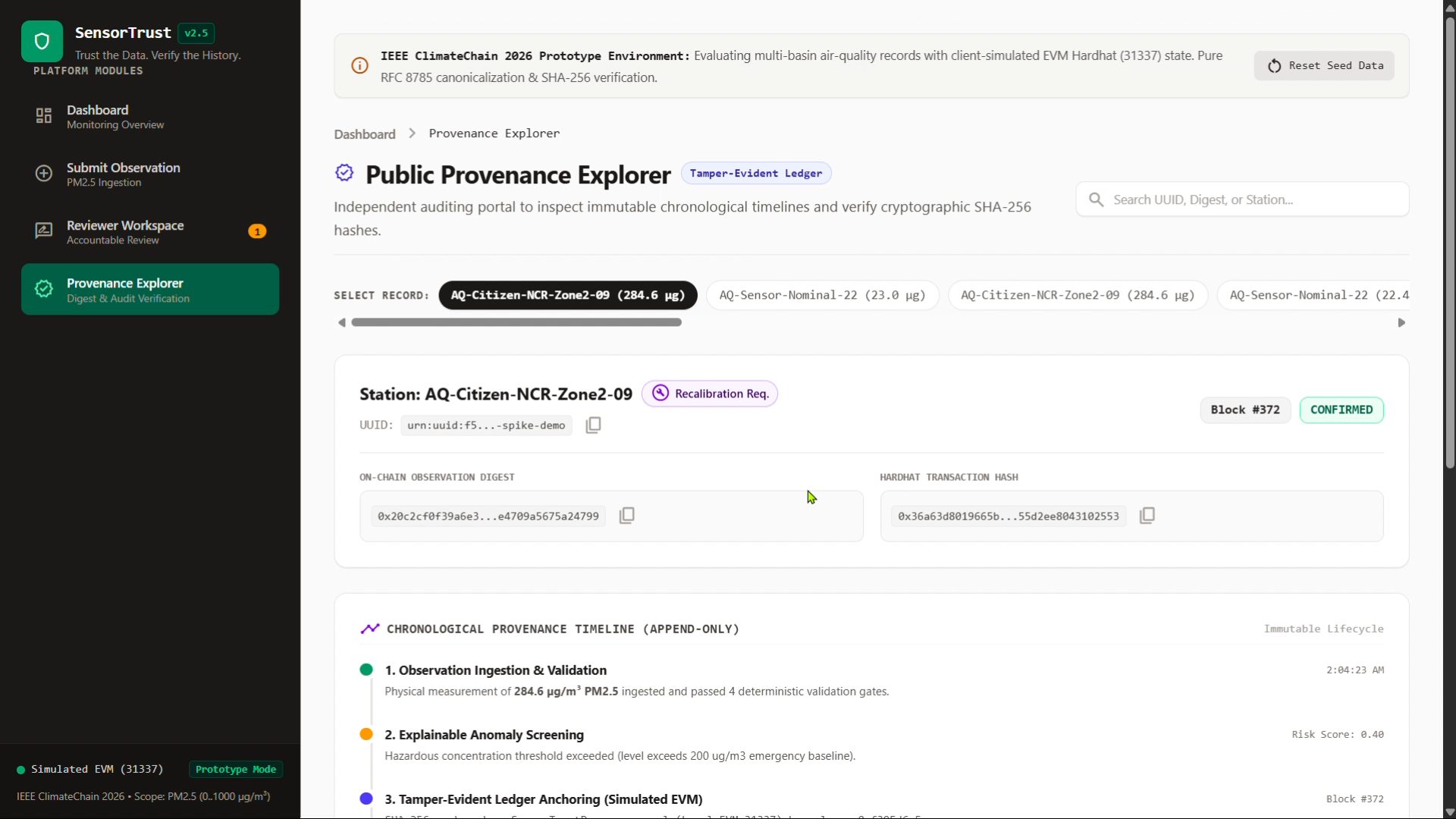
4. Verify Record Integrity
SensorTrust uses deterministic JSON canonicalization following RFC 8785 and SHA-256 digests to identify changes to observation records.
The provenance explorer lets users compare a candidate record against its recorded digest. If a measurement is modified, the recomputed digest changes and the mismatch becomes visible.
The architecture is designed to support blockchain-based provenance for observation and review records. The current prototype distinguishes simulated EVM behavior from actual on-chain verification.
What Makes SensorTrust Different?
- Explainable screening: Surface the evidence behind suspicious readings instead of presenting unexplained scores.
- Human accountability: Preserve review decisions and their justifications.
- Cryptographic integrity: Detect changes to digital records using deterministic serialization and SHA-256.
- Privacy-aware design: Quantize location information and avoid placing raw sensitive data on-chain.
- Honest uncertainty: Distinguish missing context, suspicious measurements, invalid observations, and confirmed review outcomes.
- Audit-oriented workflow: Connect ingestion, screening, review, and provenance verification in a coherent interface.
How We Built It
SensorTrust was developed as a climate-tech hackathon prototype with a React, TypeScript, and Tailwind CSS frontend. The interface uses a restrained forest-green and warm-neutral design, with responsive layouts for the monitoring dashboard, observation submission, reviewer workspace, and provenance explorer.
The project incorporates deterministic validation, anomaly-screening logic, RFC 8785 canonical JSON serialization, SHA-256 digest verification, and automated testing. The planned backend architecture uses Python and FastAPI for server-side validation and persistence, while Solidity and Hardhat are intended to support the blockchain provenance layer.
The implementation is being developed in phases so that data validation, API behavior, cryptographic consistency, and blockchain integration can be tested independently.
Challenges We Faced
One major challenge was avoiding false certainty. A spike can be a real environmental event, a sensor fault, or a data-quality issue. SensorTrust therefore emphasizes explainable evidence and human review instead of automatically labeling anomalies as fraudulent.
Another challenge was making cryptographic verification understandable. A digest mismatch can show that a candidate record differs from the recorded content, but a matching digest does not prove that the original measurement was physically accurate. Communicating this distinction is central to the product.
We also focused on privacy, consistent validation rules, reliable review history, responsive usability, and transparent prototype status.
What We Learned
Building SensorTrust reinforced that trustworthy environmental monitoring requires more than collecting data or applying an anomaly detector. It requires reproducible validation, contextual evidence, careful handling of uncertainty, accountable decisions, and a verifiable history of changes.
We also learned that blockchain is most useful when it addresses a specific trust problem. Recording a digest can support tamper-evident provenance, but it cannot independently certify sensor calibration or guarantee that a measurement reflects real-world conditions.
Potential Impact
SensorTrust aims to help environmental researchers, municipalities, and citizen-science networks identify questionable observations, understand data-quality concerns, and maintain a clearer audit trail.
By combining explainable screening with human accountability and cryptographic integrity checks, the platform seeks to make environmental datasets easier to evaluate and more trustworthy to use.
Current Status
SensorTrust is a hackathon prototype. Sample records and simulated EVM states are identified as such. Live backend persistence and blockchain transaction claims will be made only for capabilities that have been implemented and verified.
Our principle is simple: trust should be supported by evidence, and every important data-quality decision should be explainable.
Built With
- airquality
- anomalydetection
- blockchain
- climatetech
- dataintegrity
- datavalidation
- environmentalmonitoring
- fastapi
- hardhat
- playwright
- python
- react
- sha-256
- solidity
- sqlite
- tailwindcss
- typescript

Log in or sign up for Devpost to join the conversation.