-
-
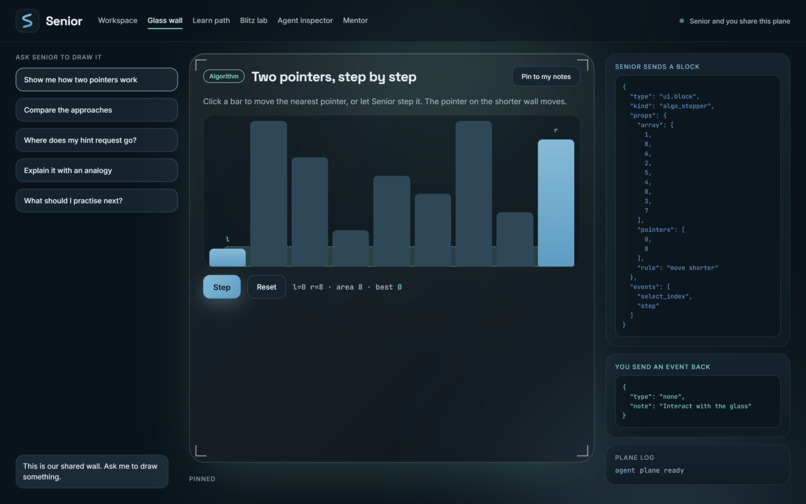
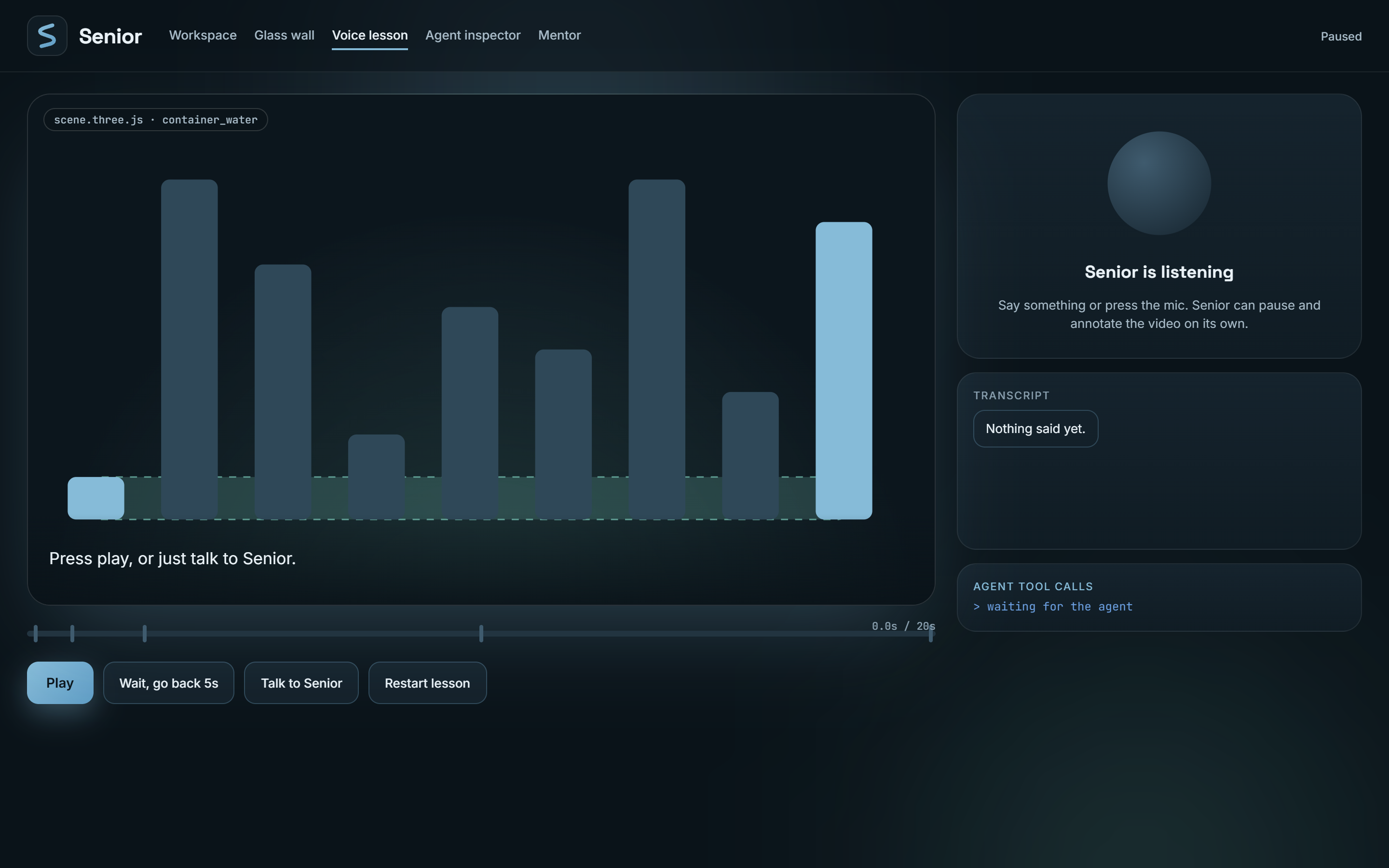
voice lesson
-
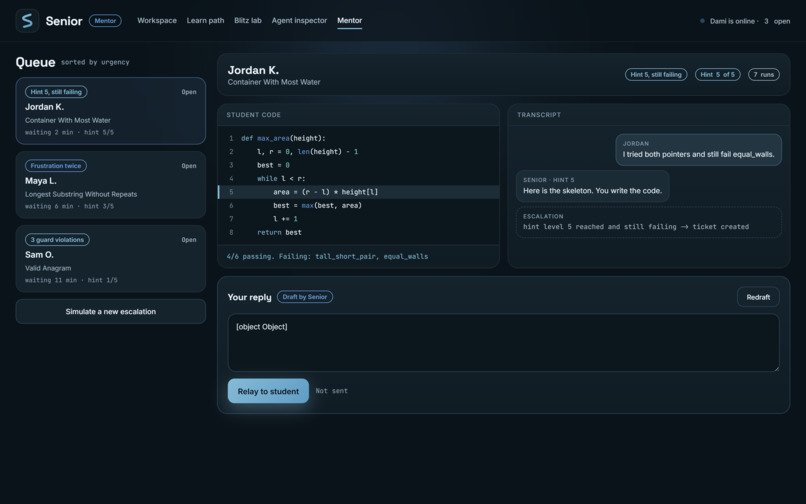
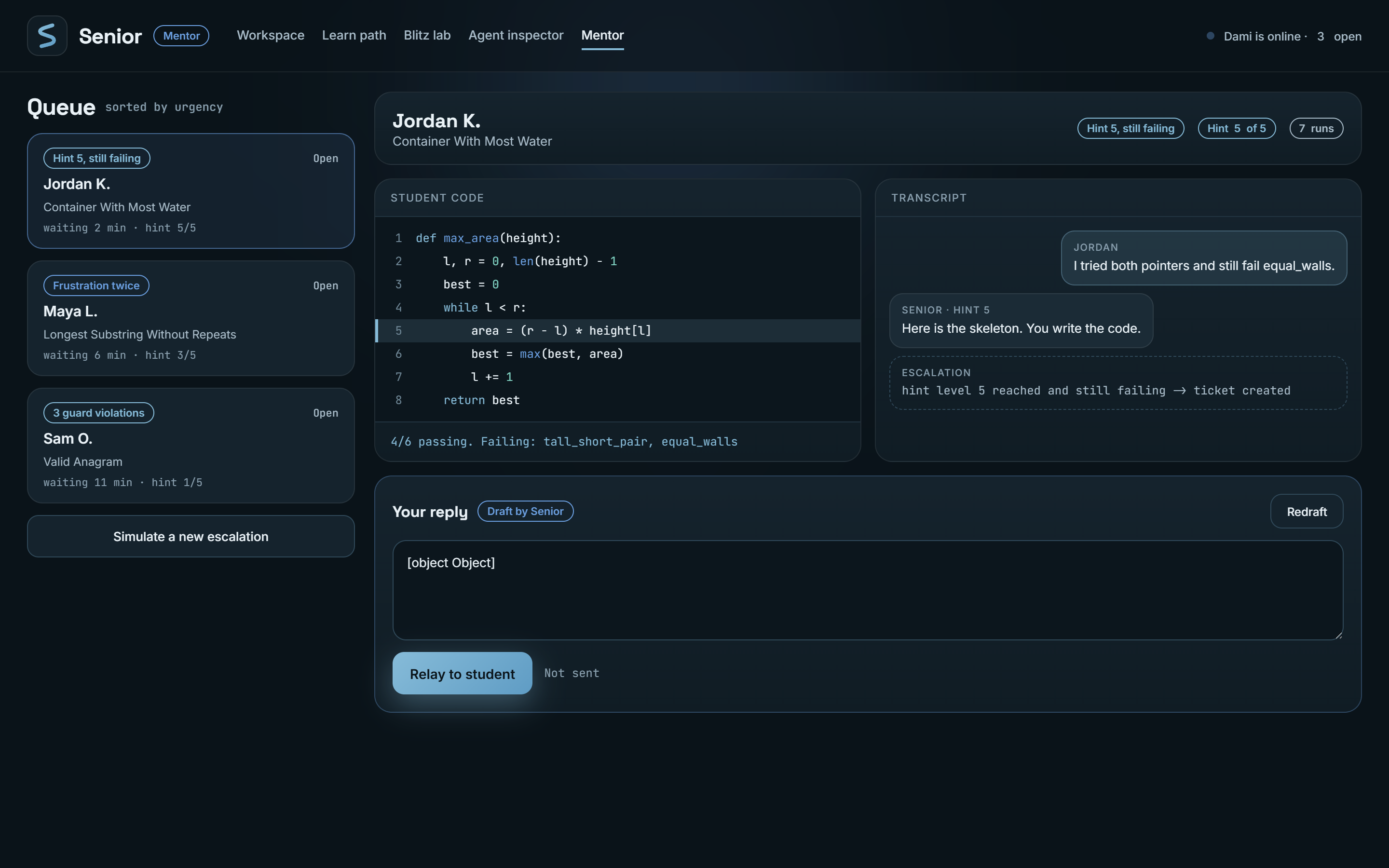
mentor dashboard
-
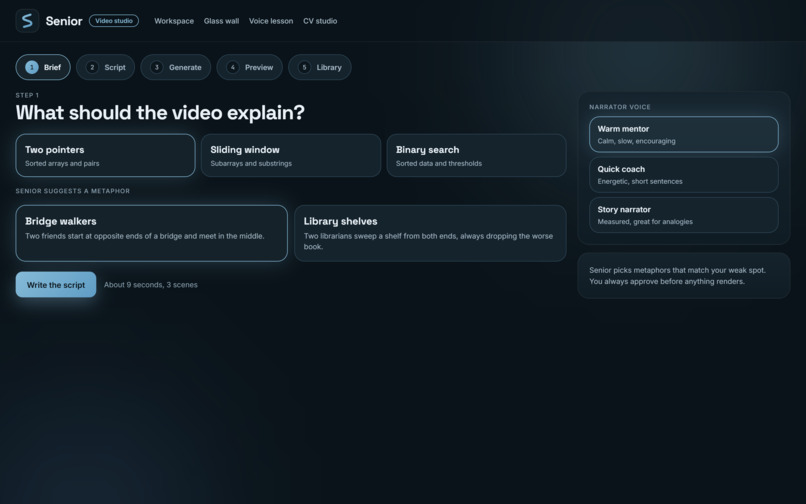
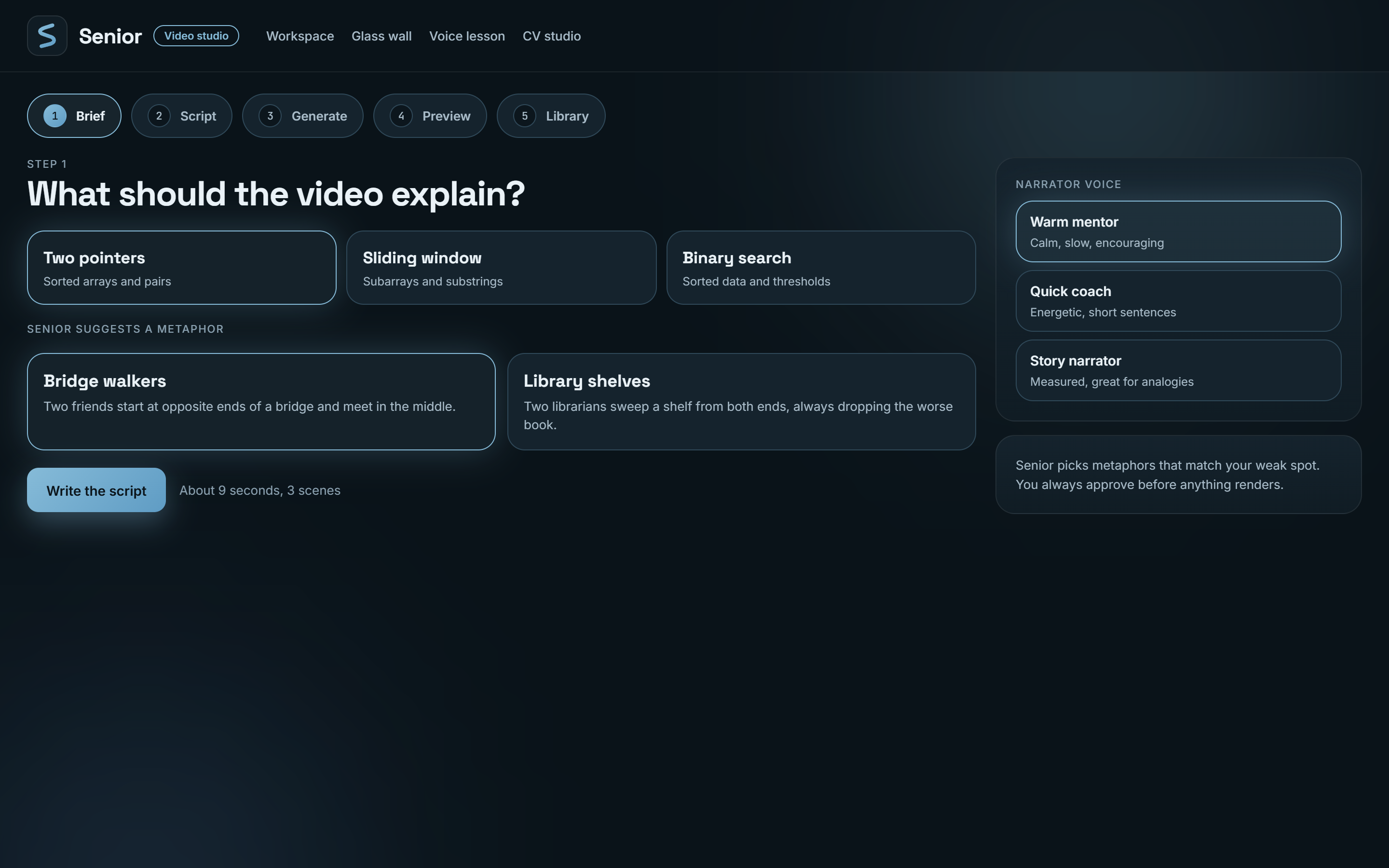
video studio
-
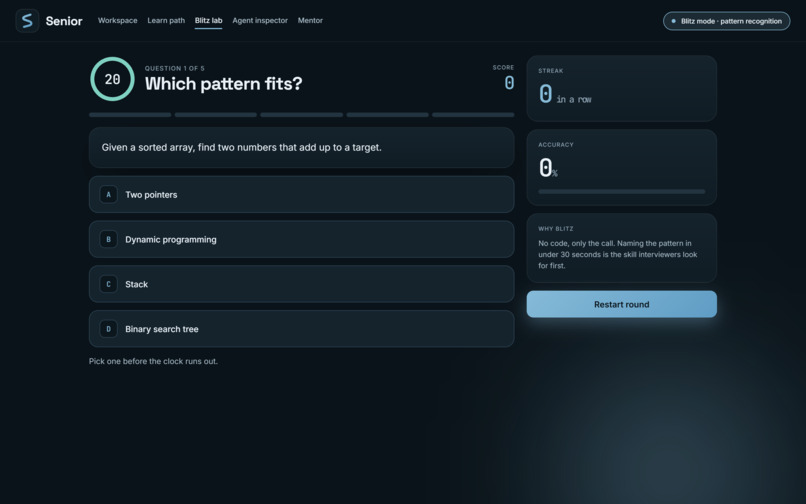
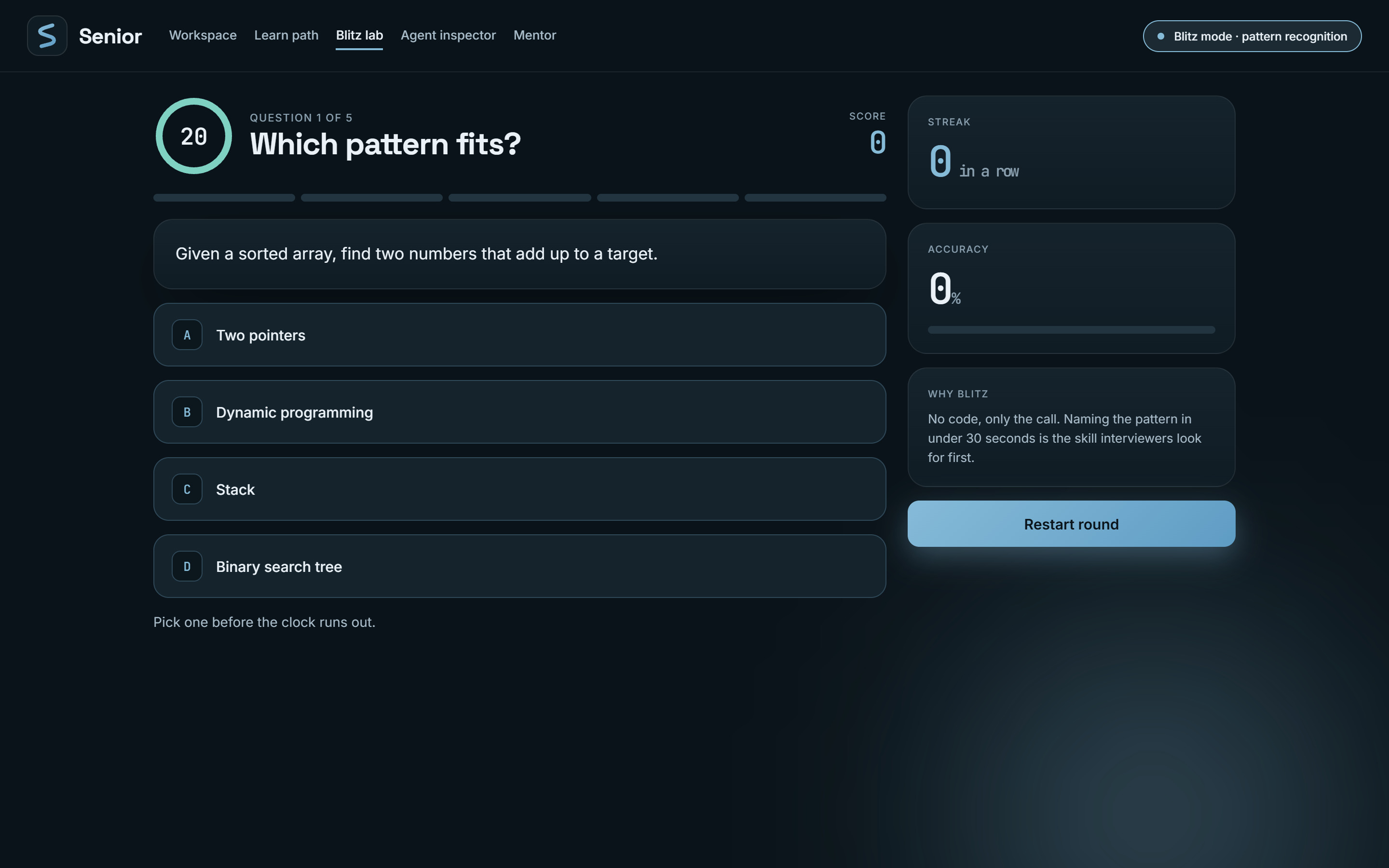
blitz lab
-
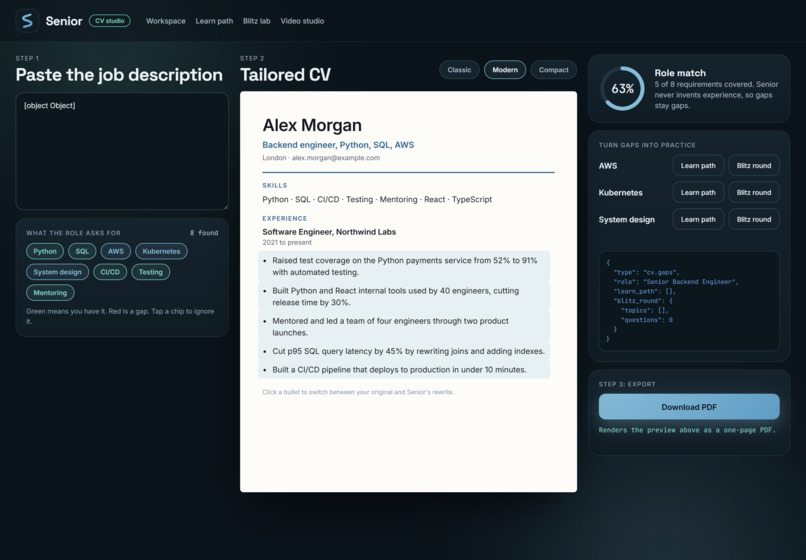
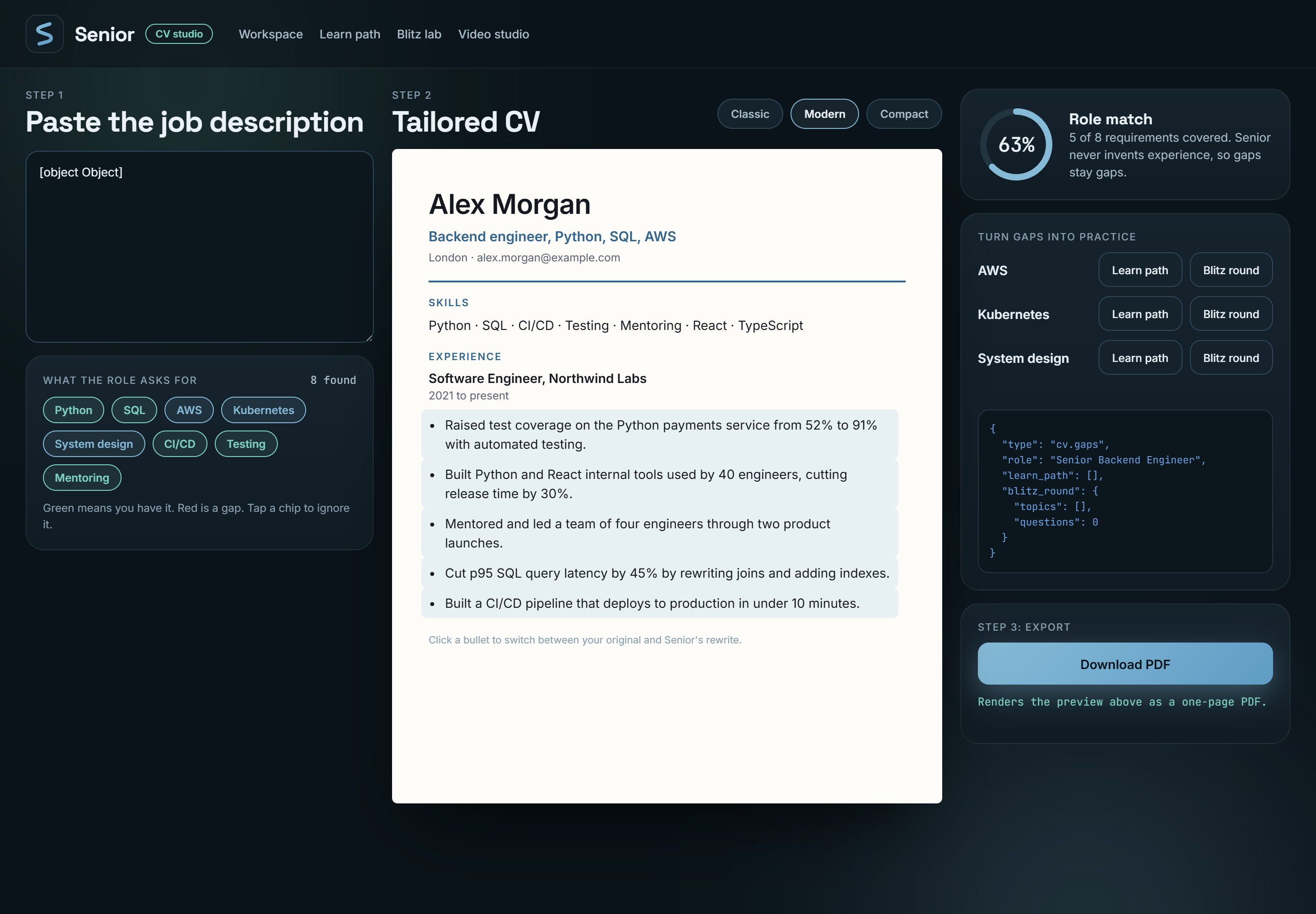
cv studio
-
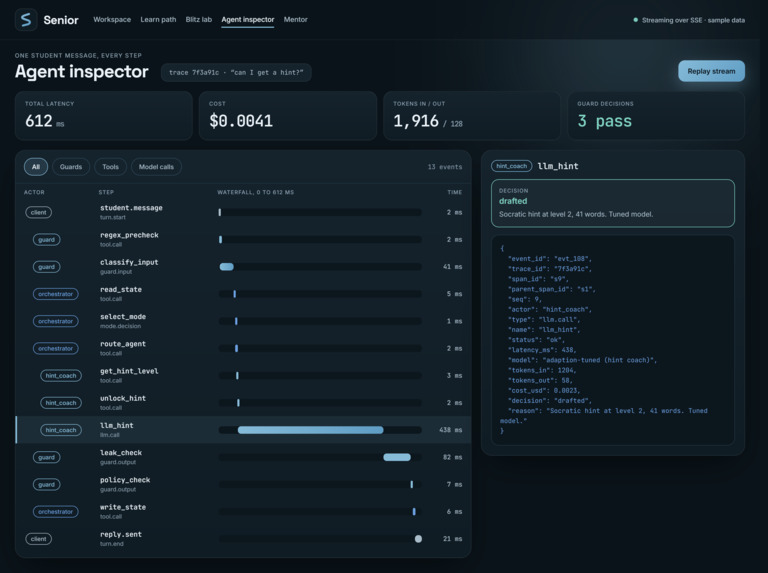
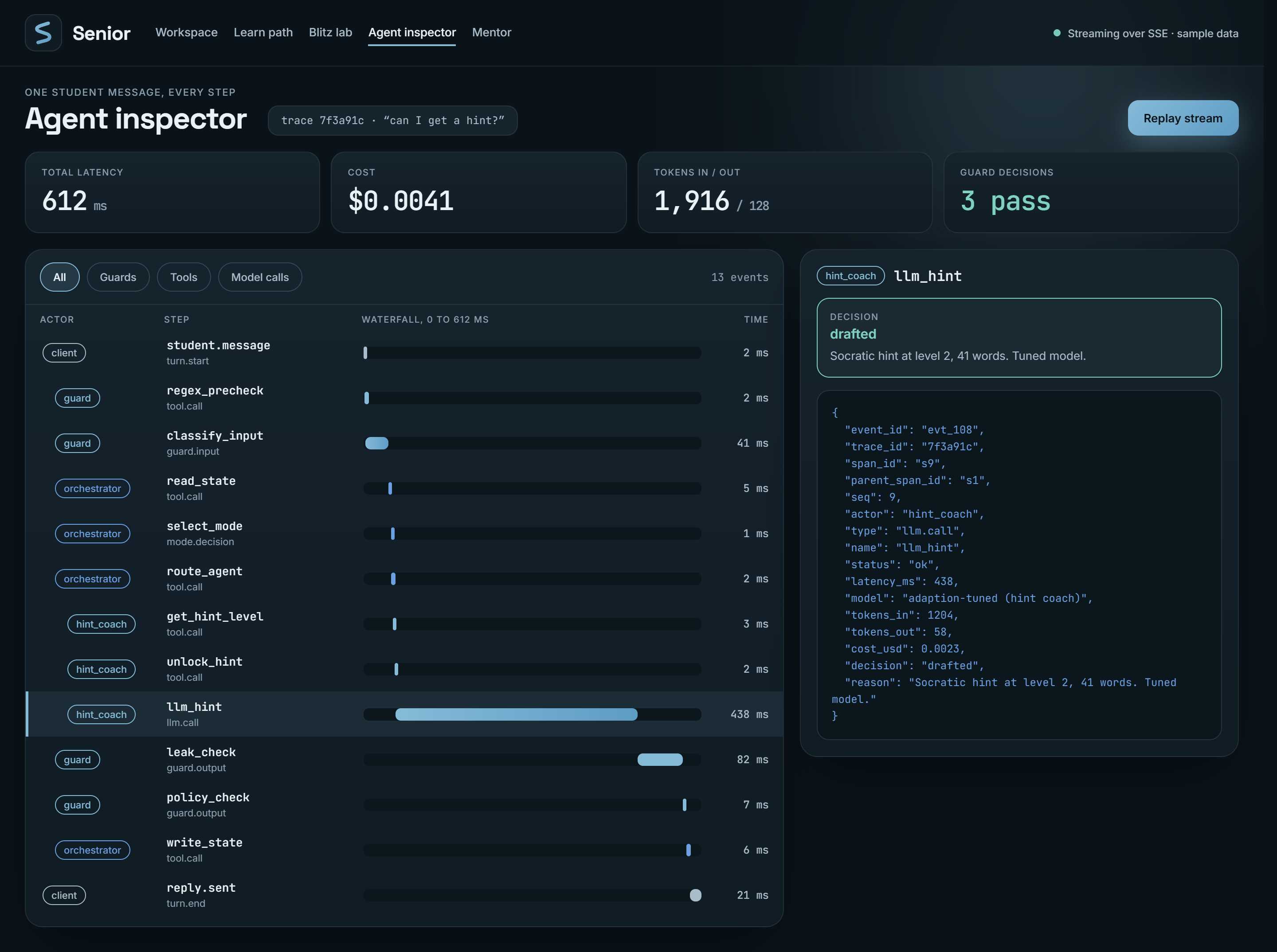
agent inspector
-
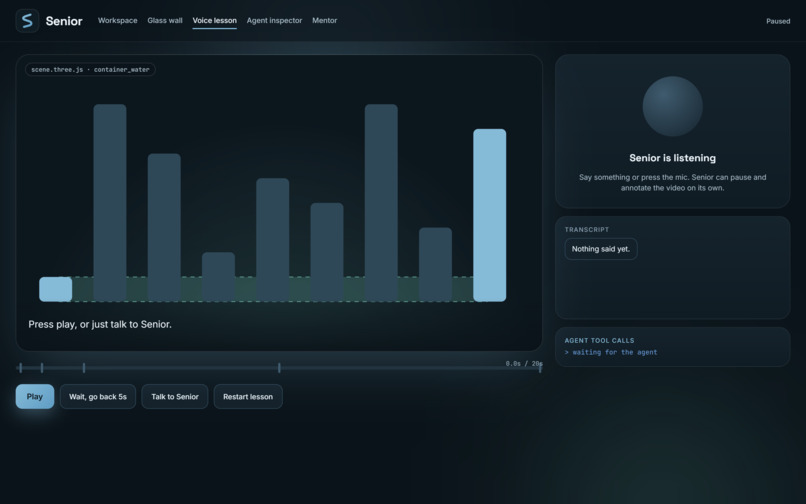
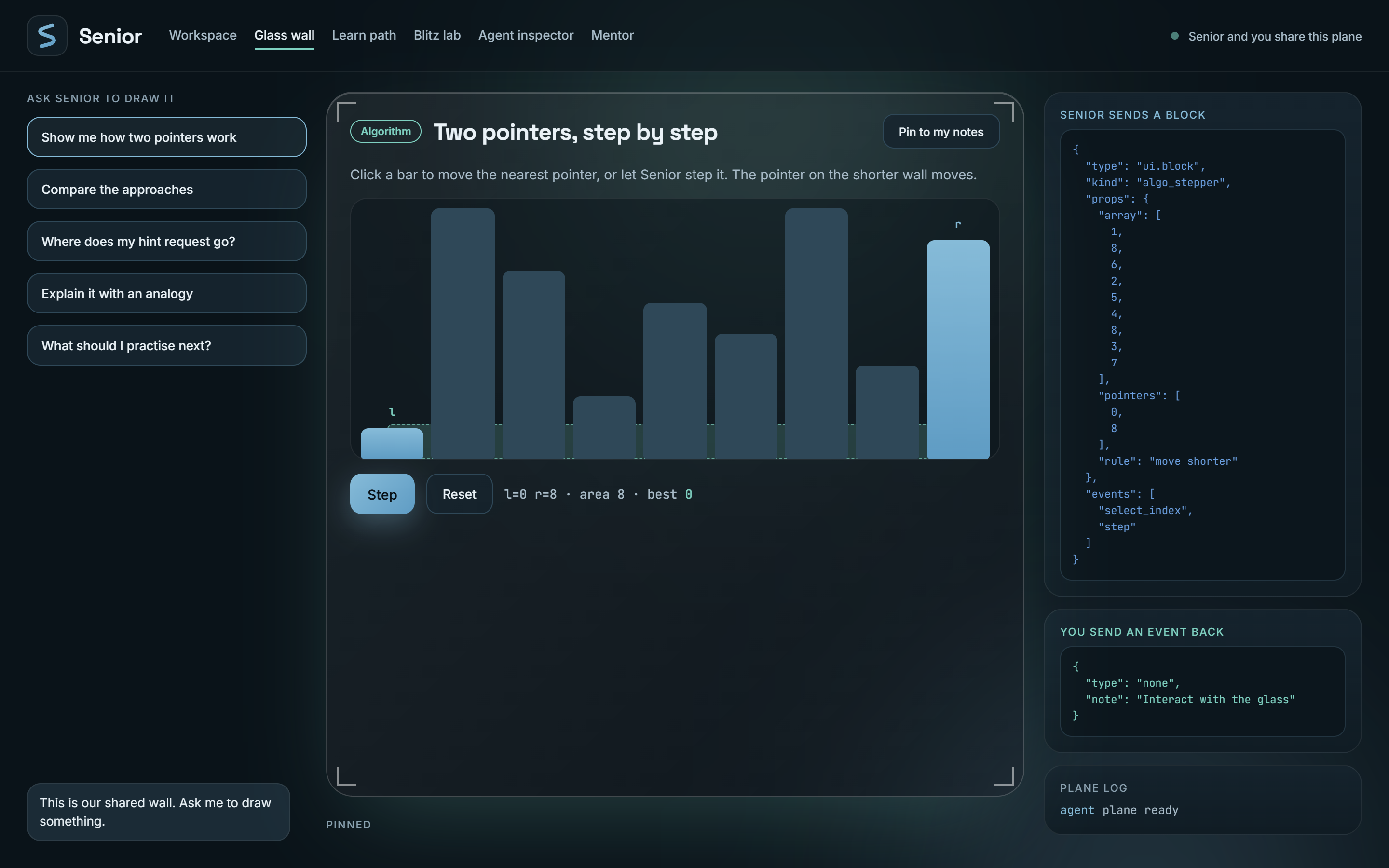
glass wall
-
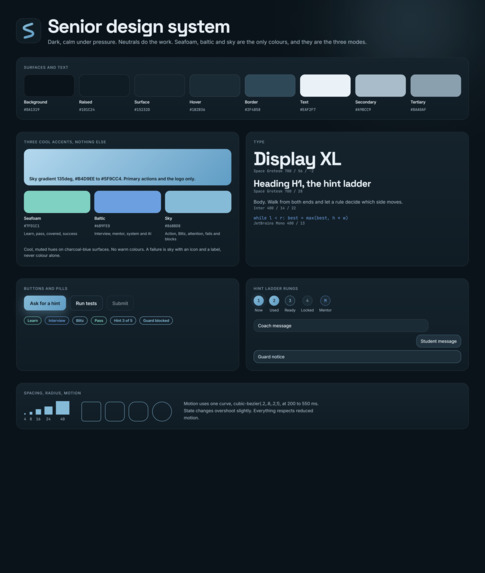
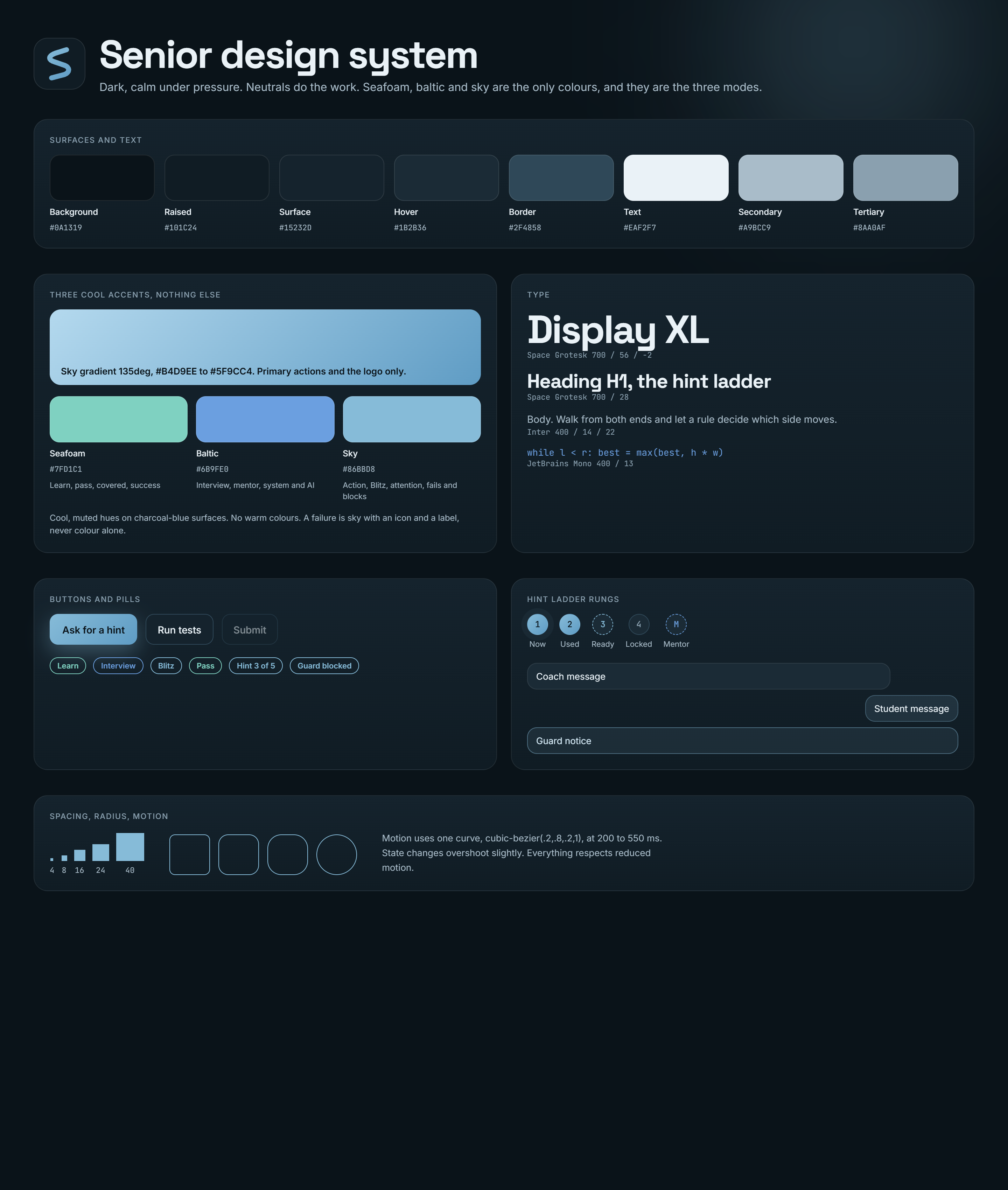
design system
-
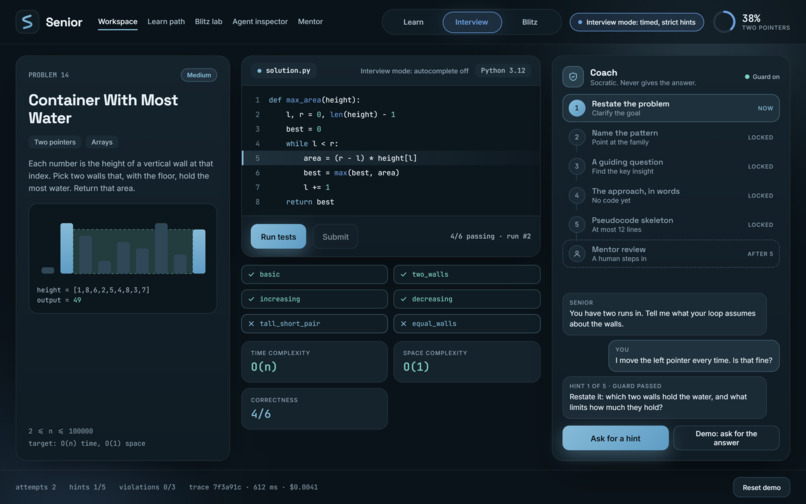
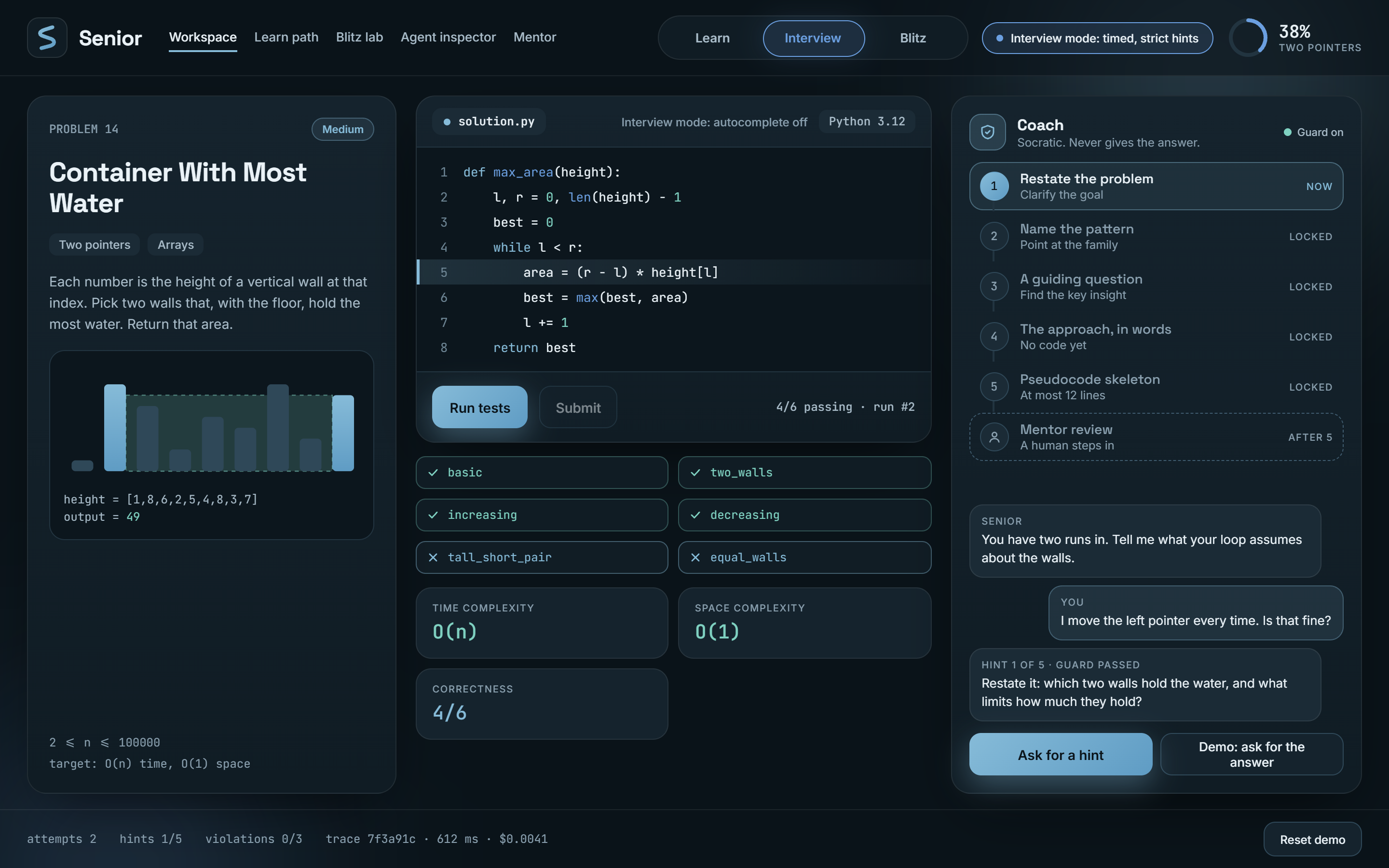
student workplace
-
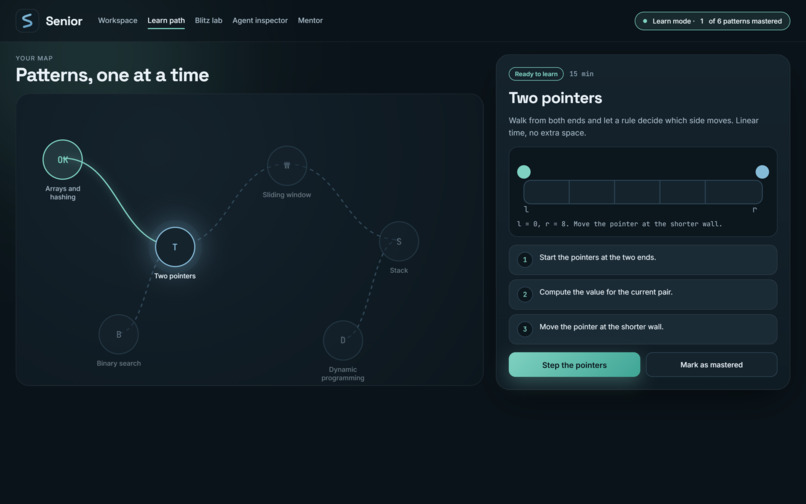
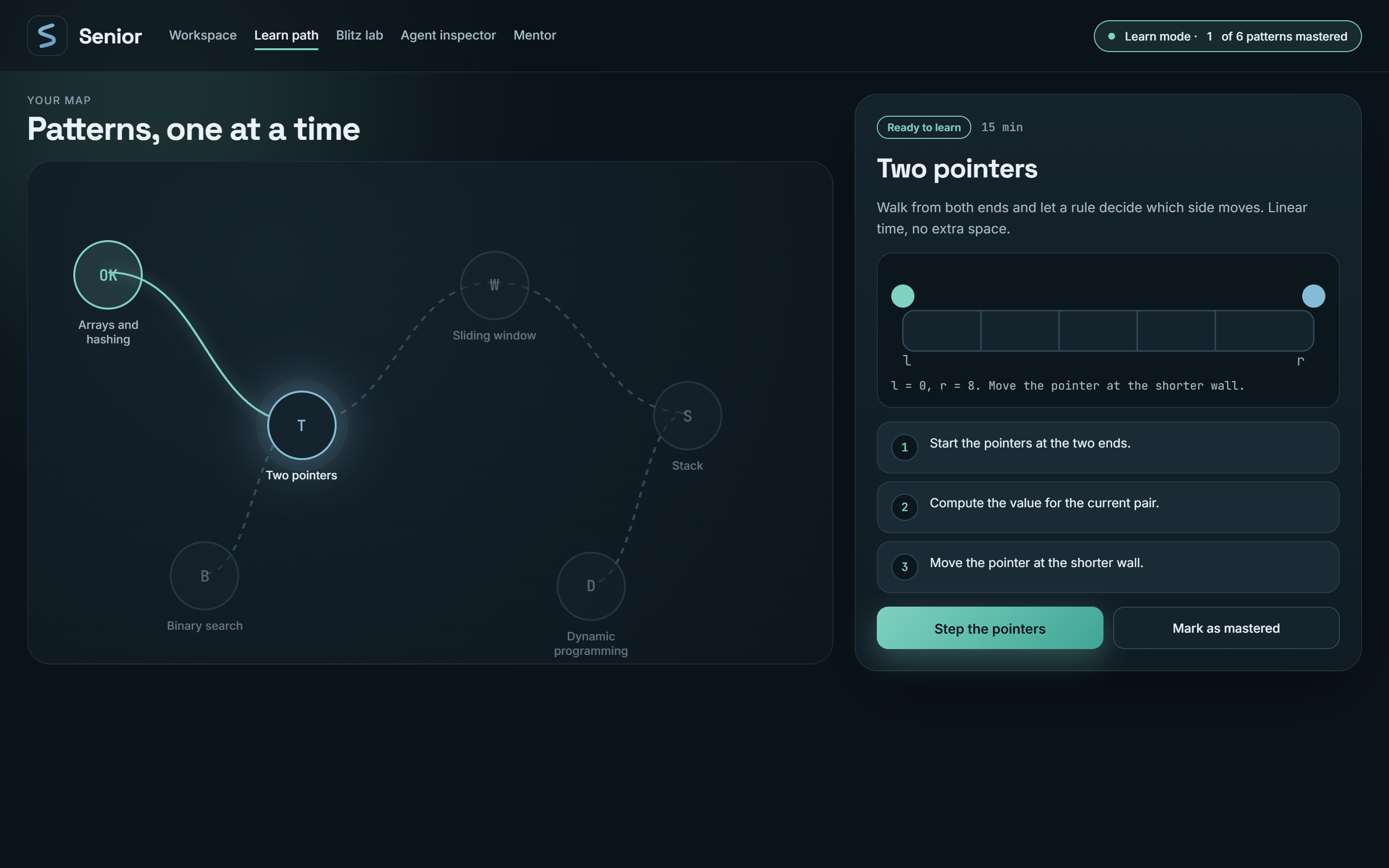
learn path
-
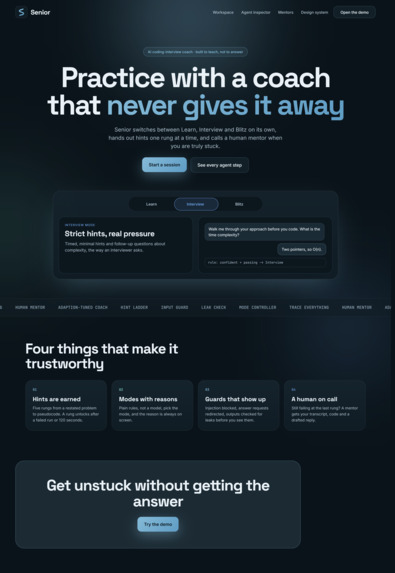
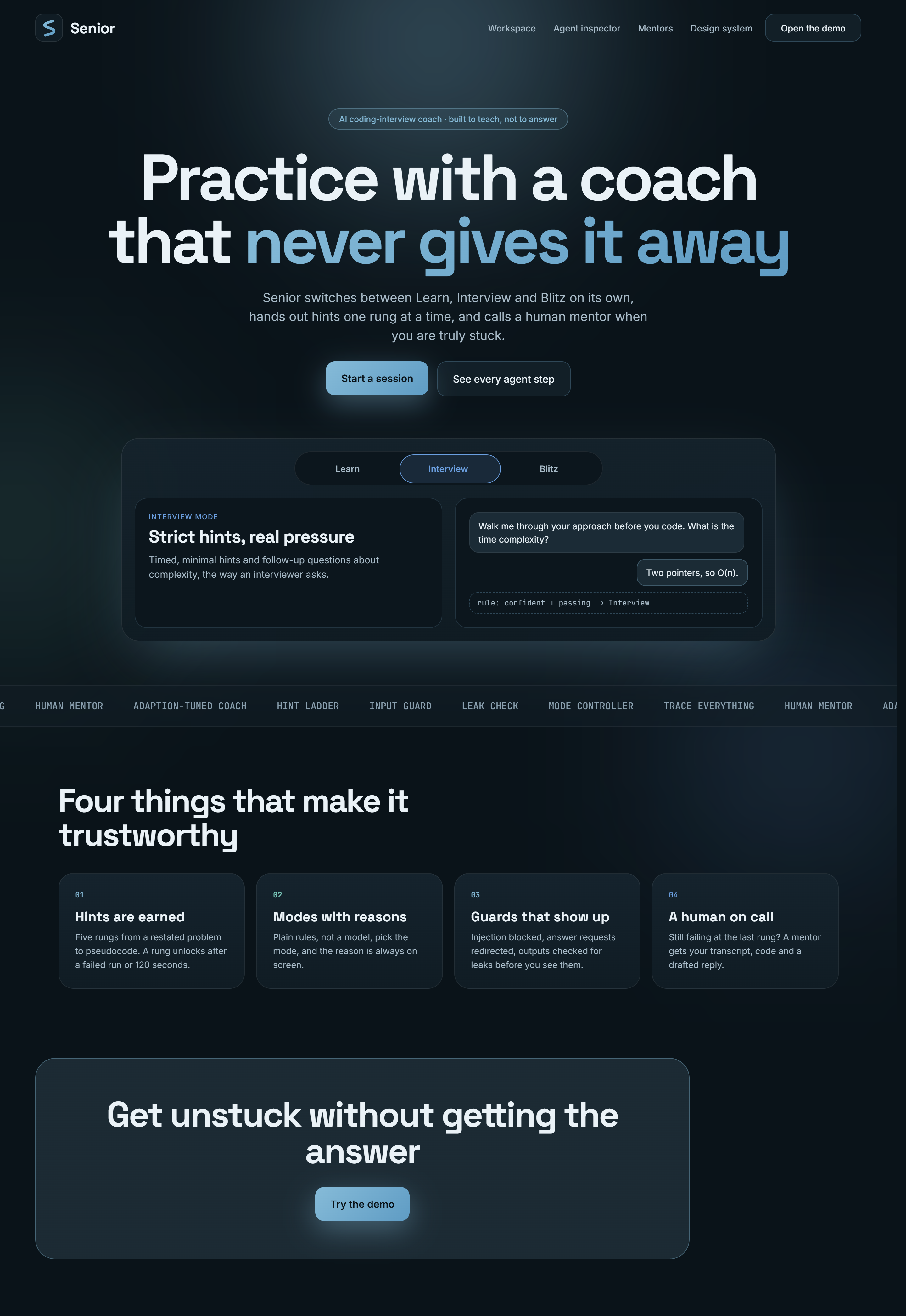
landing page
Inspiration
Coding interview prep has a cheating problem. Most AI tools either hand you the solution, which teaches nothing, or sit silently in a Zoom call feeding you answers, which is worse. We wanted the opposite: a coach that makes you better by refusing to do the work for you, like a good senior would.
What it does
Senior is an AI coding interview coach. You solve a problem in the editor, run tests in the browser, and chat with a coach that gives you progressively stronger hints across a five-level ladder. It never writes the solution.
Hint ladder: from “clarify the problem” up to a pseudocode skeleton, enforced in code, not just in the prompt. Adaptive modes: Learn, Interview and Blitz. Senior switches mode itself, for example dropping into Learn after three failed runs, and tells you why. Evaluator: estimates your time and space complexity against the target. Human in the loop: if you are still stuck at the top rung, keep tripping the guardrails, or show repeated frustration, the session escalates to a mentor dashboard with the full context prepared. Agent inspector: every decision is traceable, so you can see exactly why the coach said what it said.
How we built it
Frontend: Next.js with the Monaco editor. Python tests run in the browser with Pyodide, and results are posted to the API. Backend: async FastAPI streaming over SSE, with SQLite for session state. Orchestrator: a hand-written state machine, not a framework. It routes each student message to specialist agents: Interviewer, Hint coach, Evaluator and Planner. Guardrails: an input guard and an output guard. The output guard runs a leak check so a hint above the allowed level is blocked before it reaches the student. Models: Claude Sonnet and Haiku for the agents, plus a hint-coach model tuned with Adaption. Observability: one event schema across the whole system, with a trace id per student message, which feeds the inspector view. Adaption: we used Adaption to improve the hint coach, and measured it with a pairwise LLM-judge win rate against the base model on held-out problems.
Challenges we ran into
Making refusal reliable. Prompting a model not to leak the answer is not enough. Moving the hint ladder and leak check into code made the behaviour consistent. Knowing when to switch modes. A rule-based controller turned out more predictable and easier to explain than asking a model to decide.
Accomplishments that we're proud of
A cohesive design system built for the Figma prize A coach whose key promise, never giving the answer, is enforced by the system rather than hoped for. Full traceability: every hint, guard decision and mode switch can be inspected. A real human escalation path, not just a chatbot.
What we learned
Guardrails belong in code, with the model as one component inside them. Clear traces make debugging an agent system far easier than reading chat logs. Fine-tuning pays off when you evaluate on held-out problems, not the ones you tuned on. The best teaching tool is often the one that holds back.
What's next for SENIOR
More languages and a bigger problem library, with per-company interview formats. Voice mode for realistic spoken interviews. Long-term mastery tracking, so the Planner builds a study path from your weak patterns. A mentor marketplace so escalations reach real engineers. A university pilot, since the original hackathon theme was AI on campus.
Built With
- adaption
- anthropic
- fastapi
- figma-make-other-guardrails
- fine-tuning-infrastructure-and-tooling-sqlite
- javascript
- languages-and-frameworks-python
- llm
- monaco-editor
- multi-agent
- nextjs
- observability
- pyodide
- react
- server-sent-events
- tailwindcss-ai-and-models-claude
- typescript
- webassembly-design-figma
