SenseAI — AI-Powered Healthcare Assistant
Delivering intelligent, real-time clinical guidance to frontline healthcare workers in fast-paced, high-density urban environments.
Inspiration
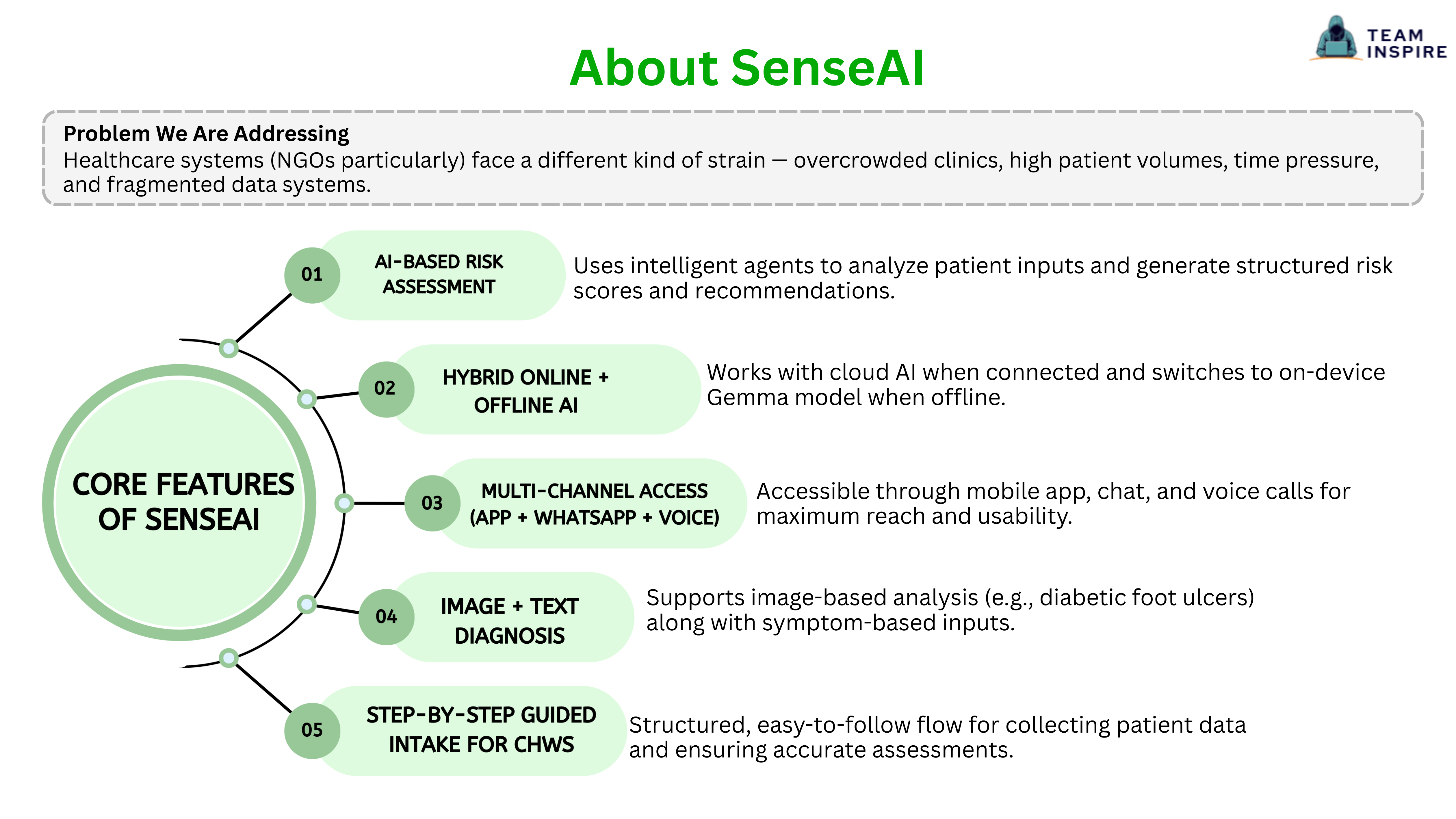
Healthcare systems (NGOs particularly) face a different kind of strain — overcrowded clinics, high patient volumes, time pressure, and fragmented data systems. Frontline workers and clinic staff often need to make rapid decisions with limited time, inconsistent patient histories, and operational overload.
We set out to build a solution that provides instant risk assessment and structured clinical guidance, helping healthcare workers act faster and more confidently — even in high-pressure, resource-constrained urban settings.
What It Does
SenseAI is an AI-powered healthcare assistant designed to support patient assessment and clinical decision-making in urban clinics and community health centers. It supports multiple conditions including:
- Maternal Hemorrhage
- Tuberculosis Adherence
- Pesticide Exposure
- Diabetic Foot Ulcers (DFU)
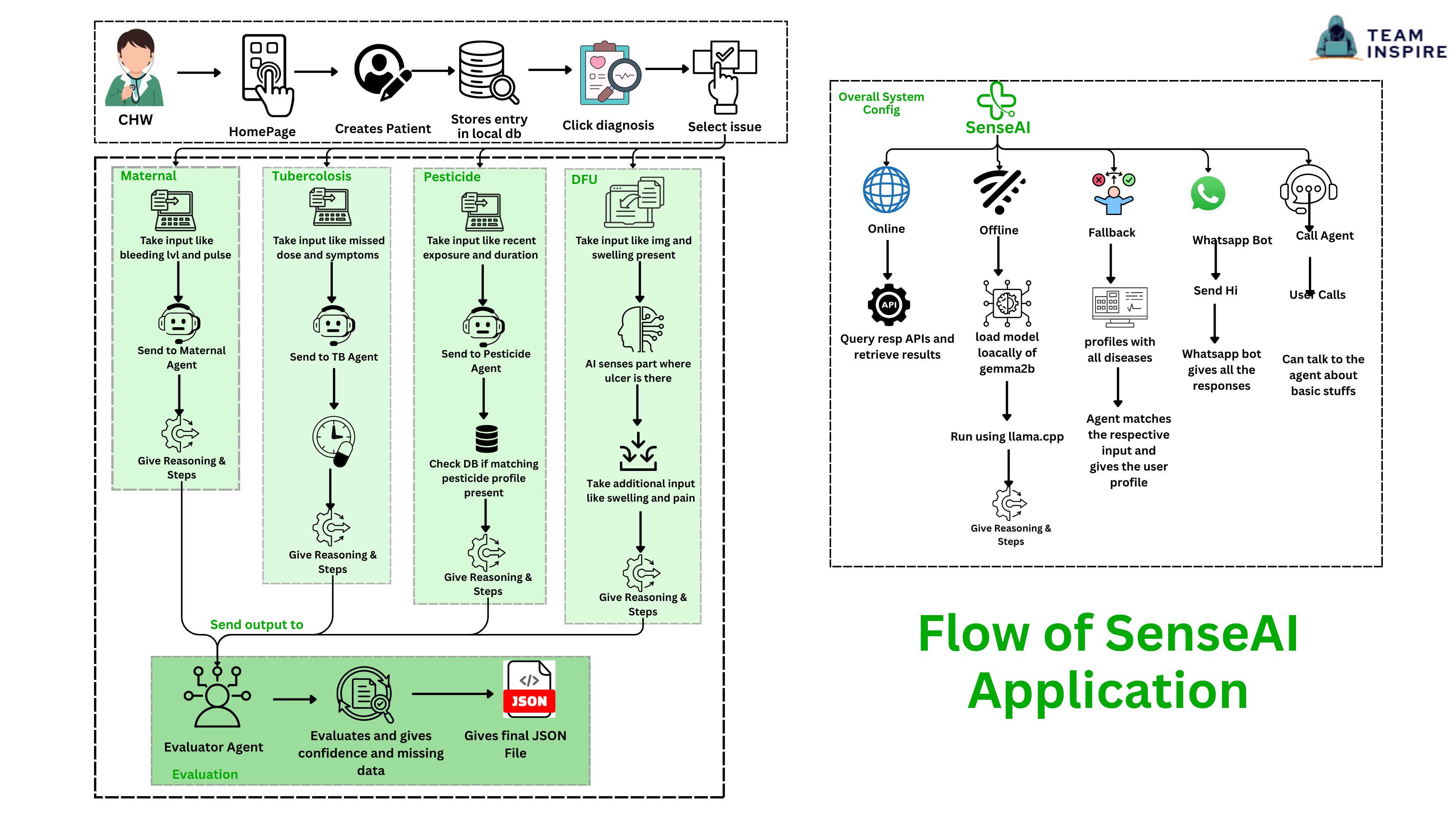
The system captures patient inputs, processes them through specialized AI agents, and delivers:
| Output | Description |
|---|---|
| Risk Score & Level | Quantified severity assessment for quick triage |
| Clear Explanation | Simple reasoning for informed decision-making |
| Actionable Checklist | Step-by-step clinical guidance |
| Missing Data Indicators | Identifies gaps to ensure complete assessment |
It works across multiple access points:
- Mobile App (Flutter) for on-ground healthcare staff
- WhatsApp Chatbot for quick interactions
- Voice Call Agent for hands-free usage in busy settings
How We Built It
SenseAI uses a hybrid AI architecture tailored for urban healthcare workflows where speed, scalability, and reliability are critical.
Frontend
- Flutter mobile application for healthcare workers in clinics and field visits
Backend
- Flask APIs managing condition-specific diagnosis agents
AI Models
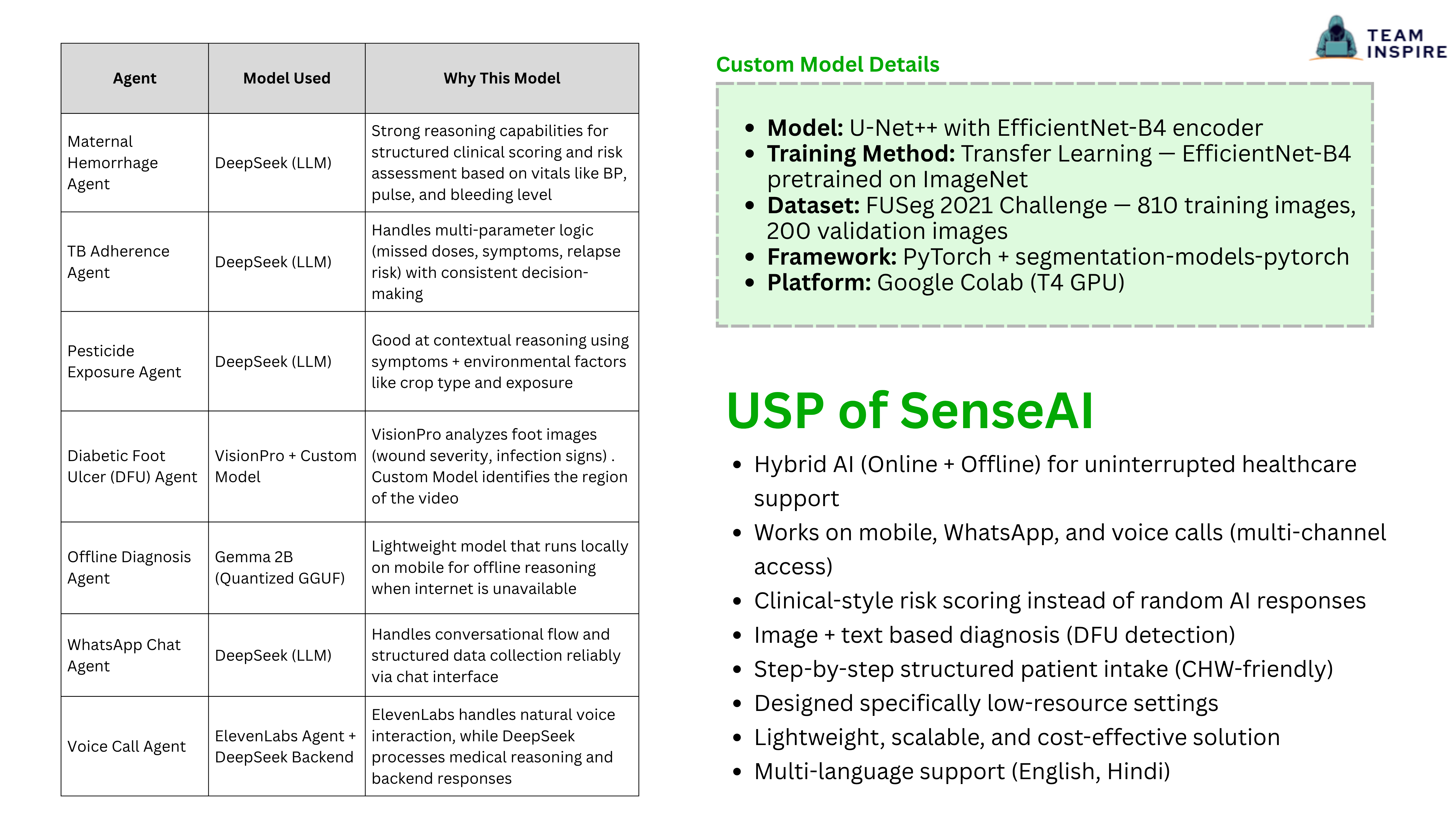
| Model | Role |
|---|---|
| DeepSeek | Structured reasoning and decision-making |
| VisionPro + Custom Segmentation | DFU image analysis |
| Gemma 2B (quantized) | Offline fallback via llama.cpp |
Integrations
- WhatsApp Cloud API — quick-access chat interface
- ElevenLabs — voice-based AI assistant
Each condition is handled by a dedicated agent with structured scoring logic, ensuring consistent and reliable outputs across high patient volumes.
SenseAI Dashboard — Clinic Management Layer (Medo)
While the mobile app supports healthcare workers during patient interactions, SenseAI is complemented by Medo — a browser-based clinic management dashboard designed for urban clinics, hospitals, and NGO networks.
What Medo Adds
In urban setups, where multiple workers handle large patient inflows daily, Medo provides centralized visibility, coordination, and analytics.
| Layer | Tool | Users |
|---|---|---|
| Point-of-care | Flutter Mobile App | Healthcare Workers |
| Clinic Management | Medo Web Dashboard | Clinic Admins / Supervisors |
What Medo Does
Medo is a mobile-responsive, lightweight dashboard that works without heavy infrastructure, making it suitable for clinics with limited IT support.
Authentication & Clinic Setup
- Clinics register with basic details and receive a unique Clinic ID
- Role-based login for Admins and Healthcare Workers
- Data isolation ensures each clinic operates independently
Worker Management
- Admins manage healthcare workers across departments or locations
- Worker profiles track:
- Patients handled
- Case submissions
- Disease distribution
- Daily consistency
Patient Entry Tracking
- Workers log daily patient cases with:
- Disease type
- Patient count
- Severity distribution (Low / Medium / High / Critical)
- Built-in validation ensures accurate reporting
Analytics
Designed for high-volume urban data insights:
- Disease trends across time
- Daily patient load patterns
- Severity distribution
- Worker performance comparisons
All analytics support filtering by date range, disease type, and worker.
Reports & Export
- Generate and export reports in CSV, Excel, or PDF format
- Useful for hospital administration, NGO reporting, and audits
Daily Reminder System
- Flags missing daily submissions
- Ensures no operational blind spots in busy clinics
Supported Conditions
- Maternal Hemorrhage
- Tuberculosis
- Pesticide Exposure
- Diabetic Foot Ulcers
How Medo Complements the Mobile App
The system creates a closed-loop urban healthcare workflow:
Healthcare Worker (Mobile App)
  → Quickly assesses patients and generates risk scores
  → Logs case data into Medo

Clinic Admin (Dashboard)
  → Monitors patient inflow and worker activity
  → Tracks disease patterns across the clinic
  → Generates reports for operational and compliance needs
This ensures real-time action at the patient level + strategic visibility at the clinic level.
Challenges We Ran Into
- Handling high patient throughput without slowing down the system
- Designing AI outputs that are fast yet reliable under time pressure
- Managing online-offline switching in semi-connected urban zones
- Ensuring consistency across multiple access channels (app, WhatsApp, voice)
- Scaling image-based diagnosis for diverse real-world cases
Accomplishments We Are Proud Of
- Built a hybrid AI system that works across connectivity conditions
- Enabled multi-channel access for different clinical scenarios
- Designed structured clinical scoring for faster triage decisions
- Integrated image-based DFU analysis into real workflows
- Developed a dual-layer system (field + dashboard) for full operational coverage
- Created a solution adaptable to high-density urban healthcare environments
What We Learned
- In urban settings, speed is as critical as accuracy
- Structured AI outputs outperform generic responses in clinical workflows
- UI must be extremely intuitive due to time constraints
- Systems must handle data scale and concurrency effectively
- Field tools without dashboards limit decision-making at higher levels
What's Next for SenseAI
- [ ] Optimize performance for high-load urban environments
- [ ] Expand to additional conditions — malaria, anemia, child health
- [ ] Integrate telemedicine for real-time doctor support
- [ ] Improve image models with more diverse urban datasets
- [ ] Add support for regional languages and voice workflows
- [ ] Transition to open-source AI models to reduce cost
- [ ] Enable real-time sync between mobile app and dashboard
- [ ] Add offline data buffering for intermittent connectivity scenarios
Tech Stack
Frontend (Field)   → Flutter (Mobile App)
Frontend (Clinic)  → React.js + Tailwind CSS (Medo Dashboard)
Backend            → Flask (Python)
AI (Online)        → DeepSeek, VisionPro
AI (Offline)       → Gemma 2B via llama.cpp
Messaging          → WhatsApp Cloud API
Voice              → ElevenLabs
Image Analysis     → Gemini-Vision Pro
Built for fast-moving healthcare systems where every second — and every decision — matters.


Log in or sign up for Devpost to join the conversation.