Inspiration
Epilepsy affects 10–12 million people in India, yet a large percentage remain undiagnosed, not because treatment is unavailable, but because diagnosis is inaccessible. EEG, the primary diagnostic tool, is heavily underutilized due to the shortage of neurologists and trained interpreters, especially in district and rural healthcare settings.
We were inspired by a simple but critical gap:
What if EEG interpretation could be made accessible to non-specialists using AI?
This led to the idea of building Sense — a system that brings intelligent EEG interpretation to the point of care.
What it does
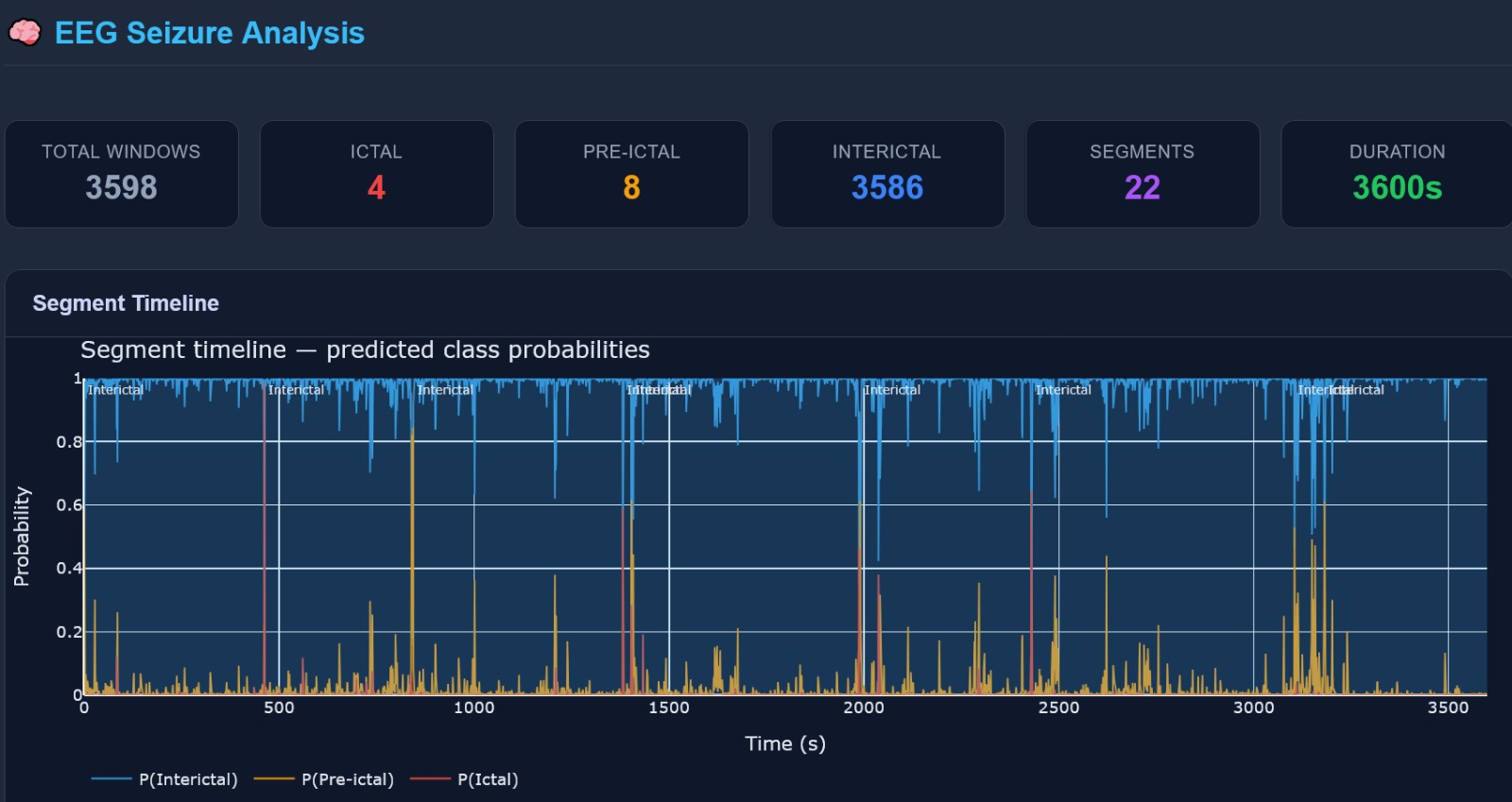
Sense is an AI-powered EEG analysis system that detects epileptic activity using a patient-specific anomaly detection approach.
- Learns normal brain activity patterns
- Identifies seizure events as anomalies
- Outputs epoch-wise seizure detection results
- Designed to assist general physicians and technicians
How we built it
- Used the Siena Scalp EEG Dataset with
.edfrecordings and annotations - Preprocessed EEG signals:
- Channel selection (standard 10–20 system)
- Resampling to 256 Hz
- Bandpass filtering (0.5–40 Hz)
- Z-score normalization
- Segmented signals into 4-second windows
Each patient gets a separate model, making the system adaptive and personalized.
Challenges we ran into
- EEG variability: Different patients had different channel configurations
- Noisy signals: Real EEG contains artifacts and inconsistencies
- Class imbalance: Seizures are rare → difficult for supervised models
- Generalization issues: Cross-patient models performed poorly
- Compute load: Long recordings required efficient processing
Accomplishments that we're proud of
- Built a fully working patient-specific EEG detection pipeline
- Successfully implemented unsupervised seizure detection
- Designed a system aligned with real-world clinical constraints
- Created a solution that can be used by non-specialists
What we learned
- EEG signals are highly individual → personalization is key
- Unsupervised learning is effective for rare medical events
- High accuracy alone is not enough → clinical usability matters
- Real healthcare problems require end-to-end system thinking, not just models
What's next for SENSE
- Integrate biomarkers and patient history for better diagnosis
- Improve model robustness to noisy real-world EEG
- Build a simple clinical interface for hospitals
- Conduct pilot testing in real healthcare settings
- Add basic decision support (severity, referral suggestions)
“Sense aims to make epilepsy diagnosis accessible, scalable, and reliable—right where it is needed most.”

Log in or sign up for Devpost to join the conversation.