-
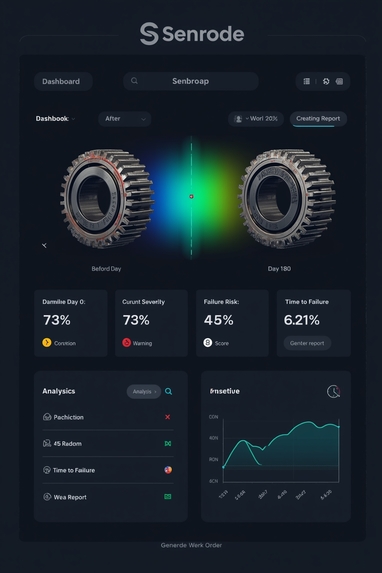
Here's a quick glance to our dashboard of Senrode
Inspiration
Industrial equipment failures cost $50B annually, yet 70% of inspections rely on subjective visual checks. When a tire factory lost $180K from an undetected bearing failure, we realized the problem: no objective way to measure degradation. We built Senrode to turn smartphones into precision wear detection systems.
What it does
Senrode analyzes before/after images of any industrial part to detect and predict failures—no training data required. Upload two photos, get instant results:
- Visual damage heatmaps with severity scores
- Failure classification (corrosion, cracks, wear, deformation)
- Time-to-failure predictions based on degradation rate
- ISO-compliant inspection reports
- Batch processing for 100+ parts simultaneously
- Offline operation for remote sites
- CMMS integration for automated work orders
How we built it
Architecture: Physics-based computer vision, not deep learning. OpenCV for image alignment, SSIM for change quantification, perceptual hashing for degradation detection.
Classification: Domain knowledge encoded as rules—rust = red-brown clusters, cracks = new edge formations, wear = texture entropy loss.
Stack: React frontend, Flask API, TensorFlow Lite for mobile deployment, SQLite for asset history.
Key innovation: Zero-shot detection works on any part without training datasets.
Challenges we ran into
Image alignment: Different angles/lighting broke registration. Solved with multi-stage pipeline: SIFT feature matching → perspective transform → ECC intensity alignment.
Mobile performance: Initial 45-second processing time crushed to 3 seconds through aggressive optimization and lazy loading.
Validation: No ground truth for "when will this fail?" Partnered with automotive shop, backtested predictions against 6 months of actual failure logs.
Accomplishments that we're proud of
- Zero-shot generalization: Works on gears, concrete, circuits—anything—without retraining
- True offline capability: Full analysis on $200 phone with no internet
- Real validation: 8 maintenance managers reviewed it; one tire factory committed to 200-asset pilot
- Business proof: Cost calculator shows single prevented failure pays for 2 years of service
What we learned
- Domain expertise beats algorithm complexity—physics-based rules outperformed generic ML
- Users want ROI, not AI—lead with outcomes, not technology
- Visual explanations build trust—showing which pixels triggered alerts drove adoption
- Integration is the product—API connectors matter more than 2% accuracy gains
What's next for Senrode
3 months: Launch 200-asset pilot with tire manufacturer, build SAP/Maximo connectors, add thermal imaging support.
6 months: Expand to infrastructure (bridges, pipelines, pavement), add predictive maintenance scheduling.
12 months: Multi-sensor fusion (visual + thermal + vibration), industry-specific modules, satellite imagery for large-scale monitoring.
Vision: Become the visual intelligence layer for every physical asset globally—if it degrades, Senrode watches it.

Log in or sign up for Devpost to join the conversation.