-
-
Intro
-
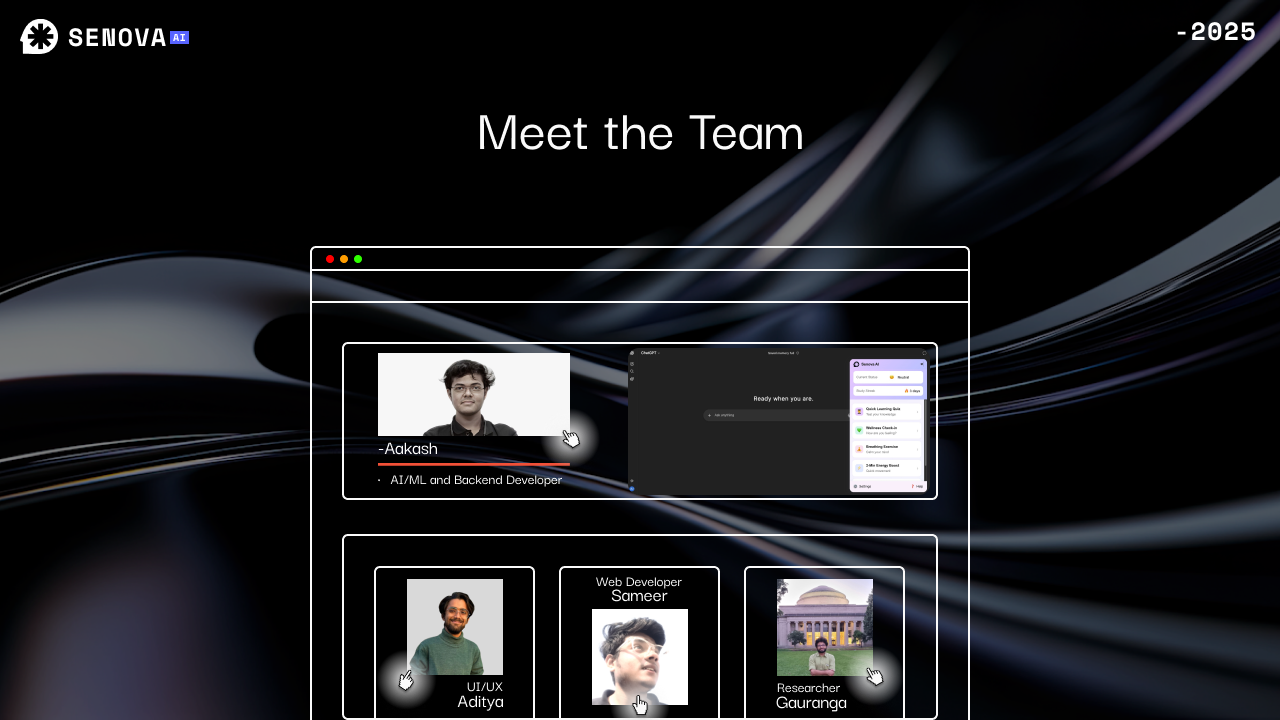
Team
-
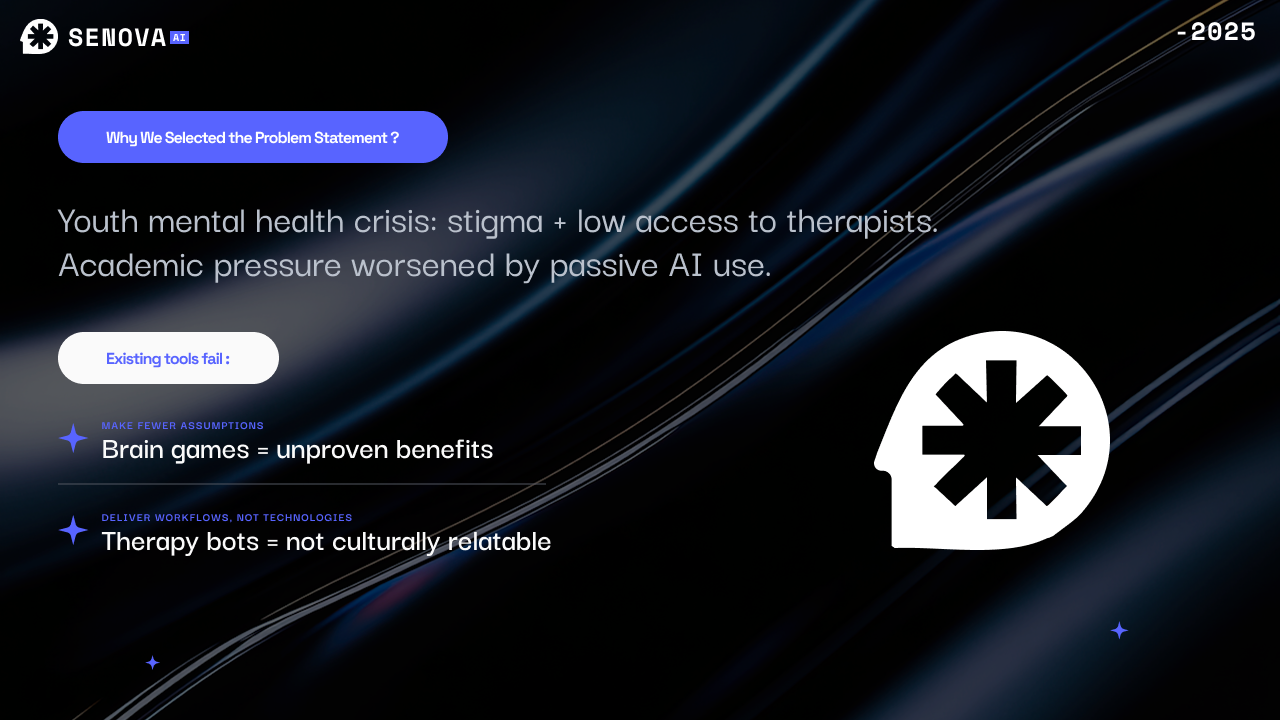
Why We Selected the Problem Statement ?
-
Market Explosion
-
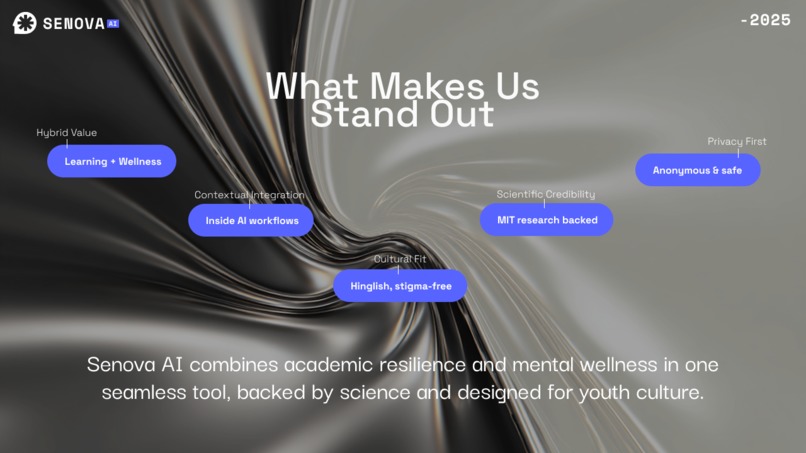
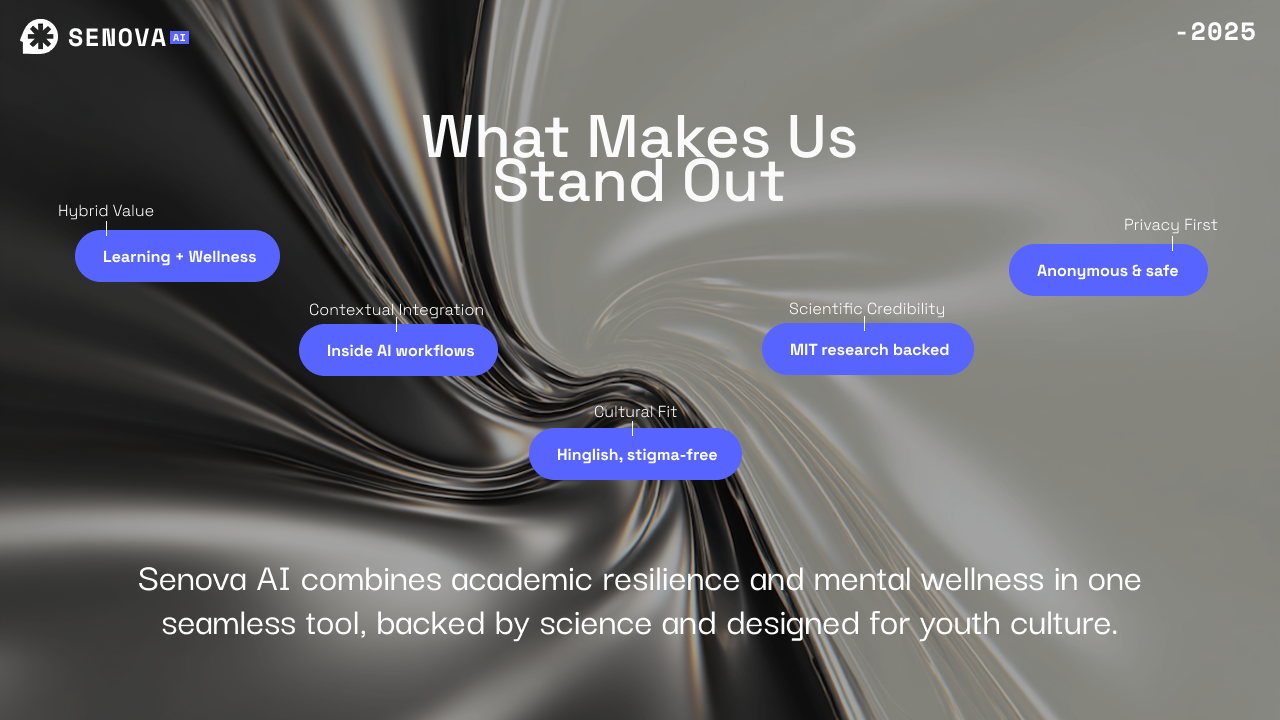
What Makes Us Stand Out
-
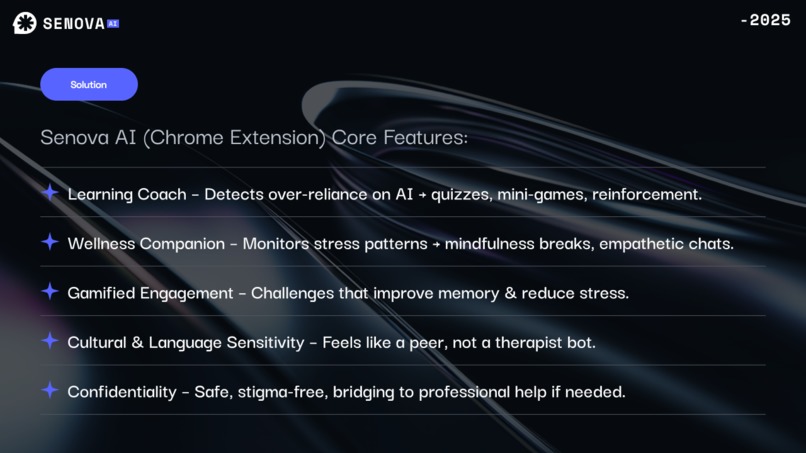
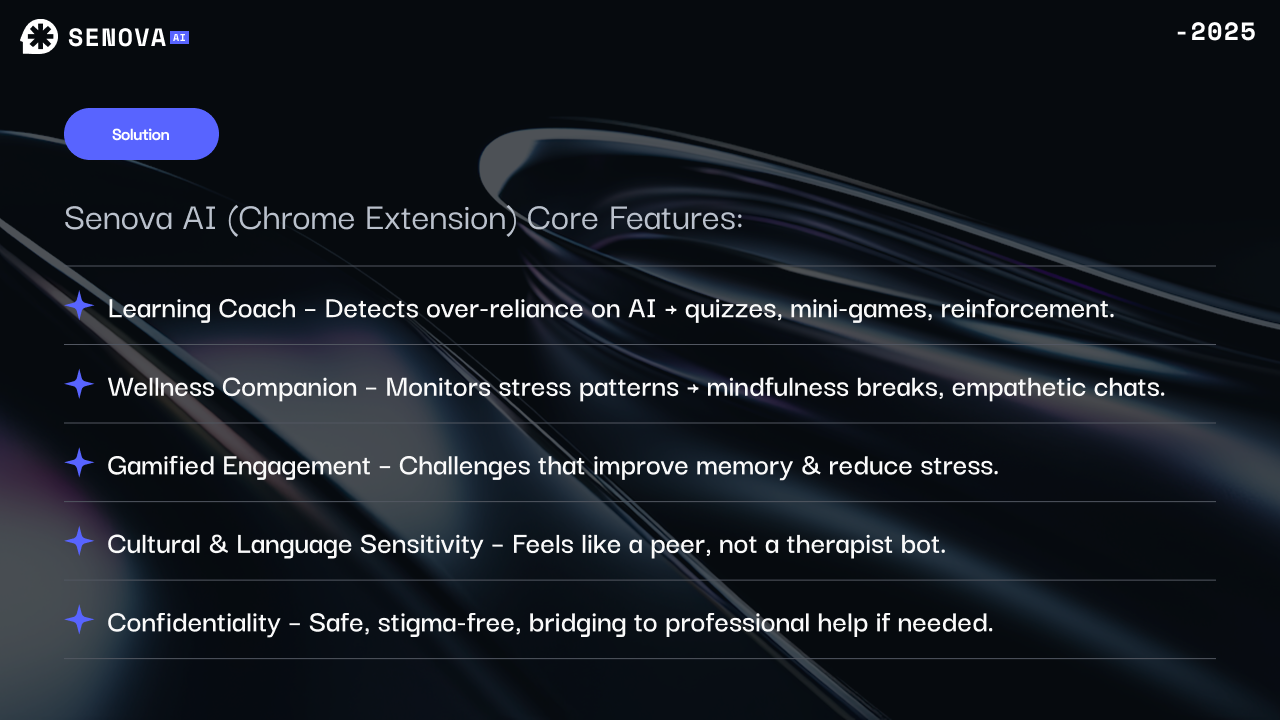
Senova AI (Chrome Extension) Core Features:
-
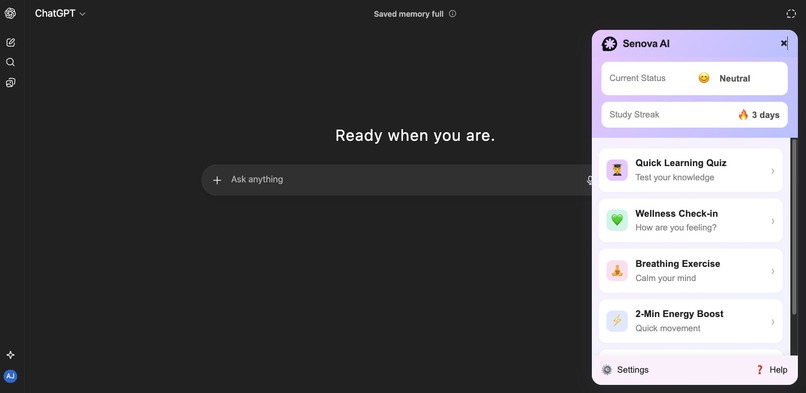
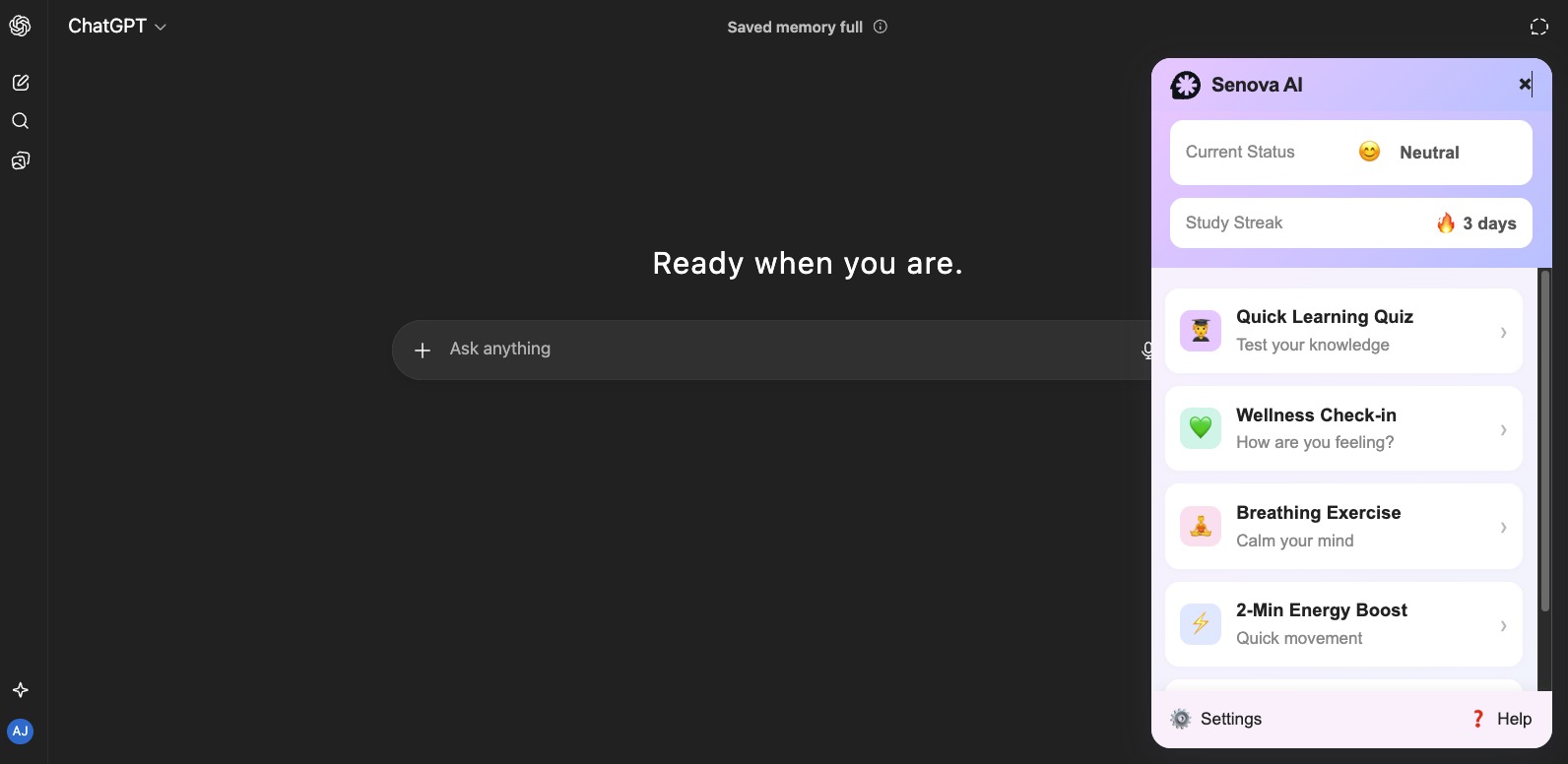
Chrome Extension being Used
-
Thank You for Reading

Inspiration
Senova AI was born from an emerging challenge in the age of generative AI: the rise of “cognitive debt”—when constant reliance on AI for writing, summarization, or analysis can reduce active engagement and critical reasoning. Instead of treating this as a limitation, we saw it as an opportunity to innovate.
Research from MIT’s Media Lab (“Your Brain on ChatGPT”) highlighted how over-reliance can weaken recall and ownership of ideas. But paired with the right guardrails, AI can do the opposite—strengthen memory, creativity, and confidence.
That’s where Senova AI steps in:
- By building on top of open models like GPT, we extend their value beyond productivity, making them partners in resilience and learning.
- We designed Senova AI to encourage active thinking, mindful usage, and skill retention, turning generative AI into a cognitive enhancer rather than a crutch.
- This approach not only empowers youth to use ChatGPT more effectively but also demonstrates how open models can be adapted safely, responsibly, and uniquely for long-term human growth.
In short, Senova AI doesn’t compete with AI like ChatGPT—it complements and amplifies it, ensuring humans stay sharp, confident, and mentally well while leveraging the full power of generative AI.
What it does
Senova AI transforms AI from a cognitive crutch into a cognitive springboard. It works as a three-part ecosystem:
- Cognitive Baseline Diagnostic – Personalized assessment of recall, synthesis, and critical thinking.
- Active Retrieval Suite (Cognitive Gym) – Structured, non-gamified cognitive workouts based on spaced repetition, argument deconstruction, and synthesis.
- Workflow Integration Plugin (Flagship Product) – A browser/app extension that integrates with ChatGPT, Google Docs, and Notion to introduce “cognitive friction.” Features include explain-before-reveal prompts, source verification nudges, and adaptive cognitive friction sliders.
How we built it
We combined neuroscience research with human-centered design principles:
- Adaptive Algorithms to personalize difficulty and reduce assistance as competence grows.
- Contextual Embedding to seamlessly insert cognitive prompts into workflows.
- On-Device Privacy-First Processing to ensure security and user control.
- Integration Layer for productivity tools (LLMs, Docs, Notion) to enable real-time interventions. We drew heavily from MIT’s neurophysiological data on brain connectivity, memory encoding, and skill retention to design features that directly counteract cognitive debt.
Challenges we ran into
- Market Adoption Risk – Convincing users and institutions to care about long-term cognitive health when short-term efficiency dominates.
- Technical Execution Risk – Building seamless plugins across evolving third-party platforms without friction.
- Data Privacy Risk – Designing strict privacy-first policies, ensuring no cognitive data fuels external models.
- Balancing Explanations – Crafting interventions that aid decision-making without creating overload or reinforcing blind trust.
- Personalization Variance – Accounting for differences in user literacy, motivation, and cognitive styles.
Accomplishments that we're proud of
- Turning academic insights into a functional, user-facing product.
- Designing a flagship integration plugin that transforms passive AI use into active, recall-driven learning.
- Forging academic validation partnerships to ground every feature in neuroscience.
- Developing a privacy-by-design framework that sets a new ethical bar for cognitive AI tools.
What we learned
- Over-reliance on AI reduces neural connectivity and diminishes ownership over knowledge.
- Active retrieval, not passive reception, is the cornerstone of preserving critical thinking.
- Transparency mechanisms alone (Explainable AI) aren’t enough—engagement is the real lever for reducing automation bias.
- Personalized, adaptive interventions are essential because cognitive risk manifests differently across individuals.
What’s next for Senova AI
- Academic Partnerships – Expanding validation with MIT, Stanford, and cognitive neuroscience labs.
- Wearable Integrations – Exploring EEG/BCI interfaces for real-time neurofeedback.
- Enterprise Pilots – Collaborating with universities, ed-tech platforms, and enterprises to deploy Senova AI at scale.
- Global Cognitive Health Standard – Positioning Senova AI as the “seatbelt for the mind” in the age of AI, ensuring productivity gains don’t come at the cost of long-term intellectual capital.
Built With
- adaptive-difficulty-scaling-|-cognitive-training
- apis
- bayesian
- browser
- cloud-services
- cognitive-science-methods
- databases
- divergence
- docker
- eeg
- embeddings-for-recall-tasks
- encrypted-local-indexeddb-|-storing-user-performance-history
- end-to-end
- enobio
- essay-evaluation
- frameworks
- gcp-ai-apis
- gpt
- javascript
- kl
- kl-divergence
- kubernetes
- levenshtein
- levenshtein-distance
- lightweight-plugins
- llama4:17b
- memory-reinforcement
- mongodb
- mvar-models
- n-grams
- ner
- neuro-wearables
- neuroelectrics
- nic2-controller
- nlp-divergence-metrics
- node.js
- node.js-(backend-services)
- notion
- openai
- pacmap
- performance-adaptive
- performance-adaptive-reinforcement-learning-|-natural-language-processing
- pinecone/faiss-(vector-embeddings)
- platforms
- plugins
- postgresql
- privacy-by-design
- progress-tracking
- python
- react
- s3
- secure-data-handling
- secure-webassembly-execution
- slack
- sm-2




Log in or sign up for Devpost to join the conversation.