-
-
Selun AI powered by Sagitta Systems
-
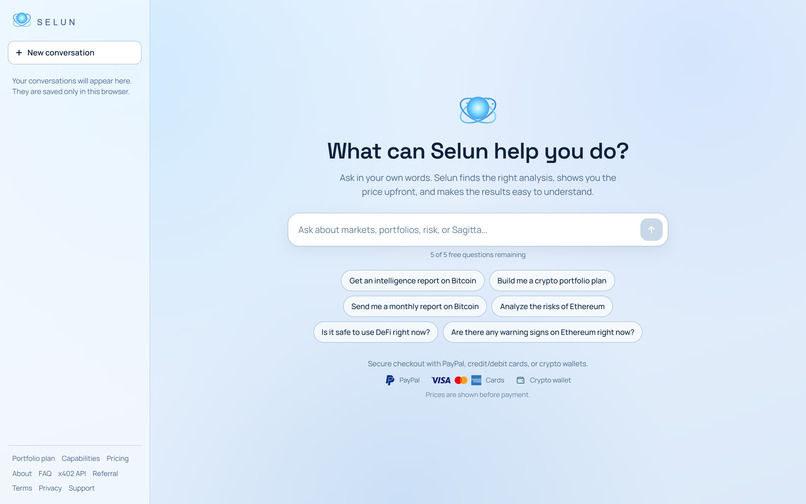
Ask Selun
-
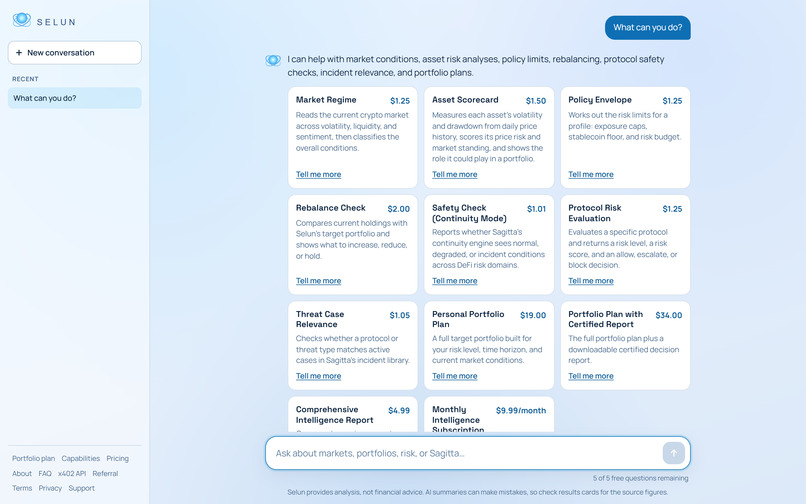
Onchain Intelligence
-
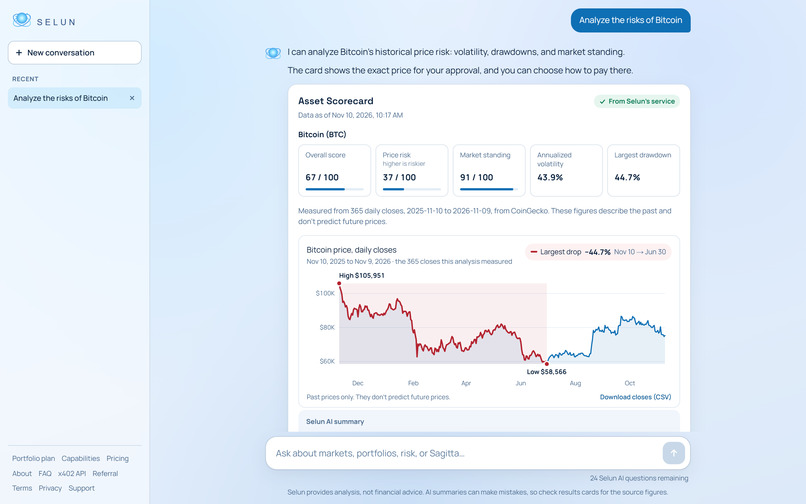
Asset scorecards
-
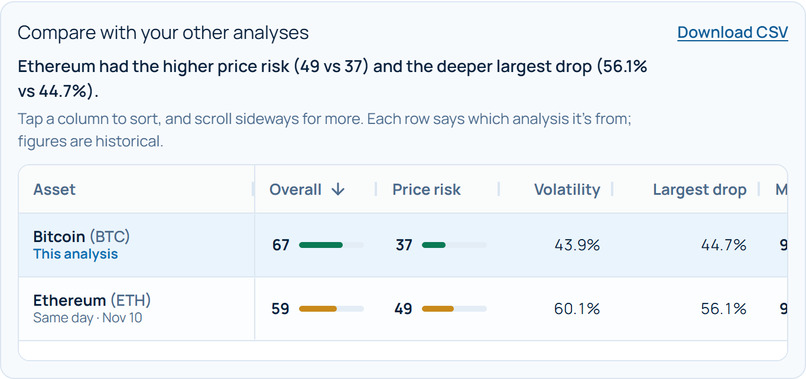
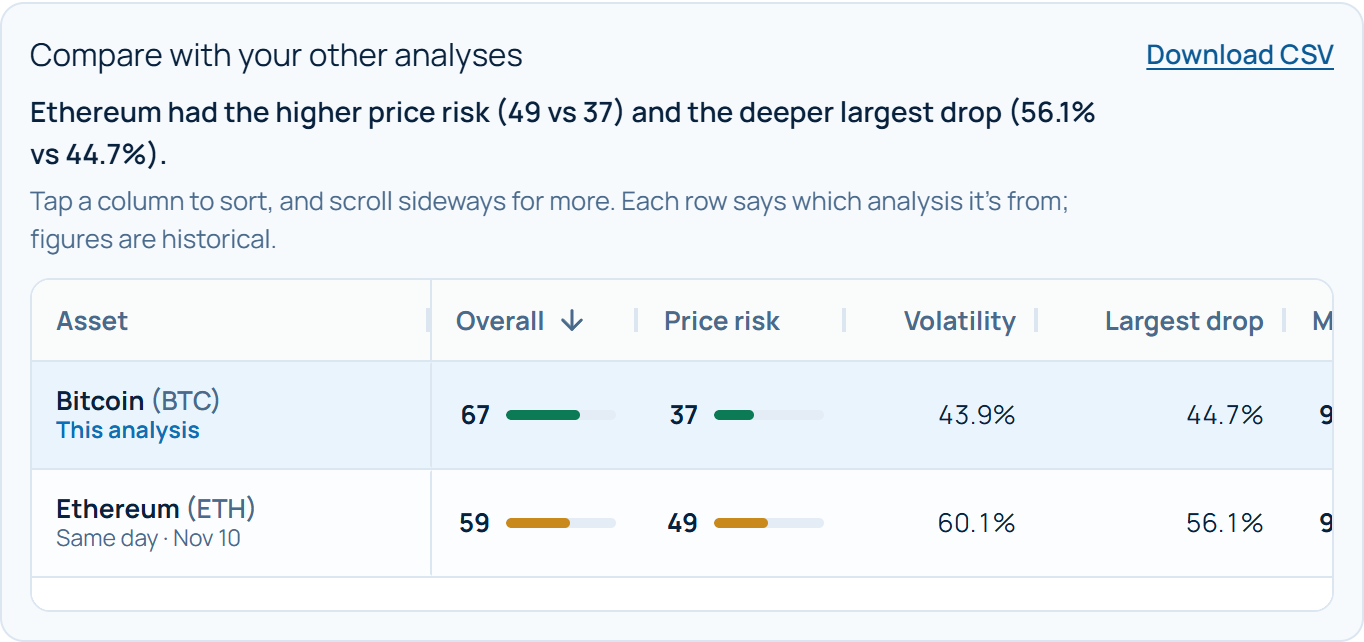
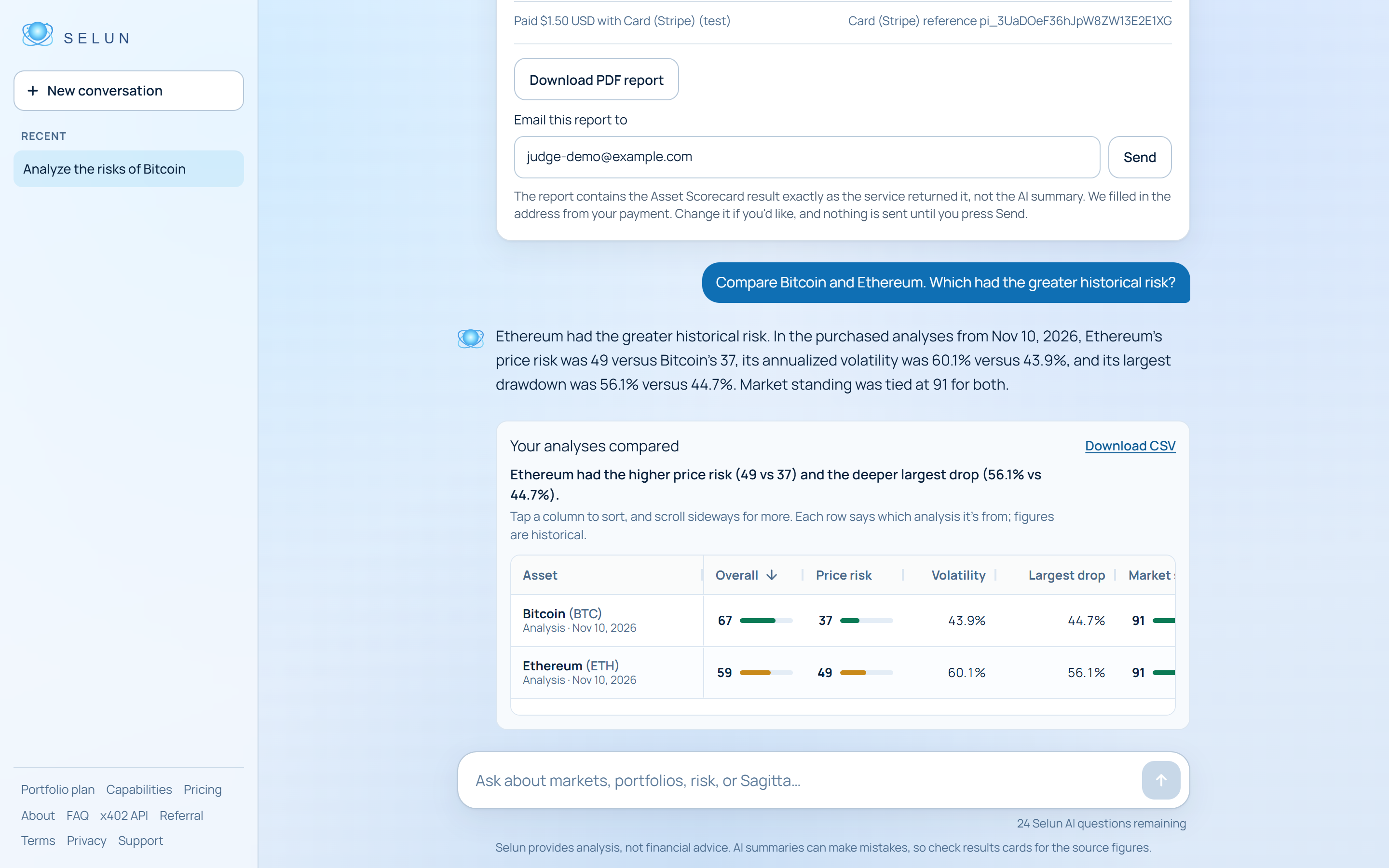
AG Grid comparisons
-
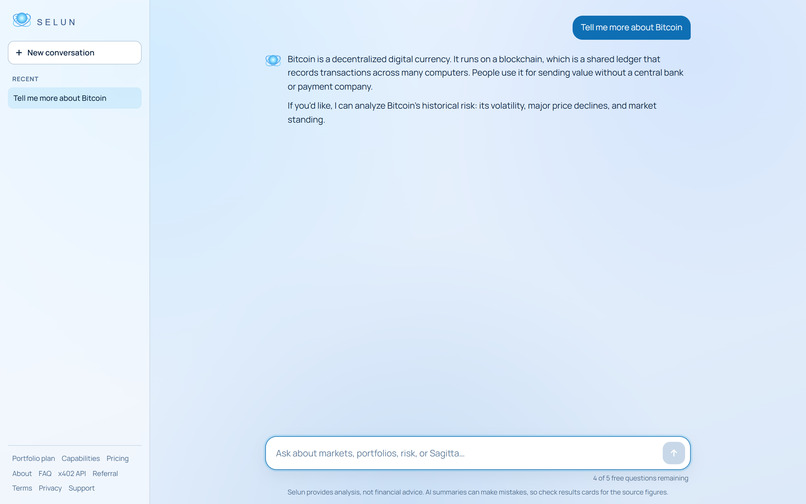
Market Research
-
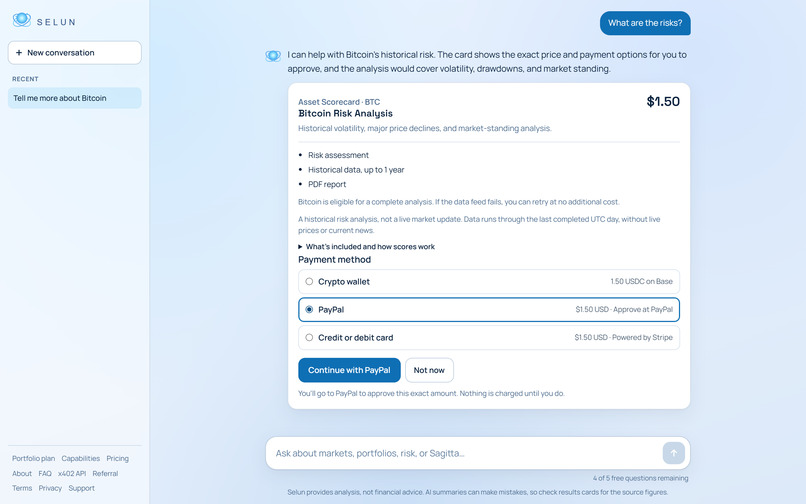
Risk Analysis
-
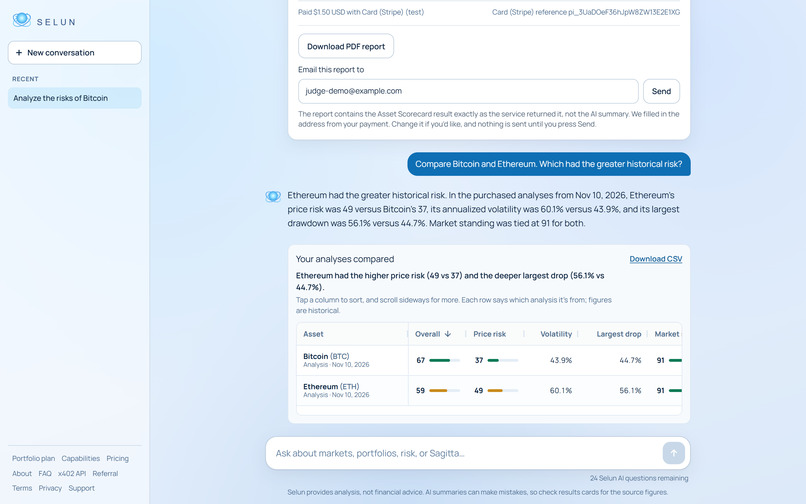
Market analysis
Inspiration
Financial sophistication shouldn't require technical sophistication.
We built specialized intelligence services at Sagitta Systems to understand digital assets, market conditions, price risk, and operational resilience. But accessing these capabilities often meant knowing which service to use, understanding its inputs, or navigating technical interfaces.
We wanted a person who is simply curious about Bitcoin to feel welcome, too.
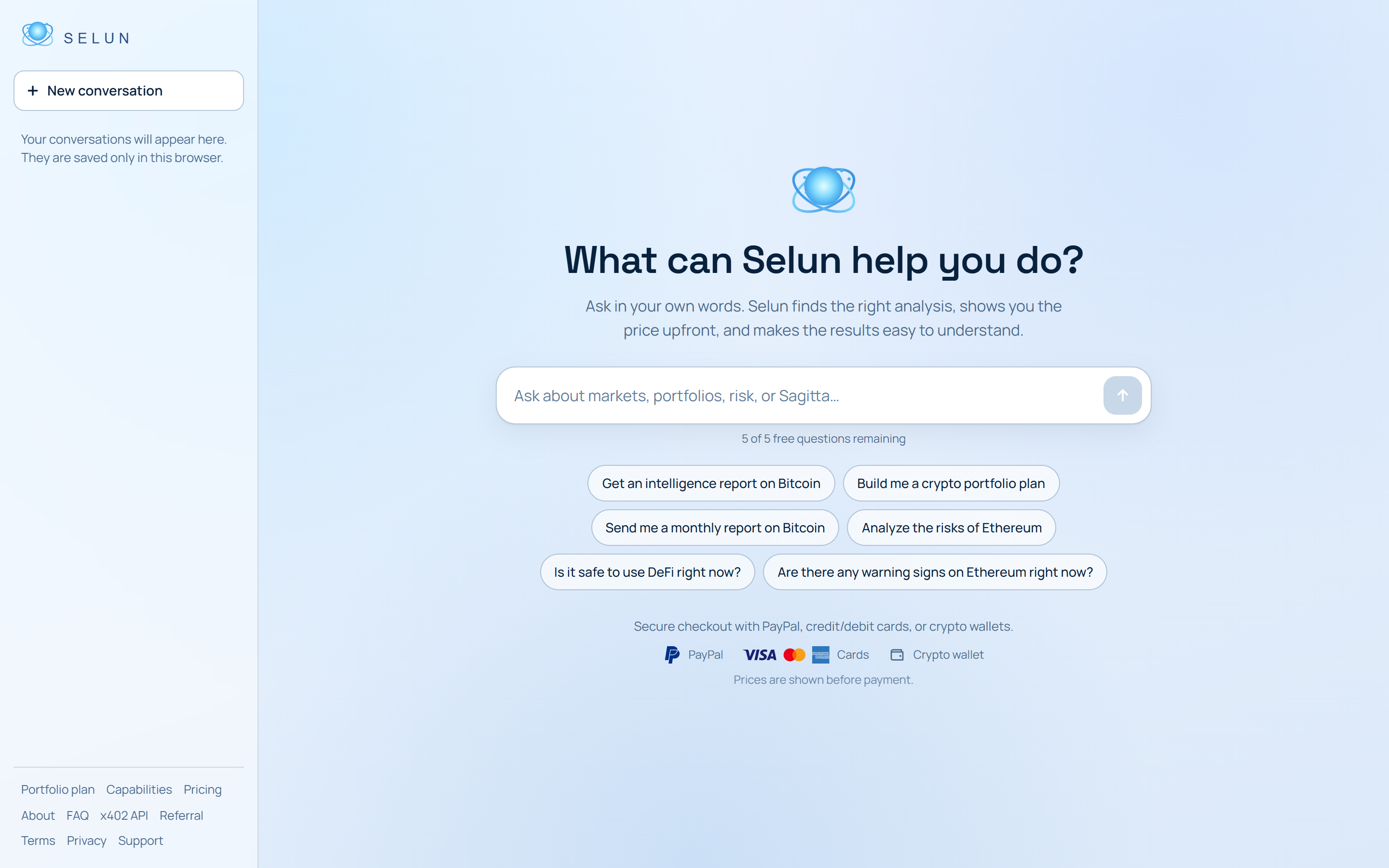
What if the experience started with a question, continued as a conversation, and ended with a useful analysis purchased through a payment method people already recognize?
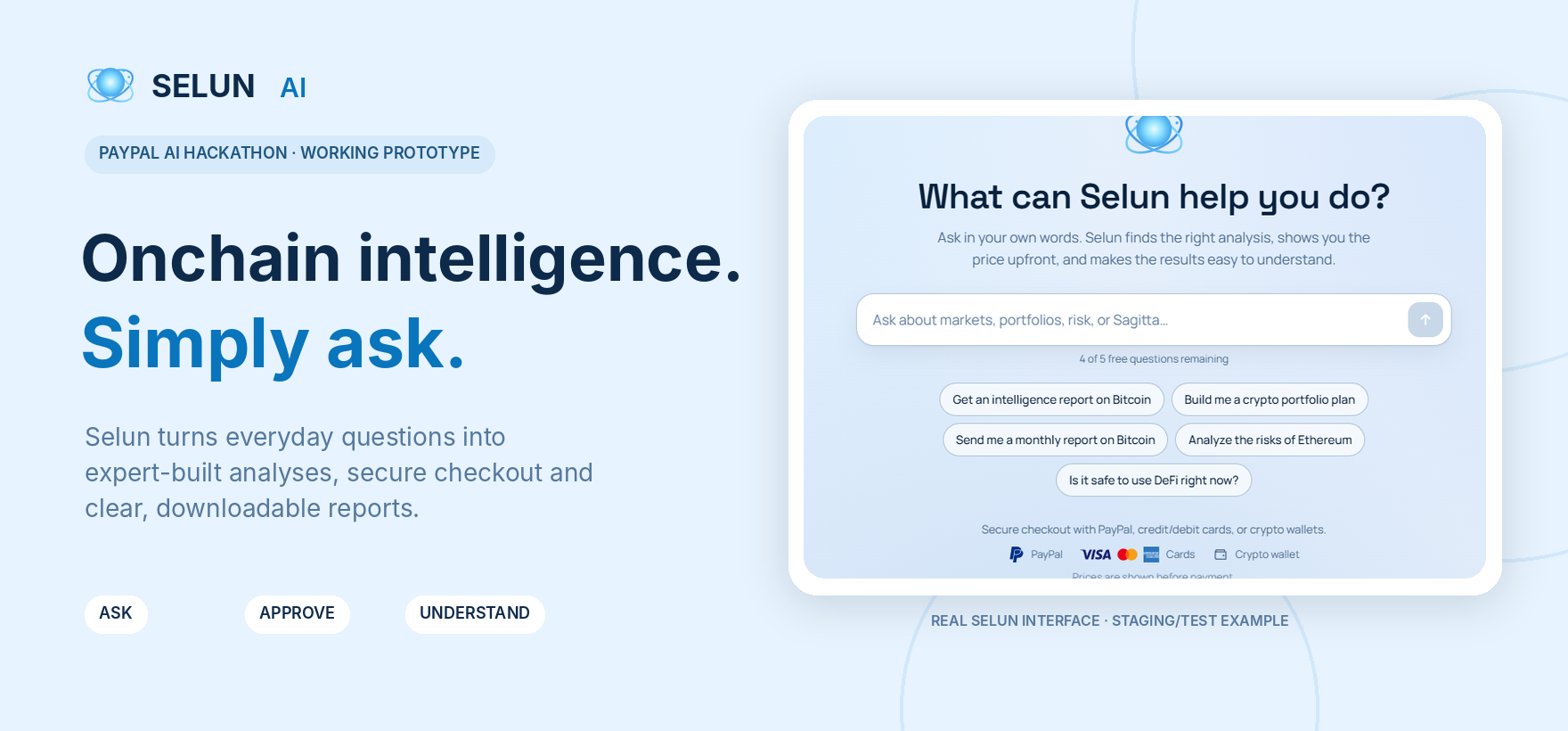
That's why we redesigned Selun AI around one simple idea: onchain intelligence, accessible through conversation.
What it does
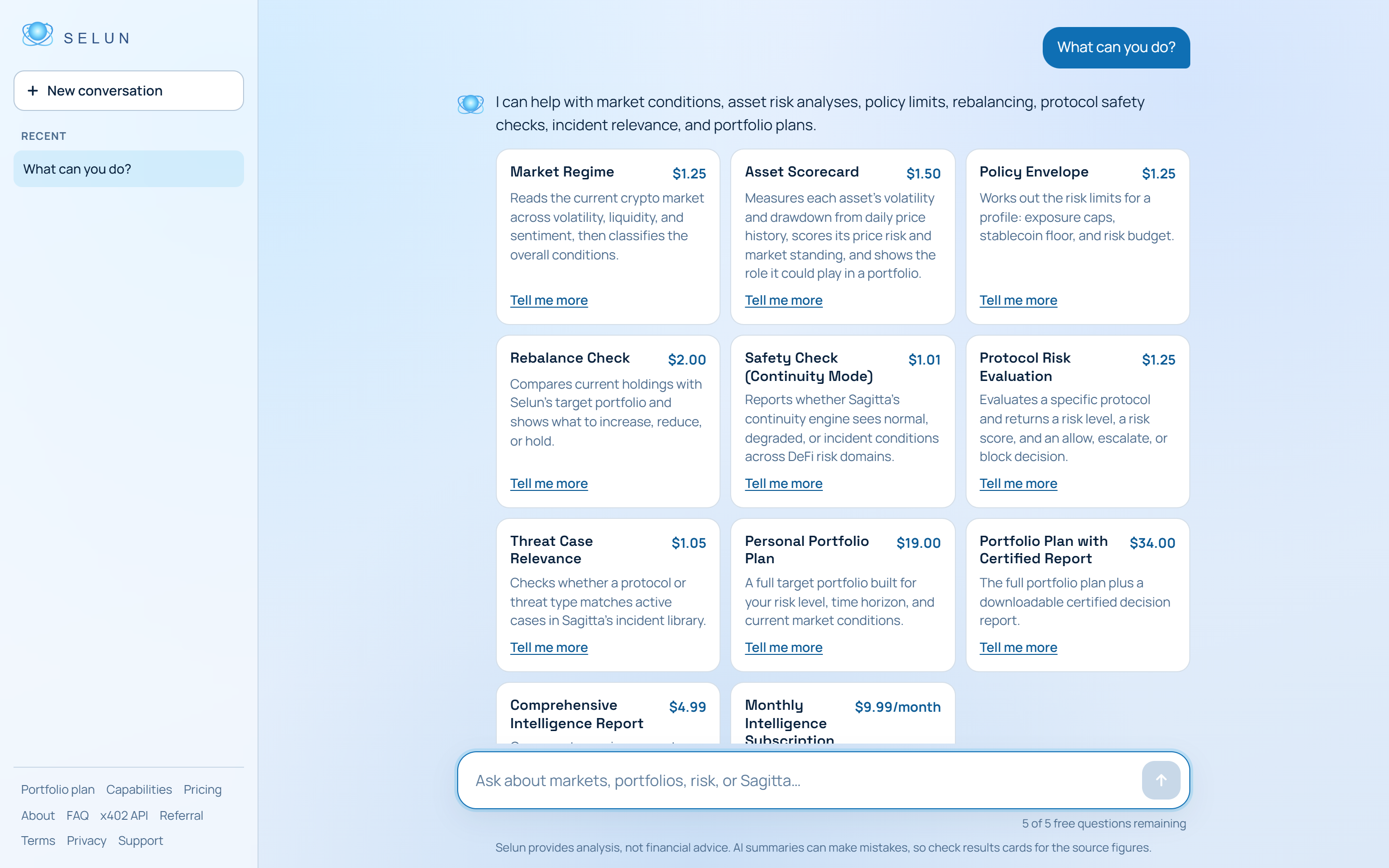
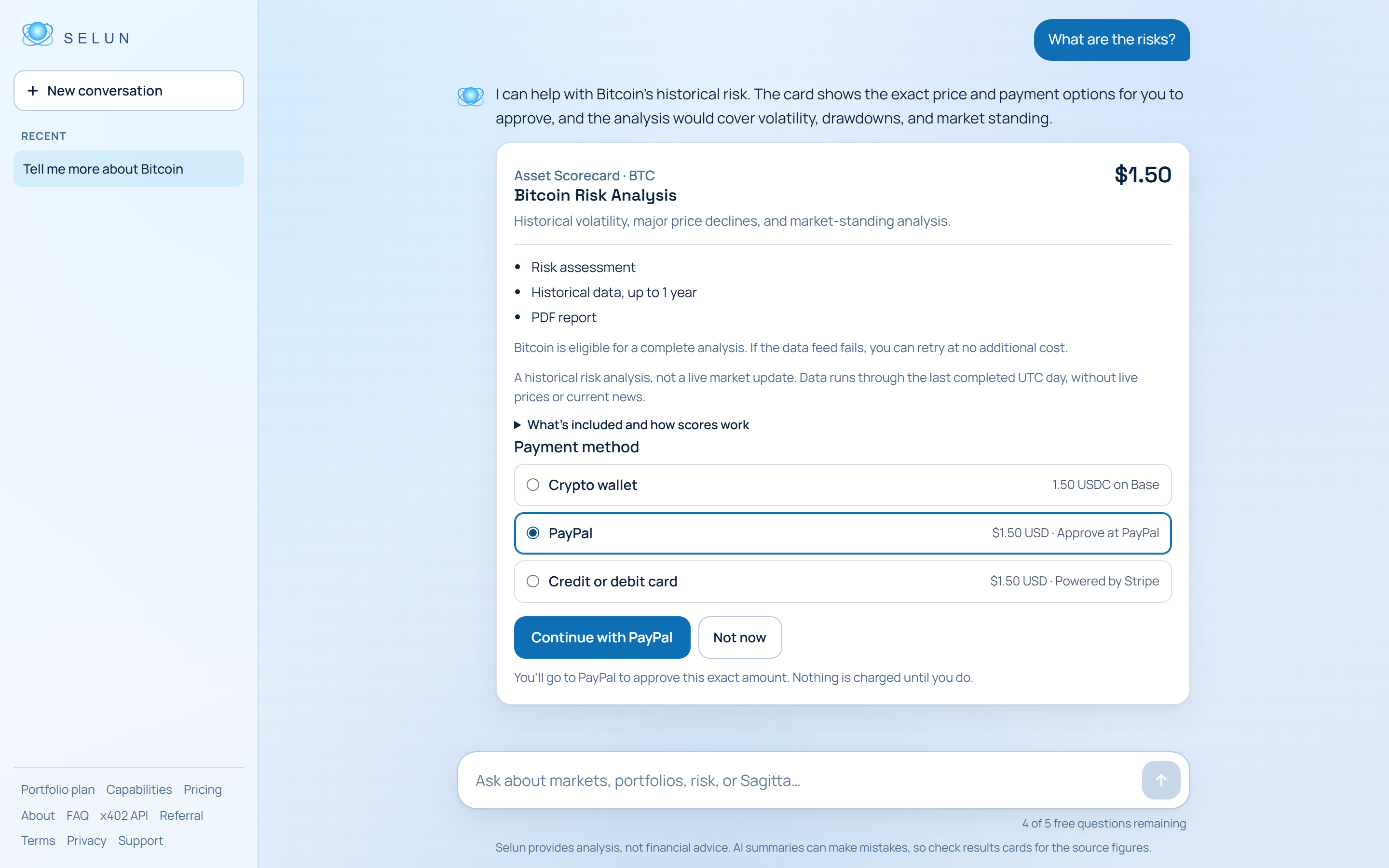
Selun connects natural-language questions to real Sagitta intelligence services. It explains concepts in plain English, finds the appropriate analysis when the customer wants to go deeper, displays an upfront quote, and provides payment choices including PayPal, cards, and crypto wallets. Following verified payment, specialized services produce the analysis and Selun explains the results, with a downloadable PDF.
A conversation that understands context
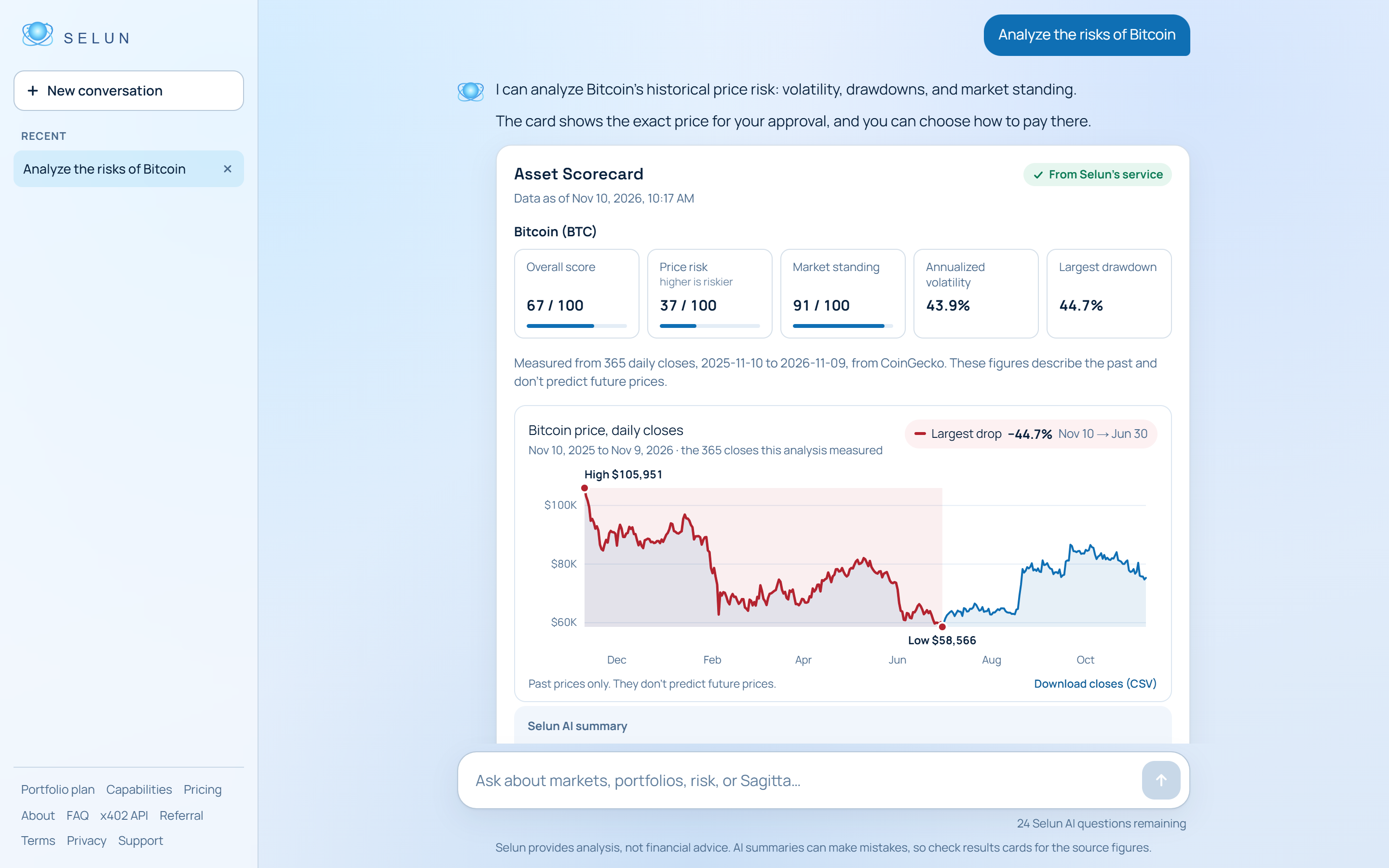
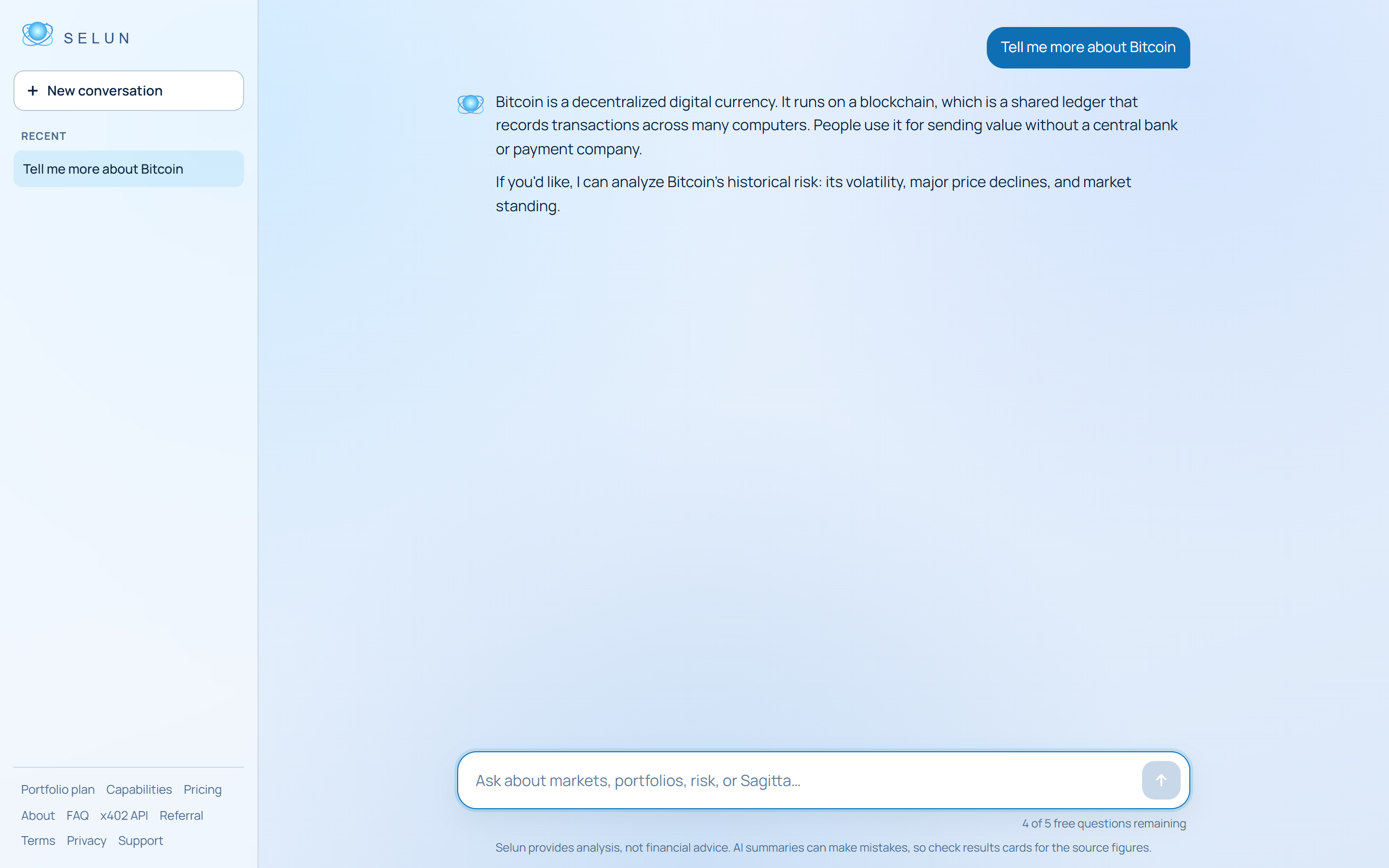
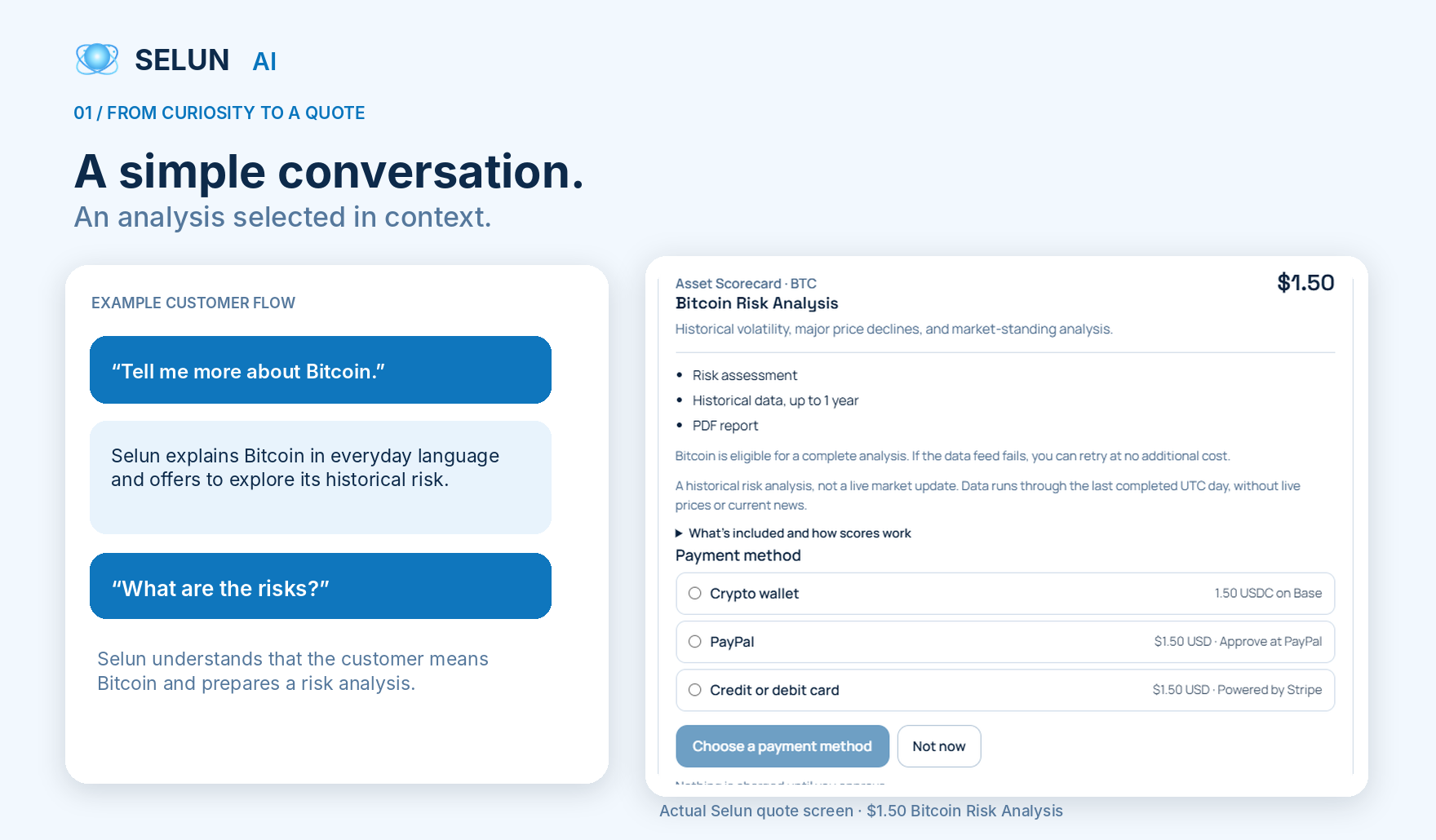
Someone asks, “Tell me more about Bitcoin.” Selun provides a short beginner-friendly explanation, without a purchase card. Then the person asks, “What are the risks?” Selun remembers that the subject is Bitcoin and presents the relevant $1.50 Bitcoin Risk Analysis. The customer never has to know the API name or repeat the asset.
A report with real substance
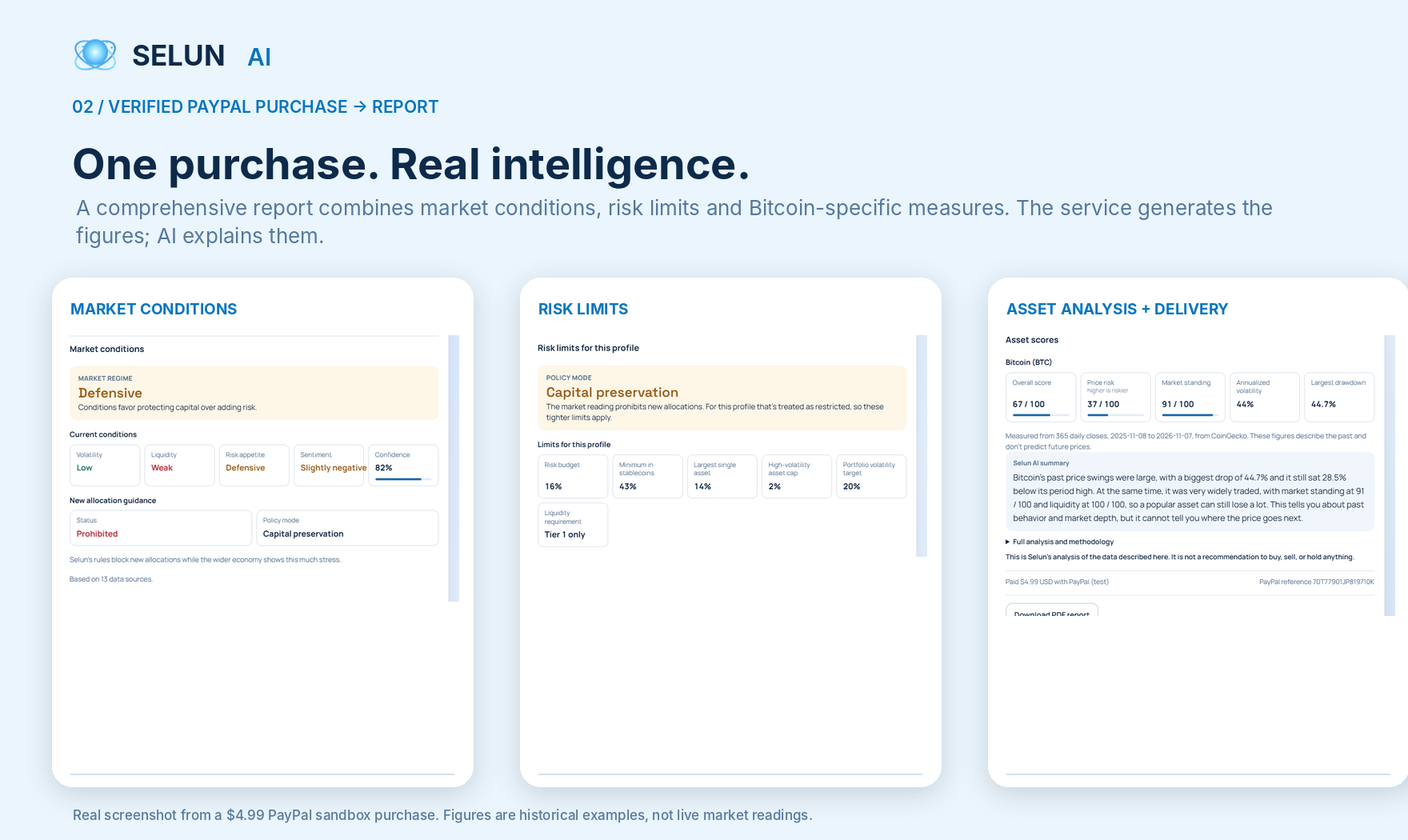
A $4.99 Comprehensive Intelligence Report brings together market regime, risk limits, and asset-specific measurements. Customers can see what stands out, explore the underlying figures, and download the full report. For example, one Bitcoin test report showed a defensive overall market regime and a 44.7% historical maximum drawdown. Those are historical snapshot results, not live price claims or forecasts.
Different questions, appropriate outcomes
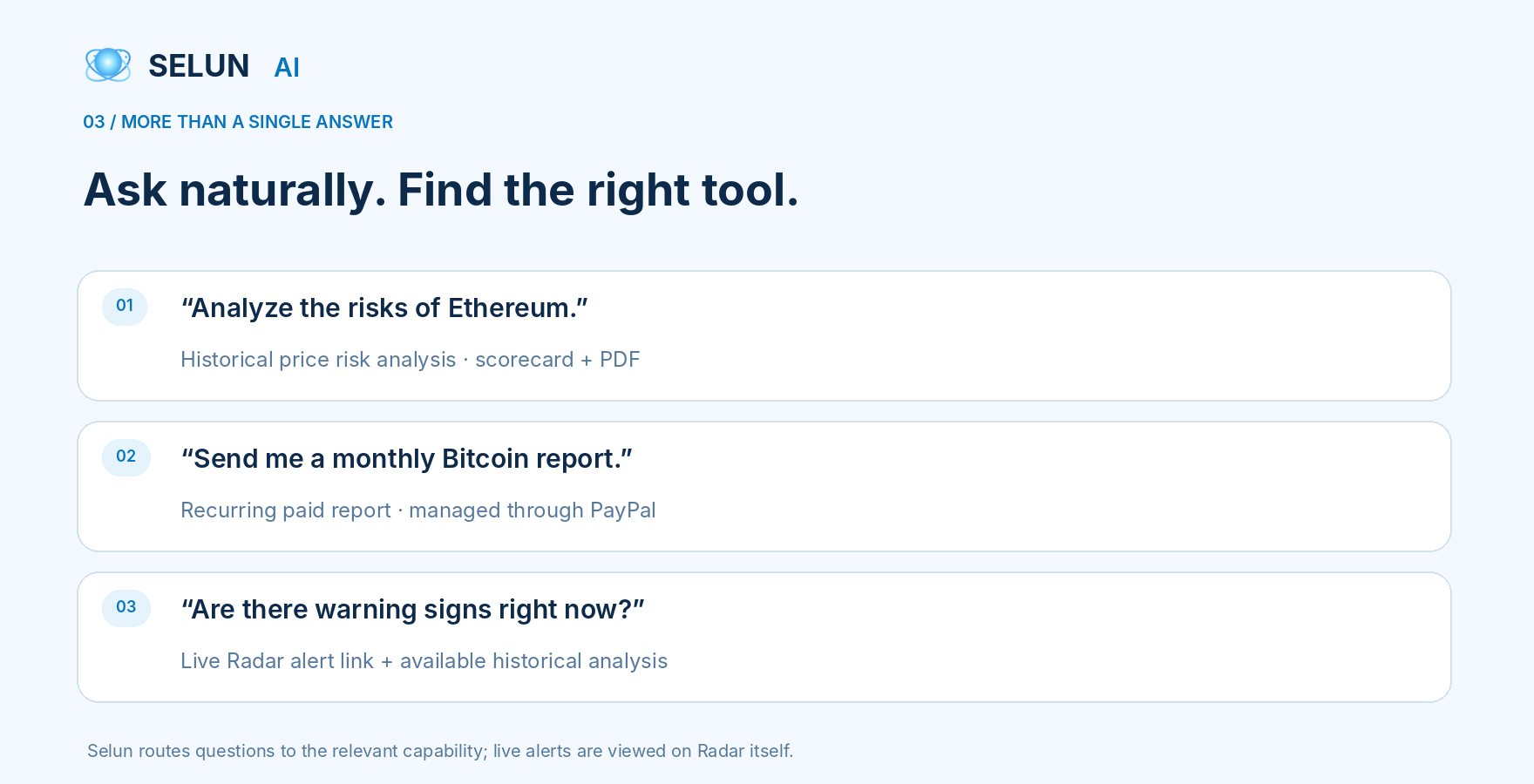
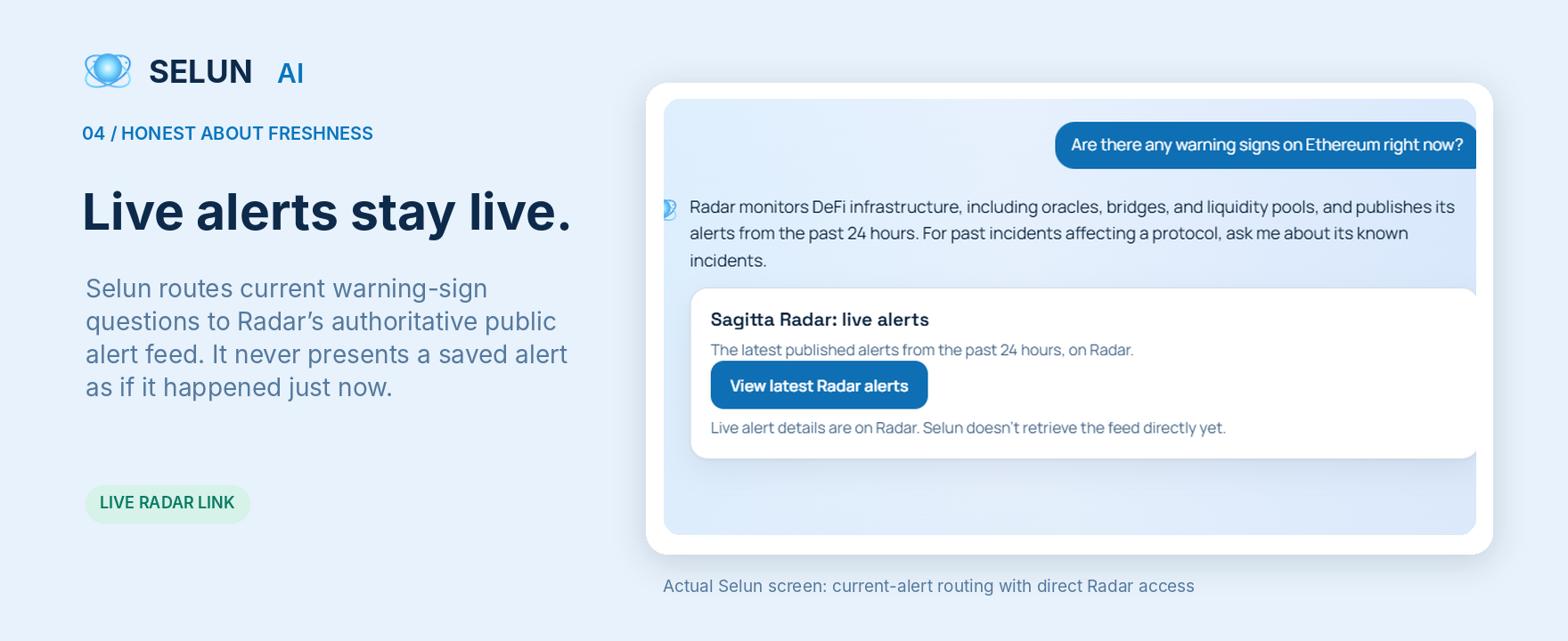
Selun also supports monthly intelligence subscriptions, historical threat-related analysis, and questions about current infrastructure alerts. When a customer asks for current Radar alerts, Selun links to Radar's live public feed rather than presenting cached alerts as current facts.
PayPal: Beyond the Checkout Button
Selun integrates PayPal across the complete intelligence-commerce lifecycle.
- Orders API: Creates, retrieves, and captures individual intelligence purchases.
- Catalog Products and Billing Plans: Defines the products and recurring subscription offerings.
- Subscriptions API: Creates subscriptions, retrieves billing information, processes recurring payment records, and supports cancellation.
- Payments API: Verifies captures and processes refunds.
- Webhooks: Verifies incoming payment notifications and reconciles purchases, subscriptions, and reversals with persistent fulfillment records.
- Disputes: Handles dispute lifecycle events, suspending access when a payment is contested and reconciling access when the outcome is resolved.
AI proposes. The customer authorizes. PayPal confirms. Sagitta executes.
This separation is fundamental to Selun's architecture. The AI interprets customer requests and selects appropriate services, but it never determines whether a payment succeeded or authorizes a charge on the customer's behalf.
Every purchase must pass through explicit customer approval, verified payment, and server-controlled execution. Completed analyses are tied to their purchase records, while retries and duplicate webhook deliveries are handled without creating duplicate entitlements.
What This Means for PayPal
Selun turns natural-language conversations into opportunities for PayPal commerce.
A beginner curious about Bitcoin can discover a $1.50 risk analysis. A customer seeking deeper intelligence can purchase a $4.99 comprehensive report. Someone who wants ongoing research can subscribe for $9.99 per month.
PayPal supports this commercial lifecycle through one-time checkout, recurring billing, verified payment notifications, refunds, and dispute handling.
The architecture is designed around a clear authorization boundary: AI understands the request, the server establishes the price, the customer approves through PayPal, and fulfillment occurs only after verified payment.
The opportunity extends beyond onchain intelligence. Businesses selling research, reports, digital services, and other specialized information can apply the same pattern to turn conversational discovery into authorized transactions.
Selun demonstrates this model with real AI orchestration, specialized analytical services, working PayPal sandbox transactions, and downloadable intelligence reports.
How we built it
We evolved an existing Selun application into an AI-first customer interface, using OpenAI for conversational understanding, contextual tool selection, and grounded plain-language interpretation. A capability registry connects requests to existing Sagitta services, while deterministic backend rules control service eligibility, quoted prices, authorized execution, and fulfillment.
PayPal is part of the complete product journey. Customers can approve one-time purchases through PayPal's Orders API or start a recurring intelligence subscription through its subscription APIs. Verified payment events authorize service execution. The same fulfillment path serves other payment methods, including Stripe and x402 on Base.
Before eligible asset analyses can be purchased, Selun screens the requested assets and locks the eligibility decision to the quote. After payment, reports are generated from stored authoritative service results, not browser-supplied financial figures. The AI's explanation is checked against those results to reduce unsupported numbers and advice-like statements.
Technology: TypeScript, Next.js, React, Node.js, OpenAI API, PayPal Orders/Subscriptions/Webhooks, Stripe, x402, Base USDC, Fly.io, Vercel, and market-data services including CoinGecko.
Challenges we ran into
The hard part wasn't making a model speak. It was building a trustworthy financial-information transaction around that conversation.
We had to prevent the model from inventing market figures, keep live alerts distinct from indexed historical content, verify that a paid service could deliver the promised result, and make successful payments survive failed analysis runs. We also encountered duplicate payment callbacks, expired quotes, refund handling, and the problem of a customer paying for a report whose data source temporarily failed.
Our solution was to enforce critical decisions in software: verified captures, idempotent execution, purchase-bound screening snapshots, retryable entitlements, server-authoritative reports, and revocable download access. The AI handles language and explanation; the backend handles money and authoritative results.
Accomplishments that we're proud of
- A real end-to-end PayPal sandbox purchase: question → quote → approved checkout → verified capture → analysis → PDF download.
- Recurring intelligence: a $9.99/month PayPal sandbox subscription with its first paid report and cancellation flow tested.
- An accessible first experience: five free substantive AI questions, with additional questions granted by paid analyses and paid subscription periods.
- Payment recovery: repeated events do not create duplicate grants, and refunds revoke affected access and unused promotional questions.
- Grounded interpretation: the system explains specialist-generated measurements without treating the model as the source of financial facts.
- Depth under the hood: over 400 backend tests passed in the latest reported suite.
These are demonstrated sandbox/test-mode capabilities. Live email delivery, cross-device recovery, and a real second subscription billing cycle are separate production-validation milestones.
What we learned
AI is most useful here as the bridge between human intent and specialized tools. A new customer should be able to begin with curiosity, learn freely, and choose deeper analysis only when ready.
We also learned that reliability comes from the boundaries surrounding the model. The assistant interprets and explains; the backend determines prices, validates eligibility, verifies payments, records results, and enforces access.
What's next for Selun AI
Selun is a permanent public gateway to Sagitta's intelligence ecosystem, not a hackathon-only prototype. We're continuing work on production payment and webhook validation, real email delivery, account and purchase recovery across devices, and more direct integrations with Sagitta's live intelligence systems.
Our vision is to make sophisticated onchain intelligence available through an experience that feels ordinary: ask a question, understand the options, approve the purchase, and receive something useful.
Selun AI - Onchain intelligence. Simply ask.
Built With
- base
- coingecko
- fly.io
- next.js
- node.js
- openai-api
- paypal-rest-apis
- paypal-subscriptions
- paypal-webhooks
- react
- typescript
- usdc
- vercel
- x402

