



Inspiration
In Senegal, a lot of small businesses run on WhatsApp, Instagram and Facebook. A vendor selling sneakers or dresses spends the day answering the same questions: "dispo ?", "c'est combien ?", "vous avez en 42 ?". Stock lives in their head or in a notebook. Payment means cash on delivery, or checking Wave and Orange Money transfers one by one.
We wanted to take that repetitive work off the vendor without forcing them into a complicated e-commerce tool. And since Lightning lets money move directly from buyer to seller, we asked: what if the platform never had to touch the money at all?
What Selly does
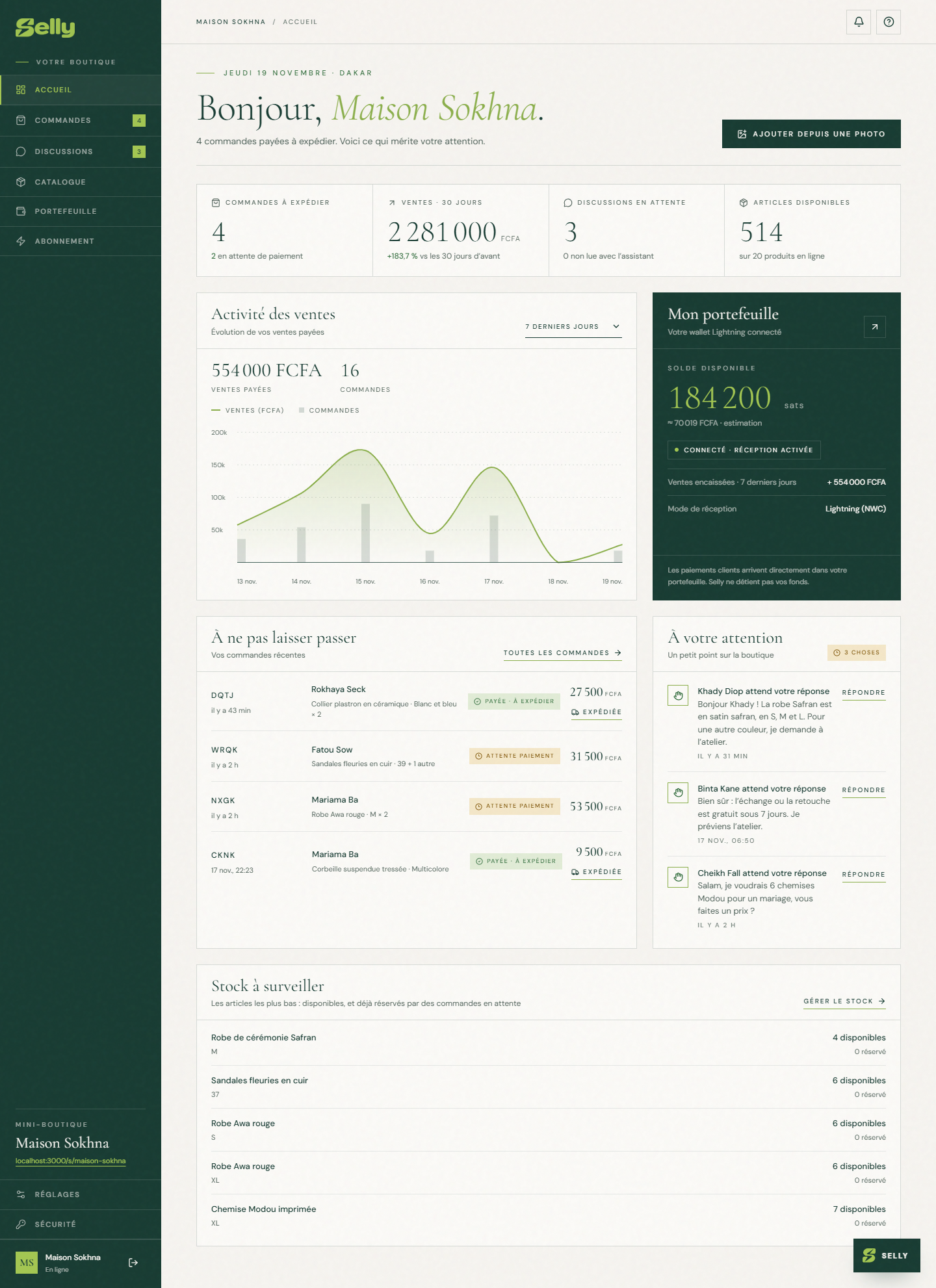
Selly gives each vendor a light web shop they can share in the chats and statuses they already use.
- A sales agent in the shop's chat. It answers customers in French (Wolof is switched on only after it passes our evaluation), checks live stock, quotes the total with delivery, creates the order and opens the payment page. The vendor can take over any conversation from the dashboard.
- A vendor assistant. The vendor sends a photo and writes "Ajoute ces baskets à 20 000, 5 paires du 40 au 44". The product is drafted, and nothing goes live until the vendor confirms it.
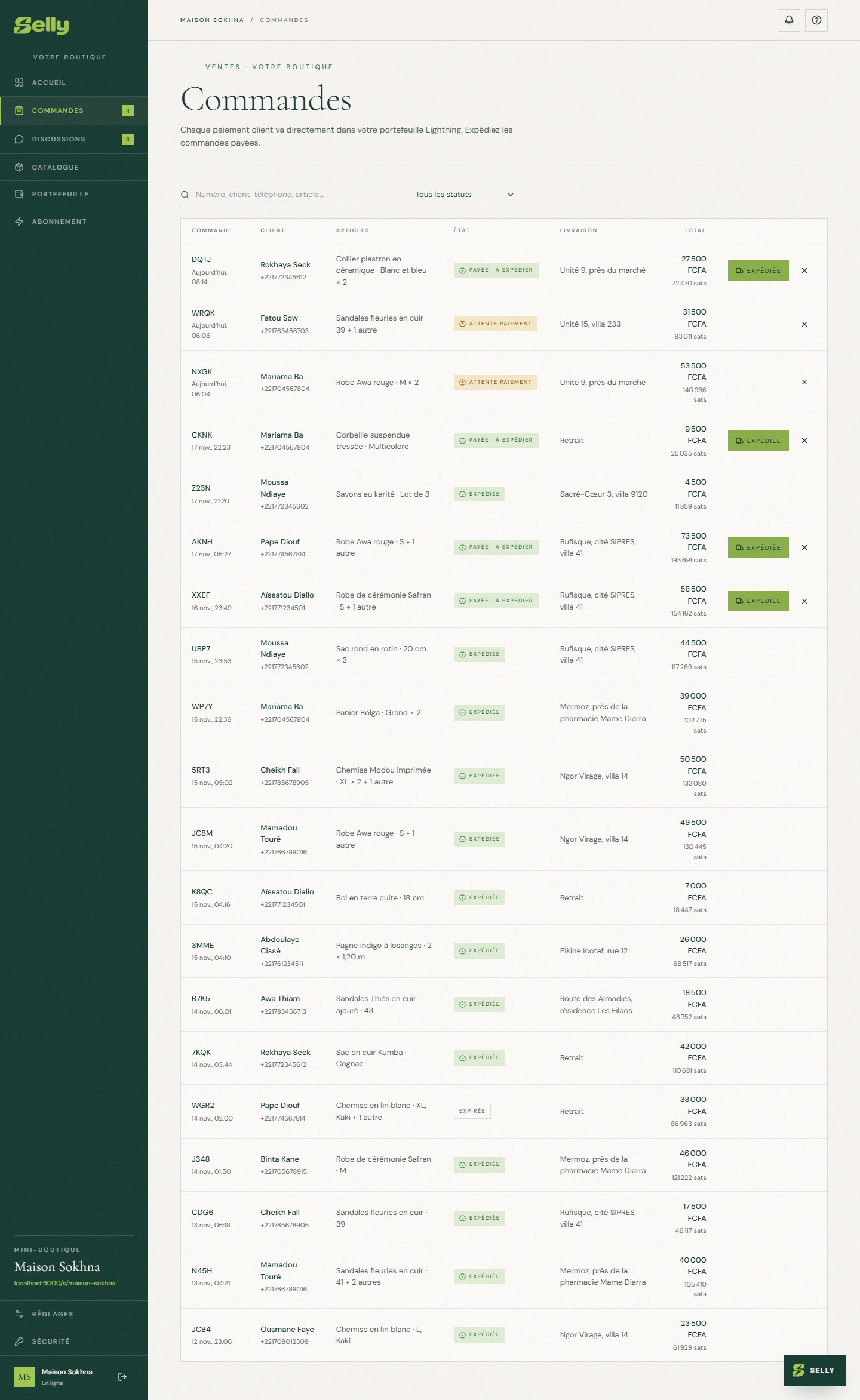
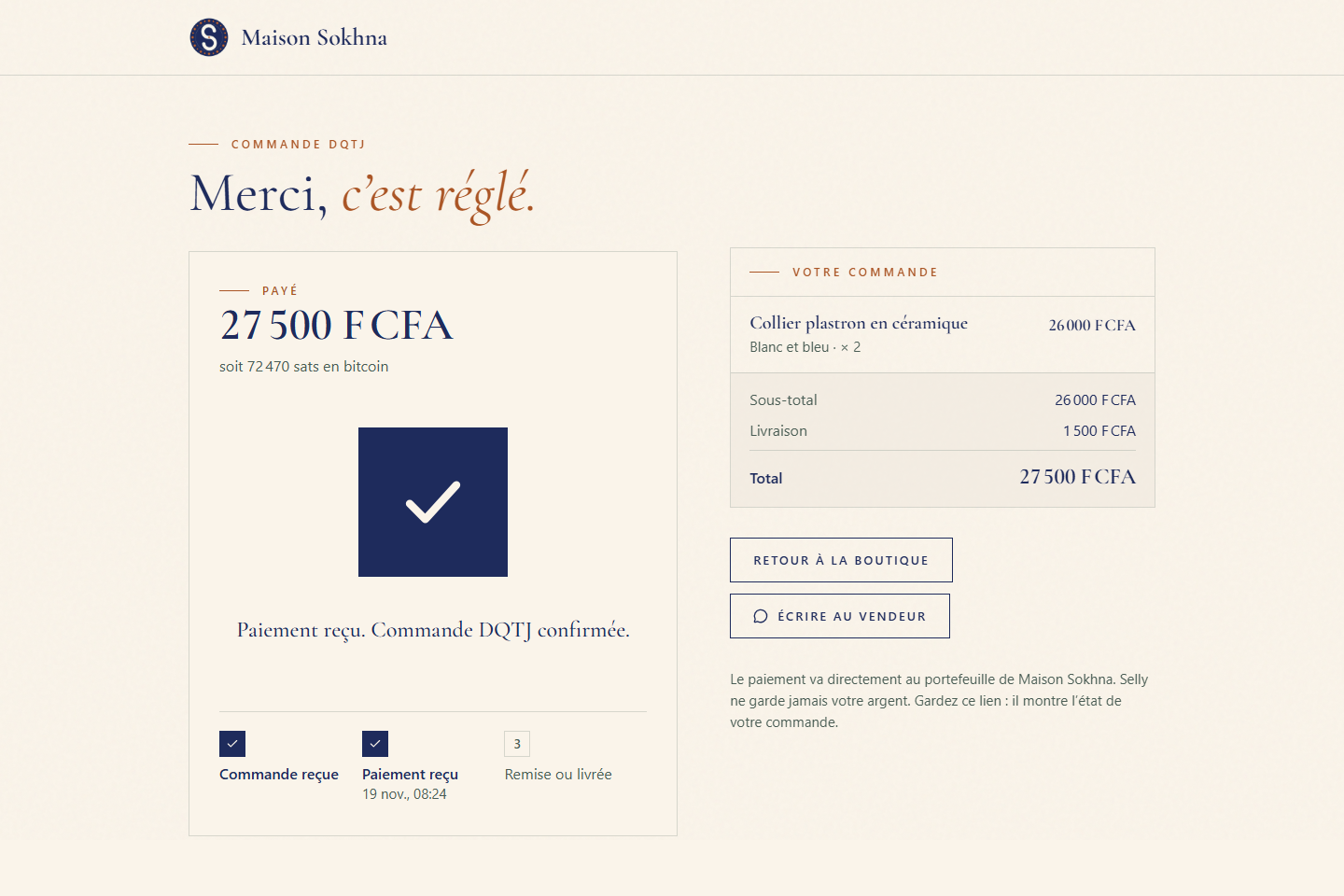
- Bitcoin payments, straight to the vendor. The customer pays a Lightning invoice created on the vendor's own wallet through Nostr Wallet Connect. Selly holds nothing and takes no fee per order.
- Sign-in with a Nostr key. There are no passwords and no SMS or WhatsApp codes.
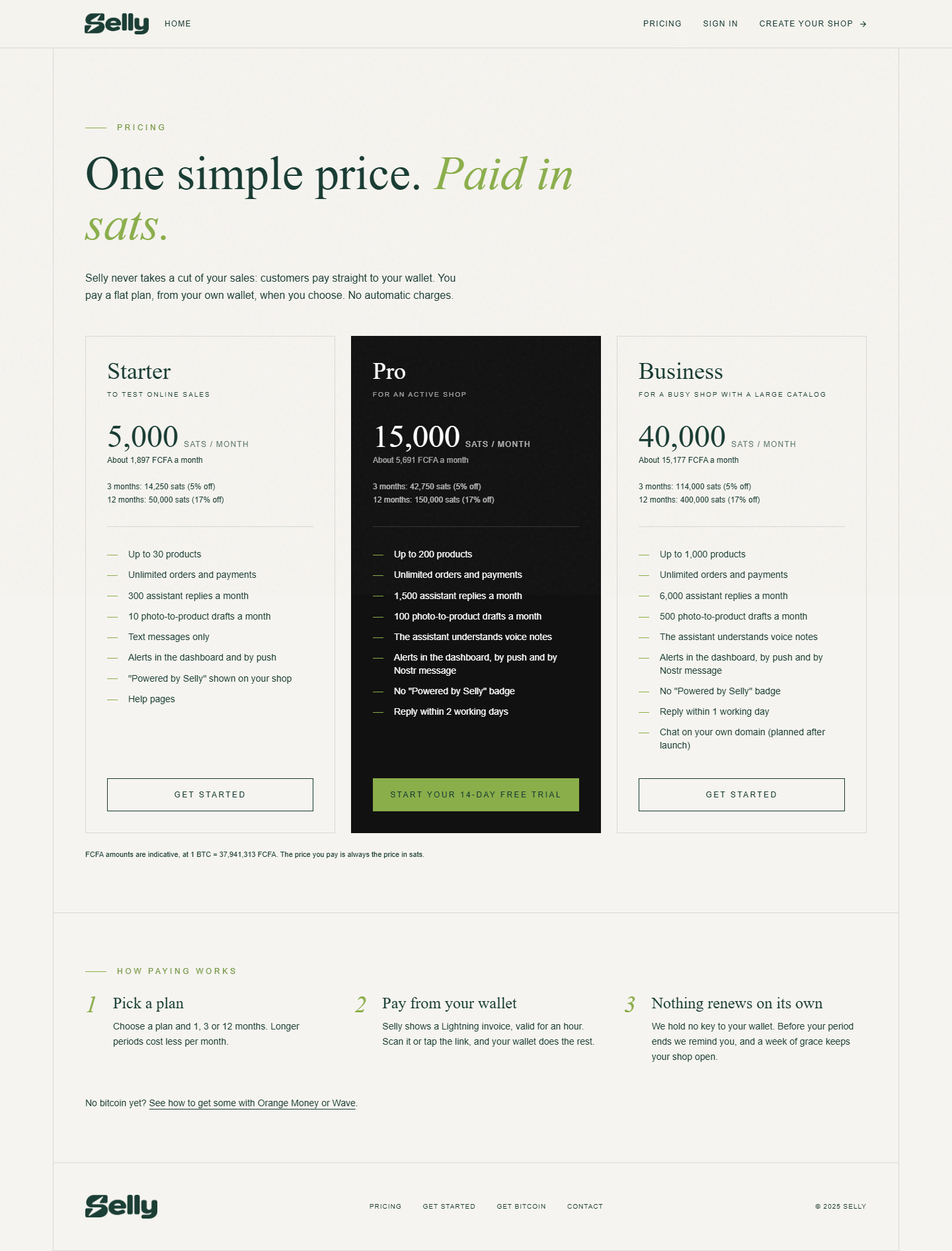
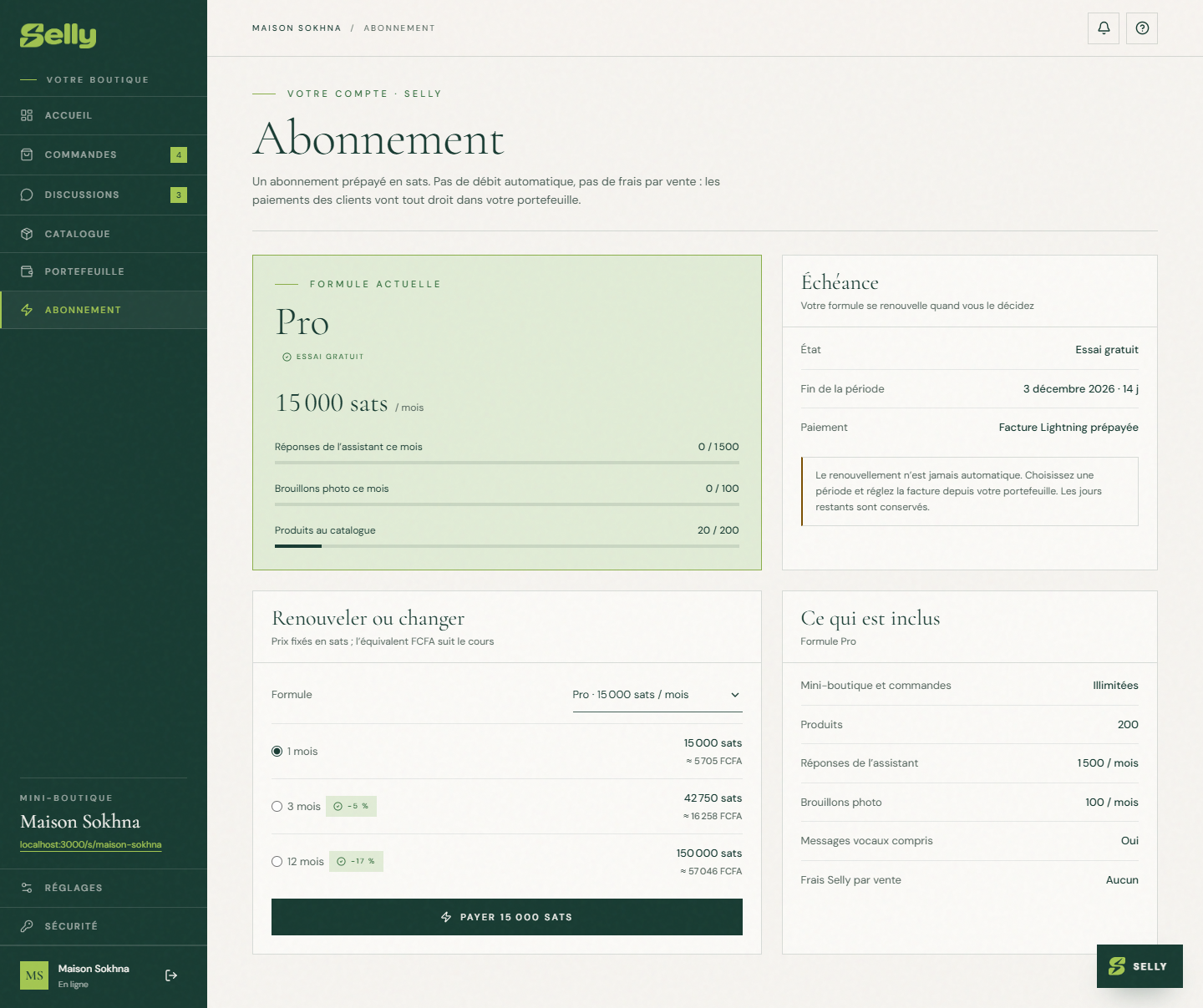
- A subscription in sats. Three tiers (Starter, Pro, Business), prepaid for 1, 3 or 12 months, with a 14-day trial.
How we built it
We are three developers, and we split the work along the three main parts of the system:
- Web: Next.js and React, one app for the storefront, checkout, chat widget and the installable vendor dashboard.
- Core: a Fastify API for catalog, stock, orders, payments, subscriptions and authentication.
- Agent: a separate service with a tool-calling loop over an LLM, plus vision for photos and speech-to-text for voice notes.
Everything is TypeScript in one monorepo, with a shared contract package so the three parts agree on every request and response. We used a single PostgreSQL database, also for the job queue and live updates, to keep the system small enough for three people to run.
Three decisions shaped the project:
- The model never does the math. Prices, stock, delivery fees and totals all come from the backend. The agent can't create an order without the customer's explicit yes, and the total must match the last quote.
- A payment only counts when the wallet confirms it. We don't trust a notification or a browser redirect. We ask the wallet that received the money directly.
- Prices stay in FCFA. Vendors think in FCFA, and a price in sats would change every minute. Sats are computed when the order is created, rounded up so the vendor never receives less than the listed price: the rate is stored on the order, so every amount can be explained later.
Challenges
- NWC is not a login. Our first brief had vendors authenticating with Nostr Wallet Connect. But whoever holds a connection can use the wallet, so a stolen link could redirect a vendor's sales to someone else's wallet. We separated the two: identity is a Nostr key, and NWC is a receive-only wallet link that we refuse if it allows spending.
- No automatic billing on Lightning. The payer always pays the invoice, so we can't debit a subscription. We made each period a prepaid invoice, with reminders at 7, 3 and 1 days and a 7-day grace period.
- Keeping the agent honest. A shop assistant that invents a price or promises stock it doesn't have is worse than no assistant. So facts come from tools, customer text is treated as untrusted, and the agent hands off to the vendor when it is unsure or a negotiation goes past the vendor's limit.
- Wallets that go offline. We added a circuit breaker, a Lightning Address fallback and a reconciler that catches late payments.
- WhatsApp and Instagram. We couldn't get Meta API access, so the first channel is a chat on the shop itself. The agent engine doesn't depend on the channel, so Meta can be added later.
What we learned
- Trust boundaries matter more than clever prompts. Most of the agent's reliability comes from what it is not allowed to do.
- Non-custodial design is a business model decision as well as a technical one. Because we never touch customers' money, we can't take a cut, so we had to build subscriptions.
- Small teams move faster with fewer moving parts: one language, one database, one contract file.
What's next
- An on-ramp, such as Banxaas, so customers without bitcoin can pay with mobile money.
- WhatsApp and Instagram channels once API access is available.
- A pilot with a handful of real vendors, to tune the plan prices and measure the real cost per agent reply.
Built With
- alby-sdk
- bitcoin
- cloudflare-r2
- drizzle-orm
- fastify
- lightning-network
- llm
- nextjs
- node.js
- nostr
- nostr-tools
- nostr-wallet-connect
- openapi
- pg-boss
- postgresql
- pwa
- react
- server-sent-events
- sharp
- tailwindcss
- tool-calling
- typescript
- vitest
- zod
