-
-
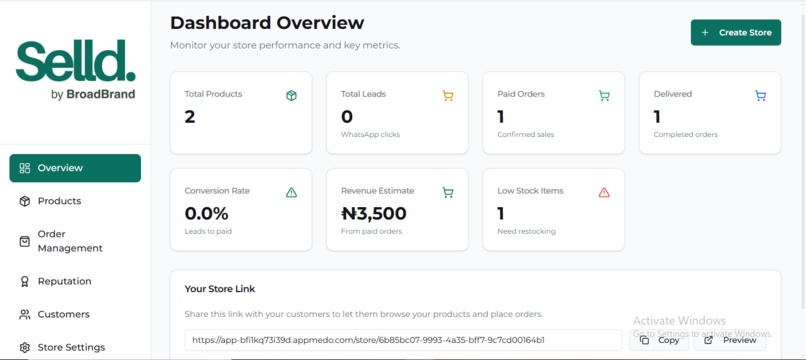
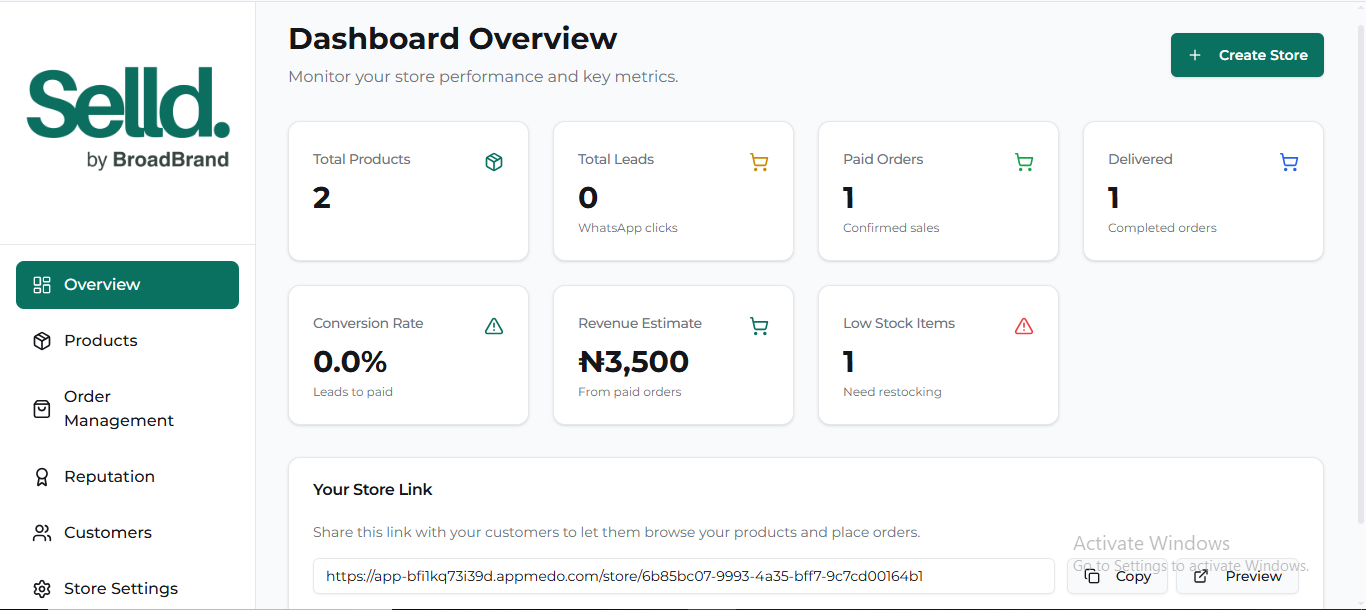
Selld Vendor Dashboard
Inspiration
In Nigeria, business is everywhere. You see it in hostel rooms, lecture halls, campus sidewalks, Instagram stories, and WhatsApp statuses. A student sells thrift clothes between classes. Someone else runs a food business from their hostel kitchen. Another person offers photography, beauty services, tutoring, or digital design work. The entrepreneurial energy is massive.
But despite how vibrant this ecosystem is, the way many small businesses operate is still fragmented.
Orders get buried in WhatsApp chats. Customer information lives in memory. Payments are manually tracked. Trust is built slowly, inconsistently, and often without any real business structure. Many vendors want to grow, but traditional ecommerce tools can feel too complex, unfamiliar, expensive, or disconnected from how commerce actually happens in Nigeria.
That observation inspired Selld.
I started by looking at ecommerce from a broad Nigerian SME perspective. But the deeper I looked, the more I realized something important: student businesses represented a powerful microcosm of Nigerian commerce itself — ambitious, creative, resilient, but underserved by digital tools built for their reality.
Students were already doing business. They didn't need another platform forcing them to change their behavior completely. They needed something that met them where they already operated.
And in Nigeria, one platform already sits at the center of everyday commerce: WhatsApp.
That became the turning point.
What if student entrepreneurs could continue selling through a familiar tool, but with the structure, professionalism, and credibility of a real business system? What if informal campus hustles could feel like legitimate brands? What if technology lowered barriers instead of introducing new ones?
Selld was born from that idea — a platform designed not to replace how Nigerians already do commerce, but to strengthen it, organize it, and help student entrepreneurs build businesses that feel bigger, smarter, and more trusted.
What it does
Selld is a campus commerce operating system built for student entrepreneurs. It allows vendors to create storefronts, add products, generate shareable store links, and receive customer orders directly through WhatsApp using structured pre-filled messages. Beyond selling, Selld helps vendors manage leads, track paid and delivered orders, monitor customers, and build trust through a Campus Reputation Layer featuring verification badges, trust scores, fulfilled order metrics, and repeat customer tracking.
How we built it
I built Selld using an iterative AI-assisted workflow powered by MeDo. Rather than using AI only for code generation, I used it for product strategy, architecture planning, UI/UX refinement, feature validation, and full-stack implementation. Through structured prompting, I refined the idea from a generic storefront builder into a focused campus business platform. I also integrated the AICC API to extend AI functionality within the application ecosystem. One of the strongest generated features was the WhatsApp ordering workflow, which created a seamless bridge between familiar communication tools and structured commerce.
Challenges we ran into
One of the biggest challenges was differentiation. The ecommerce and storefront space is extremely crowded, and early versions of the idea risked becoming “just another selling app.” I had to rethink the positioning, audience, and product identity. Another challenge was balancing familiarity with structure — keeping WhatsApp at the center of the experience while still building a system that felt professional, scalable, and business-oriented.
Accomplishments that we're proud of
One accomplishment I'm especially proud of is transforming a familiar Nigerian behavior — selling through WhatsApp — into a more structured and professional business experience.
Features like the Lead → Paid → Delivered pipeline, Campus Reputation Layer, verification badges, trust scores, and customer tracking system help student vendors feel like they're running real brands instead of disconnected side hustles.
Beyond the product itself, I'm proud of building something that has the potential to impact not only the Nigerian ecommerce landscape, but potentially the wider African commerce ecosystem as well. Across Africa, millions of small businesses already operate through informal digital channels. Selld explores a future where familiar tools can evolve into accessible business infrastructure.
I'm also genuinely proud that I put in the work and shipped. Ideas are easy. Strategy conversations are exciting. But taking a concept from market research, positioning, iterative design, AI-assisted development, countless refinements, and actually delivering a working product taught me a lot about execution.
What we learned
Building Selld reinforced an important lesson: innovation doesn't always mean changing behavior completely.
Sometimes the strongest products come from deeply understanding existing behavior and improving it with better systems, trust, and accessibility.
I also learned the importance of:
Market narrowing, Strategic positioning, Iterative product development, Designing around user, familiarity instead of forcing adoption and just simple messaging. One of the biggest practical lessons I learned was that clarity comes on the way.
I didn't start with the final version of Selld. The product became clearer through research, iteration, difficult decisions, and continuous refinement. I learned that clarity is often not something you wait to discover before building, it emerges through building itself.
Using MeDo throughout the process reinforced this lesson. What started as a broader ecommerce concept gradually evolved into a focused campus commerce platform through structured conversations, experimentation, feedback loops, and repeated iteration.
Finally, I learned how powerful AI can be when used not just as a coding assistant, but as a collaborative partner for product thinking, business strategy, design refinement, and full-stack execution.
What's next for Selld
The next step for Selld is expanding the campus commerce ecosystem into a smarter and more trusted business infrastructure for student entrepreneurs.
Future plans include stronger vendor reputation systems, campus discovery features, richer analytics, smarter customer insights, and deeper store customization.
Selld will also introduce an AI customer service assistant to help vendors automate replies, answer customer questions, and manage conversations more efficiently. Because negotiation is a natural part of commerce across Nigeria and Africa, future versions will explore built-in haggling and negotiation within chats while preserving structured order tracking.
Additional features include voice note recommendations across storefronts and dashboards, direct publishing of new products to WhatsApp Status/Stories, and stronger business verification during onboarding to improve trust and credibility.
As Selld grows, the business model will likely follow a freemium approach — keeping core selling tools accessible while offering advanced features like AI automation, enhanced analytics, premium verification, and deeper customization through affordable premium plans.
Long term, the vision for Selld is to become the commerce infrastructure layer for student entrepreneurs across campuses, communities, and emerging African markets.
Built With
- aicc-api
- architecture
- axios
- biome
- date-fns
- dotenv
- http-api-integrations
- ky
- lucide-react
- montserrat-fonts
- motion
- postgresql
- pre-filled-whatsapp-messaging-flow
- qrcode
- radix-ui
- react
- react-dom
- react-dropzone
- react-hook-form
- react-router
- recharts
- responsive
- serverless-backend-functions
- shadcn/ui
- sonner
- supabase
- supabase-auth
- supabase-edge-functions
- supabase-row-level-security-(rls)
- supabase-storage
- tailwind-container-queries
- tailwind-css
- tailwind-css-animate
- tailwind-merge
- typescript
- url-encoded-whatsapp-redirect-system
- vite
- web
- whatsapp-click-to-chat-/-whatsapp-deep-linking-(wa.me)
- zod


Log in or sign up for Devpost to join the conversation.