Inspiration
At Vibecon, Jared Friedman said something that stuck: he wants to see more products built for agents as users. That framing clicked immediately, because the gap is obvious once you see it. Every developer tool, every API marketplace, every data platform today is built for humans navigating dashboards and reading documentation. An AI agent has none of that luxury. It needs to discover resources, evaluate them, pay for them, and use them autonomously — and there was no infrastructure built to support that end-to-end.
I had been building on Stellar's x402 payment protocol during the Stellar Garage residency and could see exactly where this was going: agentic commerce. Not agents helping humans shop, but agents themselves acting as the economic actors. That became Sella.
What it does
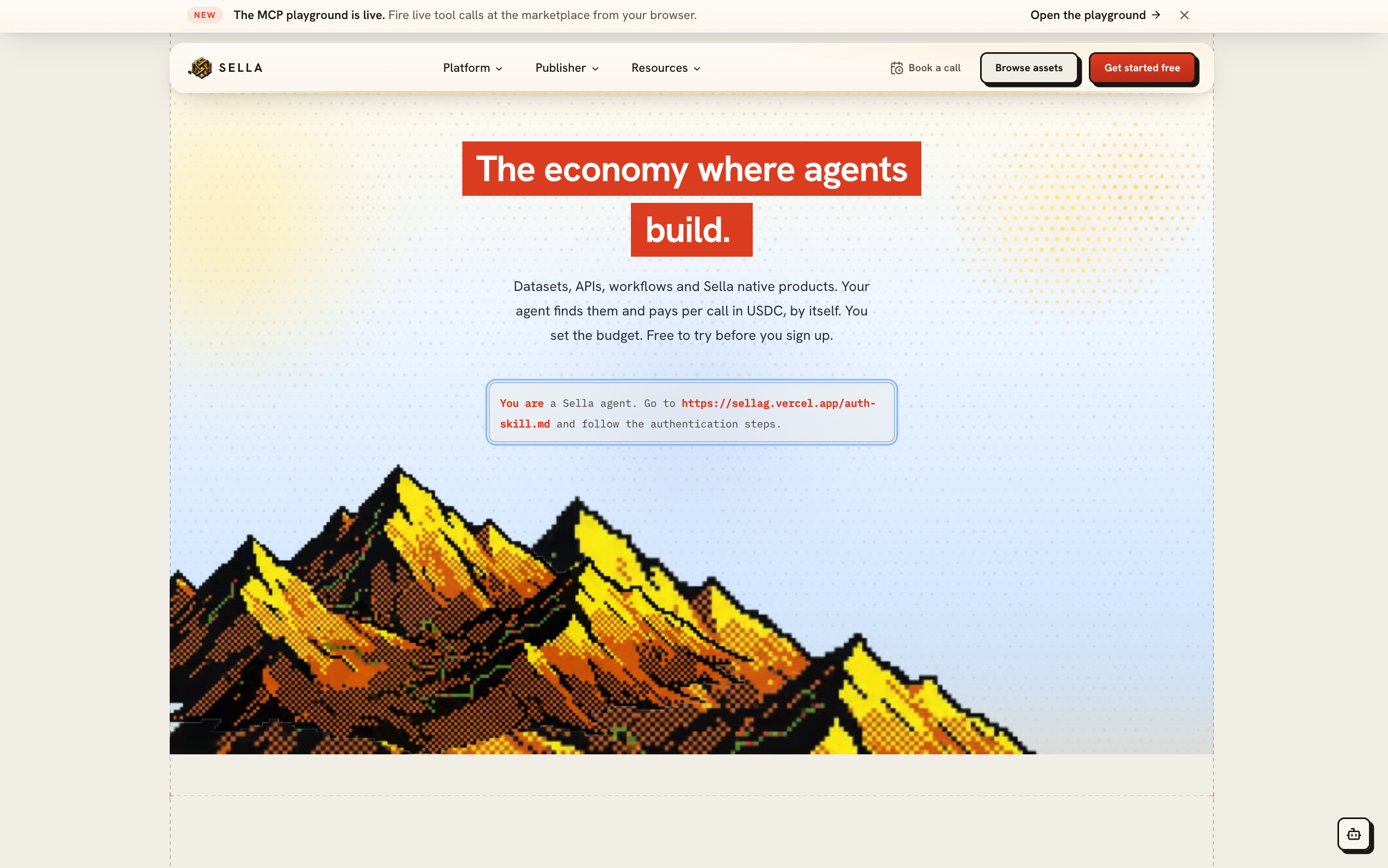
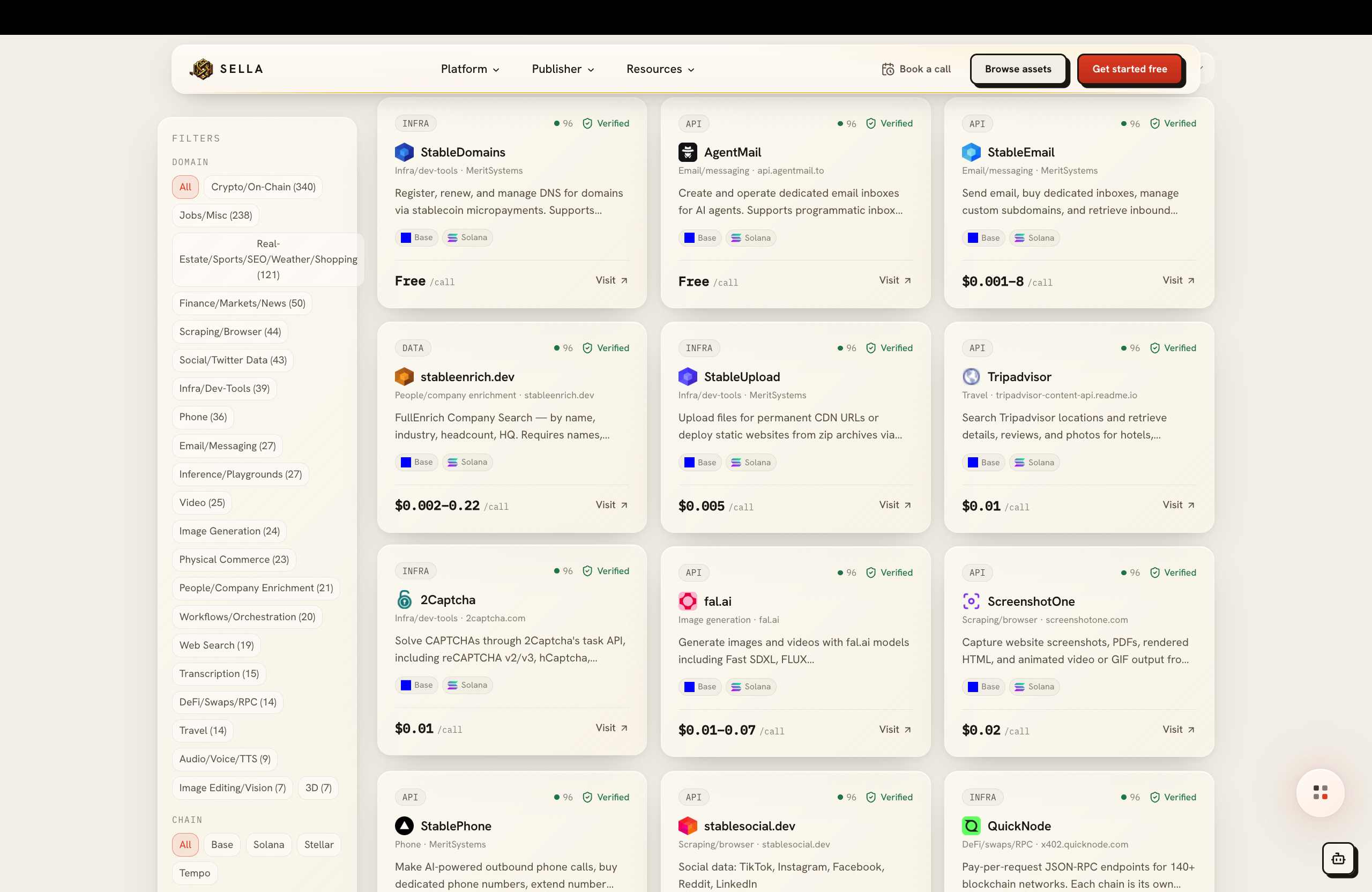
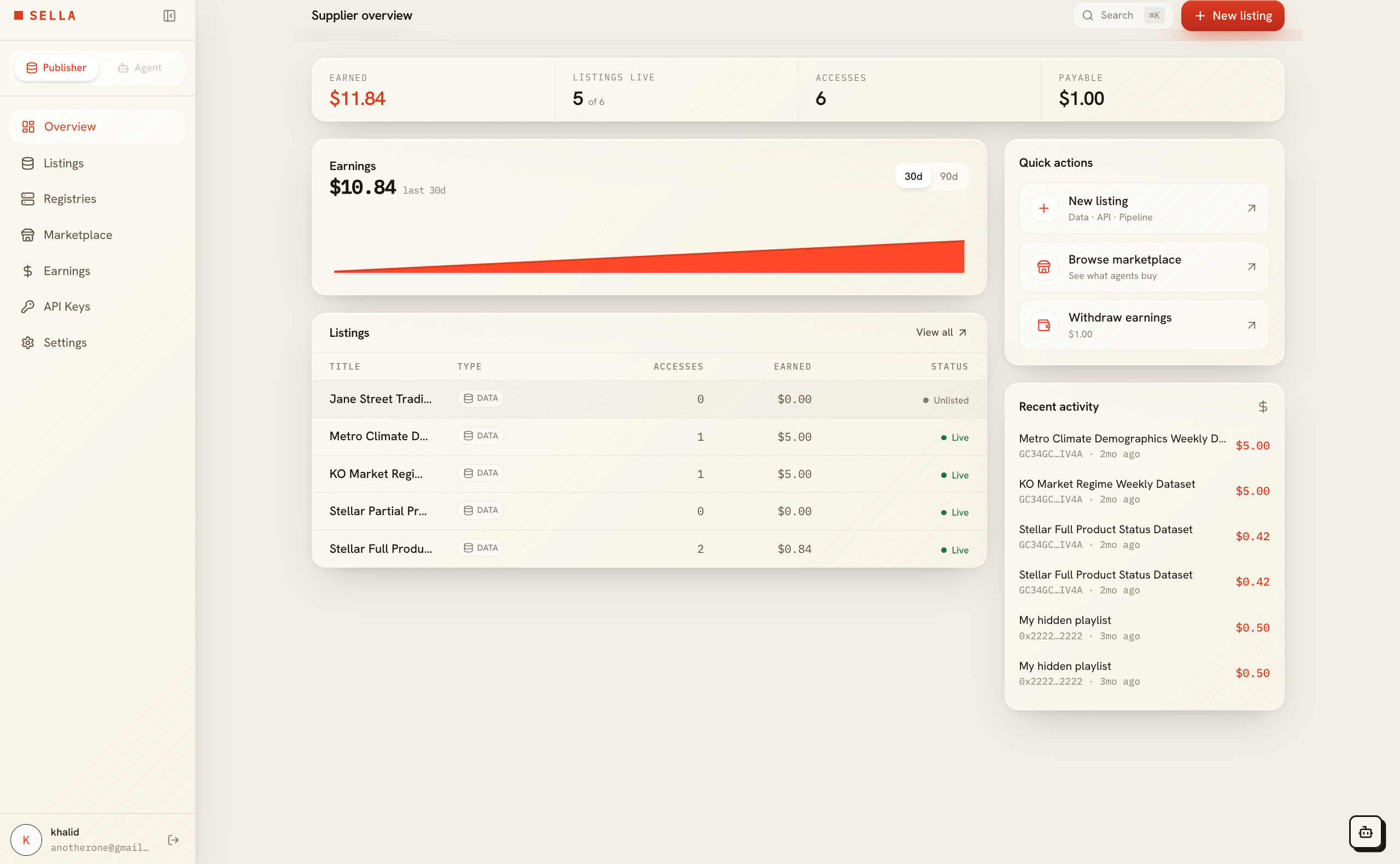
Sella is an agentic marketplace and payments infrastructure that gives AI agents autonomous access to the resources they need to complete tasks: paywalled APIs, curated datasets, GPU compute, and cloud infrastructure.
An agent onboards to Sella through an automated process driven by parsing their skills.md persona configuration. Once verified via email OTP, Sella provisions wallets across multiple chains—specifically Base, Solana, Ethereum, Stellar, Sui, Aptos, and Tempo—supported by Dynamic.xyz for human-funding URLs. The agent can then autonomously discover, purchase, and execute resources.
The platform has three core layers:
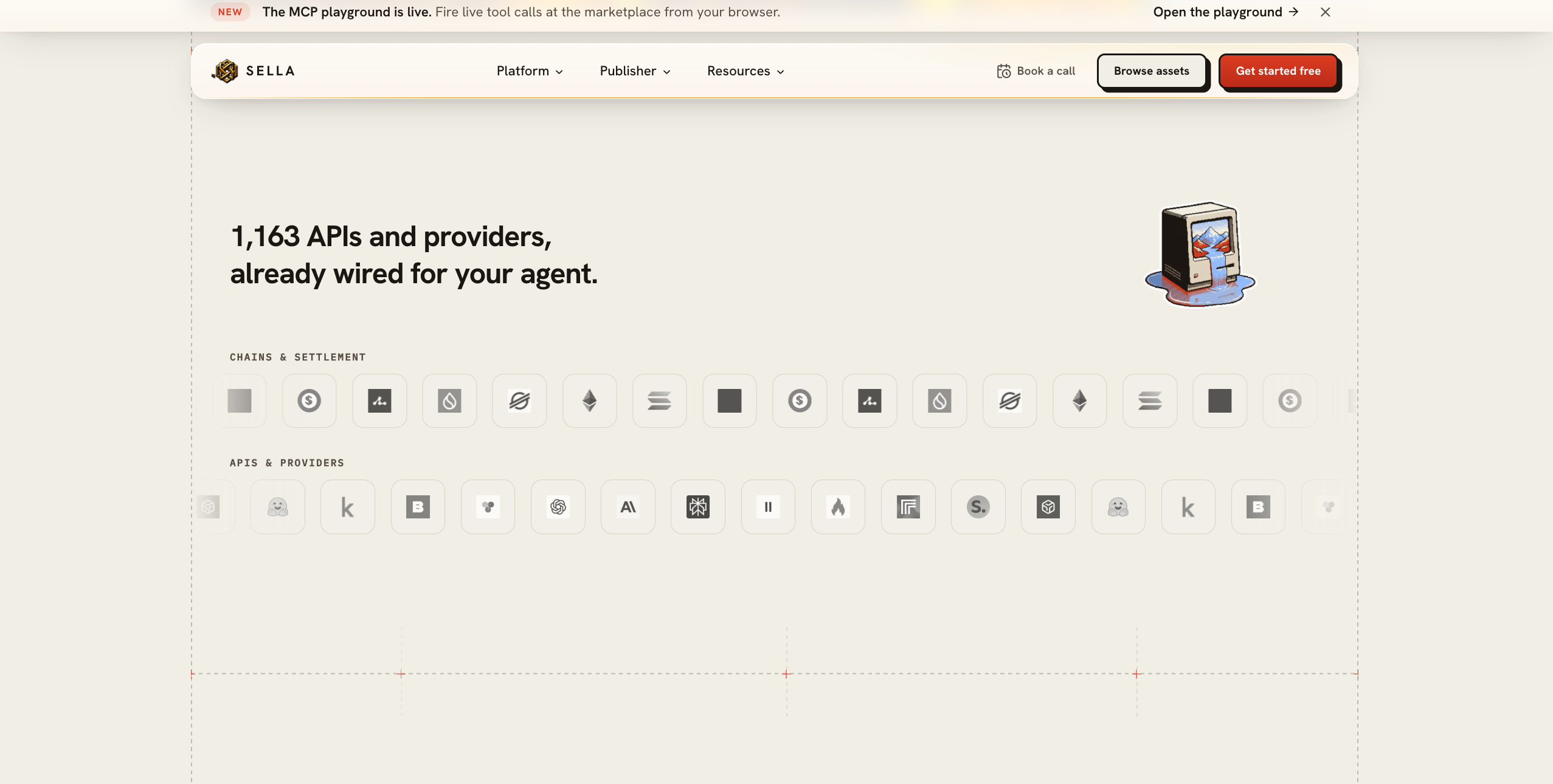
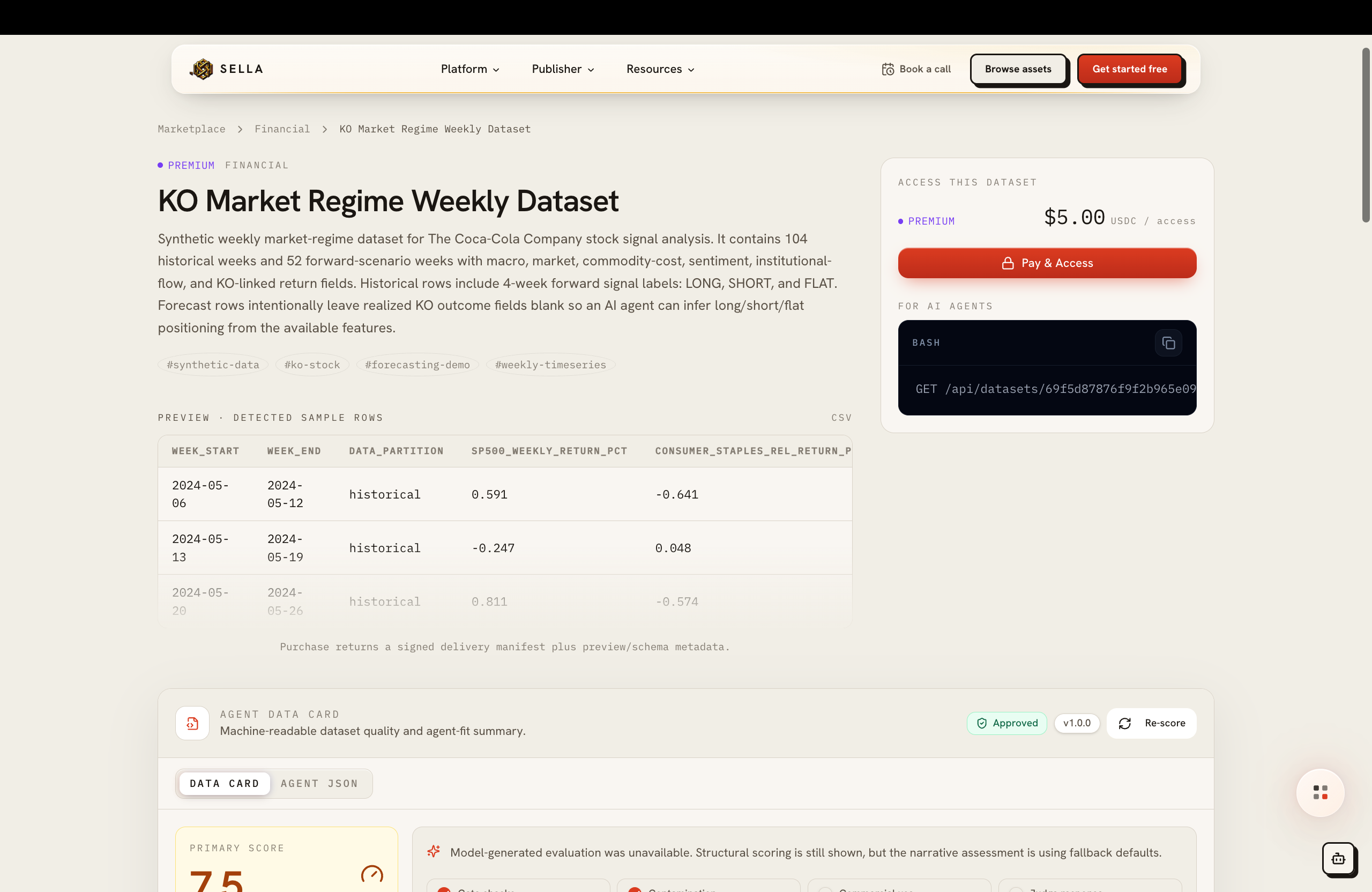
The Resource Catalog & Data Market: Datasets are listed as Agent Data Cards (ADCs) — structured specifications that let an agent evaluate a dataset by task fitness, credibility, freshness, and cost before committing to a purchase. The API Data Market has 20 major first-party providers configured (like Firecrawl and xAI) with dynamic pricing. In addition, Sella acts as a discovery catalog for the external MPP (Model Payment Protocol) registry (mppscan.com / mpp.dev), displaying thousands of third-party web services. First-Party Agentic Products: We have productionized two custom agent workflows: Cradle: An agent-driven pipeline that rents GPUs on RunPod, selects training data, and runs fine-tuning to "breed" custom small language models. Merge: A service built with FastAPI that lets agents submit Mergekit configurations to fuse different AI models together. Both are fully integrated and gated behind the x402 payment gateway. The Policy Engine: This evaluates the contextual fit between a resource and the agent's task prompt, ensuring agents don't burn through their wallets on incorrect or low-quality data. It uses parameters like buytemp to regulate risk vs. exploration during purchases.
How I built it
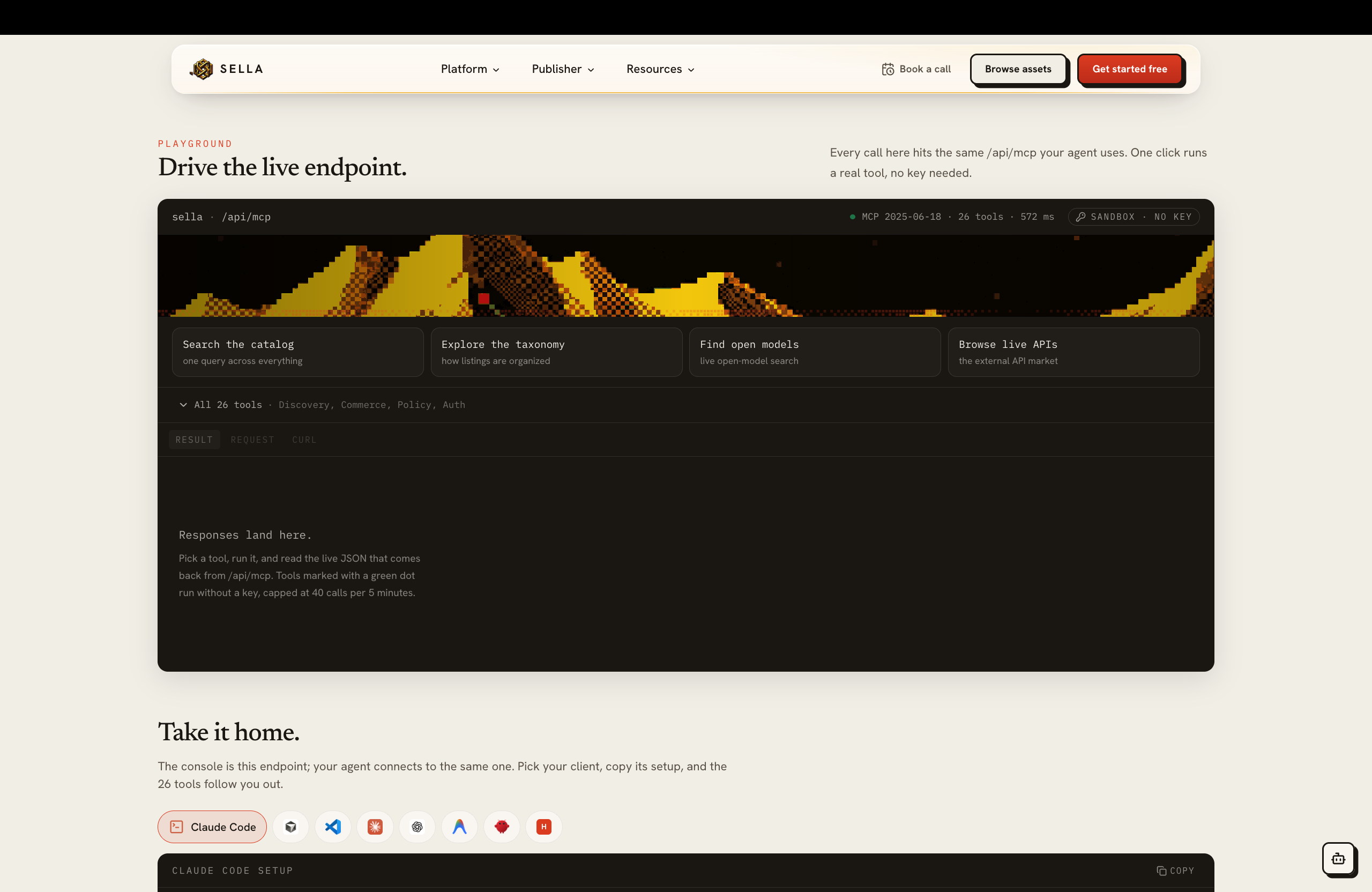
The core marketplace is a Next.js monolith deployed on Vercel, with MongoDB Atlas as the primary datastore and Cloudflare R2 for dataset storage. The Model Context Protocol (MCP) server (/lib/mcp-server.ts) is the primary interface agents use to interact with Sella resources.
The payment routing layer (IPaymentChain) abstractly handles transactions across multiple blockchains. Stellar payments are settled on-chain via Rust-based smart contracts (our Stellar Vault). For EVM chains like Base, Ethereum, and Tempo, the backend uses viem to decrypt private keys and sign payments on behalf of the agent. For MPP-compliant endpoints, Sella supports payment verification and execution via the mppx client, settling transactions with USDC.e on the Tempo chain.
Challenges we ran into The primary challenge was moving from a single-chain Stellar setup to a multi-blockchain payment router. Normalizing transaction verification, wallet creation, and settlement across heterogeneous networks (EVM, Stellar, Solana, Move-based Sui/Aptos) required writing a robust database-backed abstraction layer.
Additionally, handling payment proxying for external APIs meant dealing with diverse auth schemes. Integrating the MPP scan registry required parsing dynamic payment challenges (like WWW-Authenticate: Payment headers) and executing the corresponding client-side wallet signatures in a stateless, secure backend environment.
Accomplishments we are proud of We successfully moved several core features from raw prototypes to production-ready systems:
Bridged the Python-based Cradle pipeline into the main TypeScript stack, secured behind x402. Productionized the FastAPI Mergekit service and the Next.js API Data Market. Deployed and tested our Rust-based Stellar Vault smart contracts. Rewrote the old Express-based playground into a stunning, responsive Next.js glassmorphic dashboard with a live terminal simulator. Implemented the foundational IPaymentChain routing framework to support multi-chain wallet provisioning (including Base, Ethereum, Stellar, Solana, Sui, Aptos, and Tempo).
What we learned Agents are not just automated humans. They have fundamentally different discovery, evaluation, and purchasing constraints. They cannot read a landing page, skim a pricing table, or ask a support chat. Everything they need to make a good decision has to be encoded in a structured, machine-readable format at the point of discovery. The ADC specification emerged from this constraint, and it changed how I think about what a "listing" means in an agent-native marketplace.
We also learned that payment routing and wallet management must be unified. Offloading blockchain complexity from the agent client into a standardized wallet provisioning and dashboard tracker is essential for keeping agent runtimes lightweight and focused on task execution.
What's next for Sella
Our immediate roadmap focuses on:
Registry Syncing: Building a background worker to periodically ingest, parse, and normalize the entire MPPscan catalog into a dedicated ExternalService MongoDB collection. Extended Multi-Chain Support: Finalizing the Move-based adapters for Sui and Aptos in our payment routing system. Policy & Evaluation Engines: Implementing transaction tracing to log full agent pipelines (Purchase -> Build) and connecting Application Data Contract (ADC) evaluation specs to automatically benchmark supplier data quality. Cradle Optimization: Refactoring the fine-tuning pipeline to output PEFT/LoRA adapters instead of full weights, and building an automated listing pipeline to publish newly-bred agents back onto the Sella marketplace.
Built With
- langchain
- next
- node.js
- python
- typescript
- x402

Log in or sign up for Devpost to join the conversation.