Inspiration
I've spent years operating telecom and 5G core networks on Kubernetes, and the 3 a.m. page always goes the same way. Read the alert, check the pods, pull logs from the crashed container, look at what changed, and then decide whether a rollback is safe. Most of that is mechanical, and most alerts aren't worth waking up for. I wanted an agent that does the investigation the way a good SRE would, while a human keeps the final say on any change to production. I also wanted it cheap enough to run on every alert
What it does
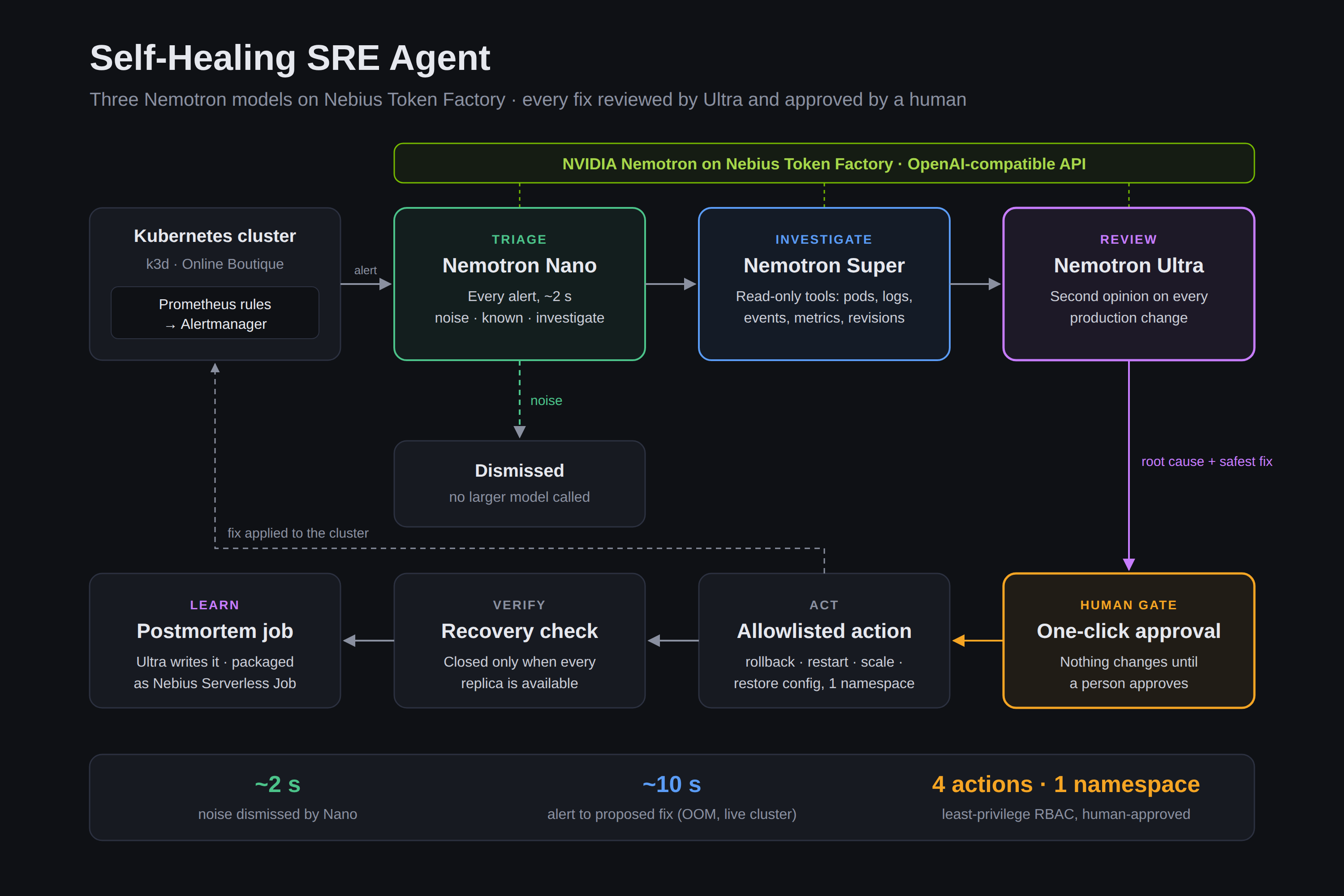
- Takes alerts straight from Alertmanager and opens an incident for each one.
- Triages with Nemotron Nano. Noise is dismissed in about 2 seconds without calling a larger model.
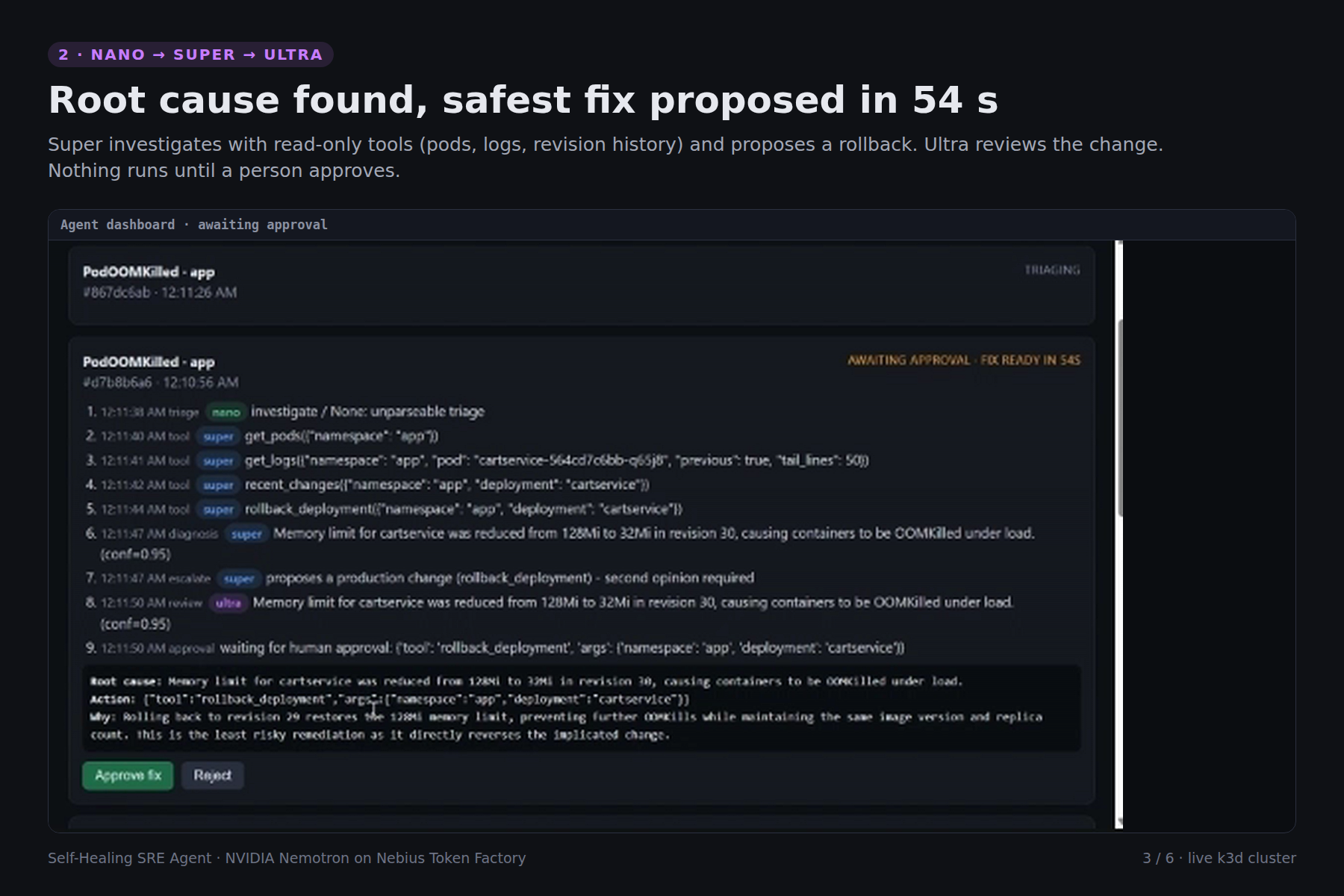
- Investigates with Nemotron Super using read-only tools: pod status, current and previous container logs, events, Prometheus metrics, and the deployment's revision history.
- Reviews with Nemotron Ultra whenever Super is unsure, the incident spans components, or Super proposes a production change. Ultra confirms or corrects the root cause and the fix.
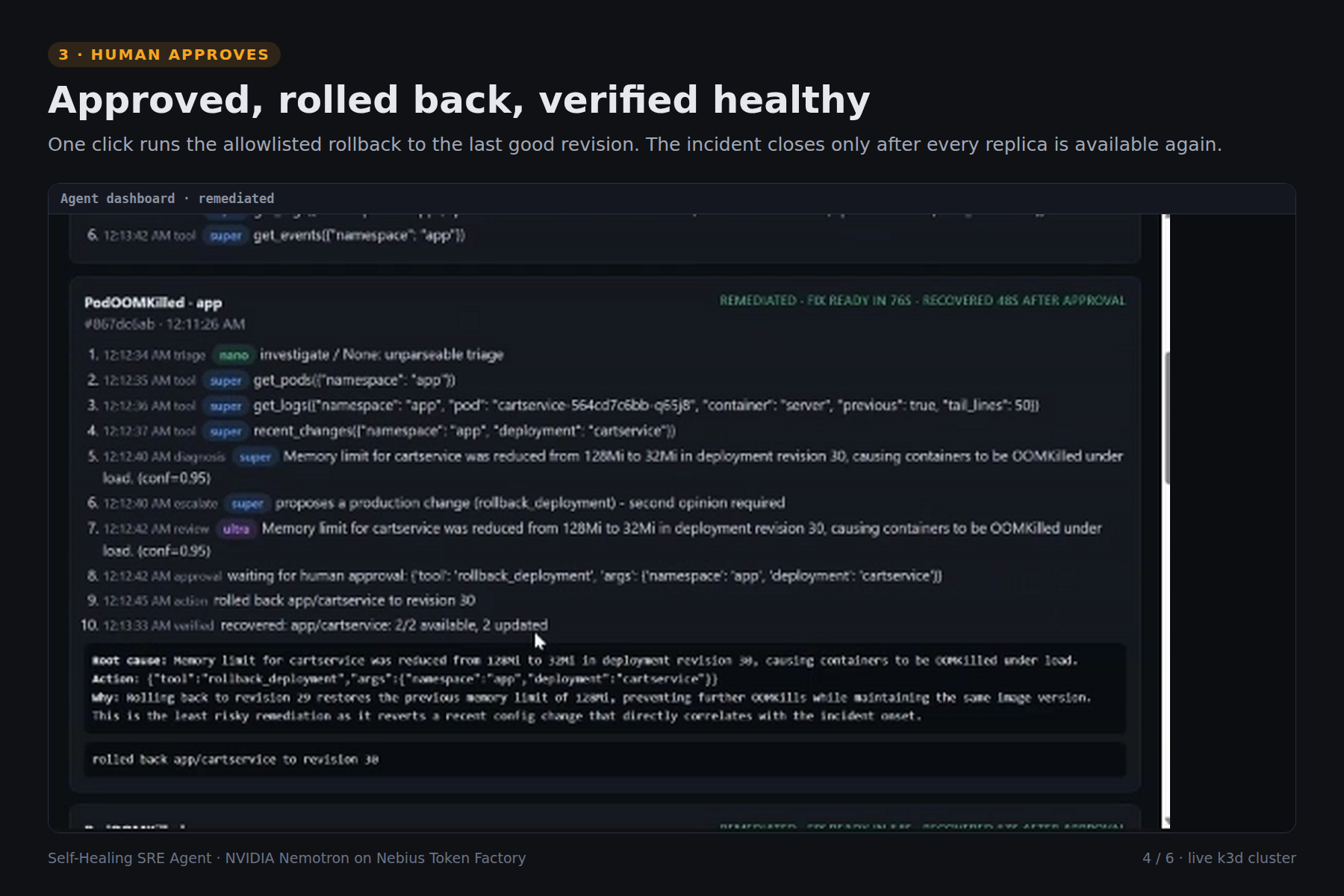
- Waits for one-click human approval, then applies one of four allowed actions: restart, roll back, scale up to 10 replicas, or restore a ConfigMap.
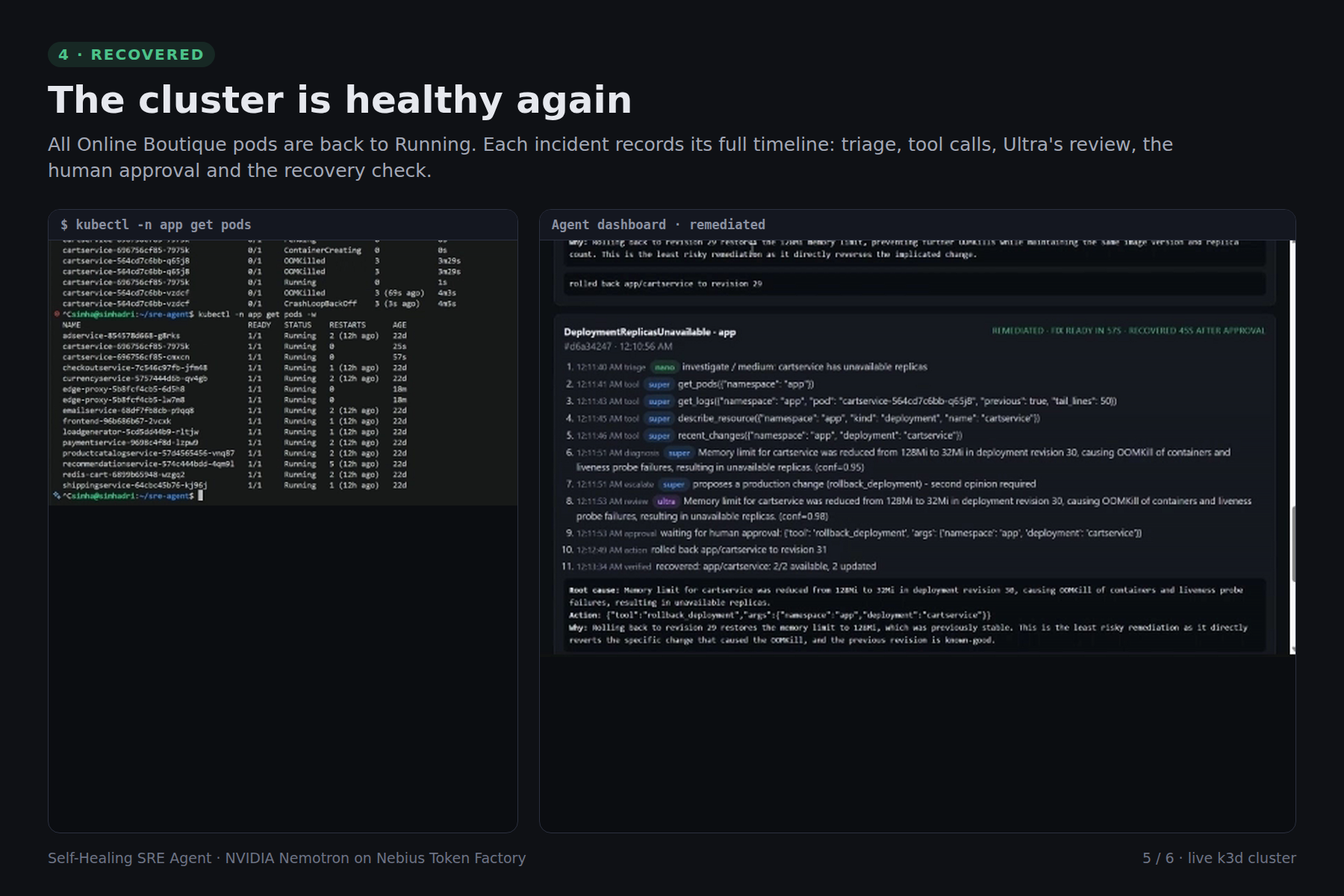
- Verifies recovery by watching the rollout until every replica is available. Only then does it mark the incident remediated.
- Writes a blameless postmortem with Ultra, packaged as a Nebius Serverless Job, and links it from the incident.
- In the OOM demo, the fix was ready about 10 seconds after the incident opened. The agent named the exact change: the memory limit was cut from 128Mi in the latest revision. ## How we built it
- Agent: Python and FastAPI, with the OpenAI SDK pointed at Nebius Token Factory. A tiered router sends each call to Nemotron Nano, Super or Ultra.
- Tools: the Kubernetes Python client and the Prometheus HTTP API, exposed to Super through native tool calling.
- Cluster: k3d (Kubernetes 1.35) on a Windows laptop through WSL2, running Google's Online Boutique, an nginx edge proxy and kube-prometheus-stack with custom alert rules.
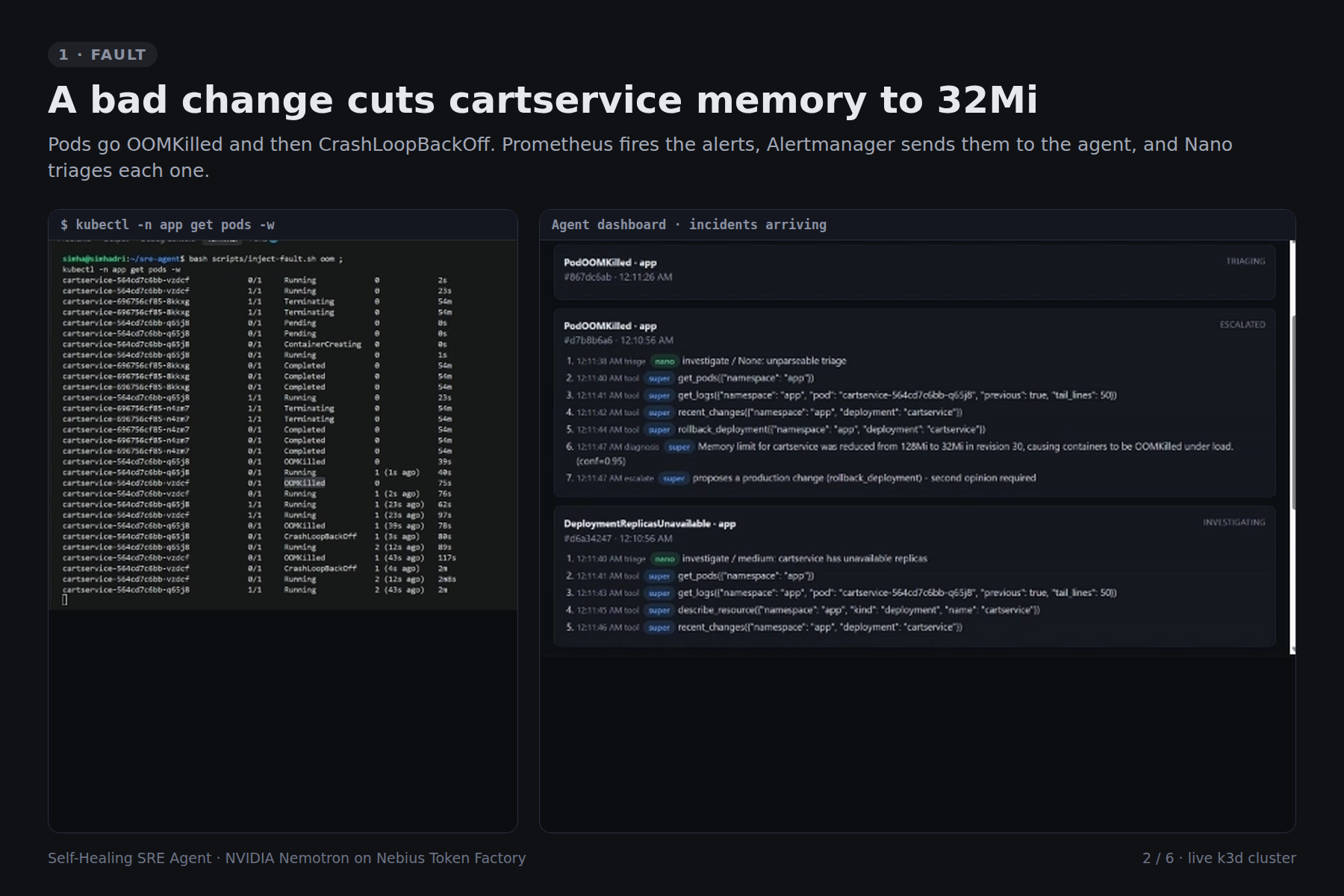
- Faults: an OOM limit cut, a missing image tag and a broken nginx config, injected by script and reset from known-good manifests.
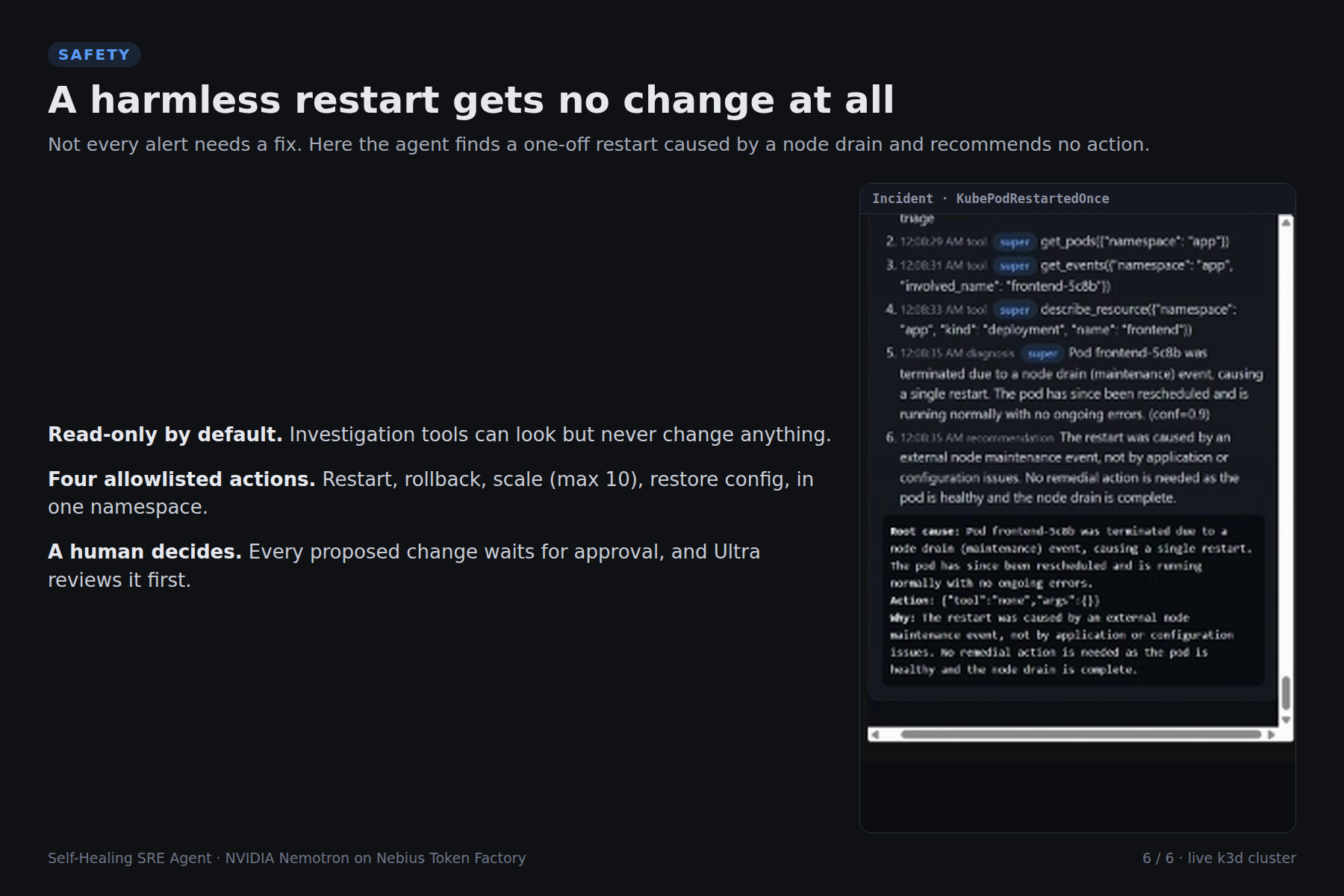
- Safety: least-privilege RBAC scoped to one namespace, an allowlist of four write actions, a shared token on every state-changing call, and human approval by default.
- Dashboard: a single-page incident timeline, colored by model tier, with per-tier call, token and latency counts, plus separate time-to-fix and time-to-recover figures
Challenges we ran into
- An alert that would never fire. During a stuck rollout the old pod keeps serving traffic, so "replicas unavailable" never triggers for a bad image. I added an image-pull-failure rule.
- A reset that undid the fix. kubectl rollout undo after the agent's own rollback reapplied the broken revision. Reset now re-applies the known-good manifests.
- Reasoning models and JSON. Smaller models sometimes wrote out their reasoning before the JSON answer. I strip blocks and turn Nano's reasoning off through its prompt.
- Measuring the right thing. The first timer counted the time a fix sat waiting for my click. I split it into time to diagnosis and time to recover after approval. 5 . Secrets hygiene. I committed .env once early on. I rotated the secret, deleted and recreated the repo, and put .gitignore and a staged-secrets check into the setup steps.
- Serverless access. Token Factory worked from day one, but creating jobs in myAI Cloud project returned PermissionDenied. The postmortem job is packaged and its command is documented; for the demo I ran the same container locally. ## Accomplishments that we're proud of
- The diagnosis is correct and specific, naming the revision and the limit that changed, on a real cluster with real alerts.
- Ultra's review earns its place: in testing it corrected a proposed restart to the safer rollback.
- The agent checks its own work by verifying recovery instead of assuming the fix worked.
- The cost structure is visible on screen: most calls stay on Nano and Super
What we learned
- Small models are strong at triage and tool use when the prompt narrows their job. The big model belongs at the decision point, not in the loop.
- Safety design matters as much as model quality: an allowlist, namespace scope and human approval make it acceptable to point an agent at production.
- The order of the investigation matters. Checking recent changes early finds most root causes.
What's next for Self-Healing SRE Agent
Run the agent itself on a Nebius Serverless Endpoint against a managed cluster, and the postmortem job on Nebius Serverless. Remember resolved incidents, so a repeat of a known pattern is fixed by Nano alone. Deduplicate related alerts into one incident. Apply the same pattern to 5G core network functions: eBPF signals in, self-healing actions out.
Built with: python, fastapi, nvidia-nemotron, nebius-token-factory, nebius-serverless, kubernetes, k3d, prometheus, alertmanager, docker, openai-sdk, cloudflare-tunnel, wsl2 Try it out: https://github.com/spodala0391/sre-agent
Built With
- alertmanager
- cloudflare-tunnel
- docker
- fastapi
- k3d
- kubernetes
- nebius-serverless
- nebius-token-factory
- nvidia-nemotron
- openai-sdk
- prometheus
- python

Log in or sign up for Devpost to join the conversation.