-
-
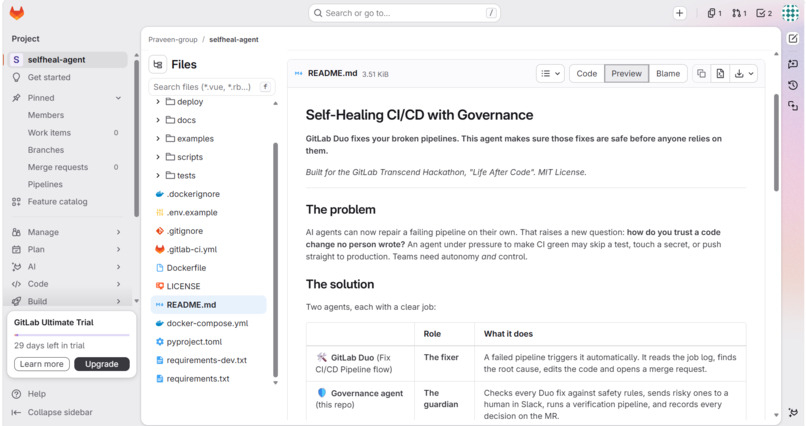
The title + the “How it works” diagram
-
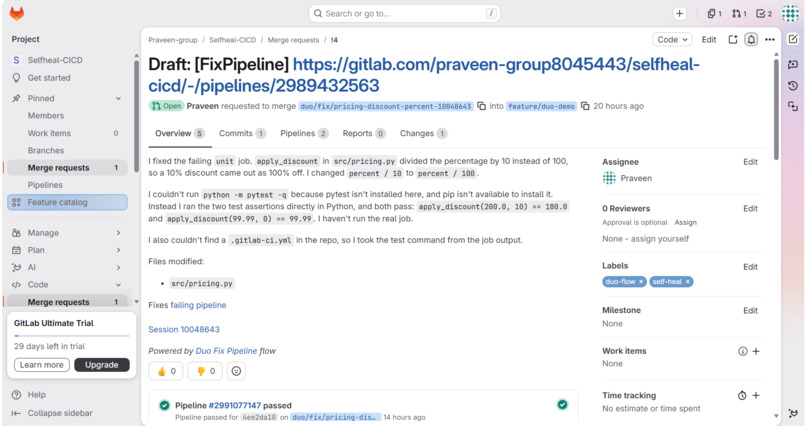
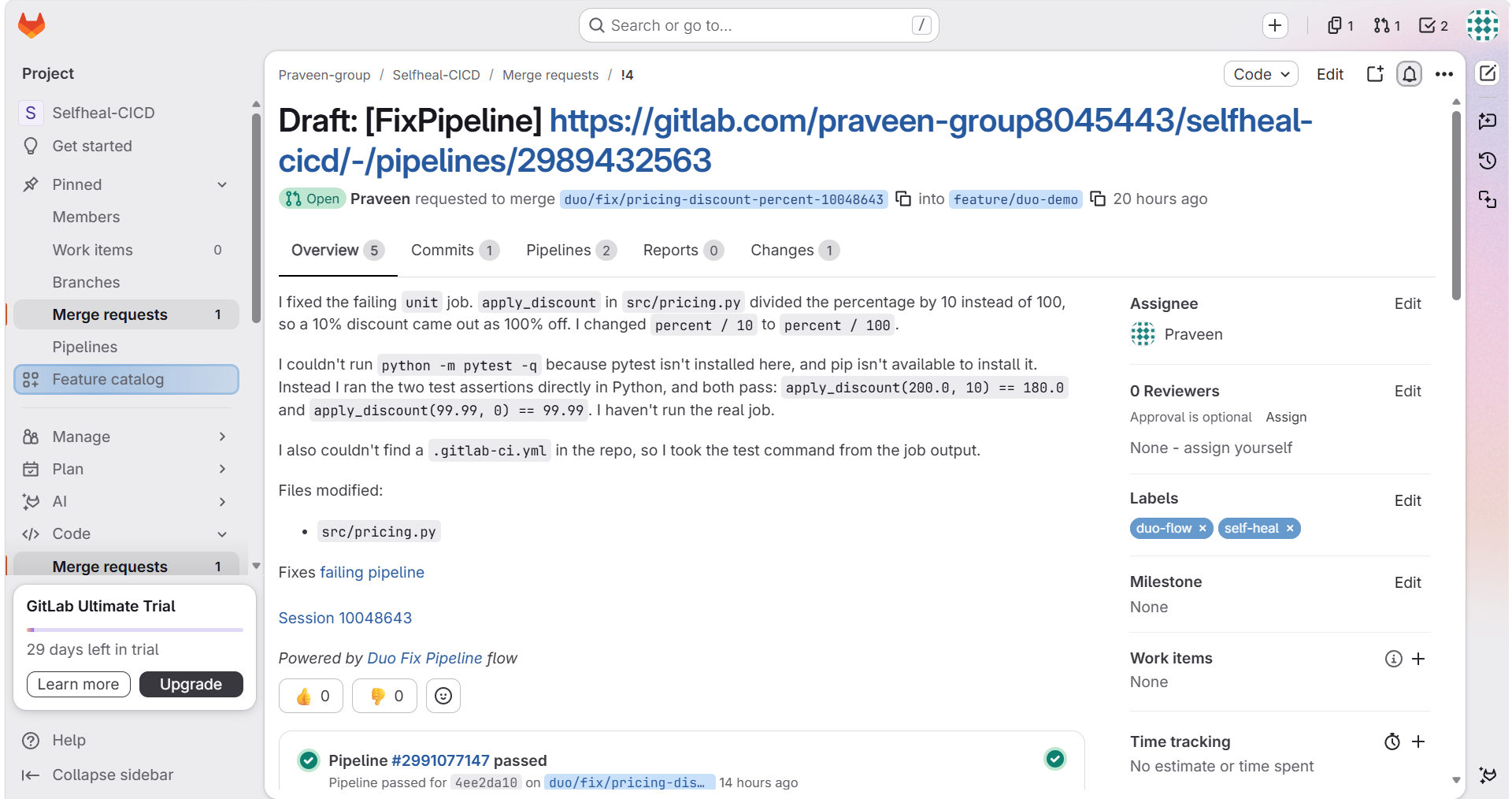
The top: “Powered by Duo Fix Pipeline flow”, plus the duo-flow and self-heal labels
-
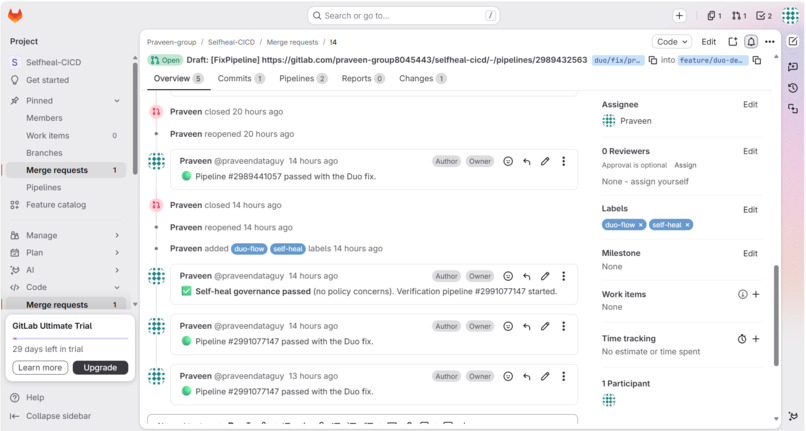
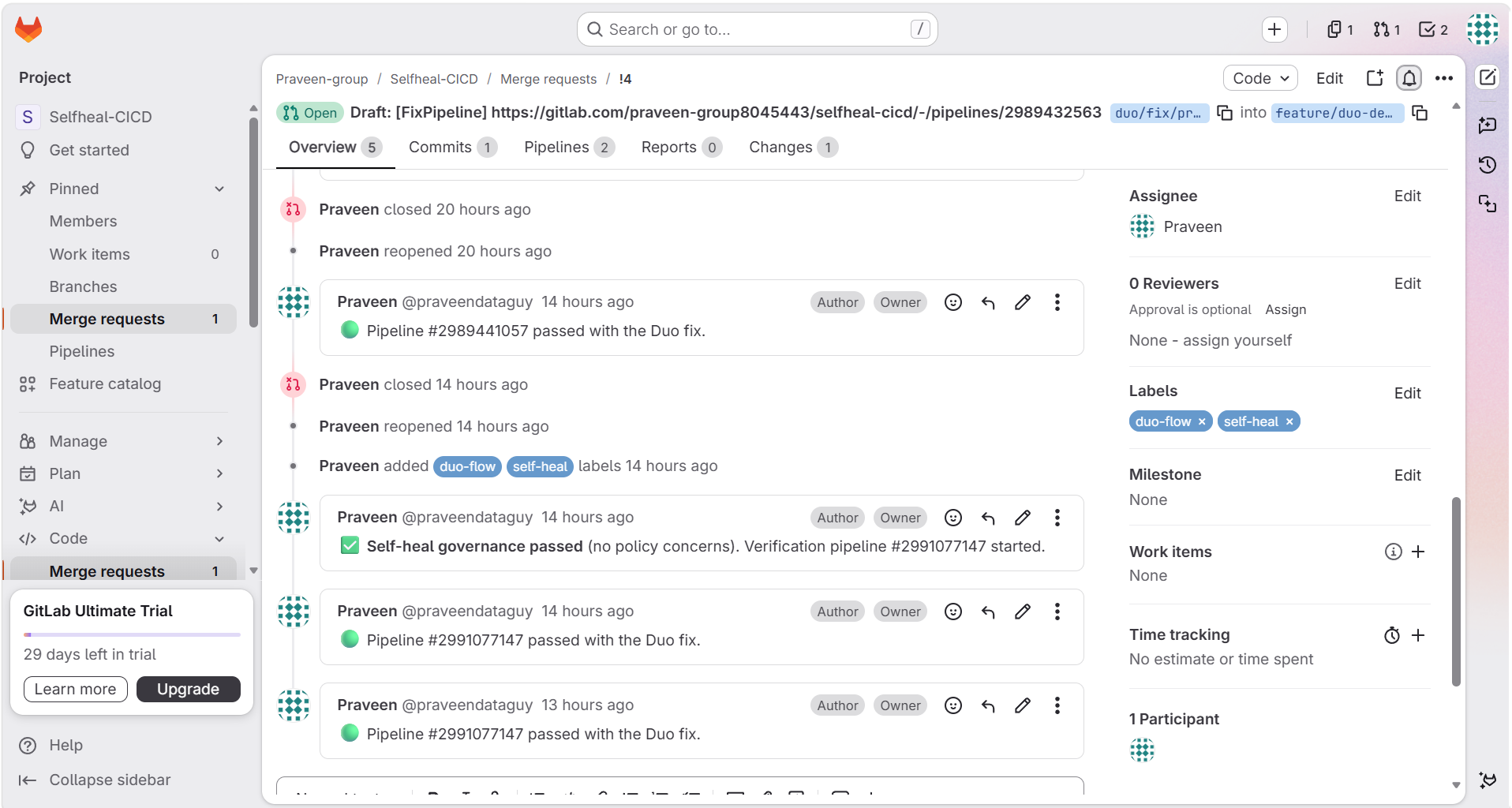
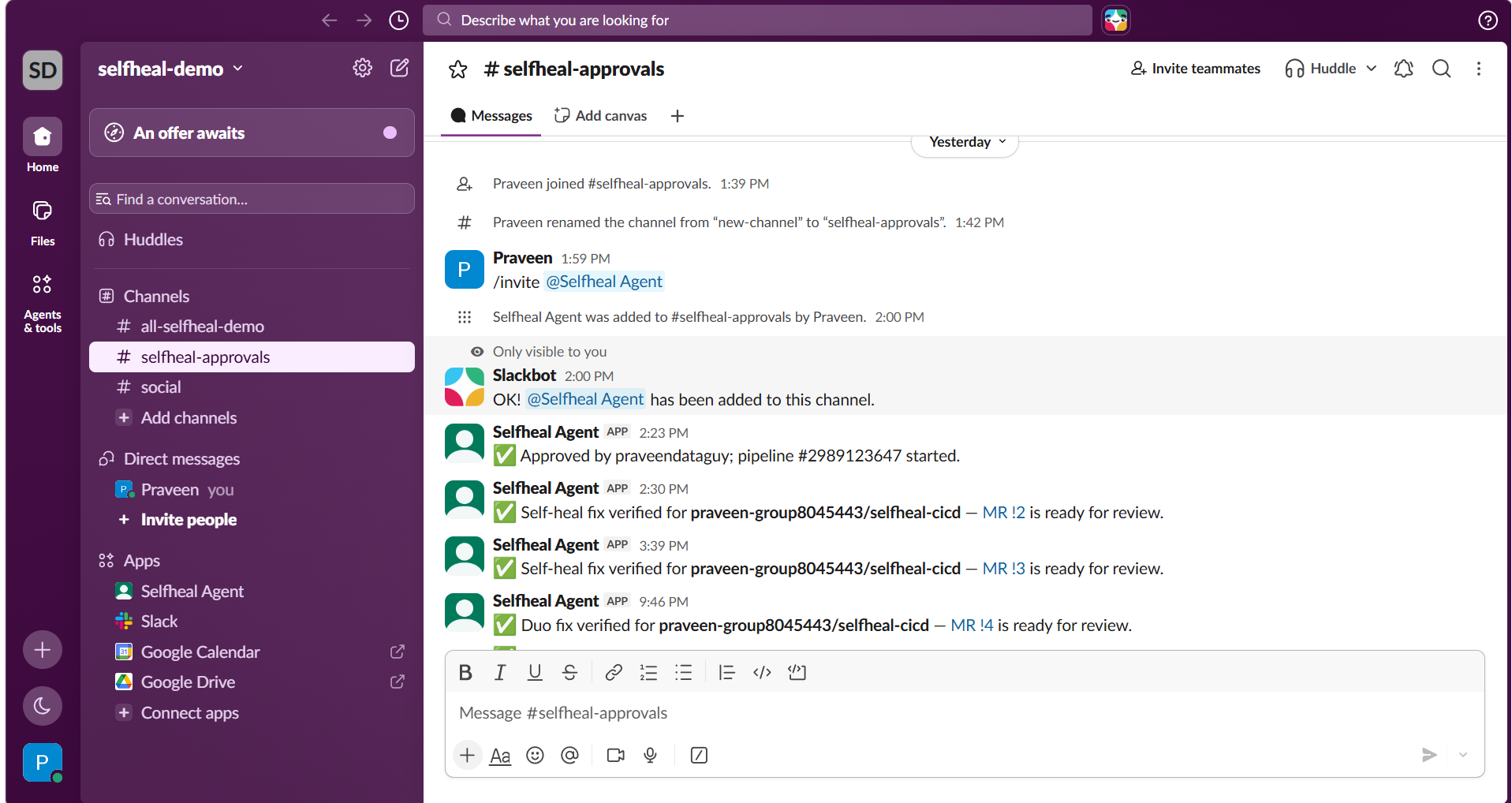
“Self-heal governance passed” and “Pipeline passed with the Duo fix”
-
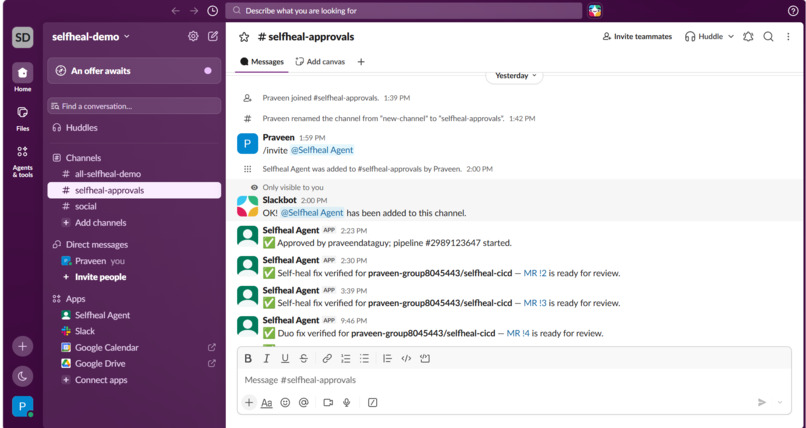
“Approved by praveendataguy” and “fix verified”
-
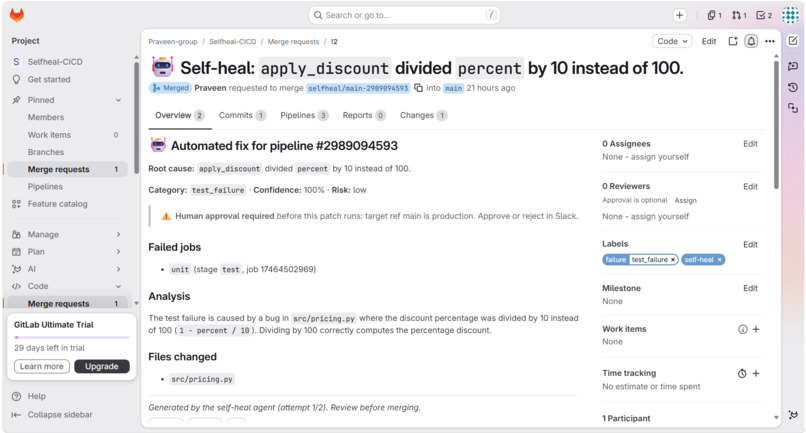
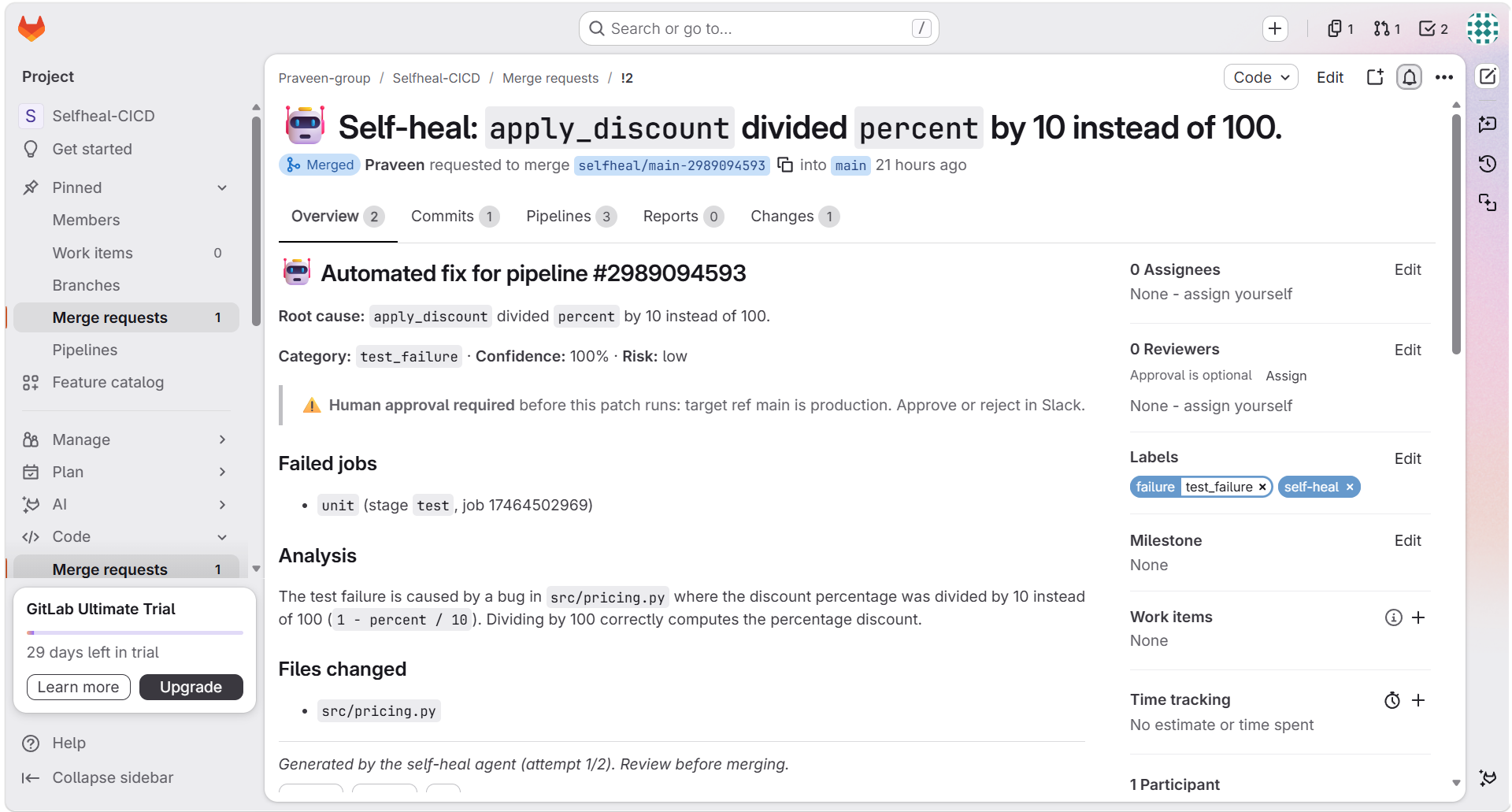
Human approval required before this patch runs: target ref main is production. Approve or reject in Slack.
Inspiration
AI agents can now fix a failing pipeline on their own. That raises a new question for every team: how do you trust a code change that no person wrote? An agent under pressure to make CI green might skip a test, touch a secret, or push straight to production. I wanted autonomy and control: let the AI fix things, but put a safety layer around it.
What it does
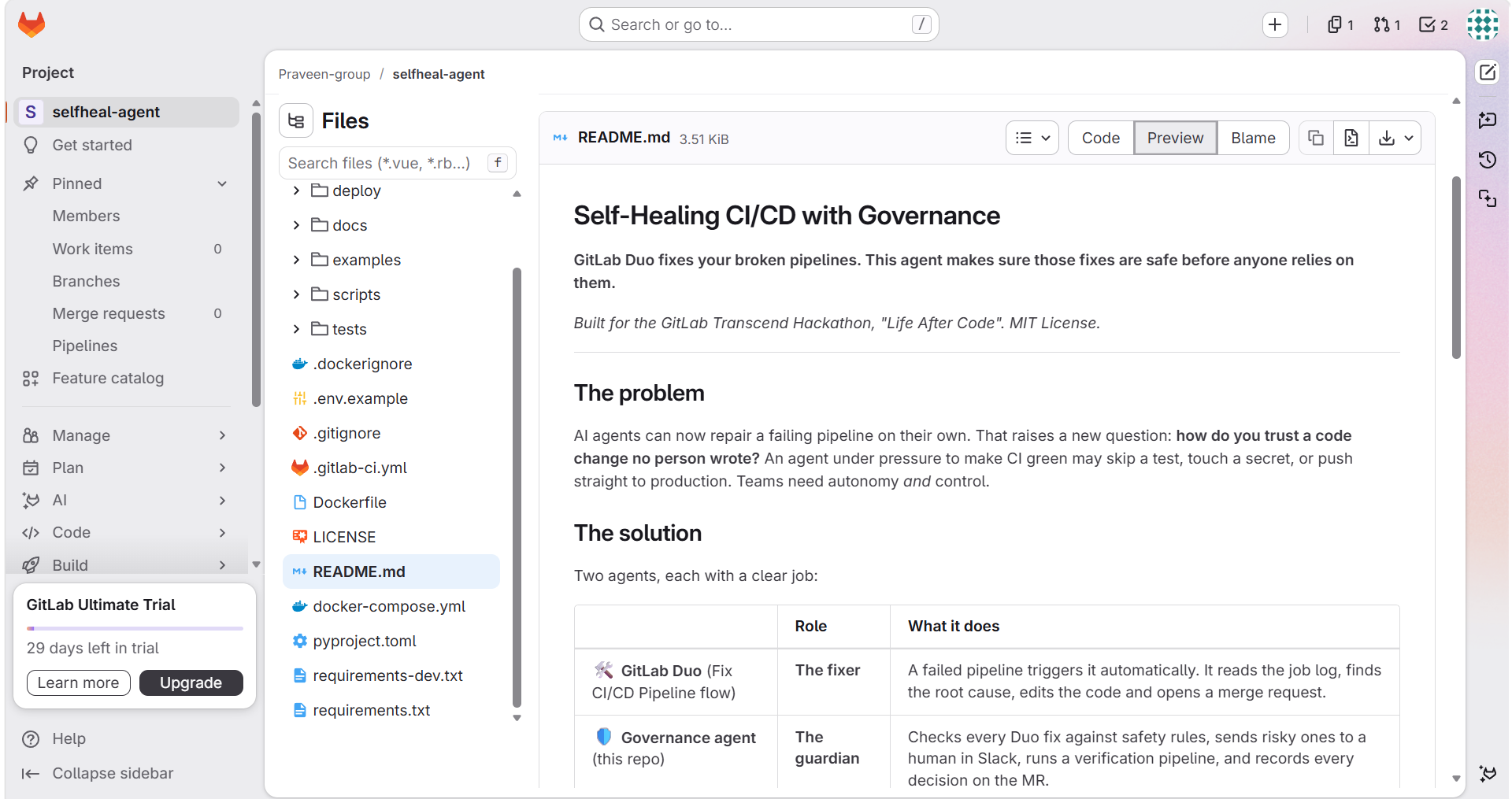
Self-Healing CI/CD with Governance uses two agents, each with one job:
- The fixer: GitLab Duo's Fix CI/CD Pipeline flow. A pipeline failed trigger starts it automatically. It reads the job log, finds the root cause, edits the code and opens a merge request.
- The guardian: my governance agent. It inspects every Duo fix MR and decides what happens next:
| If Duo's fix... | Then |
|---|---|
| is a normal code change on a feature branch | Auto-verified: a test pipeline runs right away |
targets main or a release branch |
Human approval in Slack first (the MR is held as a Draft) |
| changes CI, Docker or infrastructure files | Human approval |
| skips or weakens tests to make CI green | Human approval |
| touches secrets or keys | Blocked |
After verification it comments on the MR and posts to Slack: verified or needs a human. Every decision is written on the merge request, so the MR becomes the audit trail. Nothing is ever merged automatically.
Autonomy level: supervised. Automatic where it's safe, a human where it matters.
Proof it works
On the public demo project:
- MR !4, the automatic path. A planted bug (
percent / 10instead of/ 100) broke the pipeline. Duo fixed it by itself and left the test untouched. The governance agent labelled the MR, found no policy concerns, ran a verification pipeline, and it passed. - MR !2, the human-in-the-loop path. A fix targeting
mainwas held as a Draft with[skip ci]until I clicked Approve in Slack. Only then did it run and pass.
How I built it
- GitLab Duo Agent Platform: enabled the Fix CI/CD Pipeline foundational flow, created a pipeline-event trigger (on Failed), and enabled the Code Review flow.
- Governance agent: Python + FastAPI. It receives GitLab pipeline and merge request webhooks, and the guardrails live in
policy.py. - Human-in-the-loop: a Slack app with Block Kit Approve/Reject buttons, request-signature verification, and an optional approver allow-list.
- Quality: 47 automated tests with fake GitLab, LLM and Slack clients, plus an MIT license.
- Monitoring-ready: structured JSON event logs, plus scripts for Cloud Run deployment and Cloud Logging metrics and alerts.
- Standalone mode: the agent can also diagnose failures itself with an LLM (Claude, Gemini, or a free mock), which is how MR !1 and MR !2 were produced.
Challenges I ran into
- Duo didn't run its own tests. In MR !4, Duo wrote: "I couldn't run
python -m pytest -q... I haven't run the real job." That confirmed the core idea: an AI fix needs independent verification, so the governance agent always runs a real pipeline. - Recognising Duo's work. Duo flows act with the triggering user's identity, so MRs show my name as the author. I detect Duo fixes by their
duo/branch prefix and[FixPipeline]title instead. - Setup puzzles. The flow was blocked by a group-level "foundational flows" setting, and Duo showed "No credits remaining" until I set the default Duo group.
- Secrets hygiene. Tokens appeared in my own screenshots during development. I revoked and rotated them, and kept
.envout of the repository with.gitignore.
Accomplishments that I'm proud of
- A complete, working loop on real GitLab infrastructure: failure, Duo fix, governance, verification, then human approval.
- Guardrails that stop the classic "make CI green" cheats.
- Built entirely on free tiers.
What I learned
Autonomy is easy to add, and trust is the hard part. The most valuable piece wasn't the fix itself: it was verification, clear rules, and a visible audit trail.
What's next
- A custom Duo flow that opens an issue when a fix fails verification
- The same guardrails for Duo's security-fix flows
- Always-on hosting on Google Cloud Run
Code: https://gitlab.com/praveen-group8045443/selfheal-agent
Demo project: https://gitlab.com/praveen-group8045443/selfheal-cicd

Log in or sign up for Devpost to join the conversation.