-
-
This is project media
\section*{Inspiration}
Modern applications can fail because of bugs, unexpected exceptions, dependency issues, or configuration problems. Diagnosing and fixing these failures often requires developers to manually inspect logs, identify the root cause, modify code, run tests, and deploy the fix. We wanted to build an AI-powered system that could automate this entire incident-response cycle and reduce application downtime.
\section*{What it does}
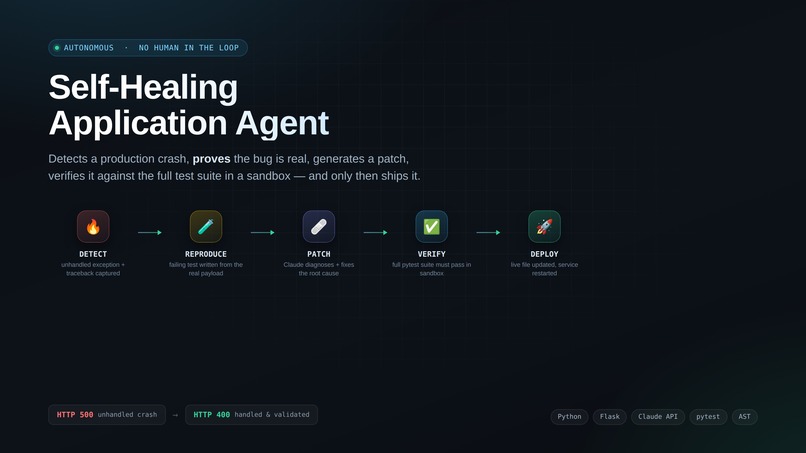
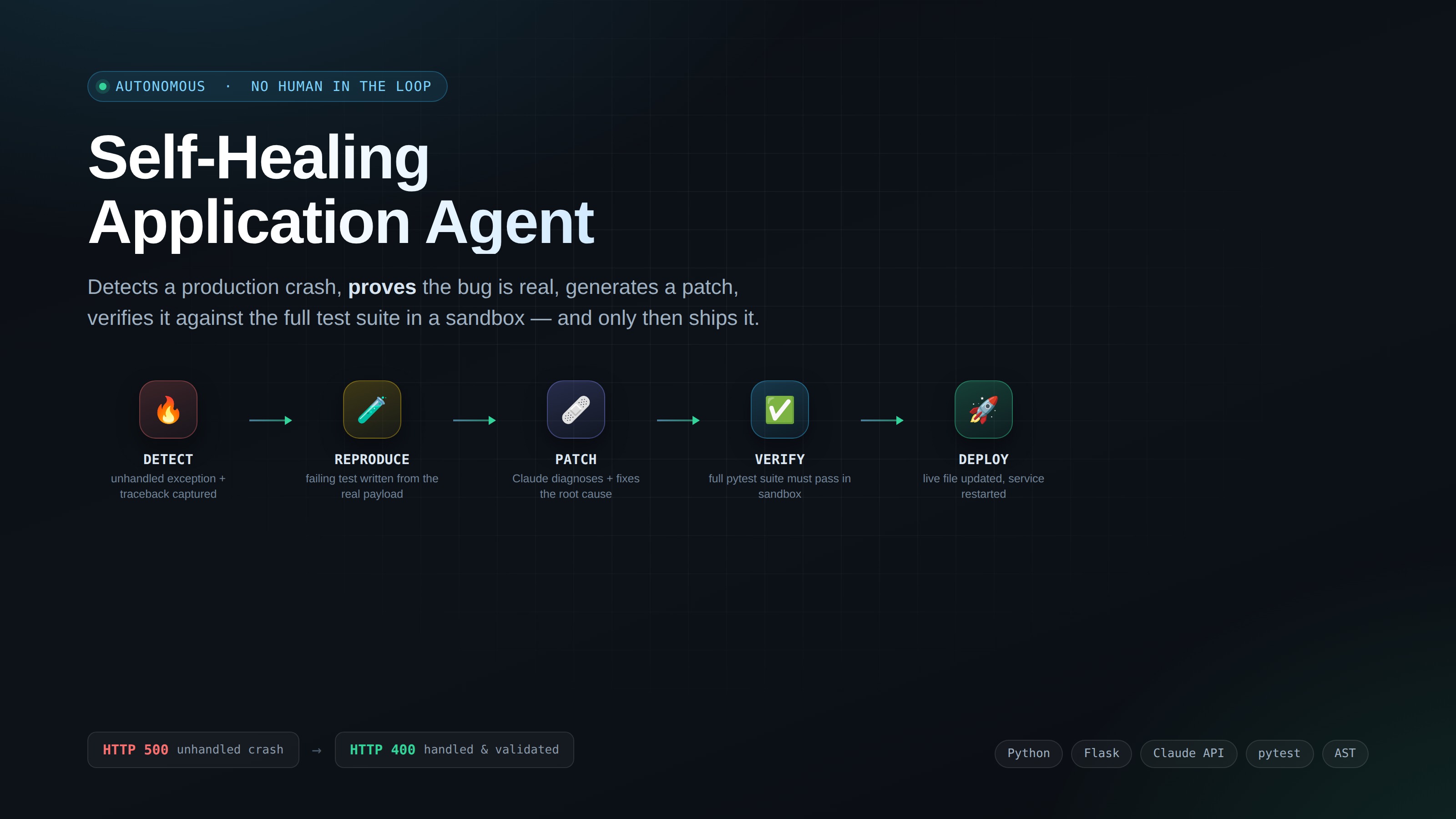
The Self-Healing Application Agent continuously monitors application logs and errors. When a failure is detected, the agent analyzes the logs and recent code changes to identify the probable root cause. It then generates a potential code fix, runs automated tests to validate the fix, and presents the result for human approval. Once approved, the fix can be deployed automatically and the application health is verified.
\section*{How we built it}
We built the system using a multi-agent architecture. A monitoring agent detects application failures, a log analysis agent investigates errors, and a root-cause analysis agent determines the likely source of the problem. A code agent generates the required patch, while a testing agent validates the solution. An orchestrator agent coordinates the complete workflow. The backend is implemented using Python and FastAPI, with integrations for application logs, Git repositories, automated testing, deployment, and health checks.
\section*{Challenges we ran into}
One of the main challenges was making the AI-generated fixes reliable and safe. Application logs can contain incomplete or noisy information, making root-cause identification difficult. Another challenge was ensuring that generated code changes did not introduce new issues. We addressed this by adding automated testing and a human-in-the-loop approval step before deployment.
\section*{Accomplishments that we're proud of}
We built a complete autonomous incident-resolution workflow instead of a simple AI chatbot. The agent can detect an application failure, analyze the available evidence, identify a probable root cause, generate a fix, validate the fix through testing, and prepare it for deployment. The human approval stage also provides an important safety layer while still keeping the recovery process highly automated.
\section*{What we learned}
We learned that effective AI agents need more than an LLM. They require reliable tools, structured workflows, access to real application context, validation mechanisms, and clear safety boundaries. We also learned the importance of combining AI reasoning with deterministic tools such as log analysis, testing, Git operations, health checks, and deployment automation.
\section*{What's next for Self-Healing Application Agent}
The next step is to make the system capable of handling a wider range of production incidents, including infrastructure failures, database issues, dependency problems, and performance degradation. We also plan to add stronger observability, rollback capabilities, automated regression testing, historical incident memory, and improved confidence scoring so the agent can determine when it can safely remediate an issue and when human intervention is required.


Log in or sign up for Devpost to join the conversation.