SehatRozgar — Health + Financial Resilience Intelligence for Workers
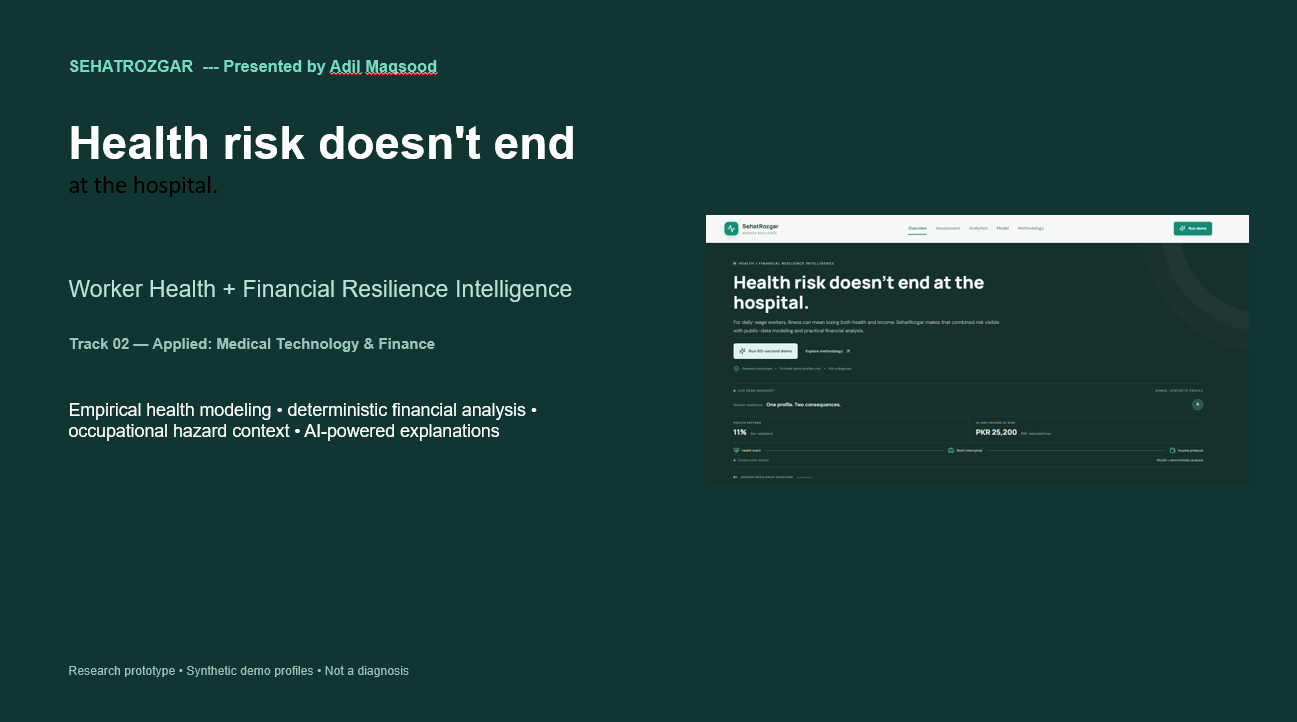
When health stops work, resilience becomes measurable.
Inspiration
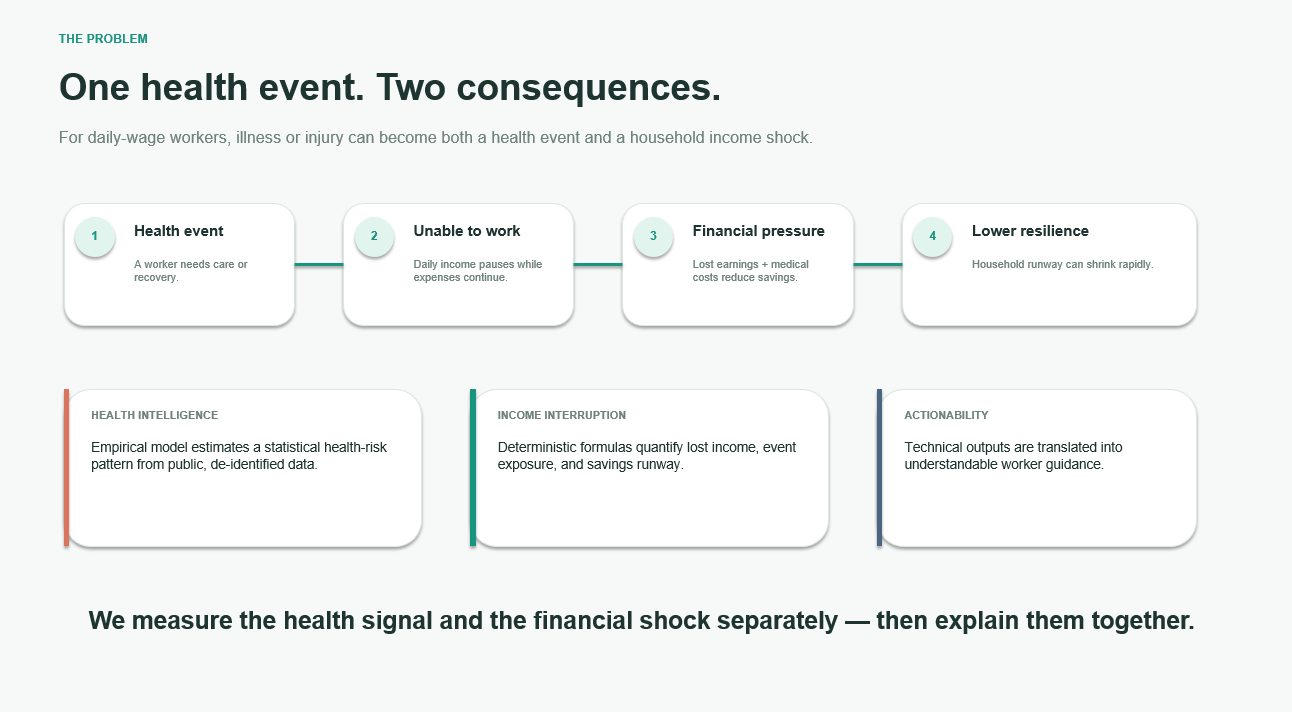
For a daily-wage worker, getting sick does not only create a health problem — it can immediately create a financial problem.
A construction worker, delivery rider, factory worker, driver, or welder may depend directly on their ability to work each day. If a health event prevents them from working, two consequences can happen at the same time:
Health Event → Medical Needs
Health Event → Unable to Work → Lost Income → Household Financial Pressure
Most healthcare systems focus on the medical side, while financial tools focus on money. We wanted to connect these two consequences and make the relationship visible.
That led us to build SehatRozgar, a worker health and financial resilience intelligence platform combining empirical machine learning, deterministic financial analytics, occupational hazard context, and AI-powered explanations.
Our core idea is simple:
When a daily-wage worker gets sick, the cost isn't only healthcare. Their income can stop too.
What It Does
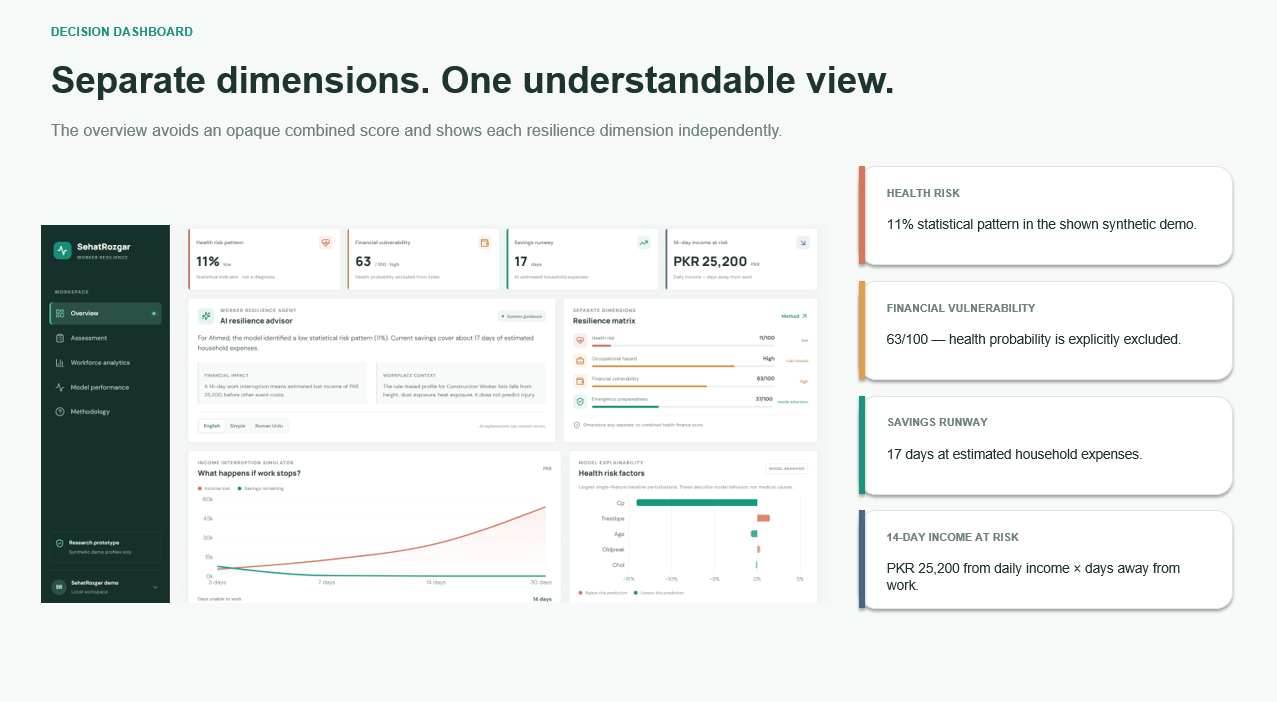
SehatRozgar analyzes worker resilience across several separate and transparent dimensions rather than hiding everything behind one black-box score.
The platform provides:
- Health Risk Analysis — identifies statistical health-risk patterns using an empirical machine-learning model.
- Financial Vulnerability Analysis — measures the worker's ability to absorb an income interruption.
- Savings Runway — estimates how many days existing savings can support household expenses.
- Income-at-Risk Simulation — calculates potential lost earnings when a worker cannot work.
- Occupational Hazard Assessment — provides rule-based hazard context based on occupation.
- Emergency Preparedness Analysis — evaluates the worker's financial buffer against unexpected events.
- AI Resilience Advisor — converts technical results into understandable and actionable explanations.
- Workforce Analytics — demonstrates aggregate resilience patterns using synthetic worker profiles.
For example, consider a synthetic construction worker earning PKR 1,800 per day.
If that worker becomes unable to work for 14 days:
$$ \text{Income Loss} = 1,800 \times 14 = 25,200\text{ PKR} $$
Instead of displaying only this number, SehatRozgar analyzes how that interruption interacts with the worker's savings, household expenses, medical costs, dependents, and emergency preparedness.
The result is a more complete picture of worker resilience.
How We Built It
SehatRozgar follows a modular architecture where each component has one clearly defined responsibility.
Public Health Dataset
        |
        v
Data Cleaning & Preprocessing
        |
        v
Machine Learning Models
        |
        v
Health Risk Prediction
        |
        v
Model Explainability
        |
        +---------------------------+
        |                           |
        v                           v
Financial Profile           Worker Occupation
        |                           |
        v                           v
Financial Engine        Occupational Hazard Engine
        |                           |
        +-------------+-------------+
                      |
                      v
             Structured Assessment
                      |
                      v
                Featherless AI
                      |
                      v
          Worker Resilience Advisor
                      |
                      v
             Accessible Guidance
                      |
                      v
               React Dashboard
Our core architectural principle is:
AI explains. Models predict. Mathematics calculates. Rules contextualize.
This separation is intentional.
We do not ask a general-purpose language model to calculate financial vulnerability or generate medical probabilities.
Empirical Health Modeling
For the health component, we wanted to use real empirical data rather than synthetic medical outcomes.
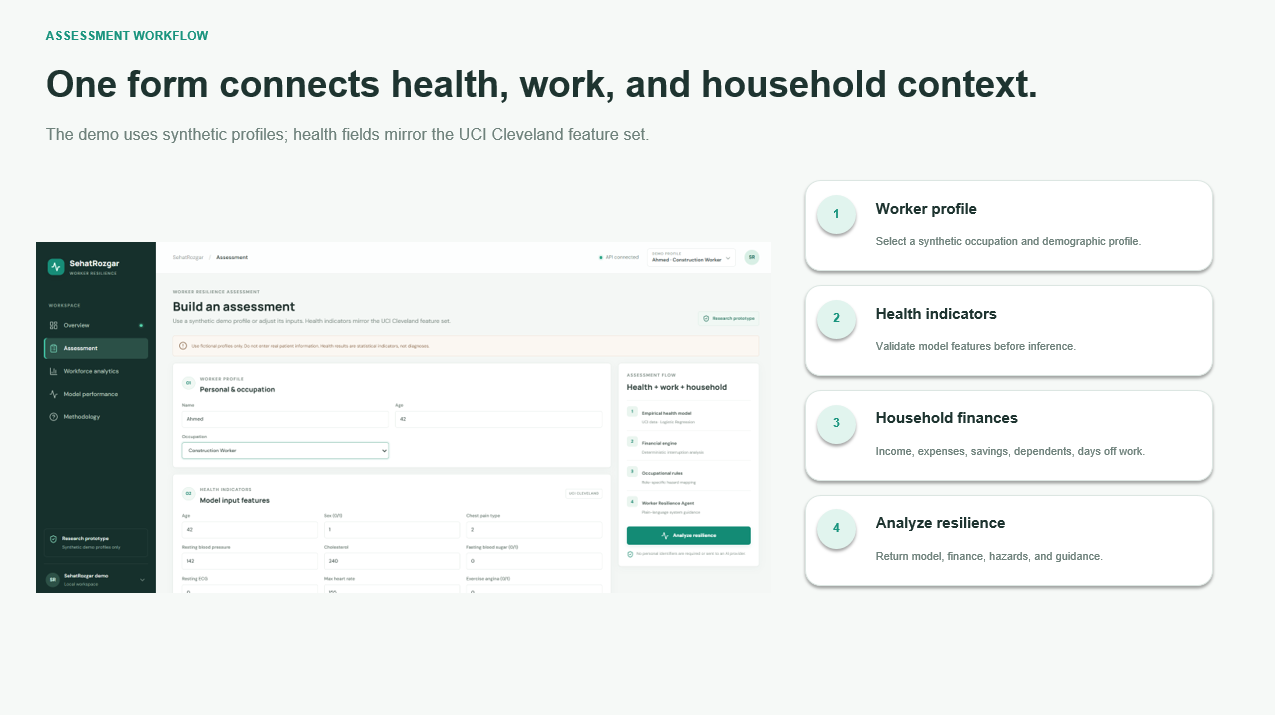
We used the UCI Heart Disease Dataset — processed Cleveland subset, containing 303 historical observations.
The dataset includes features such as:
- Age
- Sex
- Chest pain type
- Resting blood pressure
- Cholesterol
- Fasting blood sugar
- Resting ECG
- Maximum heart rate
- Exercise-induced angina
- ST depression
- ST slope
- Number of major vessels
- Thalassemia code
Our preprocessing pipeline handles missing values and categorical features before model training.
We compared three machine-learning approaches:
- Logistic Regression
- Random Forest
- Gradient Boosting
We used a fixed stratified 75/25 holdout split with random_state=42.
Model Comparison
| Model | ROC-AUC | Precision | Recall | F1 |
|---|---|---|---|---|
| Logistic Regression | 0.944 | 0.833 | 0.857 | 0.845 |
| Random Forest | 0.936 | 0.800 | 0.914 | 0.853 |
| Gradient Boosting | 0.925 | 0.789 | 0.857 | 0.822 |
We selected Logistic Regression for the prototype because it achieved the highest ROC-AUC in our experiment while also providing an interpretable baseline.
On the 76-record held-out set, its confusion matrix was:
True Negatives:   35
False Positives:   6
False Negatives:   5
True Positives:   30
These results represent experimental performance on a small historical dataset.
They do not establish clinical validity, particularly for daily-wage or occupational worker populations.
For this reason, SehatRozgar presents its output as a statistical health-risk pattern, not a medical diagnosis.
Explainable Machine Learning
A probability alone is difficult to understand.
SehatRozgar therefore includes a model explainability layer that shows which input features had the strongest influence on an individual model output.
For example, the interface can visualize contributions from features such as:
- Chest pain type
- Resting blood pressure
- Age
- ST depression
- Cholesterol
This helps users understand why the model produced a particular result rather than simply presenting a percentage.
However, an important distinction is maintained throughout the application:
Model contribution does not imply medical causality.
The explainability layer describes model behavior only.
Financial Resilience Engine
The financial component is deliberately deterministic and auditable.
An LLM is never responsible for calculating financial metrics. All financial outputs are generated using predefined mathematical formulas.
Monthly Income
$$ \boxed{\text{Monthly Income} = \text{Daily Income} \times \text{Working Days per Month}} $$
Income Loss
$$ \boxed{\text{Income Loss} = \text{Daily Income} \times \text{Days Unable to Work}} $$
Gross Event Exposure
$$ \boxed{\text{Gross Event Exposure} = \text{Income Loss} + \text{Estimated Medical Cost}} $$
Health Savings Used
$$ \boxed{\text{Health Savings Used} = \min(\text{Health Savings}, \text{Estimated Medical Cost})} $$
Net Event Exposure
$$ \boxed{\text{Net Event Exposure} = \text{Gross Event Exposure} - \text{Health Savings Used}} $$
Daily Household Burn
$$ \boxed{\text{Daily Household Burn} = \frac{\text{Monthly Household Expenses}}{30}} $$
Savings Runway
$$ \boxed{\text{Savings Runway Days} = \frac{\text{Current Savings}}{\text{Daily Household Burn}}} $$
Emergency Fund Target
$$ \boxed{\text{Emergency Fund Target} = 3 \times \text{Monthly Household Expenses}} $$
Emergency Fund Gap
$$ \boxed{\text{Emergency Fund Gap} = \max(\text{Emergency Fund Target} - \text{Current Savings}, 0)} $$
Event Coverage Ratio
$$ \boxed{\text{Event Coverage Ratio} = \frac{\text{Current Savings}}{\max(\text{Net Event Exposure}, 1)}} $$
Remaining Savings
$$ \boxed{\text{Remaining Savings} = \max(\text{Current Savings} - \text{Net Event Exposure}, 0)} $$
Because these calculations are deterministic, the same inputs always produce the same financial outputs.
Income Interruption Simulator
One of SehatRozgar's main features is the Income Interruption Simulator.
It answers a simple but important question:
What happens financially if this worker cannot work?
The system can simulate different periods of work interruption, such as:
- 3 days
- 7 days
- 14 days
- 30 days
For each scenario, SehatRozgar can show:
- Lost income
- Estimated medical expenses
- Gross financial exposure
- Net financial exposure
- Remaining savings
- Savings runway
- Emergency-fund gap
- Event coverage
For our synthetic construction worker Ahmed:
Daily income:             PKR 1,800
Working days/month:       24
Current savings:          PKR 18,000
Monthly expenses:         PKR 32,000
Health savings:           PKR 3,000
Dependents:               4
Estimated medical cost:   PKR 8,000
Days unable to work:      14
The resulting income interruption alone is:
$$ 1,800 \times 14 = 25,200\text{ PKR} $$
His estimated savings runway is approximately:
$$ \frac{18,000}{32,000/30} \approx 17\text{ days} $$
This demonstrates why even a relatively short health-related work interruption can create significant household pressure.
Financial Vulnerability Index
We developed a transparent Financial Vulnerability Index ranging from 0 to 100.
The index combines several financial resilience dimensions:
| Component | Weight |
|---|---|
| Savings Runway | 25% |
| Expense-to-Income Ratio | 20% |
| Emergency Fund Gap | 20% |
| Event Coverage | 15% |
| Dependents | 10% |
| Income Interruption Exposure | 10% |
One important design decision was to exclude medical risk probability from the Financial Vulnerability Index.
Health information should not silently become a credit score.
The Financial Vulnerability Index is therefore strictly informational.
It is not intended for:
- Lending decisions
- Credit scoring
- Insurance pricing
- Employment decisions
- Worker eligibility decisions
Occupational Hazard Assessment
Different occupations involve different working environments.
SehatRozgar therefore includes a deterministic occupational hazard engine.
The prototype supports occupations including:
- Construction Worker
- Factory Worker
- Warehouse Worker
- Delivery Rider
- Driver
- Welder
- Electrician
- Agricultural Worker
- Sanitation Worker
- Security Worker
For example, a construction worker may encounter occupational hazards such as:
Falls
Dust exposure
Heat exposure
Noise exposure
Musculoskeletal strain
A delivery rider may encounter:
Traffic accidents
Heat exposure
Air pollution
Fatigue
Prolonged riding
A welder may encounter:
Fumes
Burns
Eye injury
Heat exposure
Respiratory exposure
These mappings provide occupational context only.
They are not predictions that an injury or illness will occur.
Worker Resilience Agent
Generative AI is used as an explanation layer, not as the source of truth.
The Worker Resilience Agent, powered by Featherless AI, receives structured outputs that have already been generated by the machine-learning model and deterministic engines.
For example:
{
  "health": {
    "risk_probability": 0.11,
    "risk_level": "low"
  },
  "financial": {
    "income_loss_14_days": 25200,
    "savings_runway_days": 17,
    "vulnerability_score": 63
  },
  "occupational": {
    "occupation": "Construction Worker",
    "hazards": [
      "falls",
      "dust exposure",
      "heat exposure"
    ]
  }
}
Featherless AI converts this structured information into understandable guidance.
The AI Resilience Advisor can provide explanations in:
- English
- Simple English
- Roman Urdu
This allows technical information to be communicated in a more accessible way.
AI Safety Architecture
We deliberately restricted what the generative AI layer is allowed to do.
The AI Can
- Explain model outputs
- Summarize financial vulnerability
- Explain occupational hazards
- Prioritize existing recommendations
- Suggest questions to discuss with a healthcare professional
- Translate technical information into simpler language
The AI Cannot
- Diagnose disease
- Prescribe medication
- Invent medical measurements
- Invent probabilities
- Modify ML predictions
- Calculate financial metrics
- Modify vulnerability scores
- Determine creditworthiness
- Price insurance
- Make employment decisions
Before structured information is sent to the LLM, sensitive identifiers can be removed.
The architecture follows:
Structured Results
        |
        v
Data Sanitization
        |
        v
Featherless AI
        |
        v
Structured Explanation
        |
        v
User Interface
If Featherless AI becomes unavailable, the application can use a deterministic fallback explanation, allowing the core assessment system to continue functioning.
Workforce Analytics
SehatRozgar also demonstrates how resilience information could be analyzed at an aggregate level.
For the hackathon prototype, the workforce dashboard contains six completely synthetic worker profiles.
The dashboard visualizes information such as:
- Number of synthetic workers
- Workers with less than 14 days of savings runway
- Average emergency preparedness
- Financial vulnerability distribution
- Occupation distribution
- Occupational groups
Individual medical assessments are deliberately excluded from workforce-level analytics.
The purpose is to demonstrate aggregate resilience analysis without turning individual medical information into an employment-management tool.
Challenges We Ran Into
1. Connecting Healthcare and Finance Responsibly
The biggest conceptual challenge was combining two sensitive domains without producing a misleading universal "worker score."
A worker could have relatively low statistical health risk while simultaneously having extremely high financial vulnerability.
Combining these into one number would hide that distinction.
We therefore keep:
- Health risk
- Financial vulnerability
- Occupational hazard
- Emergency preparedness
as separate dimensions.
2. Deciding Where Generative AI Belongs
It would have been much easier to send all worker information to an LLM and ask it to generate an assessment.
We deliberately rejected that architecture.
Instead:
Machine Learning  → Statistical Prediction
Mathematics       → Financial Calculations
Rules             → Occupational Context
Generative AI     → Explanation
This makes the system more transparent, reproducible, and auditable.
3. Working With a Small Historical Dataset
The processed Cleveland dataset contains only 303 observations and was not collected specifically from daily-wage workers.
Instead of hiding this limitation, we expose:
- Dataset size
- Model metrics
- Confusion matrix
- Model comparison
- Methodology
- Limitations
directly inside the application.
The health component should therefore be understood as an empirical research demonstration, not a clinically validated system.
4. Separating Explainability From Causality
Another challenge was presenting model explanations responsibly.
A model may assign a strong contribution to a particular feature, but this does not mean that feature medically caused the outcome.
We therefore describe our visualization as model explainability, not causal medical explanation.
5. Making Technical Information Understandable
Metrics such as ROC-AUC, feature contribution, event coverage, savings runway, and emergency-fund gaps are useful technically but may not be intuitive for ordinary workers.
This motivated the Worker Resilience Agent.
Instead of replacing the analytical system with AI, we use AI to make the analytical system easier to understand.
What We Learned
The biggest lesson from building SehatRozgar was that adding AI to healthcare does not necessarily mean allowing AI to make more decisions.
Sometimes a stronger architecture gives AI less authority and a more focused responsibility.
We learned to separate responsibilities clearly:
Machine learning handles statistical prediction.
Mathematics handles financial calculations.
Rules provide occupational context.
Generative AI handles communication.
We also learned that financial resilience can dramatically change the meaning of a health event.
For someone with months of savings, a two-week interruption may be manageable.
For someone with only a few days of financial runway, the same interruption may create immediate household pressure.
That relationship became the central idea behind SehatRozgar.
Accomplishments We're Proud Of
Rather than building another medical chatbot, we created an end-to-end worker resilience intelligence system.
The prototype includes:
- Real public healthcare data
- Reproducible ML preprocessing
- Multiple-model comparison
- Holdout model evaluation
- Model explainability
- Deterministic financial calculations
- Financial Vulnerability Index
- Savings runway analysis
- Income Interruption Simulator
- Occupational hazard assessment
- Emergency preparedness analysis
- Synthetic workforce analytics
- Featherless AI integration
- AI-generated resilience explanations
- Simple English explanations
- Roman Urdu accessibility
- Deterministic AI fallback
- Interactive dashboards
- Dedicated model-performance reporting
- Transparent methodology and limitations
Most importantly, every component has a clearly defined responsibility.
Technology Stack
Frontend
- React
- TypeScript
- Vite
- Tailwind CSS
- Recharts
Backend
- Python
- FastAPI
- scikit-learn
Machine Learning
- Logistic Regression
- Random Forest
- Gradient Boosting
- UCI Heart Disease Dataset
- Model explainability
Generative AI
- Featherless AI
- Structured prompting
- Structured JSON outputs
- Deterministic fallback guidance
Analytics
- Financial resilience engine
- Income interruption simulation
- Occupational hazard rules
- Workforce resilience analytics
Ethics and Privacy
SehatRozgar is currently a research prototype.
All worker profiles shown in the demonstration are synthetic.
The prototype:
- Does not operate on real patients
- Does not execute real financial transactions
- Does not provide medical diagnoses
- Does not prescribe treatment
- Does not determine employment eligibility
- Does not provide credit scores
- Does not make lending decisions
- Does not price insurance
The health-risk model is based on a small historical dataset and should not be interpreted as clinically validated for occupational worker populations.
Any future real-world healthcare deployment would require significantly stronger evidence, external validation, clinical oversight, privacy safeguards, bias evaluation, and appropriate regulatory review.
What's Next for SehatRozgar
SehatRozgar is currently a research prototype, but the architecture could be expanded significantly.
Future work could include:
- Larger and more representative occupational-health datasets
- Longitudinal worker health data
- Income-volatility modeling
- Country-specific social-protection information
- Worker benefits and assistance discovery
- Additional local languages
- Voice-based accessibility
- Mobile-first assessments
- Wearable integrations
- Occupational telemetry
- Consent-based healthcare integrations
- Longitudinal resilience monitoring
- More sophisticated financial shock simulations
A future research direction could also study how different financial buffers change the economic impact of temporary health-related work interruptions across different occupations.
Our Vision
SehatRozgar started with one question:
What happens when a health event also stops someone's income?
The answer cannot be captured by a medical probability alone.
It involves health, occupation, income, savings, household responsibilities, and the worker's ability to absorb an unexpected interruption.
SehatRozgar demonstrates how these dimensions can be analyzed together while keeping their responsibilities separate and transparent.
By combining empirical machine learning, transparent financial modeling, occupational context, and accessible generative AI, SehatRozgar makes an often invisible consequence of illness easier to understand.
Health risk doesn't end at the hospital.
When health stops work, resilience becomes measurable.
Built With
- ai
- analytics
- explainable
- fastapi
- featherless
- financial
- fintech
- generative
- healthcare
- healthtech
- llm
- predictive
- python
- react
- regression
- scikit-learn
- tailwind
- typescript

Log in or sign up for Devpost to join the conversation.