Inspiration
Staying healthy in Indonesia often means juggling three or four different apps: one to track your health, one for workout programs, and another for nutrition and almost none of them feel local. Workout apps assume gym equipment everyone may not have, and nutrition apps suggest ingredients you won't find in a pasar. We wanted one lightweight app that understands Indonesian users: their food, their goals, and their daily habits. That question "why can't healthy living fit in one simple web app?" became SehatIn.
What it does
SehatIn is a mobile-first web app that works as an all-in-one personal health companion:
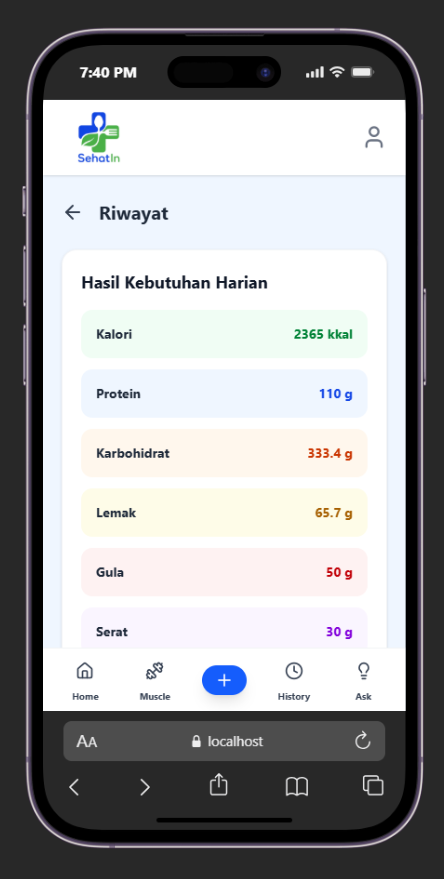
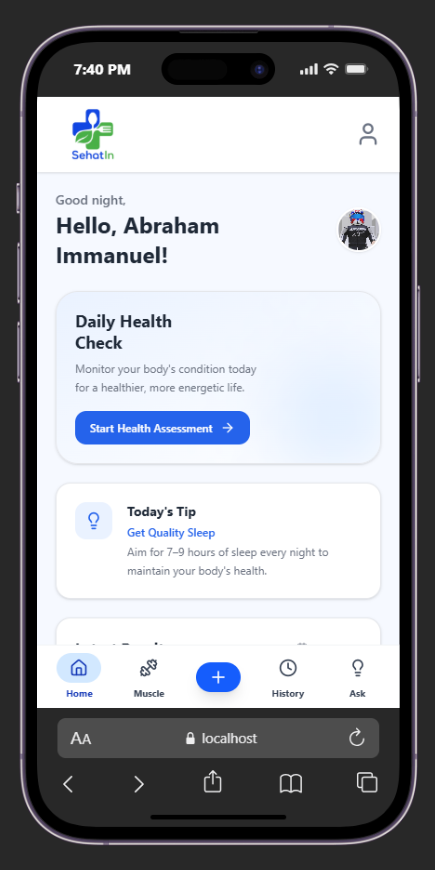
- Daily Health Check users record their physical data (age, height, weight) and get an instant health assessment, with every result saved to a persistent Assessment History so progress can be tracked over time.
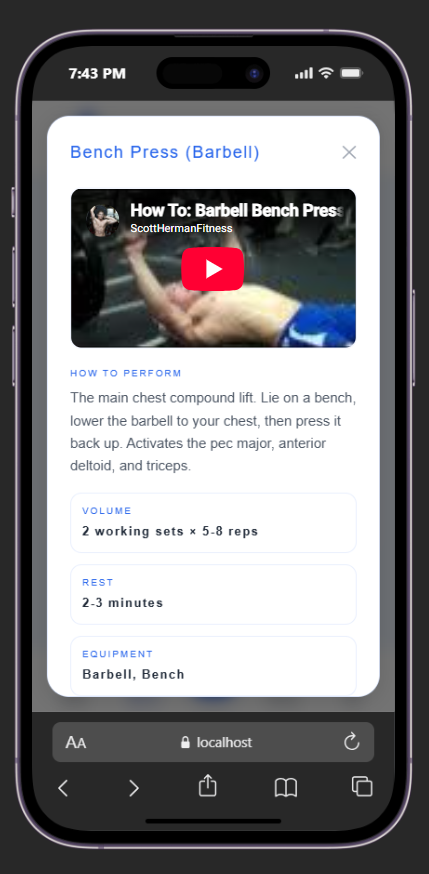
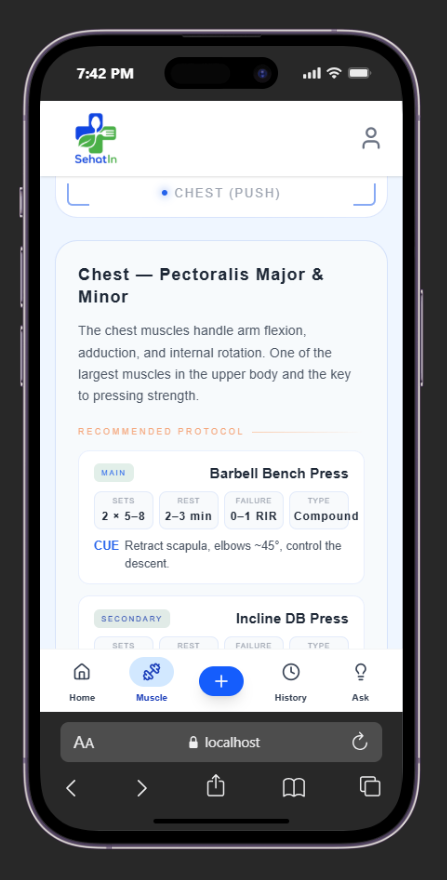
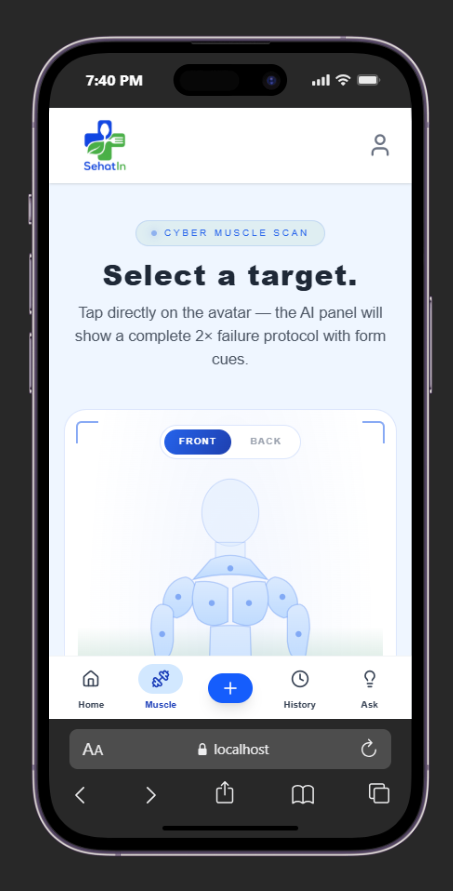
- Muscle Scan is an interactive body avatar (front and back view) where users simply tap a muscle, and an AI panel generates a complete 2× failure training protocol with proper form cues for that muscle group.
- Nutrition Calculator computes daily caloric and macronutrient needs from the user's physical data using the Mifflin-St Jeor equation.
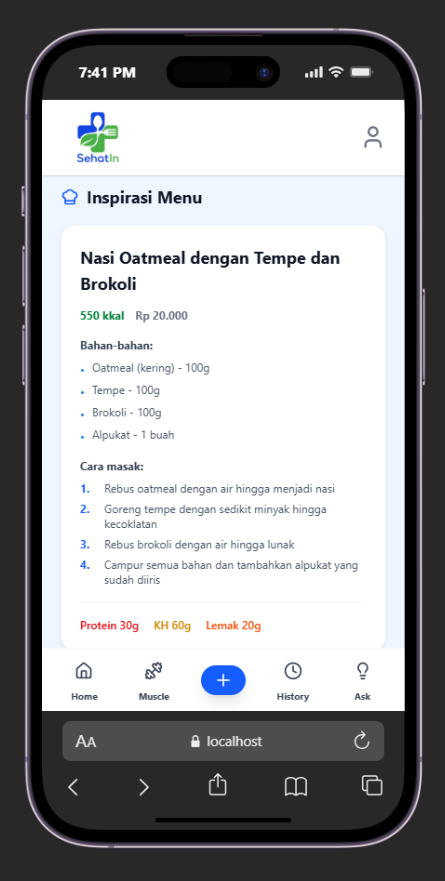
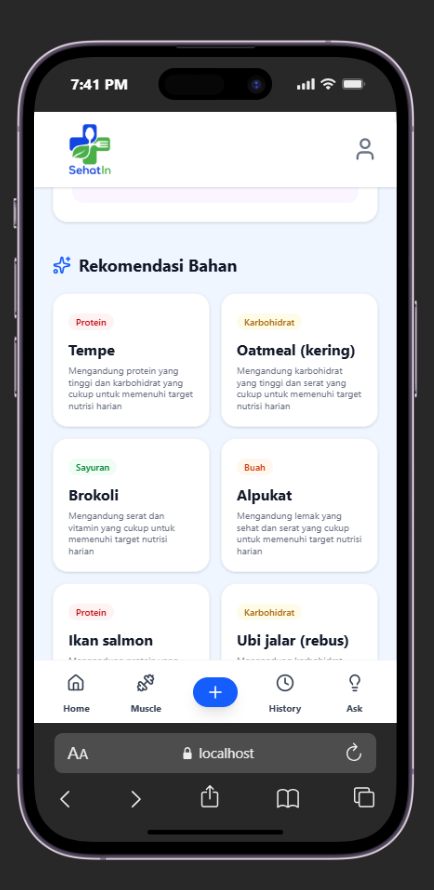
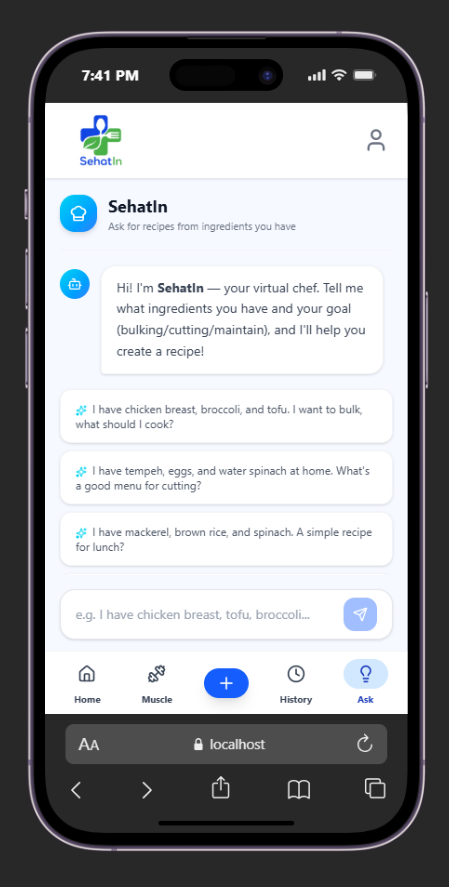
- Ask (AI Recipe Assistant) is a chat assistant that understands local ingredients like tempeh, kangkung, and mackerel, and generates meal ideas tailored to the user's goal, whether bulking or cutting.
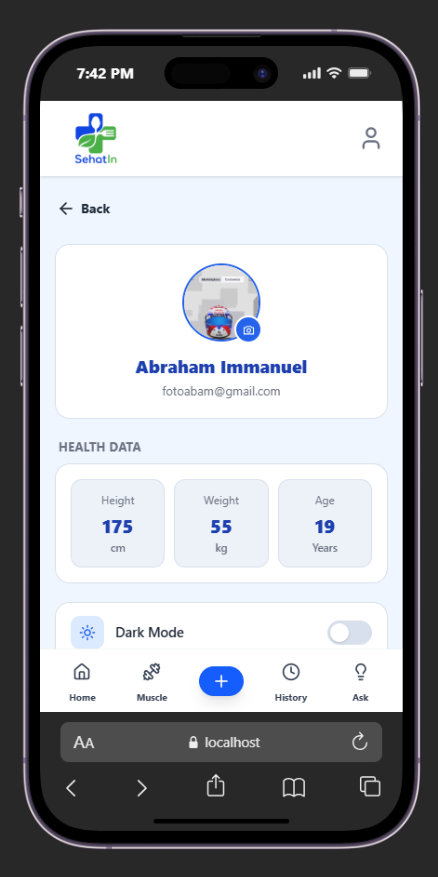
- Profile & Dark Mode is a personal profile summarizing the user's health data, with theme customization. Everything runs in the browser no installation needed so it's accessible on any smartphone.
How we built it
We designed the experience first: mapping the five core tabs (Home, Muscle, Assessment, History, Ask) and locking in a consistent design system a clean blue-and-white palette, rounded cards, and a native-feeling bottom navigation with a central action button. The UI was prototyped in Figma before any code was written.
The app is built with React and TypeScript, styled with Tailwind CSS, with icons from Lucide. The Muscle Scan avatar is a custom SVG with tap-target regions mapped to each muscle group. The AI features (training protocols and the recipe assistant) are powered by an LLM API that returns structured responses based on user input. Nutrition math is implemented directly in the app using the Mifflin-St Jeor equation, and assessment history is persisted locally on the device. The app is deployed on Vercel.
Challenges we ran into
The hardest feature was the interactive Muscle Scan. Building a tappable anatomy avatar that feels responsive on small touchscreens with accurate hit areas on both front and back views took several iterations of tuning the SVG regions. On the AI side, getting the model to return consistently structured training protocols and recipes (instead of loose, generic text) required careful prompt design and response parsing. We also had to make the whole flow work smoothly as a single connected system: assessments feeding into history, and health data flowing into the profile all while keeping the app fast on low-end devices.
Accomplishments that we're proud of
- A fully functional, polished mobile web app, not just a mockup, with five working features connected end to end.
- An interactive muscle avatar with AI-generated training protocols, something rarely found even in commercial fitness apps.
- An AI recipe assistant that is genuinely local: it speaks the language of Indonesian kitchens, from tempeh to kangkung.
- A consistent, native-feeling design system that makes a web app feel like a real mobile app.
What we learned
We learned that designing the system before writing code pays off locking the design language early kept every feature visually consistent. We also learned how much work goes into making AI output reliable: a chatbot is easy, but structured, useful, repeatable AI responses take real engineering. Finally, building for mobile web taught us to think hard about touch targets, performance on low-end devices, and making complex features feel simple.
What's next for SehatIn
- Smarter input validation and health-range checks to keep assessment data trustworthy.
- User accounts and cloud sync, so history follows the user across devices.
- Deeper progress analytics - trends, streaks, and visual charts from assessment history.
- Expanded AI coaching - weekly training plans and meal plans generated from the user's actual data and goals.
Built With
- eslint
- html
- javascript
- lucide
- node.js
- react
- sql
- supabase
- tailwind
- vercel
- vite
- vscode

Log in or sign up for Devpost to join the conversation.