-
-
SeeTurtle's Brand Image
-
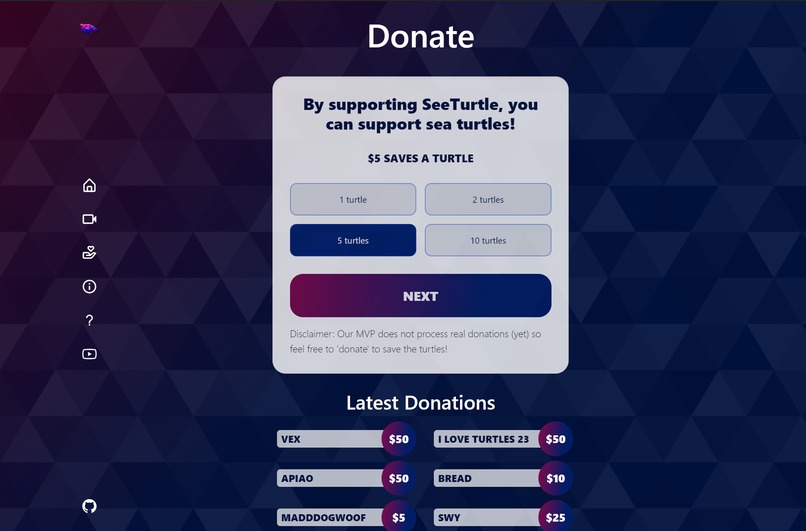
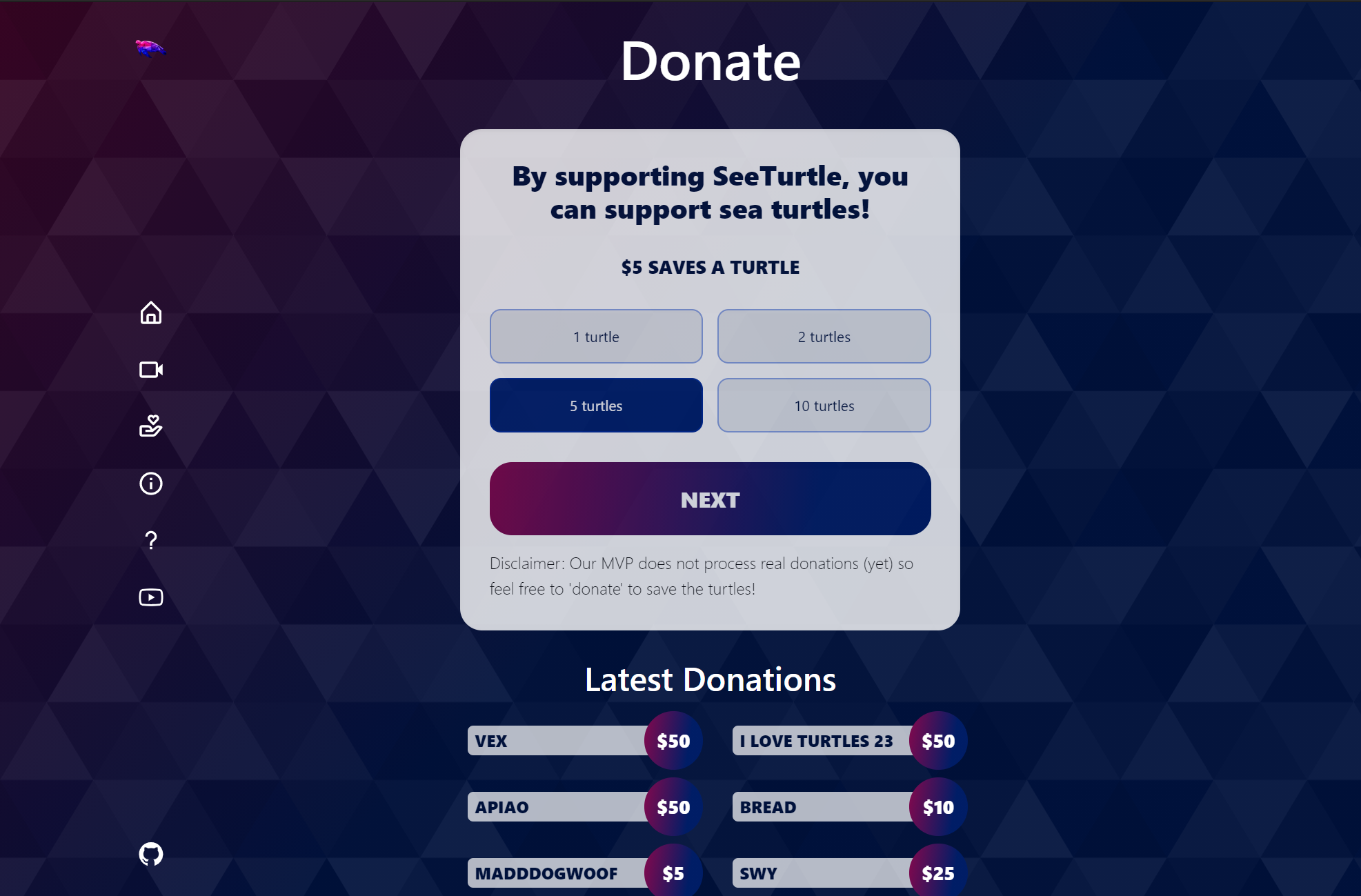
Web app's donation card
-
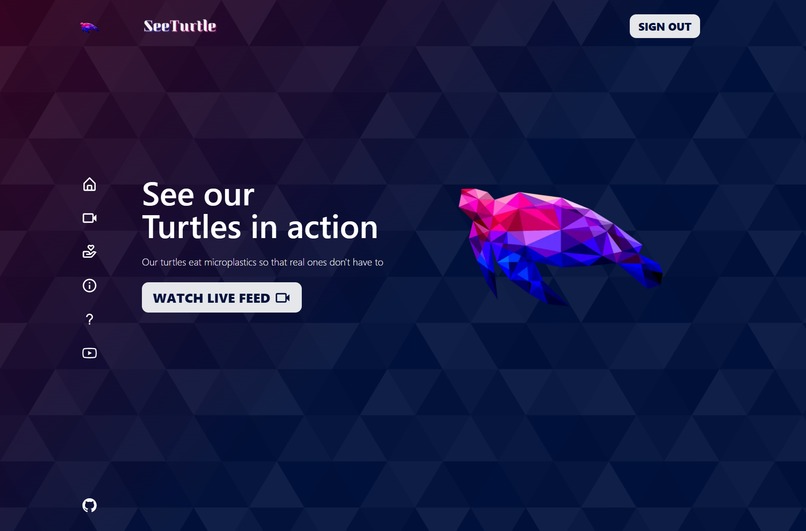
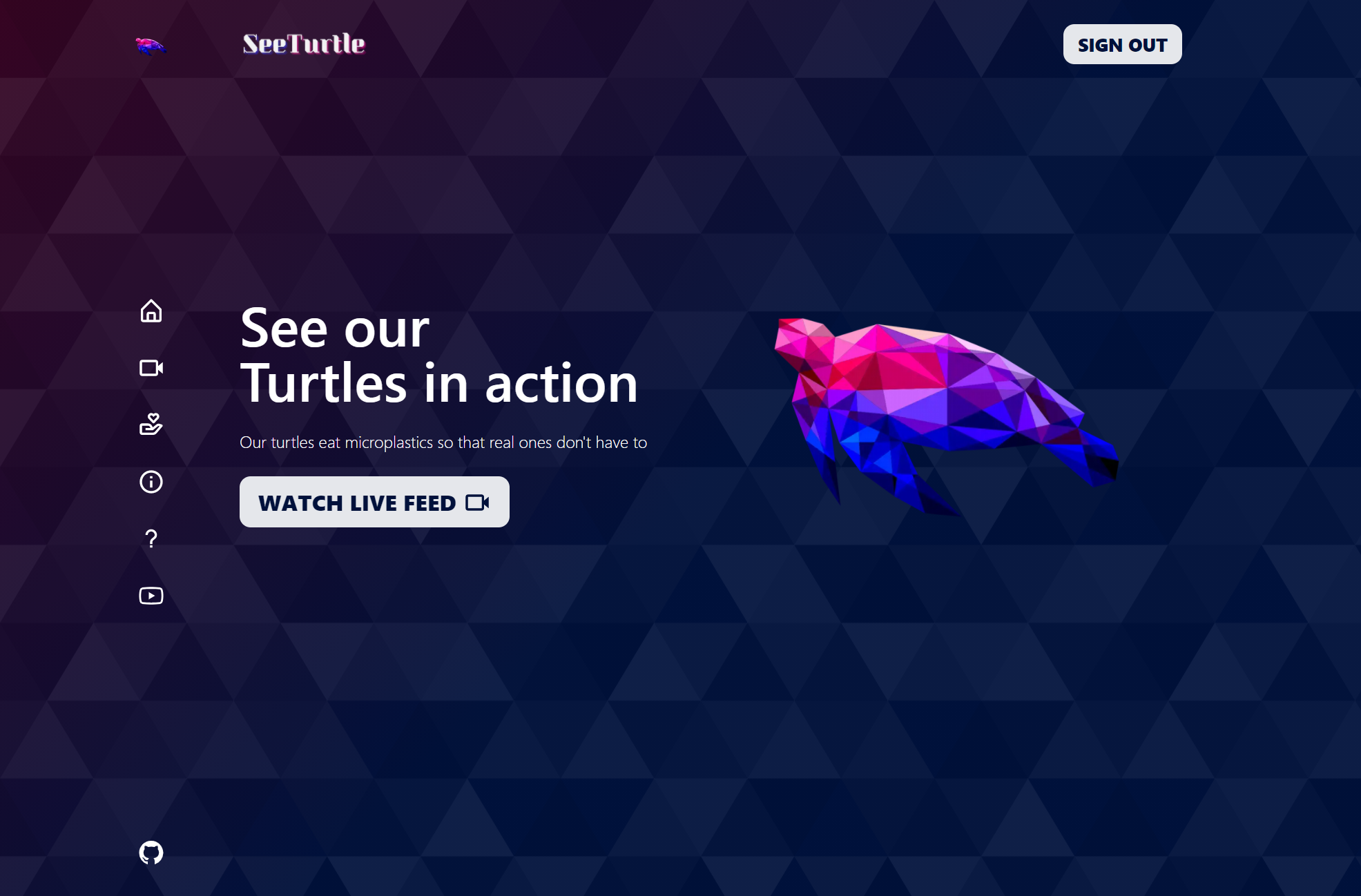
Web app's landing page
-
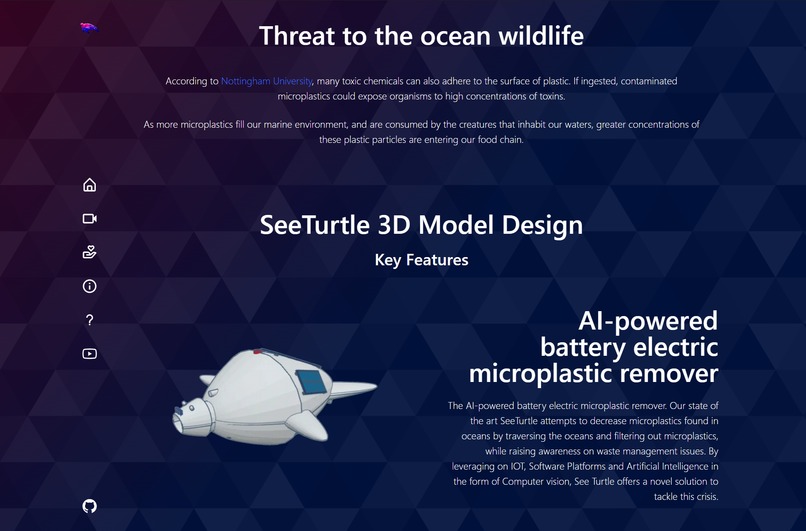
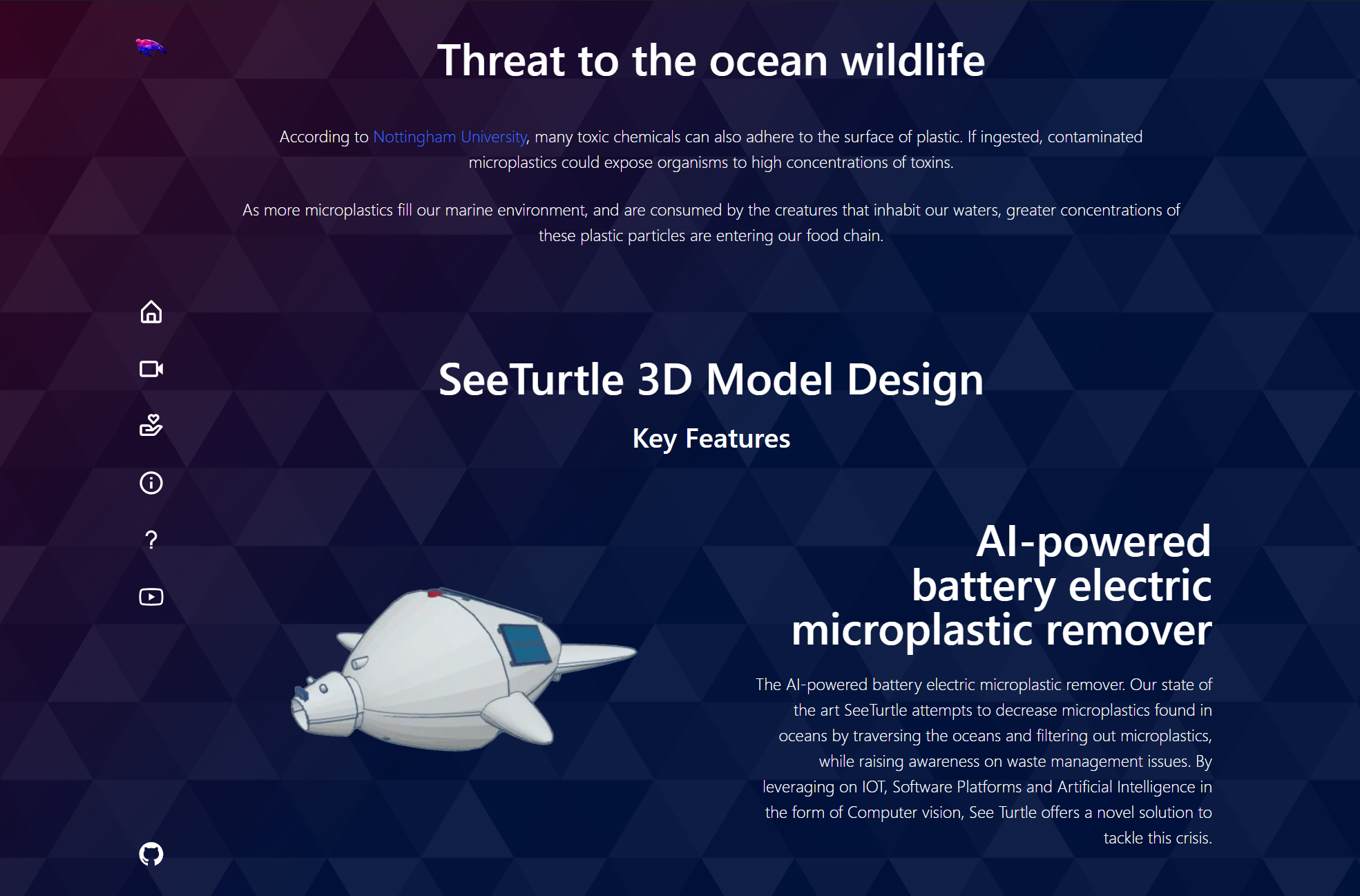
Web app's external CAD diagram
-
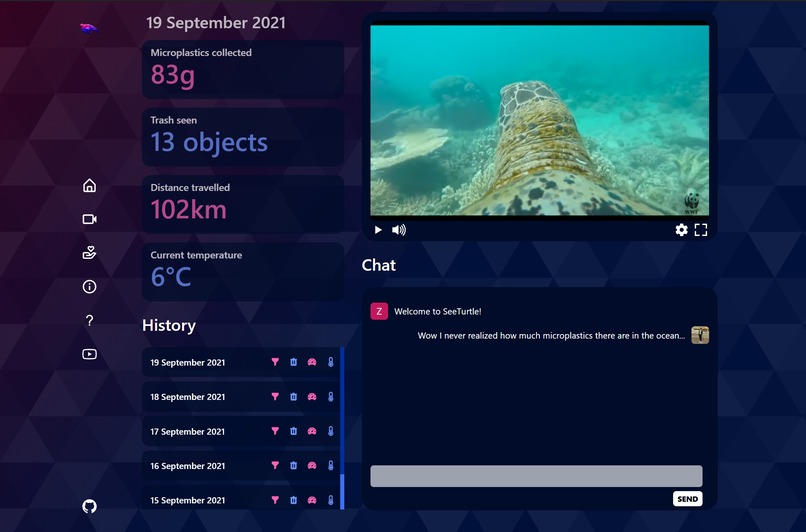
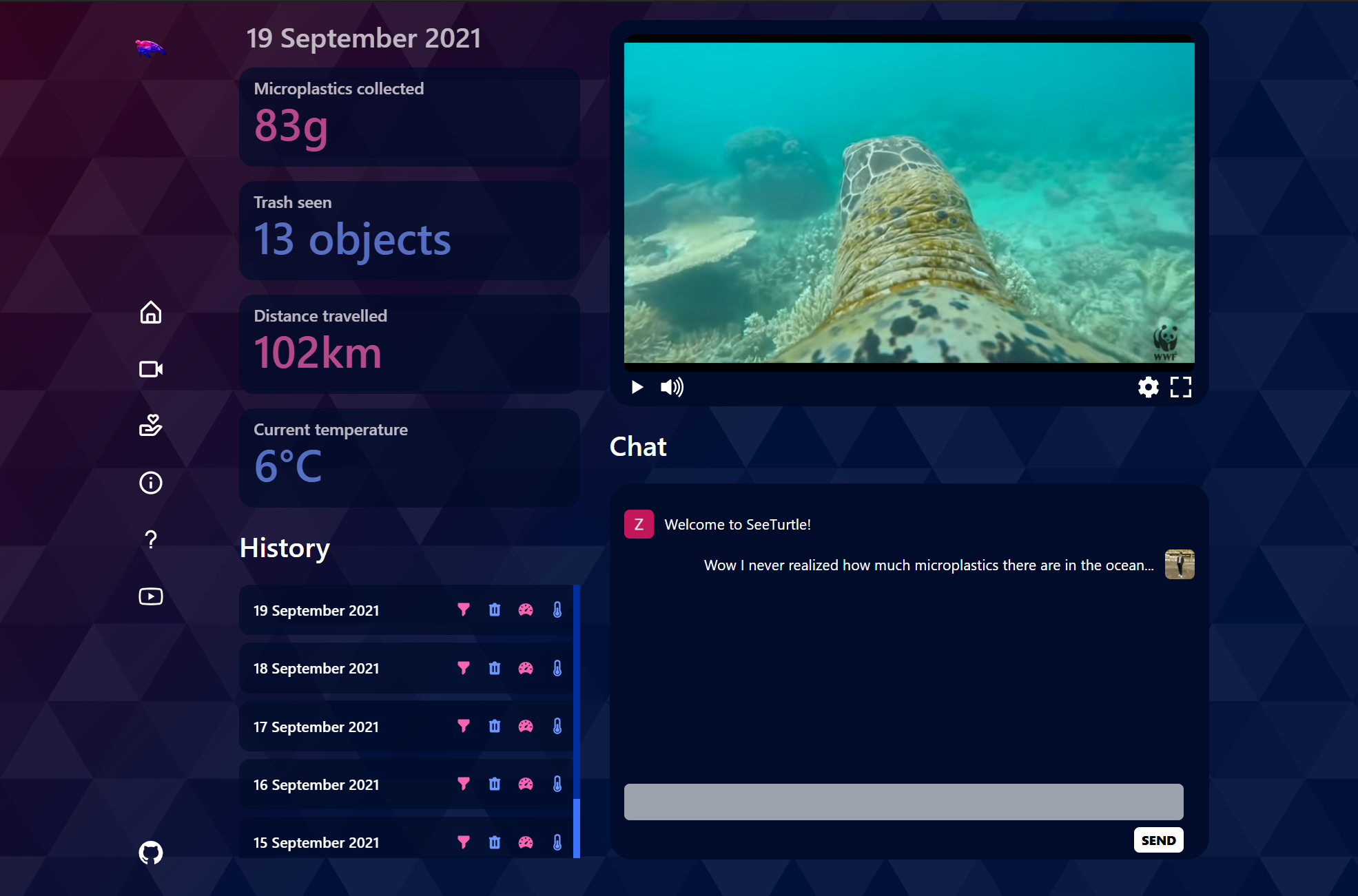
Web app's SeeTurtle livestream dashboard and live chat
-
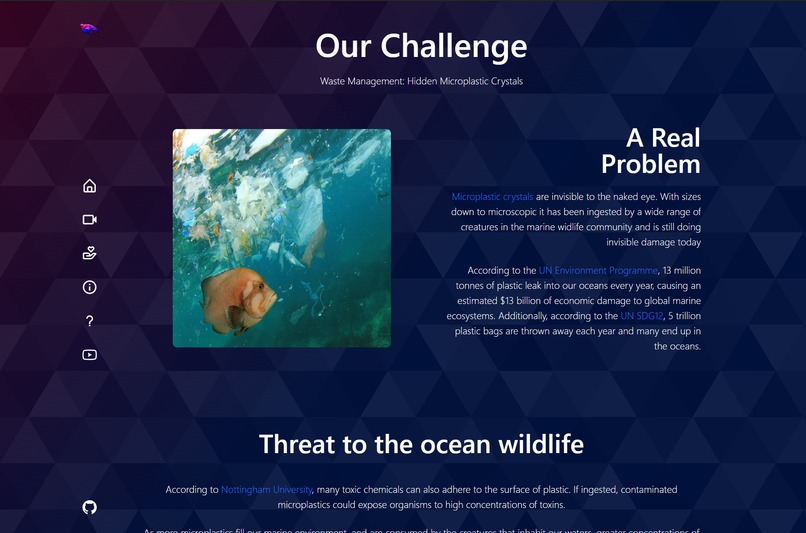
Web app's challenges
-
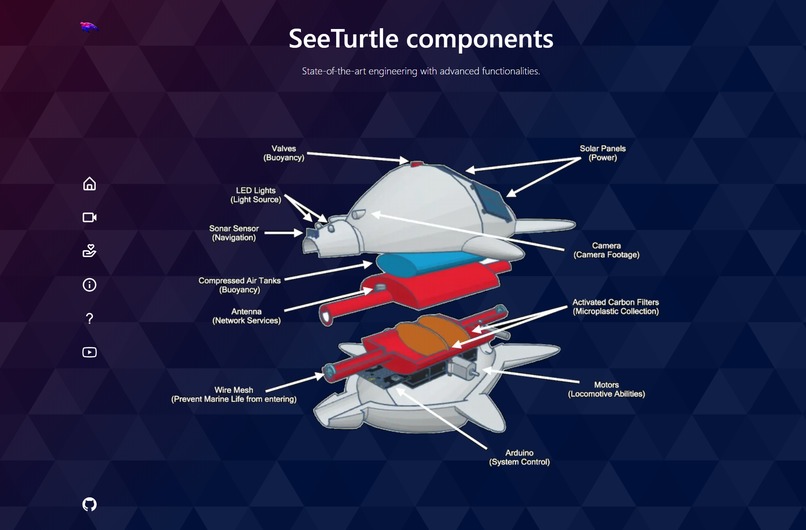
Web app's internal CAD breakdown
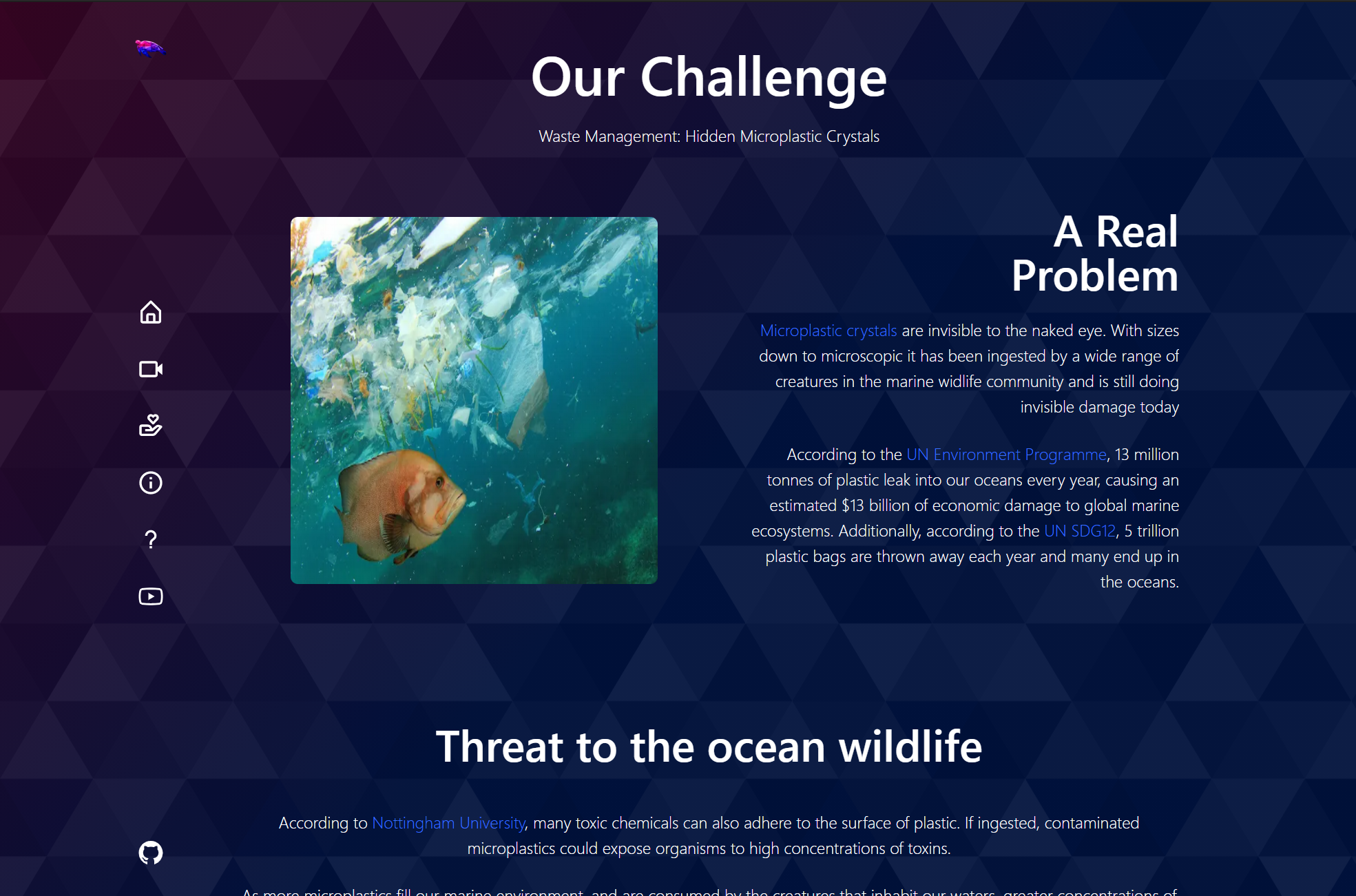
The Website
Please visit our website to try out the features yourself! 😁
https://wth-seeturtle.vercel.app/ 🐢
You can not only watch the simulated livestream of our SeeTurtle, but also learn about the global microplastics problem, learn about how we engineered our solution, as well as how you can 'donate' to support our cause! ✅
The Problem
Our project SeeTurtle 🐢 tackles the problem theme of waste management using the three technology types of software platforms, internet of things and artificial intelligence. According to the UN SDG12, 5 trillion plastic bags are thrown away each year and many end up in the oceans, resulting in the death of an estimate of 100 million marine mammals annually. 🚯
Team WhaleFood feels strongly about focusing our effort to reduce the amount of waste in our precious oceans. We acknowledge many valiant efforts to clean up floating garbage patches which are making headway. We therefore would like to focus our project on a more unseen waste problem: microplastics. 🔍
Microplastics are extremely small pieces of plastic debris in the environment which are very difficult to remove. Despite being hard to spot with our naked eyes, microplastics can carry a range of contaminants such as trace metals and some potentially harmful organic chemicals causing cancer in humans and killing 100 million marine mammals each year. ☢️
The Solution
Our solution SeeTurtle 🐢 is a robotic turtle which travels the ocean, filtering microplastics as it swims. It is battery powered and has solar panels on its shell to reduce its carbon footprint. ♻️ We have also developed a web app that livestreams its dives in order to raise awareness of the amount of plastics removed. 📢
1. The Device
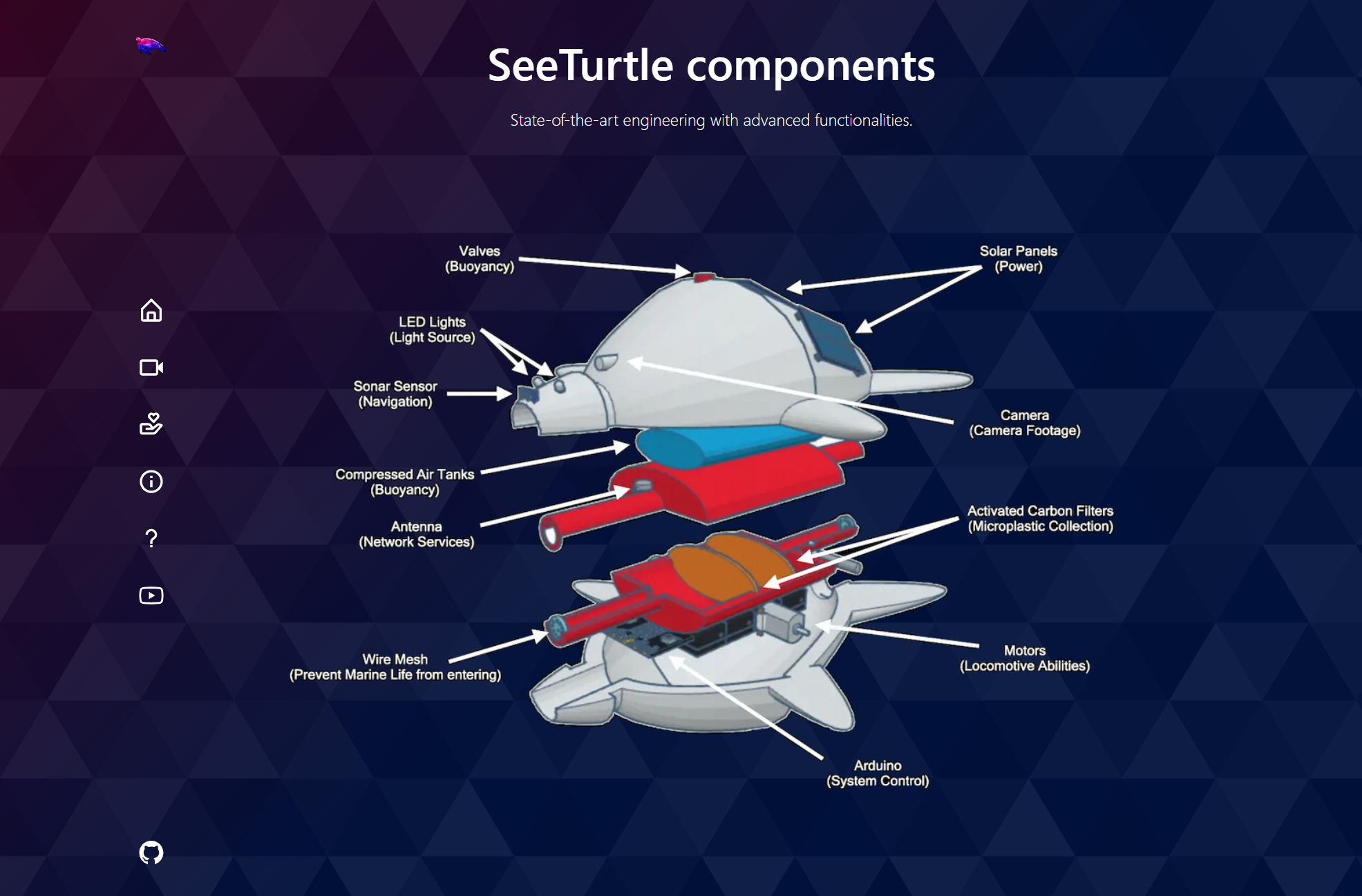
Our SeeTurtle utilises an Arduino to control all systems within the robot. This robotic turtle controls its buoyancy similar to that of a submarine, utilising a buoyancy device in the form of a pressurised air tank and valves for water entry and exit. The SeeTurtle is propelled using its 4 flippers. 🏊♀️
Additionally, navigation abilities are enabled using its sonar sensor to avoid obstacles. The filtration system of our SeeTurtle comprises of a relatively larger filter to keep marine life out of the internals of the robot, and two activated carbon fibre filters in order to filter out microplastics. The antenna behind the head of the SeeTurtle provides network services, enabling the livestream and location tracking features. 📡
2. The Web App
Our web app’s main goal is to livestream our turtle’s underwater POV as well as display statistics about microplastics filtered and trash seen to raise awareness about how plastics are polluting our oceans. Trash identification data is carried out using existing Computer Vision models, such as YOLOv4. 👀
Our web app is built with Nextjs and TypeScript to support static site generation for the educational content as well as client-side rendering for the livestream. We also used Tailwind for the CSS framework while Firebase is used to store turtle data, plastic statistics, donation amounts and to support user authentication. Finally, our website is hosted on Vercel. 💻
The Unique Selling Points
1. Biomimicry 🐙
Our solution is modelled after sea turtles for efficiency and to reduce disruption to ecosystems
2. AI-powered 🛢
Computer vision helps us to differentiate harmful plastics from living organisms
3. Battery-Electric 🔋
Zero emissions to minimise carbon footprint
4. Solar power ☀️
Renewable energy ensures our solution has minimal carbon footprint
5. Livestreamed everywhere 🎥
To raise awareness on microplastics as education is a crucial part of the solution
6. Consumer Interaction 💬
Our supporters can comment on our website or donate to us!
The Challenges 🆘
As none of us are from an engineering background, we found it daunting to come up with a solution that incorporates not just software technologies but hardware as well. As such, we had a difficult time coming up with the CAD models to prototype our product whilst simultaneously coming up with a functional Nextjs SPA linked to a Firestore backend that is not just aesthetic but useful as well. Additionally, ideating, conceptualizing, designing and developing under such a tight deadline was stress-inducing though exhilarating.
The Accomplishments and Learning Points 💯
This being our first time participating in a 24 hour hackathon, we are really proud of how far we've come. From designing an aesthetically pleasing front-end to coming up with a CAD prototype model and filming a business pitch, we have definitely enjoyed the entire development process thus far.
We learnt the basics of CAD through TinkerCAD and persevered through all the challenges. In addition, we also conducted extensive research on the dire situation of microplastics in our oceans.
What's next for SeeTurtle - Team WhaleFood 🔜
We dream of deploying SeeTurtles across the globe to clean microplastics in all oceans across the globe.
In the future we also plan to design robo-SeeWhale motherships where our SeeTurtles can also come home to dock and charge
We also envision our SeeWhales as capable of capturing larger pieces of plastic waste.
Frequently Asked Questions (FAQ) 🤔
1. How will the SeeTurtle's movements be controlled? 🦿
The SeeTurtle's movements will be controlled using AI and Computer Vision. By combining the video feed, sonar sensors and GPS technology to visualize its surroundings and identify its location, we would use AI to manoeuvre underwater while avoiding obstacles.
2. What is the mechanism behind the SeeTurtle's movements? 🤖
The SeeTurtle will utilize a servo motor powered by an electric battery that rotates it's 'limb's and 'fins'. By rotating these limbs, the SeeTurtle will be able to propel itself just like an actual turtle. This will reduce Turbulent Flow caused by our SeeTurtle, reducing the enviromental impact on other marine creatures. Admittedly, as our expertise does not lie with motors and engineering, we would definitely need to enlist the help of engineers to help us design and implement the SeeTurtle and the exact mechanics.
3. Wouldn't large and wide microplastic filters be more effective than a small SeeTurtle unit? 🧠
Though it is true that a large underwater unit would filter more microplastic, there is the possibility that it would disrupt marine life by accidentally sucking in and killing nearby organisms. It could also damage coral reefs. All these negative externalities are counterproductive to our cause and as such we have decided not to create a large underwater unit.
4. How will you ensure that the SeeTurtle won't be eaten by other living organisms? 😥
Our SeeTurtle would be approximately 3m long. As such, the only marine creature that could potentially eat it would be whales. However, turtles are typically not part of whales' diets and a case where a whale swallows our SeeTurtle whole would be extremely unlikely.
For other predators such as sharks, there has been some research into utilizing magnetic repellents, electropositive repellants, electrical repellents, and semiochemicals in order to repel sharks. From what we have found out, we believe that utilizing sonar waves seems to be the most effective in repelling sharks to ensure that our SeeTurtle does not get damaged. However, this area requires further research and we may need to find alternative ways to repel sharks and other predators.
5. How will the SeeTurtle transmit livestream footage deep in the ocean? 🤓
Our pilot tests would involved deploying the SeeTurtle in shallower bodies of water such as rivers and reservoirs. These shallow to moderately deep water bodies are small enough that the SeeTurtle would still be able to access WiFi through an antenna to transmit the livestream footage. In the future, we will experiment with sonar technology for deep dives to explore the possibility of streaming live footage from deep in the ocean.
Built With
- cad
- css
- ecmascript8
- firebase
- html5
- javascript
- next.js
- node.js
- react
- tailwindcss
- typescript
- vercel

Log in or sign up for Devpost to join the conversation.