-
-
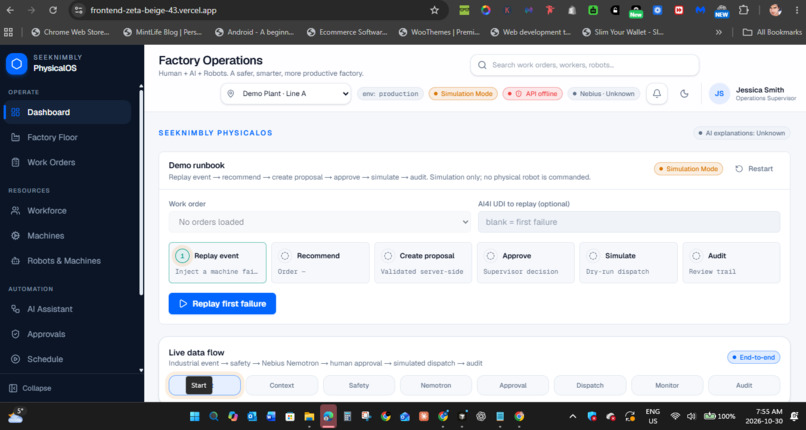
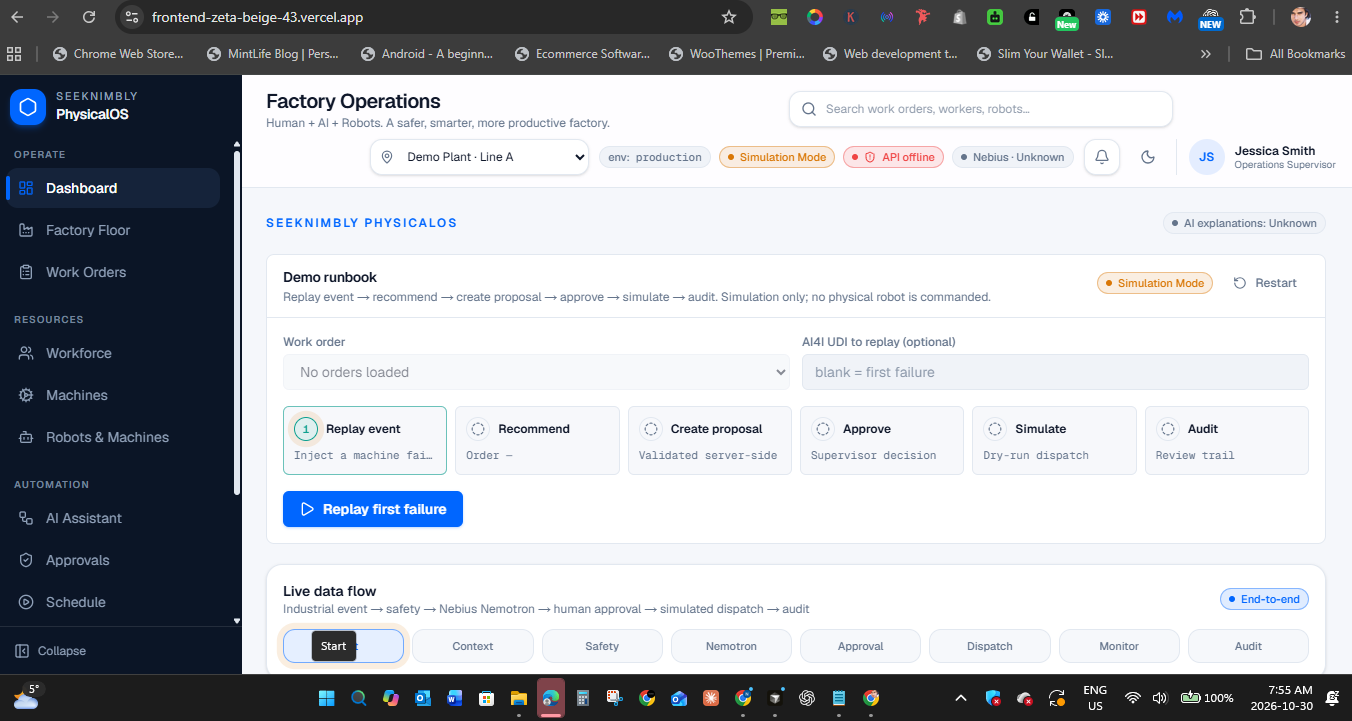
SeeknimblyPhysicalOS Front UI
Inspiration
Factories frequently coordinate workforce availability, qualifications, production orders and machine capacity across disconnected spreadsheets. A supervisor needs a safe, auditable answer when an urgent order arrives and the planned worker is unavailable.
What it does
Seeknimbly PhysicalOS is a synthetic manufacturing control-plane prototype. It displays eight simulated workers, five work orders and three simulated robots; proposes eligible human–machine assignments; rejects unavailable or unqualified workers and incompatible robots; routes changes through a supervisor approval queue; and records decisions in an audit trail. Robots are simulated: the application does not control real machinery.
How we built it
A FastAPI API serves the dashboard and workflow. Qualification and availability checks are deterministic guardrails, separate from AI-generated explanation. The prototype includes an optional Nebius Token Factory OpenAI-compatible chat-completions adapter to produce a concise rationale for an eligible assignment. If no key/model is configured or inference fails, recommendations fall back to deterministic rules rather than inventing an AI response.
The local repository uses SQLite for demonstration; the deployed Vercel version uses ephemeral storage, so persistence across requests or deployments is not guaranteed. The frontend is a lightweight HTML/JavaScript dashboard.
What we learned
Human-in-the-loop control matters: language-model output should explain a candidate assignment, not bypass workforce qualification checks or autonomously issue machine commands. A small token budget makes inference economically practical for a hackathon demonstration.
Challenges
Maintaining eligibility checks, supervisor approval and auditability in a fast prototype; packaging FastAPI for serverless deployment; and integrating a hosted NVIDIA open-source model without exposing credentials.
Current status and next steps
The Vercel deployment is ready, and the local reconstructed repository passed eight automated tests. A live Nebius-hosted NVIDIA model call has not yet been verified. Before final submission we will configure a suitable Nemotron model, demonstrate actual Token Factory inference, publish the public MIT-licensed source repository, record a public YouTube video of three minutes or less, and validate the deployed workflow and persistent storage.
Significant changes during the submission period
PhysicalOS builds on an earlier internal synthetic-factory MVP. During this submission period we reconstructed the FastAPI workflow, added a Vercel deployment, and prepared a Nebius Token Factory adapter and low-cost inference configuration. The model integration remains unverified pending credentials and live testing.
Tools and technologies
Python, FastAPI, SQLite, HTML/CSS/JavaScript, Vercel, Nebius Token Factory API adapter (configuration pending), NVIDIA Nemotron (planned, not yet verified).
Nebius/NVIDIA feedback (draft; to update after live testing)
The OpenAI-compatible API interface makes it straightforward to integrate model inference without changing the safety-critical qualification rules. We will add specific feedback about model quality, latency, documentation and actual usage after running live tests.
Built With
- fastapi
- javascript
- nebius-token-factory
- nvidia-nemotron
- python
- sqlite
- vercel
