-
-
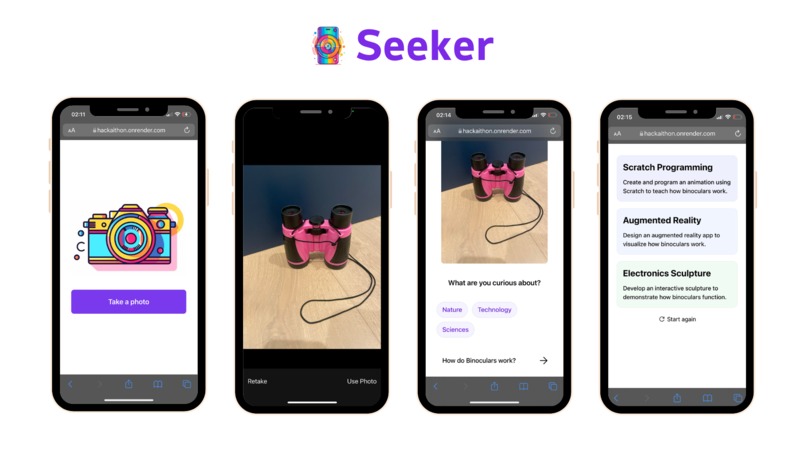
Here's how kids can capture their curiosity and take their questions further with a mini tech project on the go.
Inspiration
The potential of 📱mobile first learning is the future, especially for us South Africans 🇿🇦. We're from a place where both 💻computer and skilled 👩🏫 teachers are in short supply. But 📱phone penetration is growing everywhere. The potential for AI-powered, mobile learning experiences is thrilling!
"Knowledge is fractal 🧠, and our ignorance is vast. For proof of this, spend some time with a curious 5-year-old. They wield the word "why⁉️" like a weapon 🙋♀️. It only takes a few rounds of this for you to come abyss-staringly close to the realization that you [the grown-up in the room] know nothing, nothing at all 😳. You will run out of answers before they run out of curiosity." - Tim Maly
But as kids go to school and it seems curiosity is stifled. 🏫 School focuses on teaching children what to think, how to pass tests, and how to memorize pedestrian facts. When really we need more young people who can think for themselves.
AI has the potential to supply endless answers to questions with such ruthless efficiency, but it cuts off the supply of a valuable commodity: productive frustration that is required for knowledge seeking and creation 💡.
Perhaps we must create technologies that build 💪 reps of wonder and reward as we develop increasingly difficult curiosities to resolve. Perhaps, the combination of intriguing, fun, bite-sized projects on phones is the kind of curiosity 🏋️♀️ gym young people these days need.
What it does
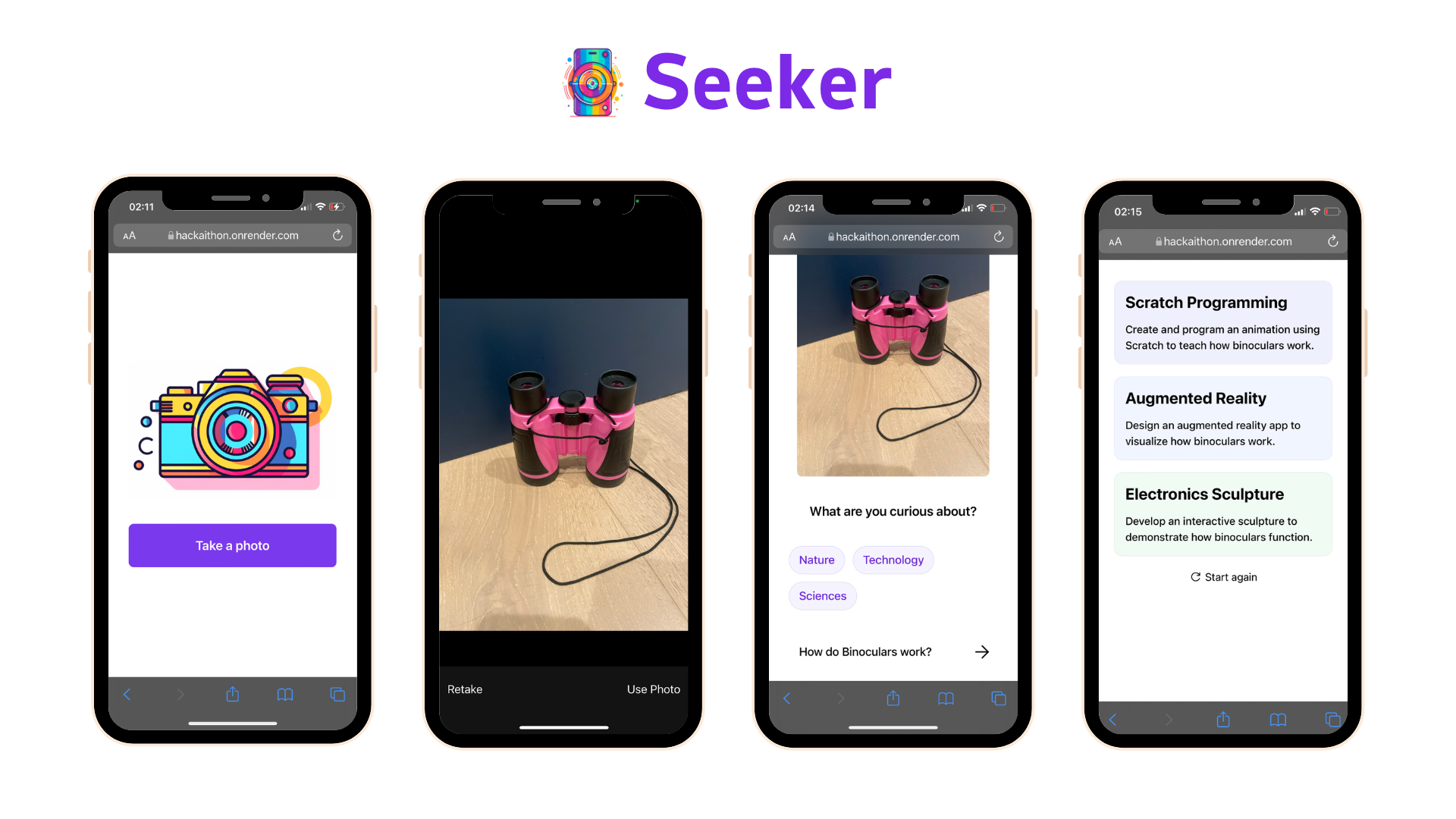
Kids anywhere can use their phones to explore the world around them to seek knowledge and ideas about LITERALLY anything.
Through a mixed reality experience, kids can explore their world and capture their curiosity by taking a photo and capturing their questions. We even nudge curiosity for those struggling to articulate their thoughts.
We then use that question to generate a fun mini tech project inspired by their captured curiosity.
How we built it
We're two founders from South Africa 🇿🇦, on a mission to create a world where all young people can access experiences that develop real tech skills to build a future where humanity can flourish with technology.
We were lucky to recruit some super team members to hack with us on a mobile-first project.
We came with some constraints in mind for our project:
- We’re going to build a prototype for kids aged 10-14
- Our prototype will be kid-centric and spark curiosity
- Use a technology we haven’t used before -Must be mobile-first
Bonus: Create a mixed-reality learning experience
We spent the early part of the hackaithon refining our concept, breaking down our time into chunks of work, and writing up tasks. Then we went ahead and started hacking while checking in every now and then. We used Google's Cloud Vision API and chaining of OpenAI's GPT models to build the workflow for Seeker. The end result was built using Express and React.
Challenges we ran into
We initially planned to incorporate some augmented reality elements into the app, which led us to build a React Native app combined with Unity. It turns out that this was a rather time-consuming route – lots of installing, fighting with build and config errors, and not a lot of progress made.
We started investigating alternatives and switched to React with a service worker.
Accomplishments that we're proud of
We met most of the objectives we set out for ourselves at the start of the hackaithon, such as using particular technologies and having hard fun (and yes that is an ode to Seymour Papert). In particular, the second day started off with very little working and ended on a high as things came together (there were was much high-fiving 🙌).
What we learned
Doing tooling setup is not a great use of time during a hackaithon 😅, ideally, be set up long in advance. We also learned about how you can creatively combine various forms of AI to build something interesting.
That you can "mask" completion latency a little with fun UI and good pedagogy 😜
Always start with a user problem; it's easier to make hard choices.
What's next for Seeker
We'd like to partner with exciting places like the Exploratorium, MoMA, and Aquarium to introduce Seeker to schools and organizations worldwide to make Seeker available to more children to spark curiosity everywhere.
There is an opportunity for us to incorporate this project as a student-led experience on our Mindjoy platform for educators and students. We're also excited at the opportunity to learn about interactivity and data collection of objects in real-world contexts.

Log in or sign up for Devpost to join the conversation.