-
-
Motto
-
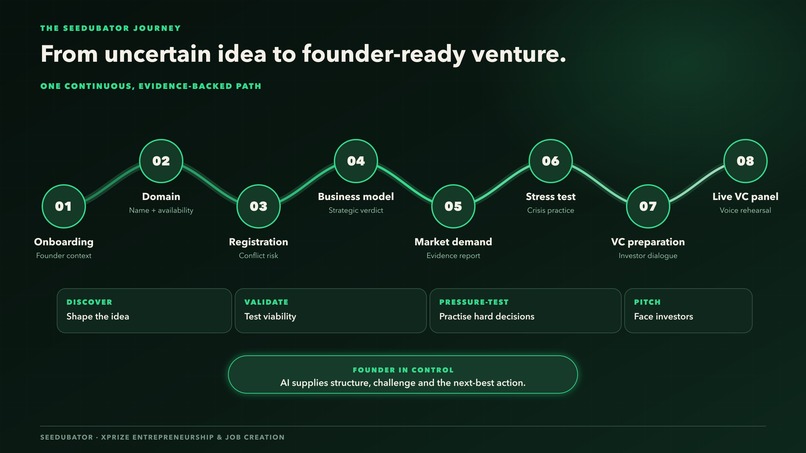
Journey
-
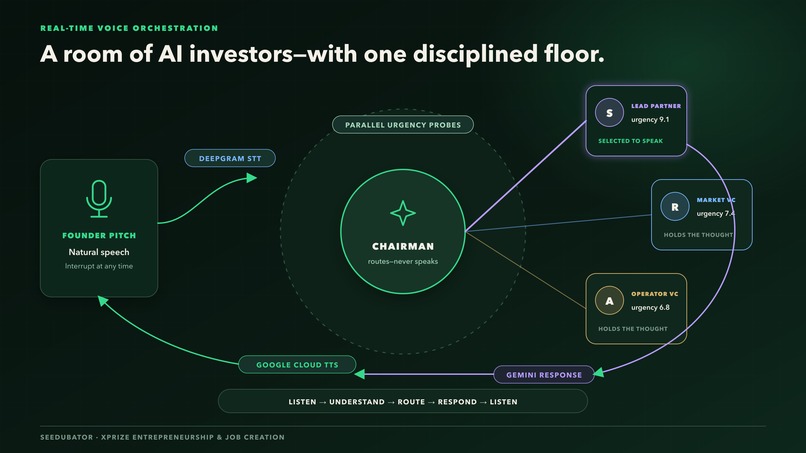
VC Meeting
-
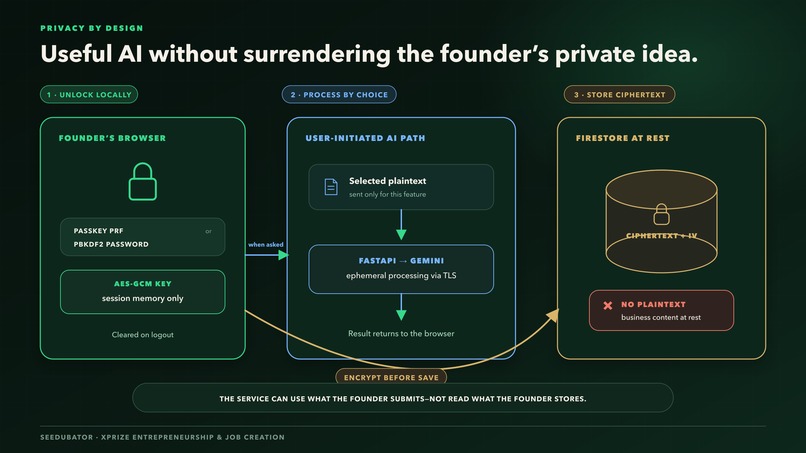
Privacy First
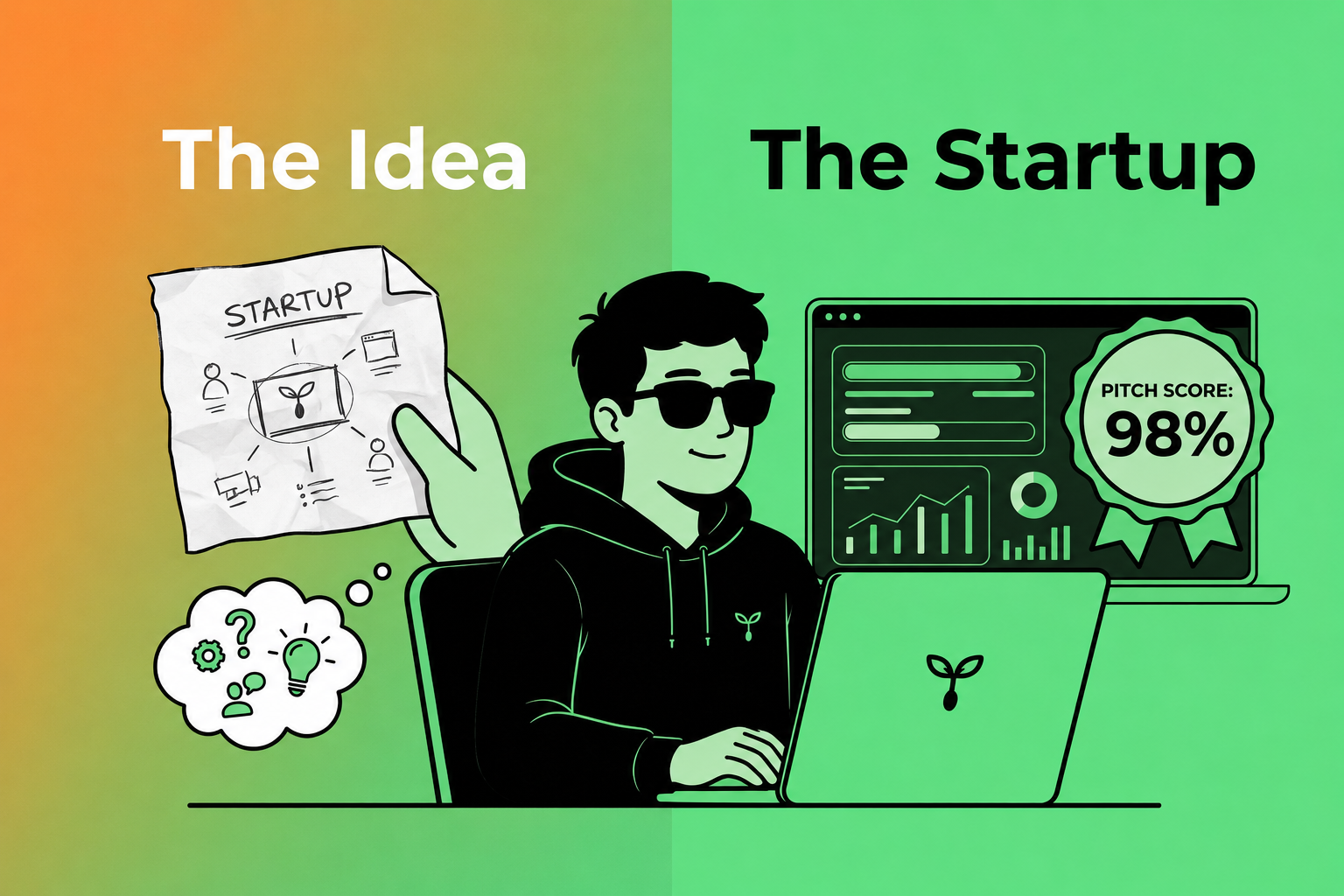
From "I have an idea" to "I know what to do next"

Seedubator gives a first-time founder a coordinated room of AI specialists before they can afford a human one - then turns every conversation into a concrete next step.
Try the judging build | Open the narrative diagram pack | Open the technical diagram pack
At a glance
Seedubator is an AI-native incubation system that turns the work normally scattered across naming tools, registration research, strategy workshops, market reports, crisis simulations, and investor coaching into one continuous founder journey. India is the launch market and the source of the hackathon evidence; the longer-term product ambition is global, with market-aware experiences that can expand country by country without pretending that one jurisdiction, currency, or founder ecosystem fits everyone.
By the final evidence lock, the working product had recorded:
- 287 eligible users acquired during the hackathon window after removing identified internal/test accounts;
- product activity spanning founder onboarding, venture creation, Gemini-backed analysis, and investor simulation;
- 11 processor-verified paying users and INR 3,927 in captured plan revenue; and
- INR 5,877.21 in Meta advertising spend, reaching 39,441 Meta Accounts and producing 2,636 landing-page views;
- an active public Seedubator Instagram channel sharing founder education, product stories, and an independently viewable organic community presence.
These numbers show early product use and willingness to pay. They do not yet prove product-market fit, ad-to-payment attribution, or jobs created - and we do not present them as if they do.

Open the traction diagram at full resolution
Inspiration
Starting a company can feel like opening seventeen browser tabs and somehow ending up with eighteen unanswered questions.
A founder may use one site to search for a name, another to check a domain, a consultant to understand registration, a spreadsheet for the business model, several search tabs for market research, and a friendly investor - if they are lucky - to rehearse the pitch. Each tool may answer one question, but none remembers the journey. Every hand-off discards context, adds cost, and asks the founder to become the integration layer.
That fragmentation is more than inconvenient. It makes entrepreneurship intimidating and unevenly accessible. Experienced founders can lean on networks, pattern recognition, advisers, and warm introductions. First-time founders are often asked to make equally consequential decisions with far less support - and they frequently learn the lesson only after the mistake becomes expensive.
Seedubator began with a simple question:
What if every first-time founder could walk into a room full of specialists before they could afford one?
Not a chatbot that produces a cheerful paragraph. A system that remembers the venture, challenges assumptions from several independent viewpoints, distinguishes evidence from inference, rehearses difficult moments, and ends with an actionable decision.
We chose Entrepreneurship and Job Creation because employment begins before the first hire. It begins when a person can test an idea, understand its risks, reach customers, and build a venture credible enough to survive. That need is global, even though the legal, commercial, and cultural context is local. Seedubator's immediate role is to improve that path in its launch market; its long-term impact is to help more credible ventures across countries reach the point where they can create work for other people.

Open the founder-problem diagram at full resolution
What it does
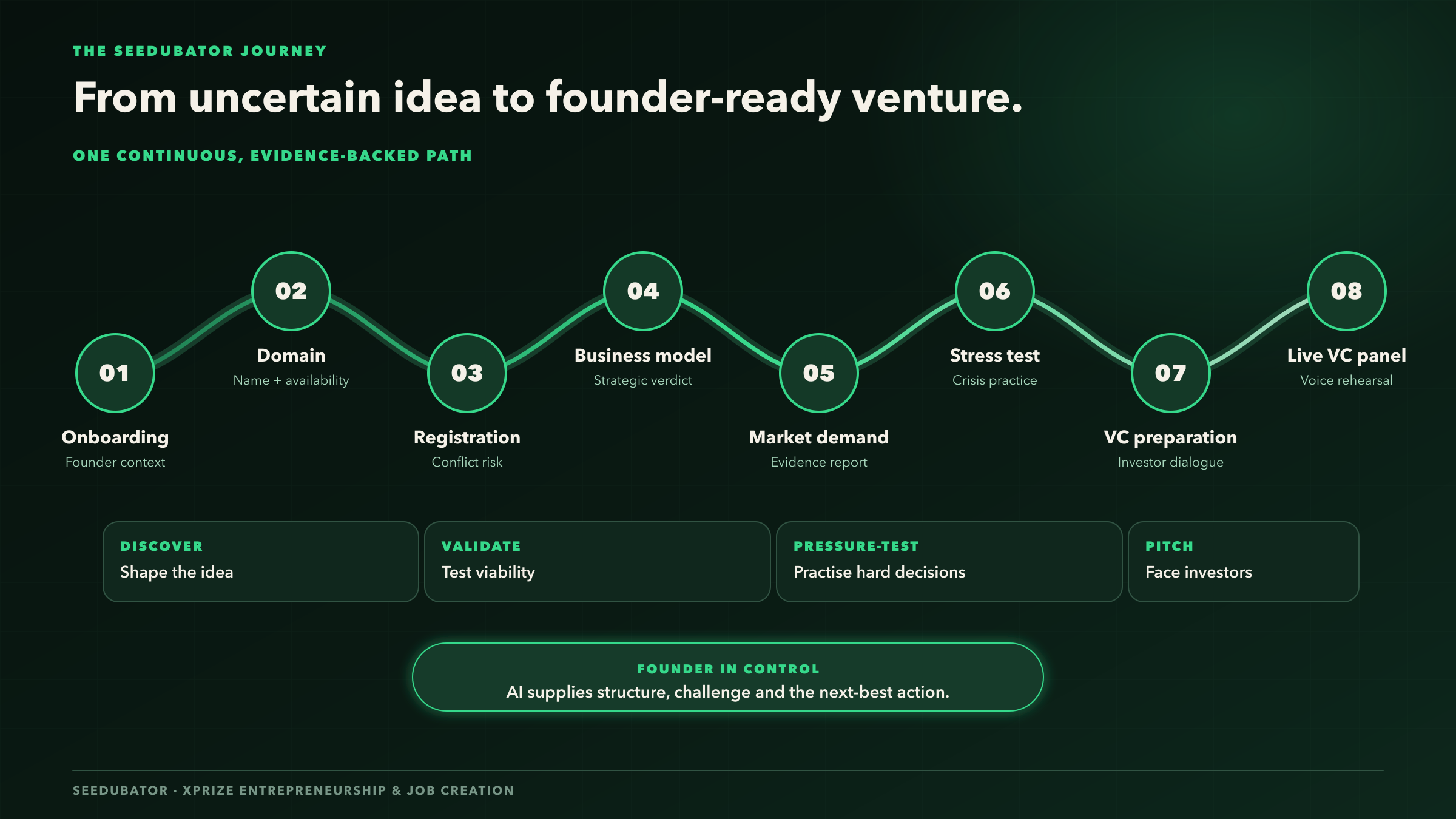
Seedubator is not eight disconnected AI demos placed behind one login. It is one stateful, forward-moving journey. Each stage receives the founder's permitted context, produces a bounded result, records completion evidence, and unlocks the next decision.
A founder moves through eight stages:
- Founder onboarding captures the founder's goals, experience, location, constraints, and working context.
- Domain discovery generates, checks, and ranks name and domain alternatives instead of returning an unfiltered brainstorm.
- Company registration research examines likely conflicts and country-aware risks using market-specific research contexts. The current product includes India and UAE contexts; additional jurisdictions will be released only after their sources, safeguards, and limitations are validated. The founder retains every legal decision.
- Business-model analysis convenes independent specialist roles for market, customer, positioning, monetization, and strategy, then asks a synthesis judge to reconcile disagreements.
- Market-demand research dispatches six parallel research streams across demand signals, market structure, competitors, social signals, venture-specific risks, and macro trends.
- Situational stress testing introduces realistic operating shocks so the founder can practice difficult decisions before the stakes are real.
- VC outreach generates relevant investor personas and lets those personas independently decide whether the pitch earns a meeting.
- Live VC panel places the founder in a real-time voice conversation with AI investors while a chairman agent routes the floor, remembers context, and selects the next speaker.
The founder remains the decision-maker throughout. Seedubator does not incorporate a company, provide regulated legal or investment advice, guarantee funding, or make employment decisions. It supplies structure, evidence, challenge, and rehearsal so a human can decide with greater clarity.

Open the journey diagram at full resolution
What the founder actually experiences
The interface keeps the complexity behind the scenes. A founder sees a guided workspace, clear stage boundaries, explicit questions, ranked or synthesized outputs, and a visible next action. Underneath that simple experience, several specialized workflows may be researching, disagreeing, validating schemas, checking confidence, enforcing access, and preserving state.

That difference matters: the product is not valuable because it can generate more text. It is valuable when it helps a founder identify the riskiest assumption, understand why it matters, and decide what to test next.
How we built it
Seedubator was built after the hackathon start date; the repository begins on June 4, 2026. The application combines a FastAPI backend with a Vite/React frontend and runs on Google Cloud Run. Firebase Authentication handles identity, and Firestore stores account state, venture progress, entitlements, operational events, and encrypted venture records.
1. A founder-facing experience layer
React and Vite provide the guided workspace. REST APIs handle product actions, while authenticated WebSockets support real-time voice sessions. Journey state is explicit: a user cannot simply skip to the investor meeting without completing and proving the earlier stages.
2. A server-enforced trust layer
The backend validates Firebase identity, venture ownership, feature level, plan entitlement, quotas, and short-lived workflow tokens before executing sensitive actions. Payment success in the browser never grants access by itself; Razorpay signatures, server-side verification, and an atomic Firestore transaction determine entitlement.
3. A coordinated Gemini intelligence layer
Production LLM calls use the Google GenAI SDK with Vertex AI enabled. Gemini is not limited to a help widget; it executes product decisions that directly shape the service:
- independent agents classify and debate a venture's business model;
- parallel researchers investigate distinct market-evidence streams;
- a synthesis layer cross-checks claims, exposes missing evidence, and creates a readiness result;
- registration workflows combine Gemini reasoning with search grounding;
- VC personas independently decide whether to continue a pitch; and
- a chairman agent scores urgency and routes the next speaker in a live meeting.
Rather than relying on one oversized prompt, the workflows use explicit state, typed outputs, bounded retries, confidence gates, and failure paths. The goal is not theatrical complexity. Independent viewpoints reduce single-model blind spots, while a synthesis step gives the founder one accountable result.

Open the AI-native operations diagram | Open the business-model agent graph | Open the market-demand agent graph
4. A real-time voice layer
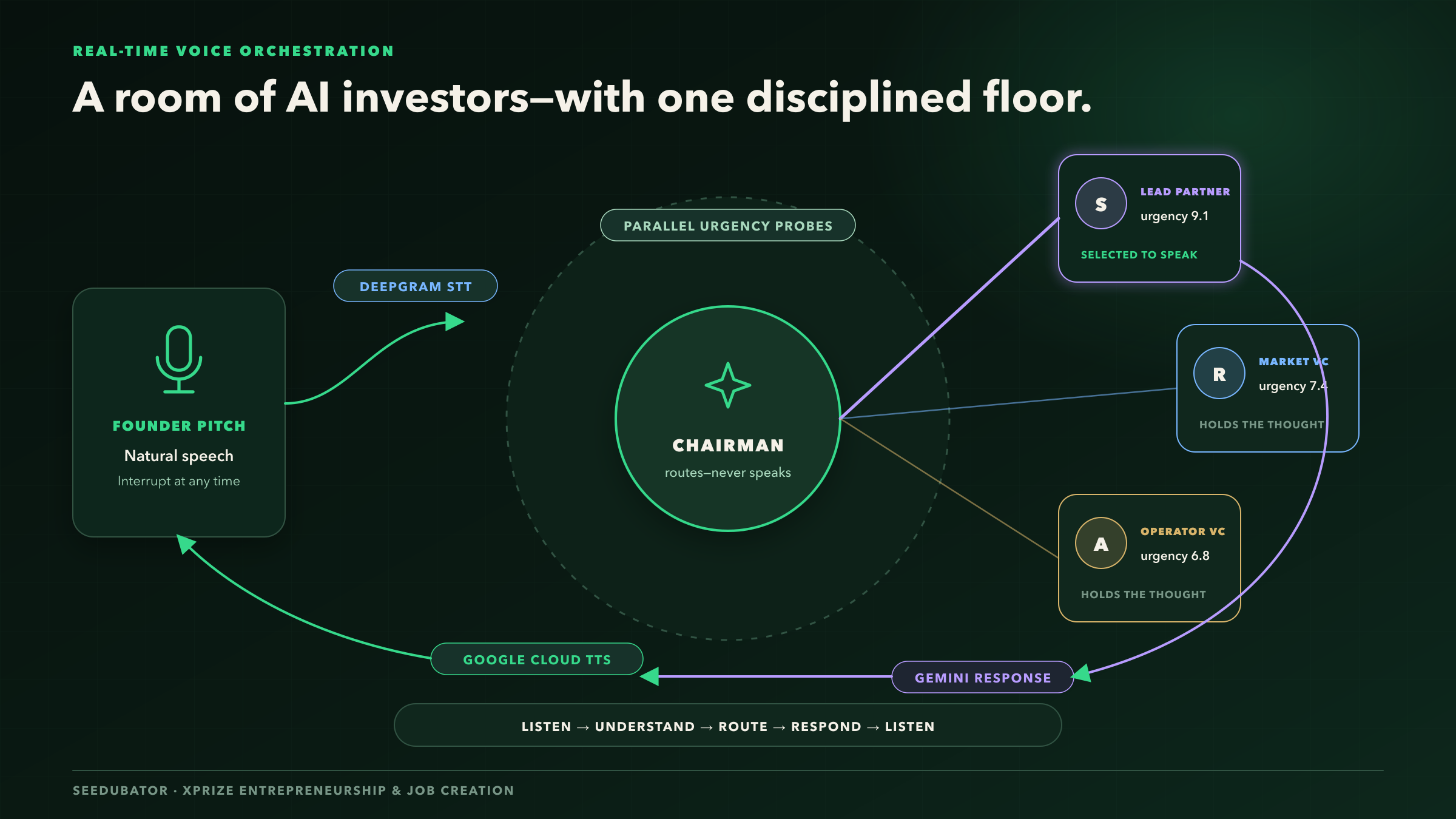
The live VC panel combines Deepgram speech-to-text, Gemini reasoning, and Google Cloud Text-to-Speech. A stateful meeting orchestrator manages voice activity detection, transcript aggregation, turn arbitration, agent routing, session memory, interruptions, and response streaming.
The chairman agent never competes for attention. It listens, scores which VC has the strongest reason to respond, and routes the floor. That creates a panel that feels coordinated rather than a set of bots talking over one another.

Open the live-voice technical architecture
5. Privacy as architecture
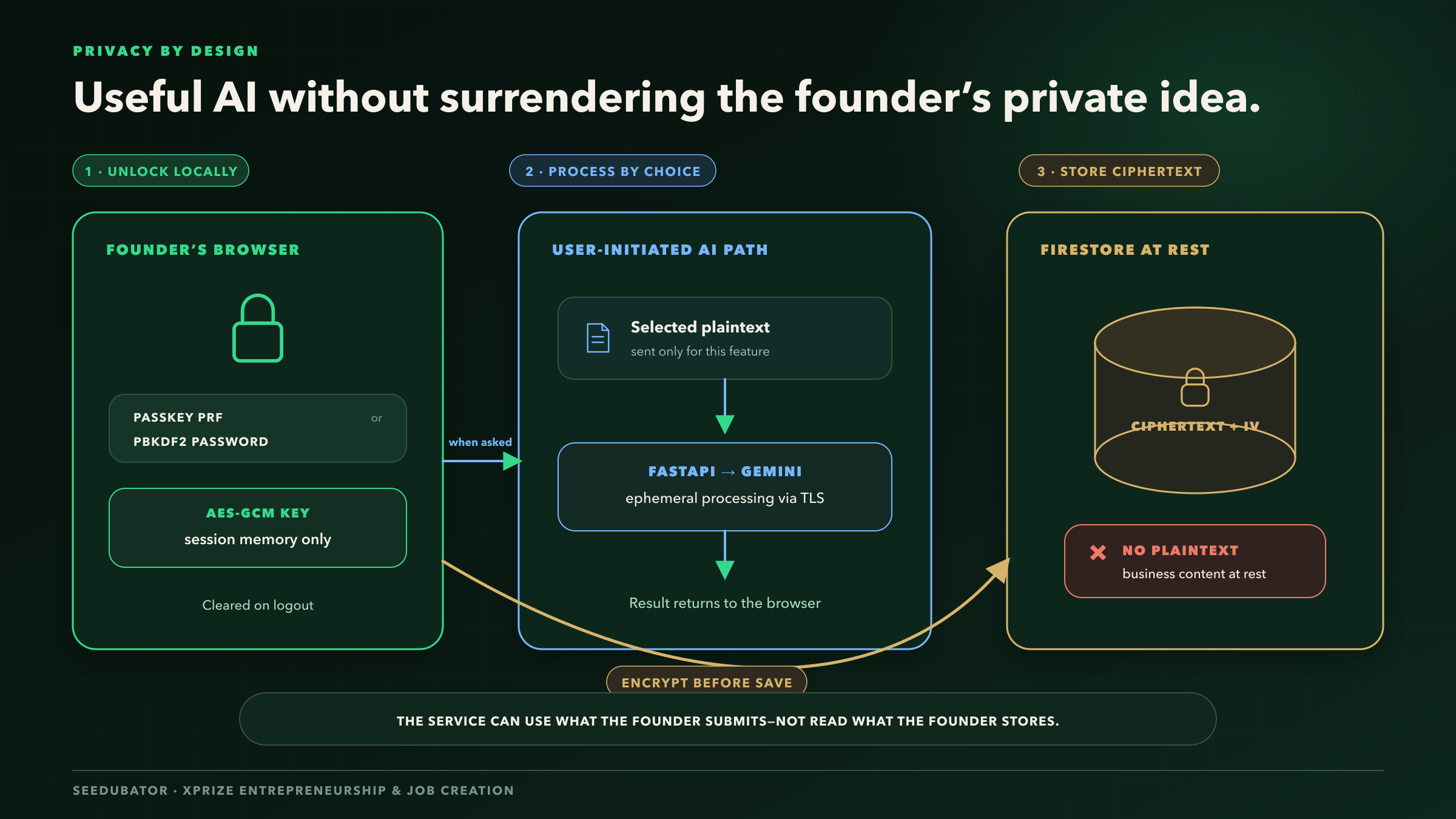
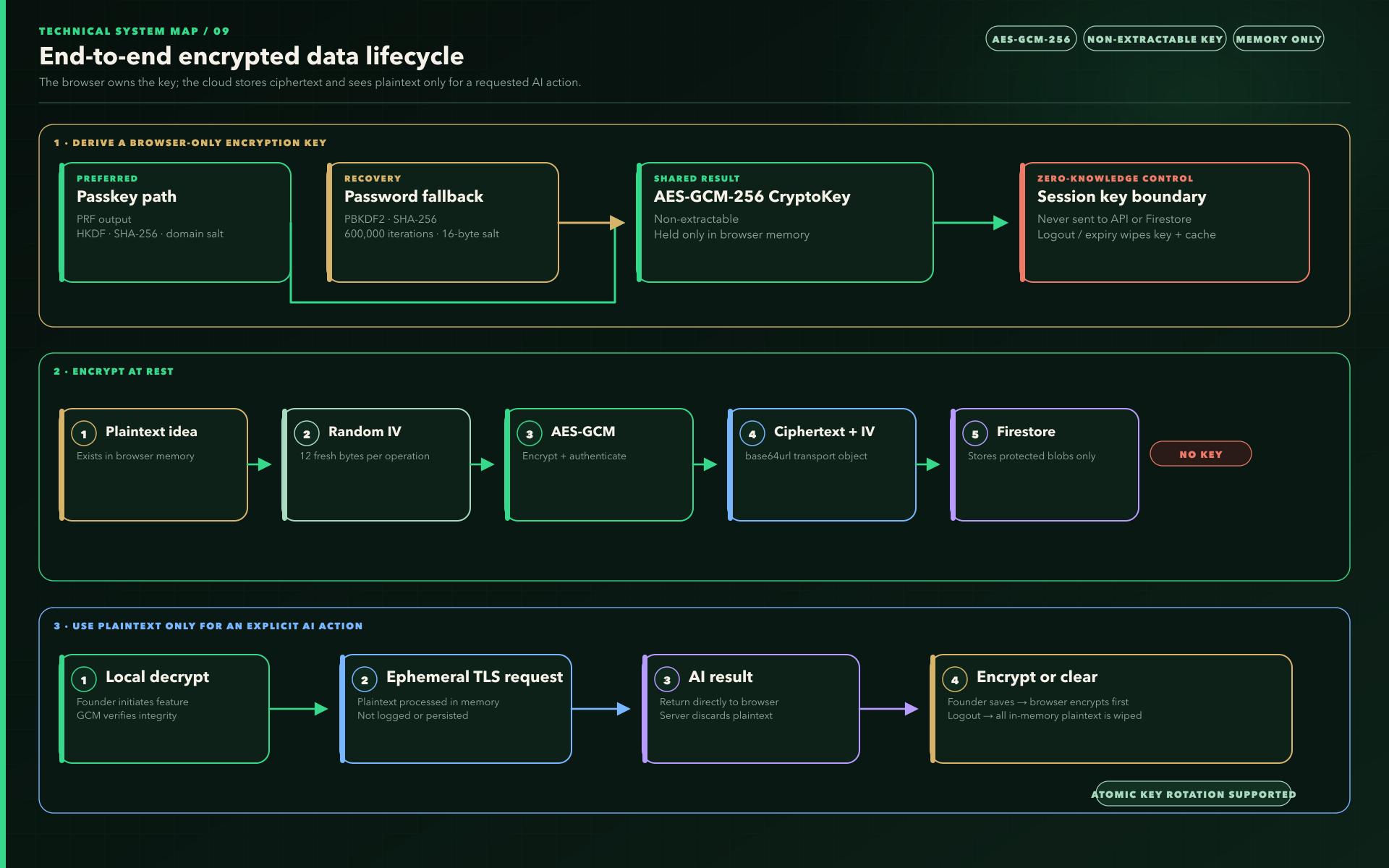
Founders may reveal pricing, strategy, market assumptions, and their most valuable insight. Sensitive venture content is therefore protected with client-side encryption. The browser derives and retains the encryption key; Firestore stores ciphertext and its initialization vector rather than the founder's decryption key. Plaintext is submitted to an AI workflow only when the founder invokes that feature, and it is not persisted by the application as decrypted venture content.

Open the end-to-end encryption lifecycle
6. Managed cloud and commerce services
Cloud Run hosts the FastAPI intelligence core; Vertex AI supplies Gemini; Firebase and Firestore provide identity and persistence; Cloud Monitoring and structured logs provide operational evidence; Razorpay handles subscriptions and refundable INR 2 payment-method verification; Deepgram and Google Cloud Text-to-Speech power the voice loop; and AWS SES delivers transactional email.

Open the detailed system architecture
Challenges we ran into
Making several agents behave like a team
Parallel opinions are easy; a useful decision is harder. Early flows risked repeating the same analysis in several voices. We had to narrow each role, define shared state, validate structured outputs, introduce a synthesis judge, and bound retries so disagreement became a useful trade-off instead of duplicated prose or runaway cost.
Making voice feel live
A pitch rehearsal cannot pause for an eternity after every sentence. We had to coordinate transcription events, interruption handling, turn ownership, model latency, text-to-speech, reconnection, and Cloud Run's distributed environment. The hard part was not generating a response; it was preserving the social contract of a conversation: listen, understand, choose one speaker, respond, and return the floor.
Keeping private ideas private without making the product unusable
Client-side encryption is only valuable if founders can still recover access and intentionally use AI features. Passkey-derived keys, a password fallback, browser memory boundaries, logout cleanup, explicit plaintext submission, and failure recovery all had to work together.
Separating evidence from excitement
Growth dashboards can tempt a team into turning correlation into causation. We reconciled Razorpay against Firestore, removed failed and fully refunded verification payments from revenue, treated the Meta account total as the advertising source of truth, and refused to label advertising spend as customer acquisition cost without attribution. We also excluded an unmatched INR 1,949 Firestore payment record after Razorpay reported that the referenced payment ID did not exist.
Shipping something a judge can actually run
A technically impressive product still fails if a reviewer cannot start it. We created a separate judging deployment, added health checks, and prepared a private hosted-access handoff that keeps cloud and local-development secrets out of the repository. At the project owner's direction, organisers receive one existing administrator login for the hosted build; they do not receive an .env, cloud identity, provider key, or payment credential.
Accomplishments that we're proud of
We built a complete system, not a concept deck
During the hackathon, real people created accounts and ideas, used Gemini-backed stages, reached the investor simulation, and paid for access. That matters because the hardest product question was whether the stages could feel like one coherent experience rather than eight impressive fragments.
We found commercial proof without overstating it
Razorpay confirmed 11 captured monthly-plan payments at INR 357 each, for INR 3,927 of revenue. Payment notes contained 11 distinct user identifiers, supporting 11 paying users. Thirteen INR 2 verification payments were fully refunded and five verification attempts failed, so neither group was treated as revenue.
The advertising campaign produced a separate top-of-funnel signal: INR 5,877.21 spent, 47,019 impressions, 39,441 Meta Accounts reached, 3,986 Clicks (all), 3,887 unique link clicks, 2,636 landing-page views, and 244 Meta leads. Every campaign is paused, so those figures are locked.
Paid distribution is not the whole public footprint. @seedubator on Instagram is an active founder-facing channel where the project publishes practical entrepreneurship content and product storytelling. We present it as an organic community touchpoint—not as proof of payment attribution or product-market fit.
We preserved the difference between proof and ambition
We have not attributed payments to ads without evidence. We have not converted registrations into "active founders." We have not invented testimonials, product-market fit, or jobs. The category impact is a testable theory backed by an operating product - not a victory declared too early.

Open the payment and entitlement lifecycle
What we learned
Structured disagreement is more useful than instant certainty
The best AI output is often not an answer. It is a clear account of which assumption matters most, why specialists disagree, and what evidence would change the decision.
State and observability are product features
An agent that forgets where the founder is, a voice session that cannot recover, or a metric that cannot be traced is not merely an engineering inconvenience. It weakens trust. Explicit state, idempotent transitions, structured logs, and evidence events make the intelligence usable.
Acquisition and activation are different problems
The final evidence shows activity across account creation, founder onboarding, venture creation, Gemini-backed workflows, and paid access. The next product gains will come from helping more founders reach the first meaningful result quickly, not simply increasing registrations.
Revenue is encouraging; retention is the real test
Eleven monthly purchases demonstrate willingness to pay. They do not yet demonstrate repeat usage, durable outcomes, or product-market fit. Renewals, completed journeys, founder decisions changed, ventures launched, and cost per successful journey will be stronger tests.
Honest limitations make the evidence stronger
One unmatched payment record was not an inconvenience to hide; it was a reason to improve the reconciliation. A missing public testimonial is not a blank to fill with a private message; it is a consent problem to solve properly. Credibility compounds when the measurement rules remain stable even when they lower the headline number.
Global reach requires local truth
International expansion is not a currency toggle. Pricing, payment methods, company-registration sources, policy language, founder expectations, privacy requirements, and outcome benchmarks all change by market. We learned to keep the core AI journey reusable while treating every country as a validated market pack with its own evidence and release gate.
What's next for Seedubator
The next phase is about proving outcomes, deepening the product, and earning sustainable economics.
Prove founder outcomes
We will measure time from sign-up to first useful decision, completed stages, founder confidence before and after workflows, evidence quality, decisions changed, venture launches, first revenue, funding milestones, and verified jobs at 30-, 90-, 180-, and 365-day follow-ups.
Improve activation
We will simplify the path between account creation, email verification, profile completion, idea creation, and the first AI-backed decision. The goal is not more registrations. It is more founders reaching a useful result quickly enough to return.
Expand country by country
India remains the launch market and baseline for activation, willingness-to-pay, and founder-outcome measurement. The next planned validation markets are the UAE and the United States, followed by additional countries selected through founder demand and institutional partnerships. Each launch will require market-specific URLs and language, local-currency pricing, approved payment rails, jurisdiction-aware research sources, policy and privacy review, and a small outcome-measured pilot before broader acquisition. This is a roadmap—not a claim of current international traction or availability.
Make AI quality measurable
Scenario-based evaluations will test factuality, grounding, consistency, latency, safety, cost per completed journey, and human-rated usefulness. High-impact conclusions will continue to show assumptions, supporting evidence, uncertainty, and failure boundaries.
Build sustainable economics
The current India launch subscription is INR 357 per month or INR 1,949 per year, with regular prices of INR 549 and INR 2,999. Future markets will use locally tested pricing and currencies rather than a cosmetic conversion of the India price. We will measure model, cloud, voice, support, payment, and market-support costs per completed journey before making margin claims. The longer-term model combines founder subscriptions with B2B cohort licences for universities, incubators, and ecosystem programmes across markets.
Connect venture progress to job creation
Seedubator's long-term score will not be prompts answered. It will be credible ventures launched, revenue earned, and verified jobs created and retained by founders who used the platform. Where sample size permits, staged rollouts or comparable cohorts will test whether Seedubator catalysed progress rather than merely appearing alongside it.

Open the impact diagram at full resolution
Seedubator's ambition is straightforward:
Give every first-time founder—wherever they begin—a room full of experts before they can afford one, and help more good ideas survive long enough to employ someone.
Built With
- antigravity
- cloudflare
- gcp
- gemini
- github
- google-cloud
- python
- react
- vertex




Log in or sign up for Devpost to join the conversation.