-
-
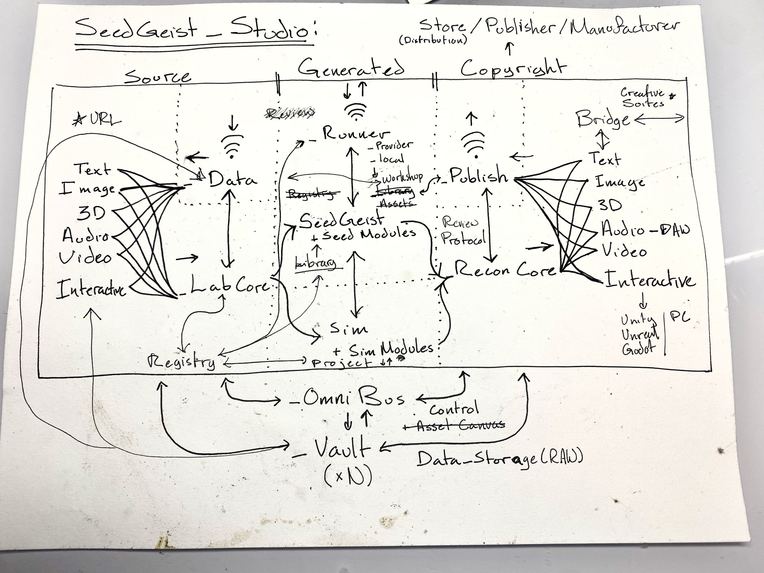
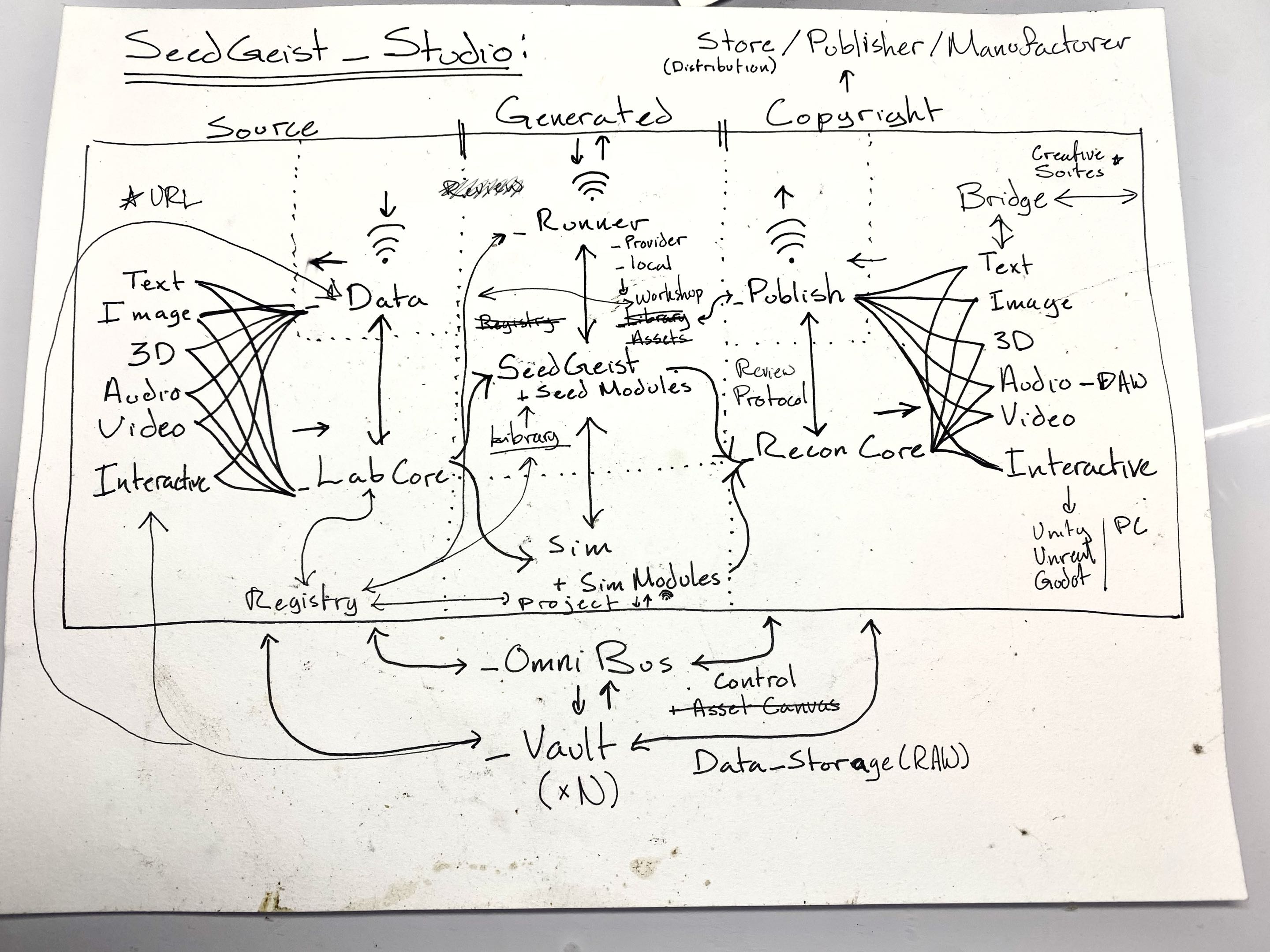
Architecture Mapping (Pre-Construction)
-
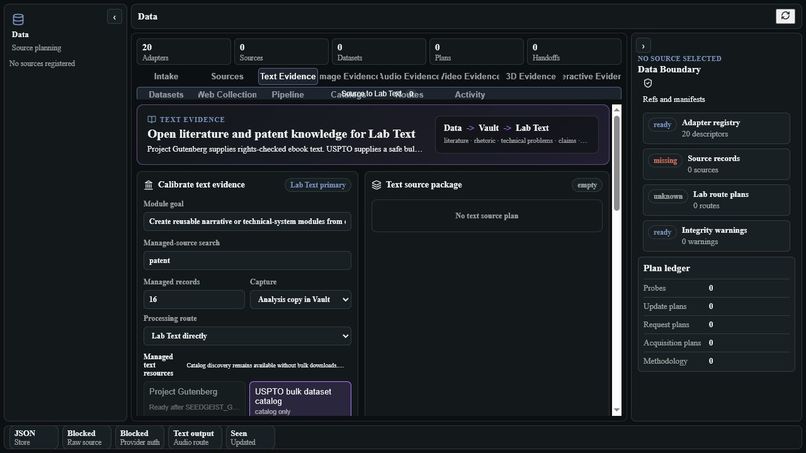
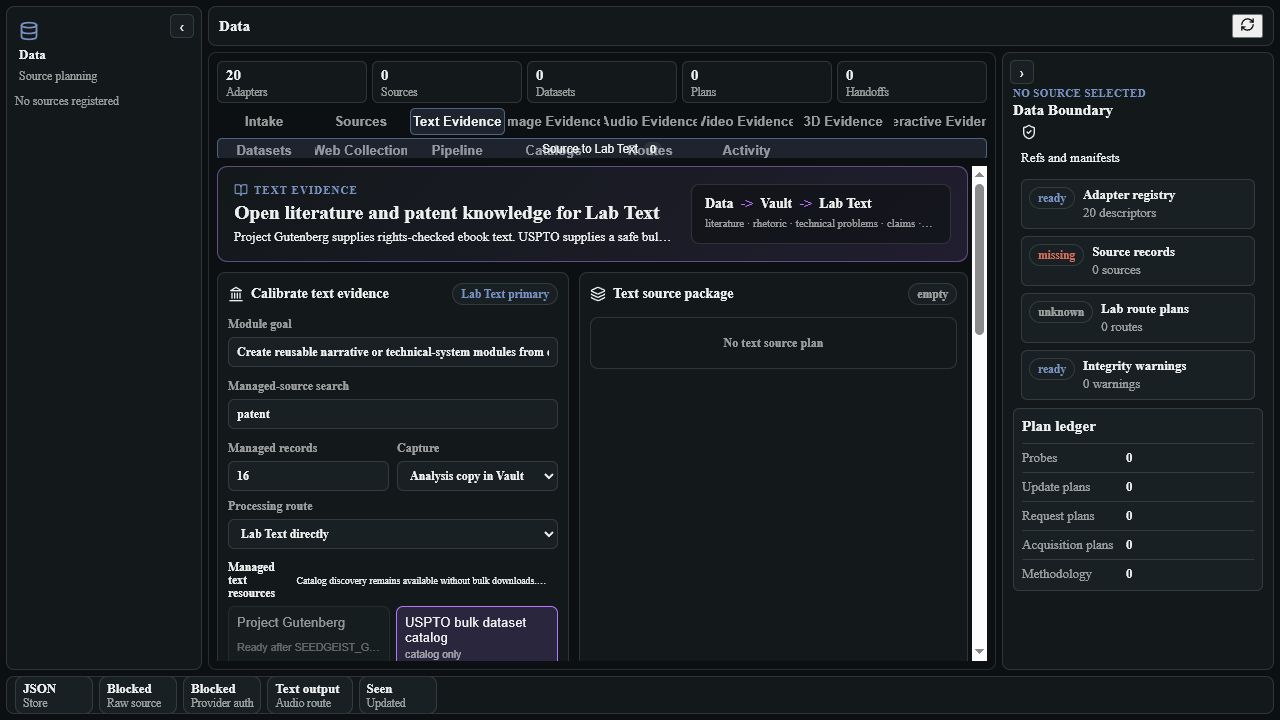
SeedGeist Data: Data Acquisition
-
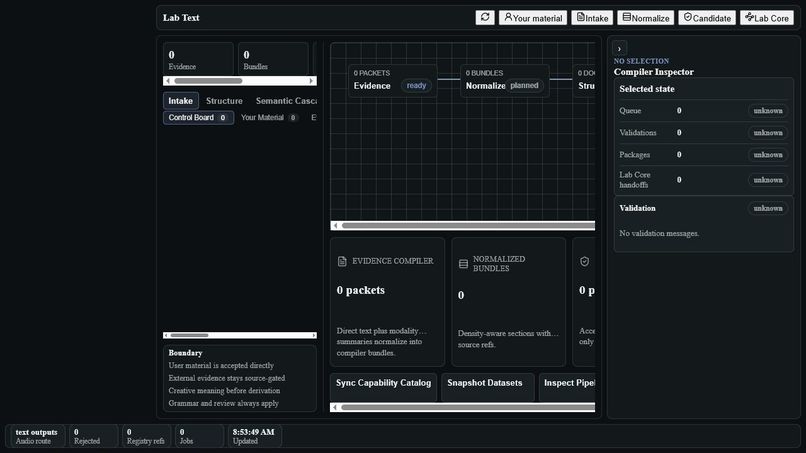
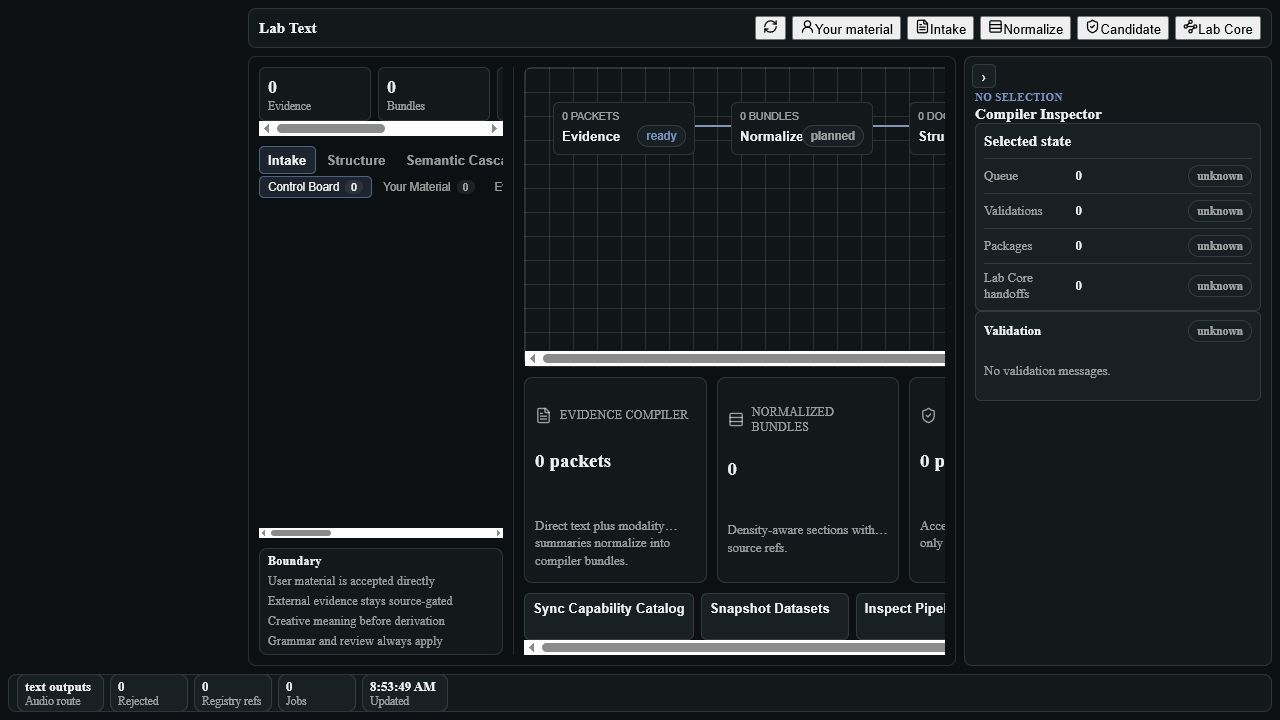
SeedGeist Lab Text: Textual Analysis
-
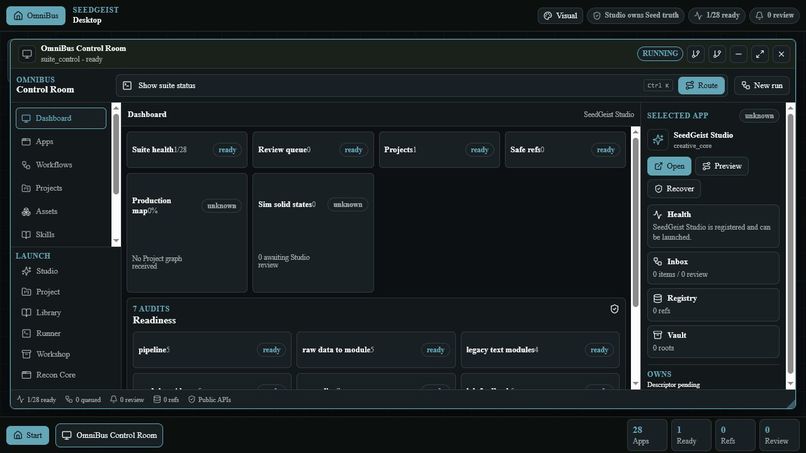
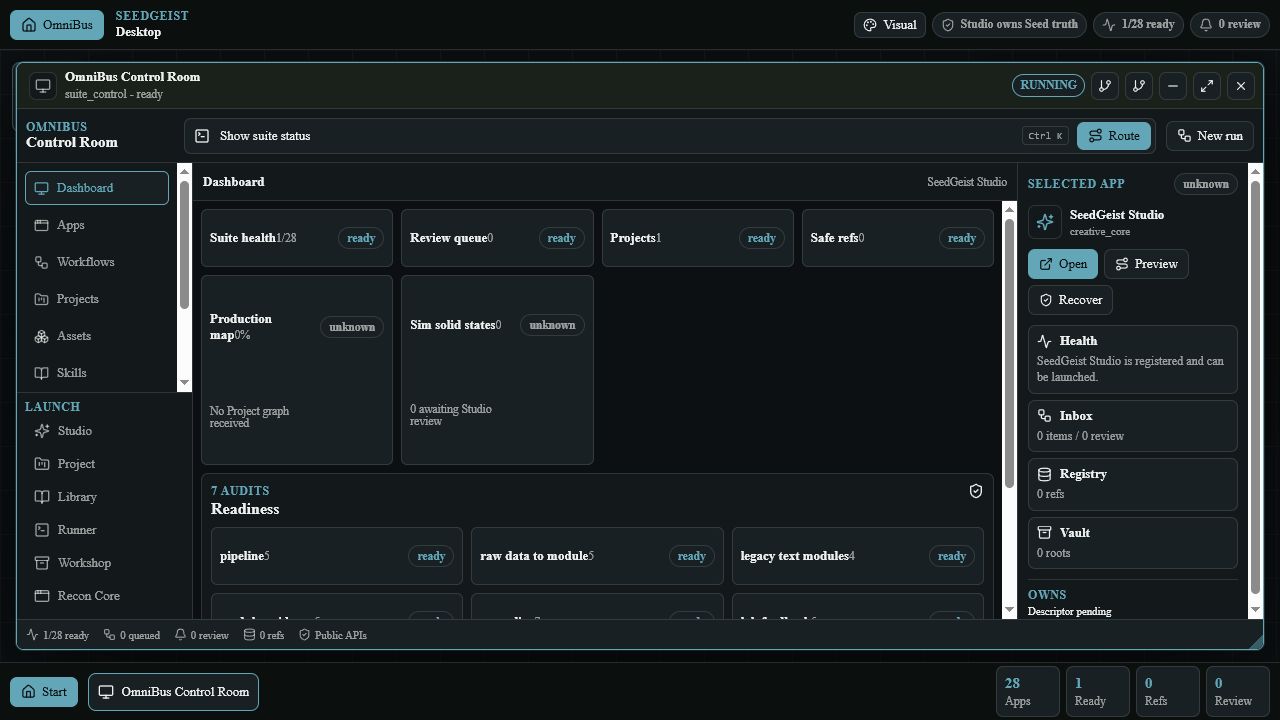
SeedGeist Omnibus: Control Central
-
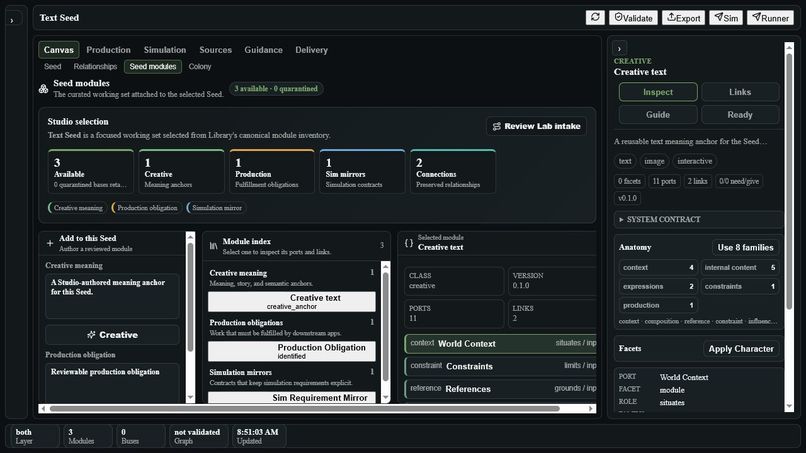
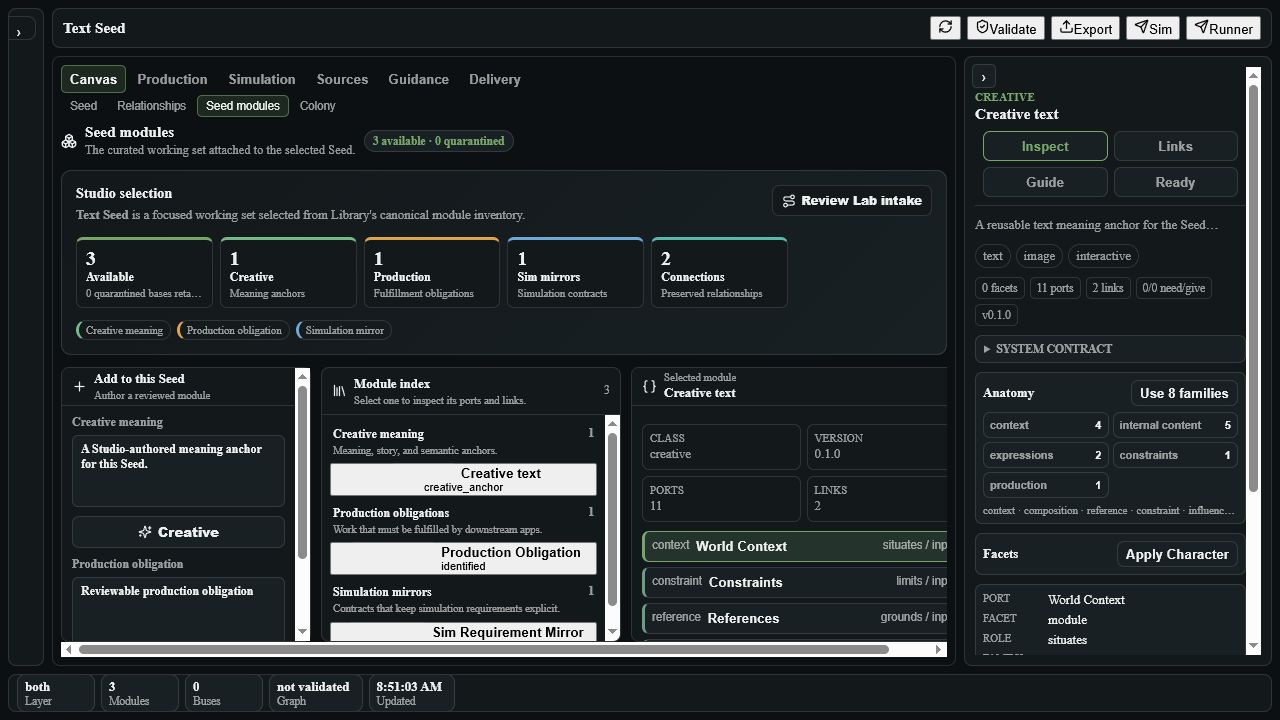
SeedGeist Studio: Module to Seed Compilation
Inspiration
SeedGeist is Inspired by Blue Ocean Strategy, where in competition is minimized by breaking the cost/value hierarchy. Many companies focus on AI solutions with generation as the main value proposition, and with that there can only be so much competition over processing costs. SeedGeist looked to flip this by not only making AI a middle focal factor, but by also integrating itself with the common host of providers and applications on the market for producing IP with AI.
Creative AI workflows are powerful, but they become difficult to trust when research provenance, source rights, model outputs, human decisions, and physical files are mixed together. SeedGeist explores a different model: a local-first creative intelligence operating system where AI accelerates IP work without silently becoming the owner of data or decisions. This allows users to carry rights through AI generation by first establishing a non-generated seed truth compiled of semantic based modules, and then reconstructing those generations procedurally with input from the user after AI generation.
What it does
SeedGeist coordinates research, semantic analysis, reusable creative modules, production planning, simulation, reconstruction, review, and publication preparation across 28 focused local applications.
The heart of SeedGeist is the Project Seed Colony, which is a compilation of research derived semantic modules that direct AI generation, and post AI generation reconstruction of IP assets. Seeds in themselves are not AI generated, and depending on licensing, modules are able to be collected and compiled into a seed that shares a semantic lineage with other seeds in a colony that can span multiple media/product outputs for a single IP.
OmniBus is the suite cockpit. Data qualifies sources and rights. The Lab family turns approved material into reviewable evidence modules. Library manages those reusable modules, while Studio owns creative Seed truth. Project, Runner, Sim, Workshop, Recon, Review, Protocol, and Publish continue the workflow through typed, metadata-safe handoffs.
Registry indexes descriptors and safe references rather than source bodies. Vault owns physical storage. Credentials, cost-bearing execution, destructive operations, and publication remain explicit and review-gated.
How we built it
SeedGeist is a TypeScript and React monorepo using pnpm, Vite, Node local services, Zod contracts, Vitest, Turborepo, DuckDB-backed data tooling, ESLint, Prettier, Gitleaks, and GitHub Actions. Windows 11 is the authoritative desktop platform, with Linux verification in CI.
The judge command creates a temporary sanitized runtime, removes inherited SeedGeist configuration, launches Desktop Host and OmniBus, audits that no user data or Vault roots are present, and deletes the temporary state on exit. A fully working version of SeedGeist will be released in the coming months with a fully built out set of module packs to start users off.
How Codex and GPT-5.6 were used
During OpenAI Build Week, GPT-5.6 in Codex built out and audited the existing monorepo and implemented the eligible reliability and launchability extension. Codex helped create serialized Windows-safe atomic writes, migrate JSON-backed stores, diagnose cancellation and worker-contention races, centralize tooling, enforce architectural boundaries, add CI and secret scanning, measure and lazy-load the largest clients, test the live UI against isolated state, and assemble the judge documentation.
The human author retained the key product and engineering decisions: the local-first model, application authority boundaries, review semantics, proprietary licensing, category positioning, and the decision to freeze risky structural and dependency upgrades before the deadline.
The current iteration of the SeedGeist system is a complete rebuild of the architecture of the 1st iteration of seedgeist. This rebuild took started on 7/11 and continued through 7/15 at which point Codex had been continued to be used for system hardening.
Challenges
The largest feasibility challenge was making a broad local suite deterministic on Windows without changing schemas or application behavior. Concurrent test workers amplified filesystem latency and exposed cancellation cleanup races. A shared per-path atomic writer, bounded Windows retries, isolated temporary test state, and a controlled root worker pool restored deterministic verification.
The largest conceptual challenge was coming up with this architecture. most companies and researchers are focused on using AI as a means to a final output, and so there is not a lot of reference for a system like this. This makes almost all aspects of the applications within the suite non-competitive with others on the field though.
What we learned
Local-first software needs more than a local database: ownership boundaries, process authority, redaction, test isolation, cancellation semantics, and inspectable handoffs all matter. Codex was most effective when the human constraints were explicit and each refactor was verified against existing contracts rather than treated as a rewrite opportunity.
There is much more to rights ownership than can be covered with current tooling. Copyright ownership in particular is a huge fault point with today's market of AI driven applications. A lot of background documentation and legal structures need to be fully accounted for, and through the work done during this hackathon I believe SeedGeist is a strong contender for acquiring legitimacy for what you make with AI.
What's next
The next phase is physical decomposition of the largest stores and contract implementation, deeper DataEngine responsibility extraction, and dependency-family upgrades one family at a time. I plan on bringing SeedGeist to the market in a layered way so that users can build upon the core system, and begin creating community input for modules.
The URL domain name for the project was acquired and will be becoming the central point of exchange for modules and seeds. I will also be collaborating with providers so that the AI generation portion of the application suite can be done locally or through them.
Built With
- codex
- duckdb
- gpt-5.6
- node.js
- react
- turborepo
- typescript
- vite
- vitest
- zod

Log in or sign up for Devpost to join the conversation.