Inspiration
The current landscape of AI video generation is plagued by a highly fragmented post-production workflow. Creators are forced to juggle multiple disjointed tools: one platform for generating the visual video, another for lip-syncing dialogue, and yet another for adding foley sound effects and background music.
We were inspired to eliminate this steep learning curve and tedious process. Our vision was to create a unified, "one-stop" cinematic studio—Seedance 2.0—where a simple text prompt or image could instantly generate a complete, production-ready video with natively synchronized audio, realistic physics, and director-level camera control.
What it does
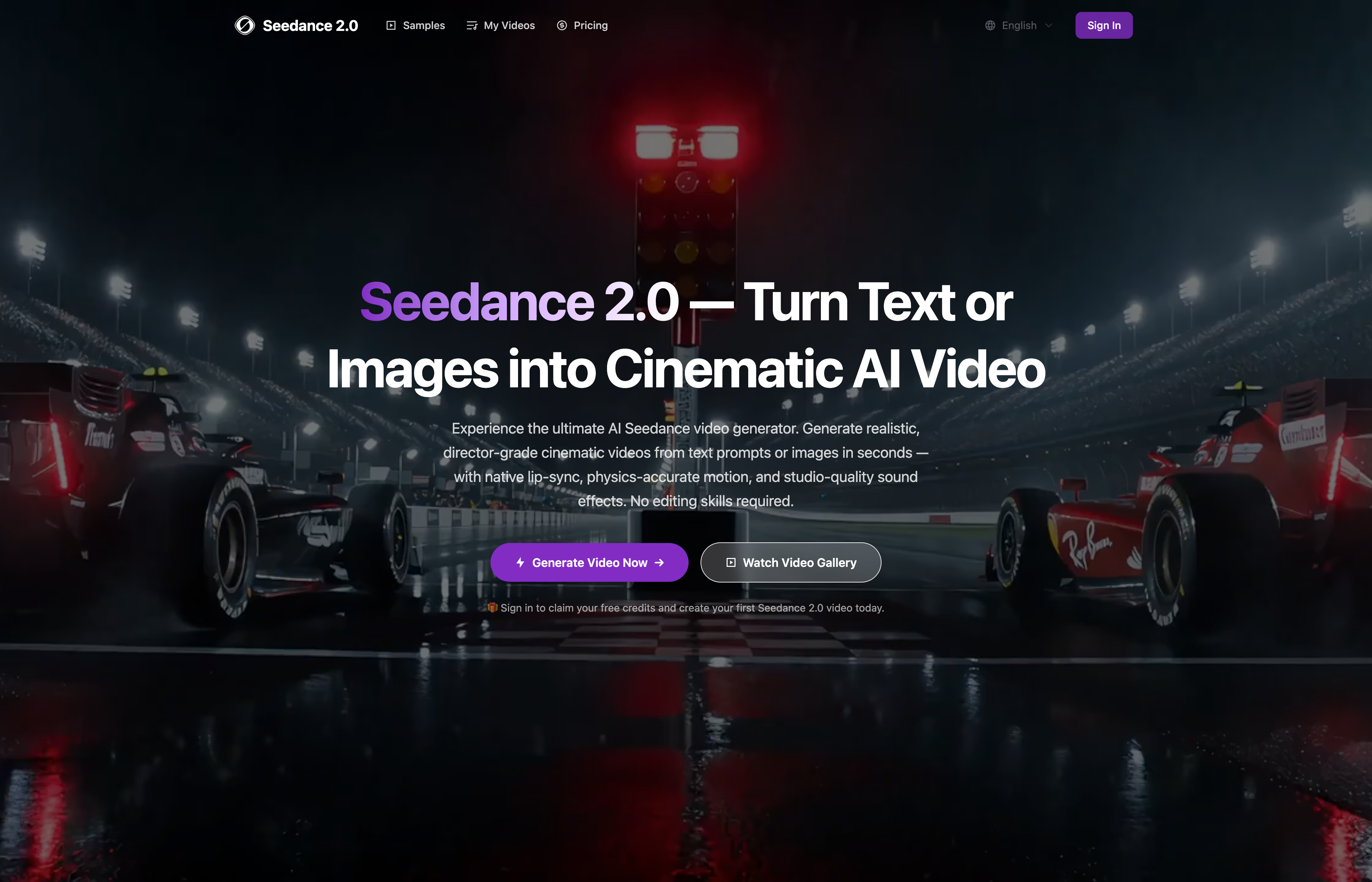
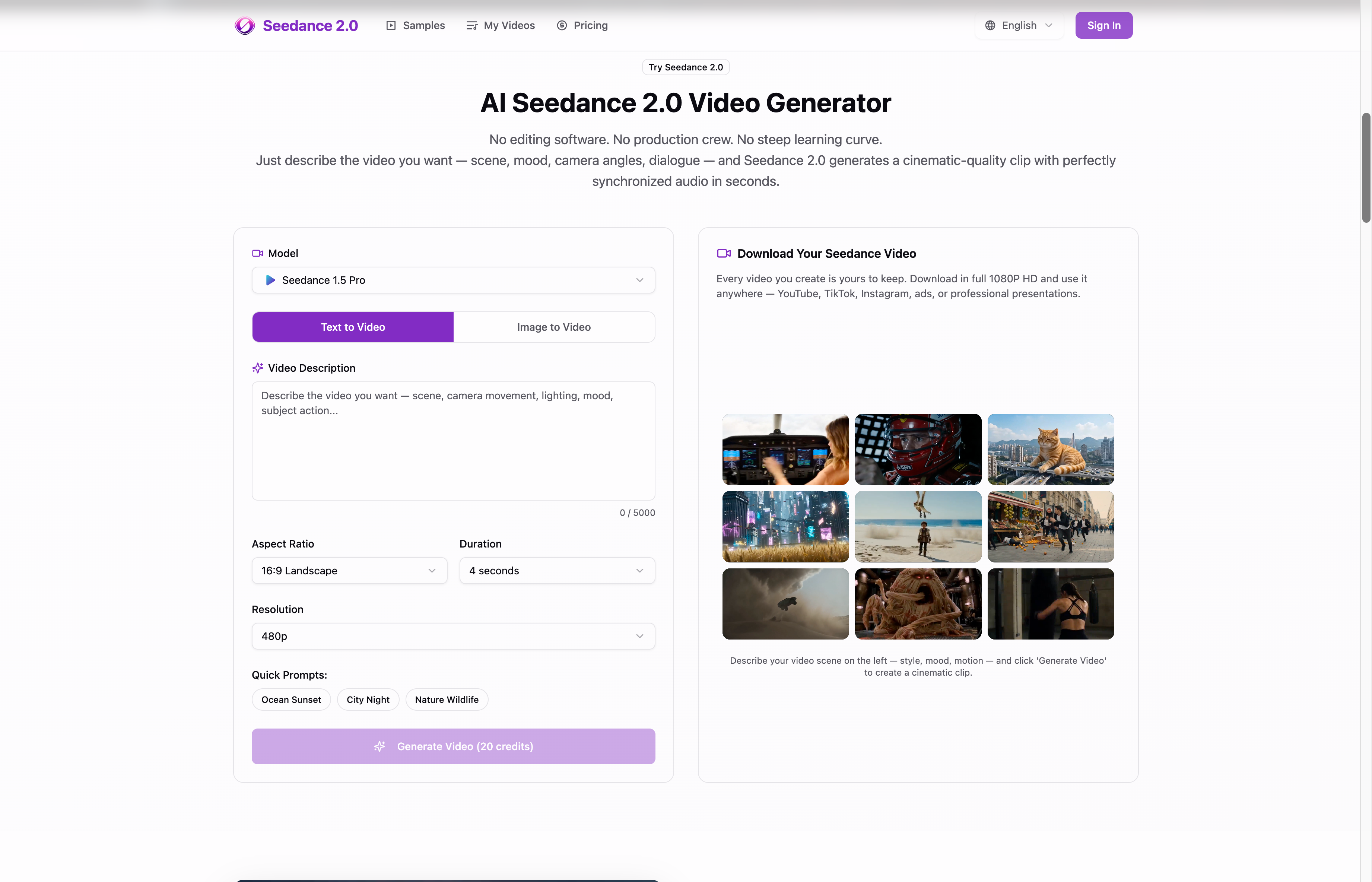
Seedance 2.0 is a next-generation unified multimodal AI video generator. It transforms text prompts, static images, reference audio, and video into cinematic-grade content in seconds.
Key features include:
- Native Audio-Video Synchronization: It jointly generates visuals, dialogue, pixel-perfect lip-sync, and ambient sound effects natively in a single pipeline.
- Physics-Accurate Motion Engine: Simulates real-world physics such as gravity, fabric weight, light refraction, and collision force feedback.
- Director-Level Camera Control: Executes complex cinematography like one-take tracking shots, Hitchcock dolly zooms, and rack focus transitions.
- Extreme Character Consistency: Maintains strict identity retention across all frames without face collapse, supporting up to 9 reference images.
How we built it
At the core of Seedance 2.0 is a revolutionary Dual-branch DiT (Diffusion Transformer) architecture.
Instead of bolting on audio as an afterthought, we designed a unified multimodal input system that fuses text, images, and audio into a shared latent space. This allows the model to process up to 9 reference images, 3 audio tracks, and 3 video clips simultaneously. The visual and audio generation branches communicate at the foundational level, ensuring that environmental sound effects (foley) and lip movements are generated concurrently with the corresponding visual pixels.
Challenges we ran into
- Multimodal Alignment: Synchronizing high-fidelity audio with visual micro-expressions (like natural lip-sync) natively within a diffusion model was incredibly difficult. We had to rethink how the latent space handles temporal audio-visual data.
- Physics Simulation: Moving beyond just "painting moving pixels" to actual physics simulation required training the model on massive datasets of real-world physical interactions (e.g., water splashing, fabric inertia) to prevent the "floaty" look common in AI videos.
- Consistency over Time: Preventing AI hallucinations like extra fingers or face collapsing during violent camera movements required significant optimization of our attention mechanisms.
Accomplishments that we're proud of
We successfully achieved a first-generation usable output rate exceeding 90%—the highest in the industry. This drastically reduces the "gacha" aspect of AI video generation, saving creators immense time and computing credits. We are also incredibly proud of our native spatial audio integration, which completely removes the need for third-party dubbing software.
What we learned
Building Seedance 2.0 taught us that true cinematic AI generation cannot be achieved by chaining separate specialized models together. We learned that a joint-generation approach (audio + visual generated simultaneously) is the only way to achieve true pixel-perfect synchronization and physical realism. We also gained deep insights into scaling Diffusion Transformers efficiently for high-resolution (1080p) output.
What's next for Seedance 2.0
We are currently working on expanding the temporal context window to allow for continuous generation of much longer narrative short films (beyond the current 15-30 second clips) without losing consistency. We are also fine-tuning our interactive digital avatars feature to provide even more nuanced control over micro-expressions for professional digital human broadcasting.
Built With
- nextjs

Log in or sign up for Devpost to join the conversation.