-
-
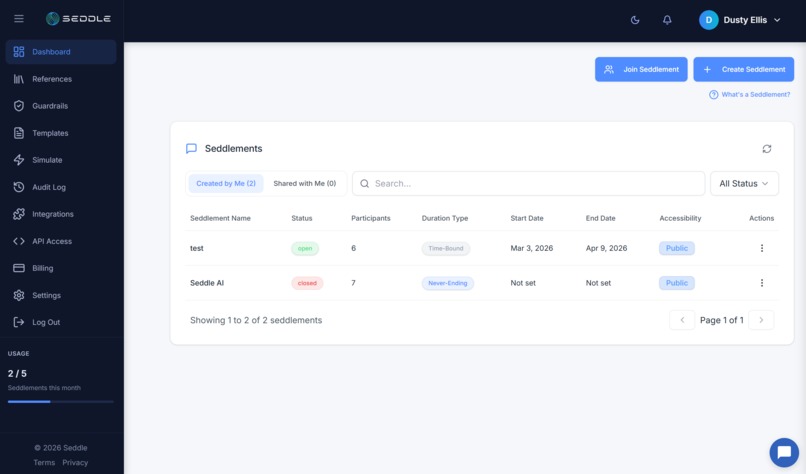
Dashboard
-
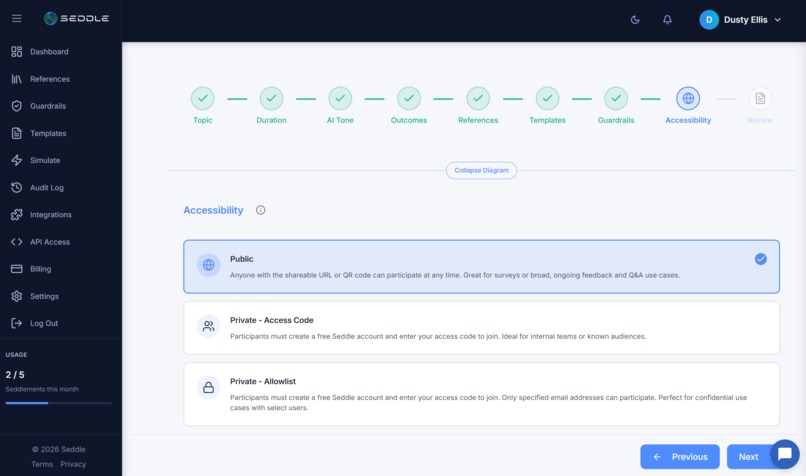
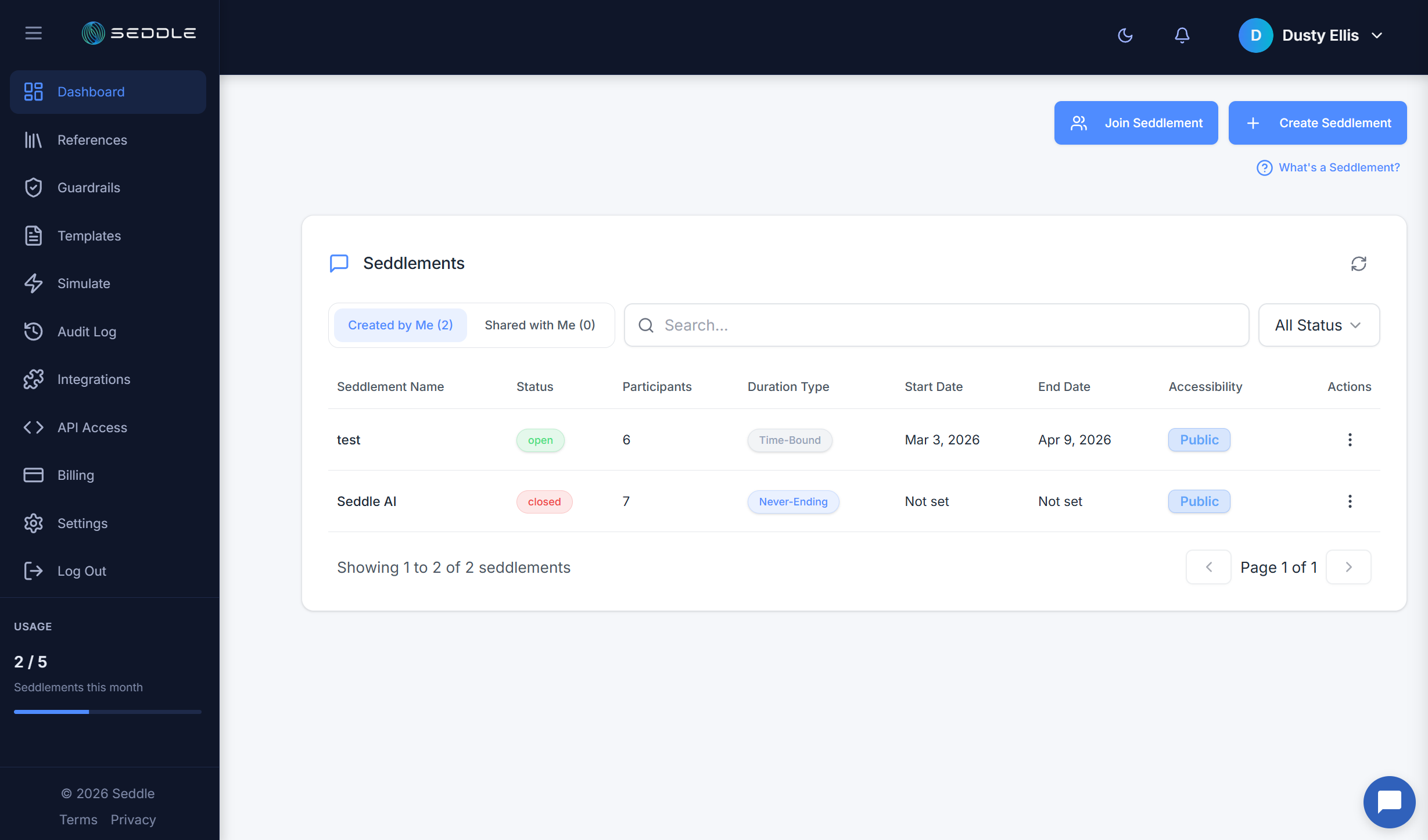
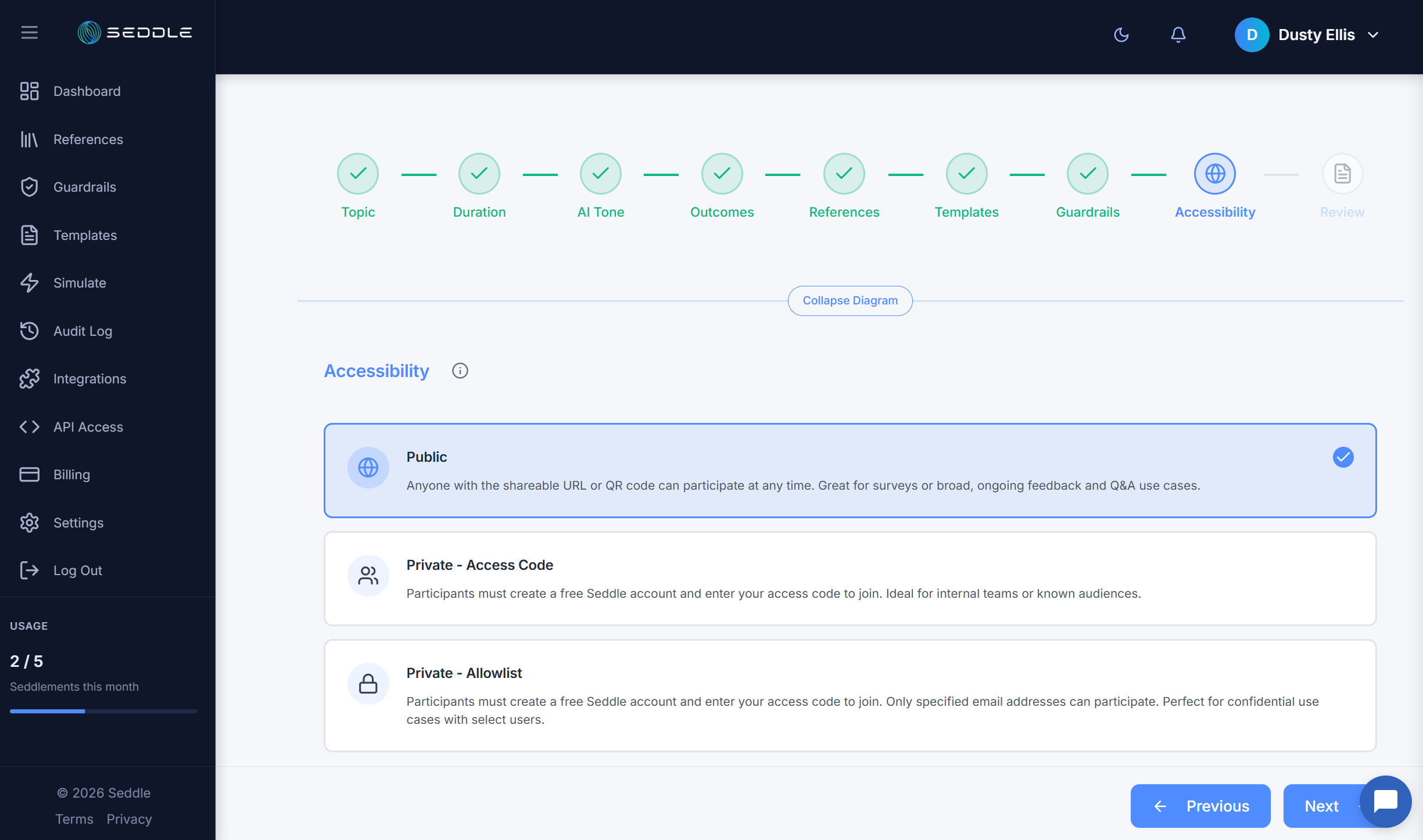
Seddle Agent Builder
-
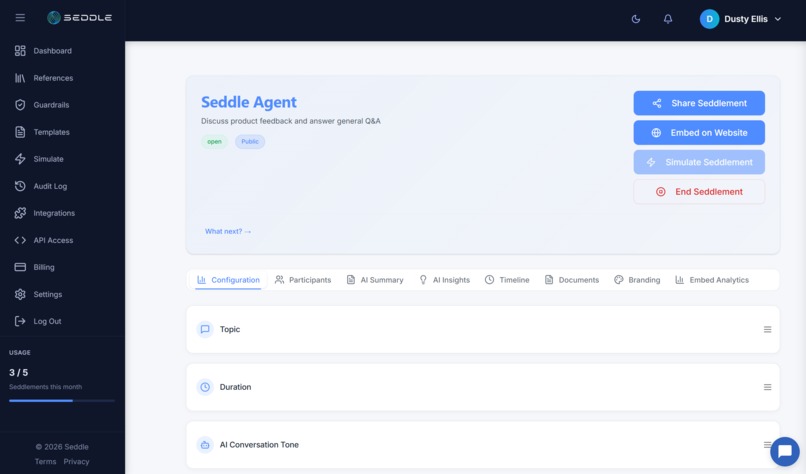
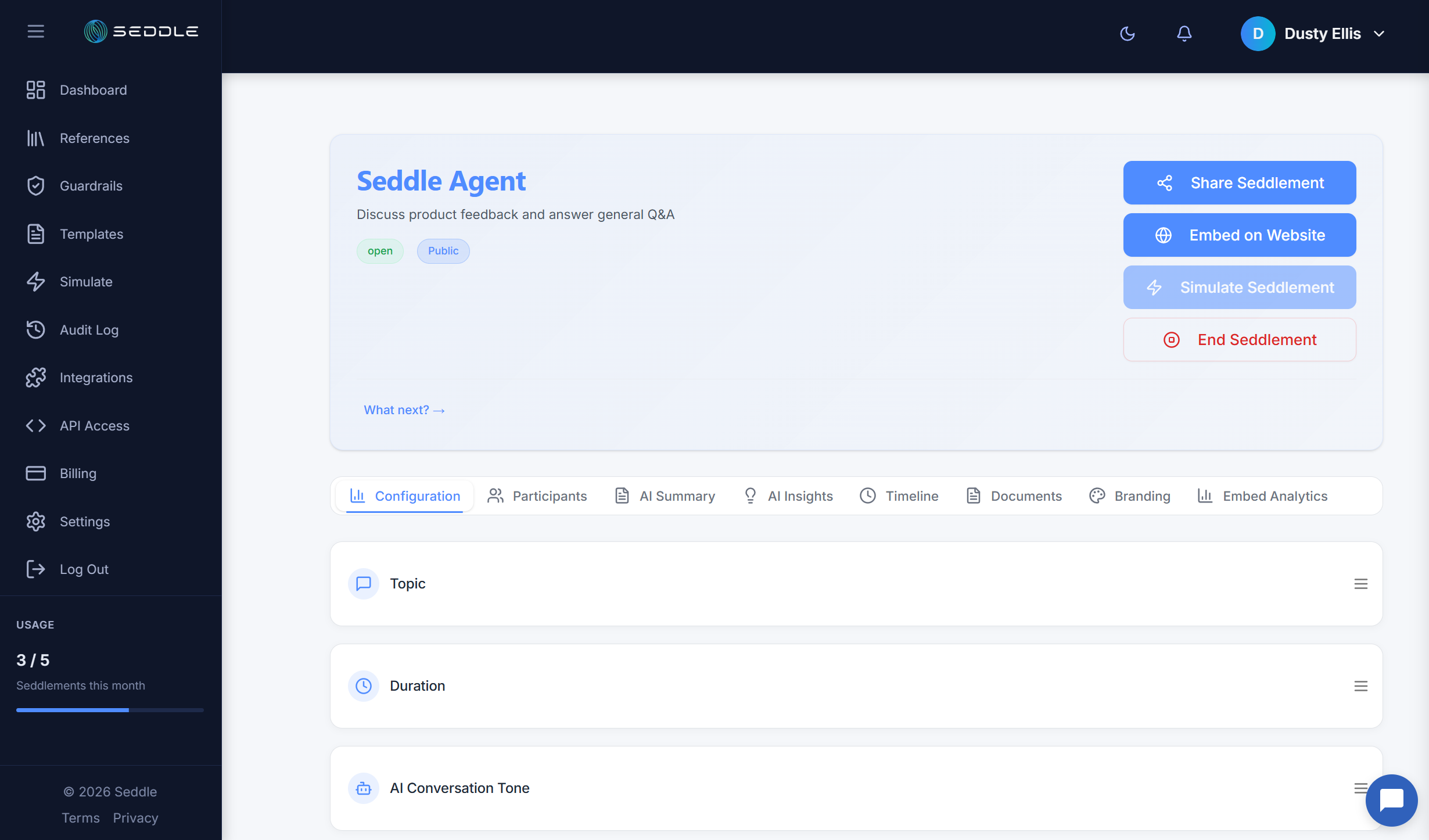
Manage Seddle Agent Configuration
-
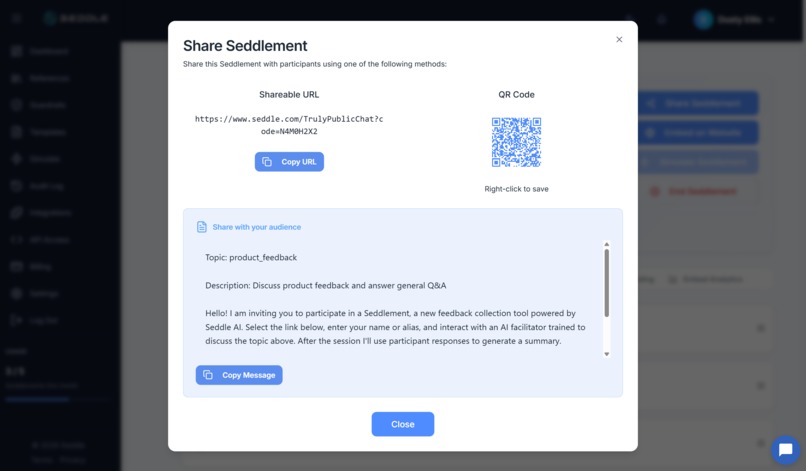
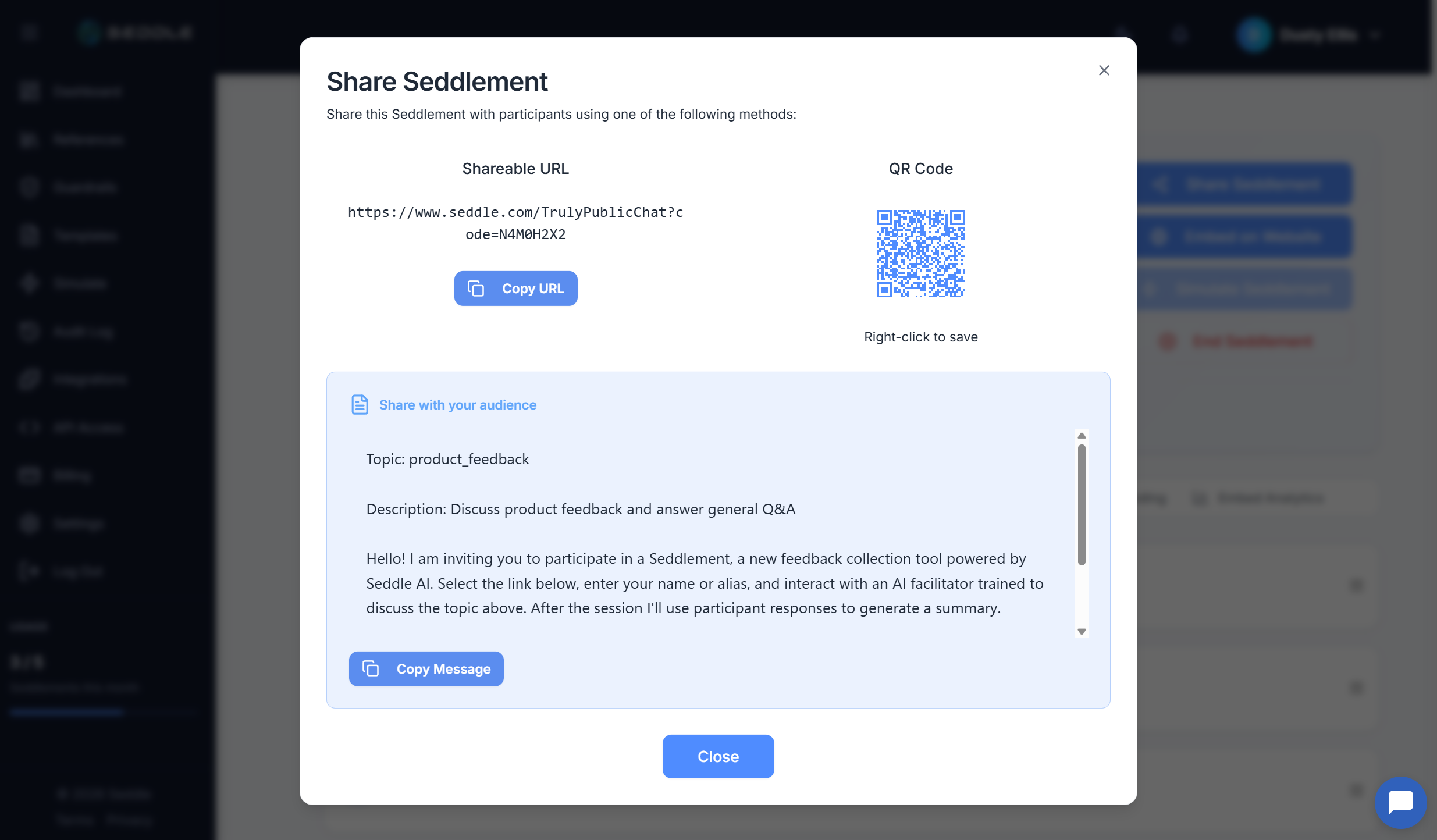
Share Seddle Agent
-
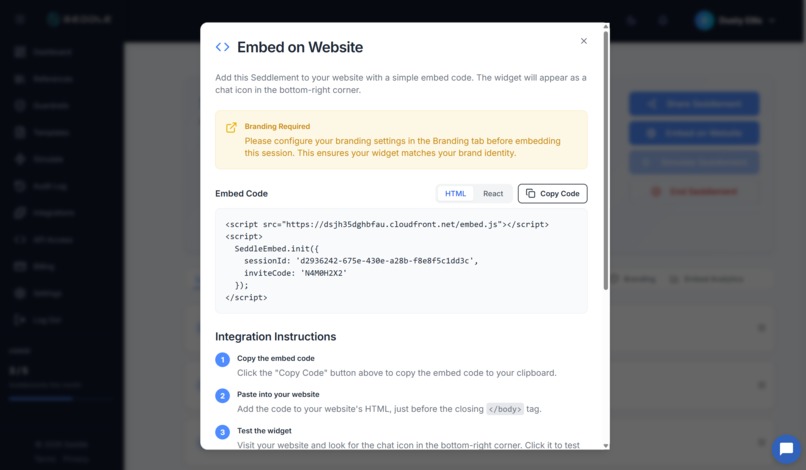
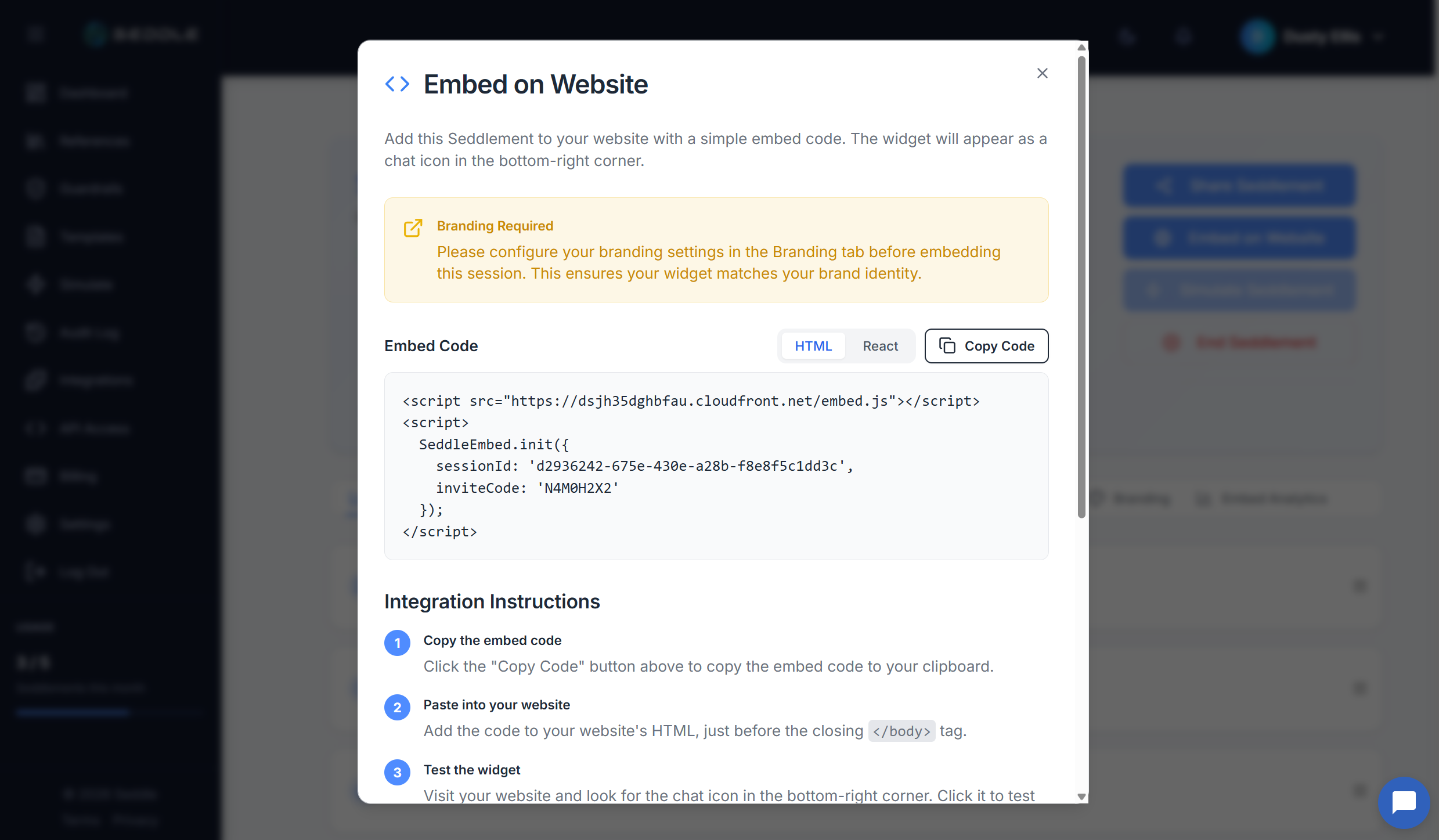
Embed Seddle Agent
-
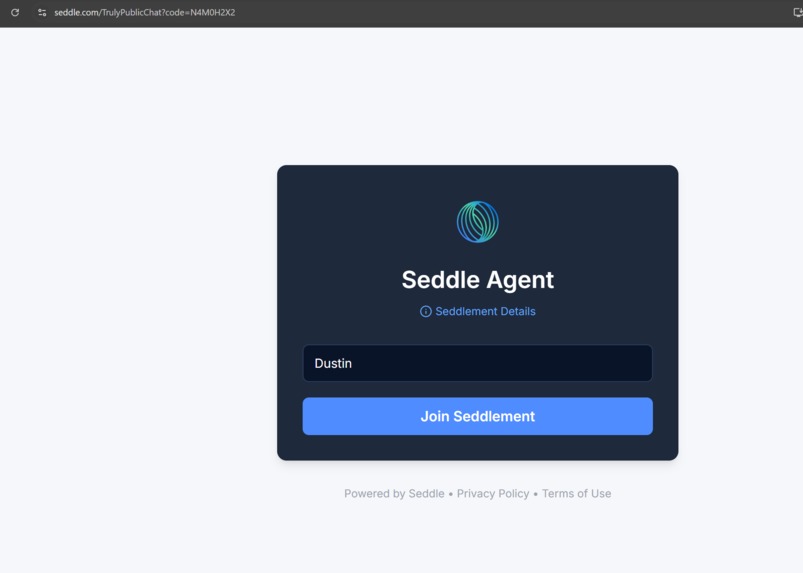
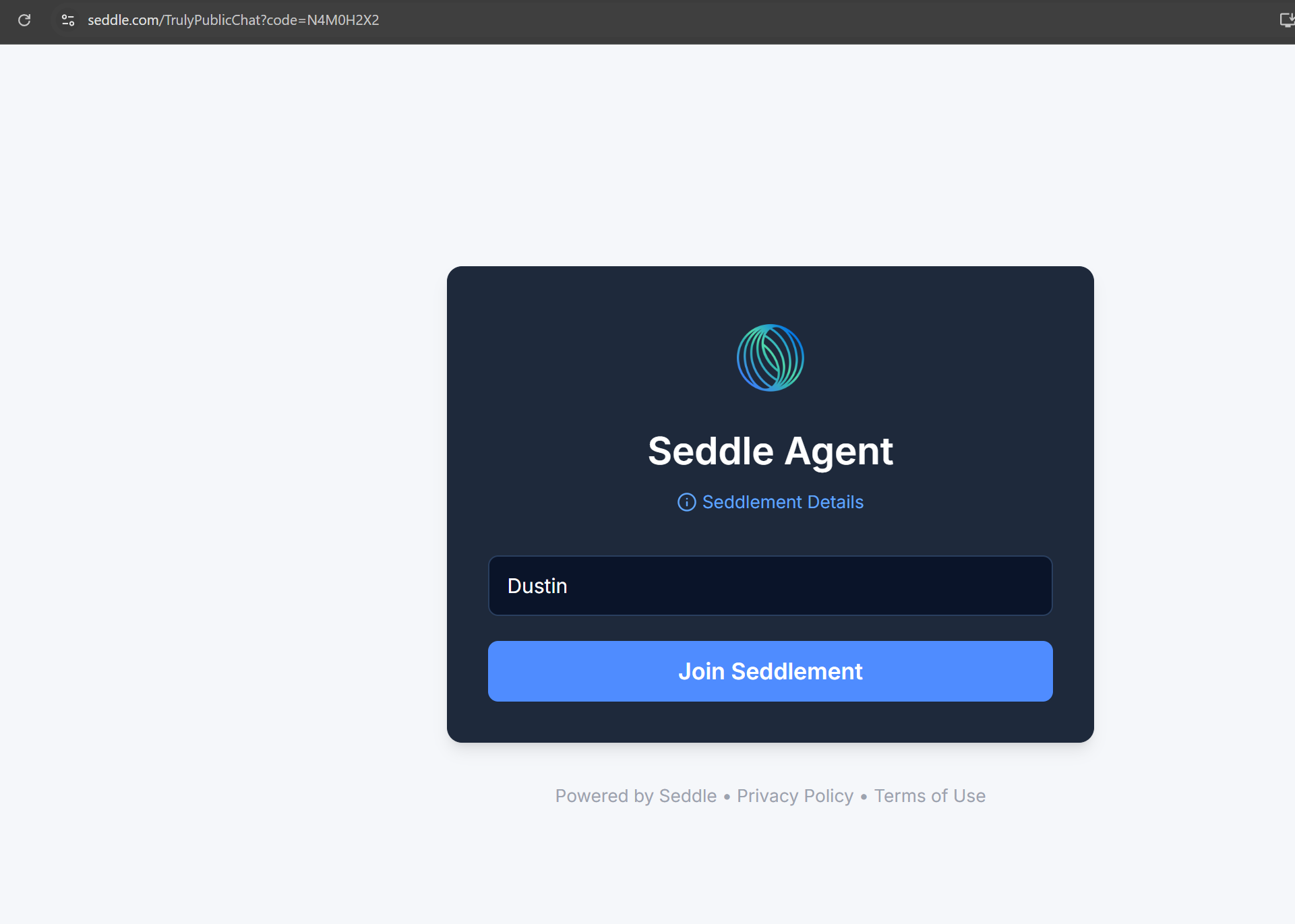
Join Agent Session
-
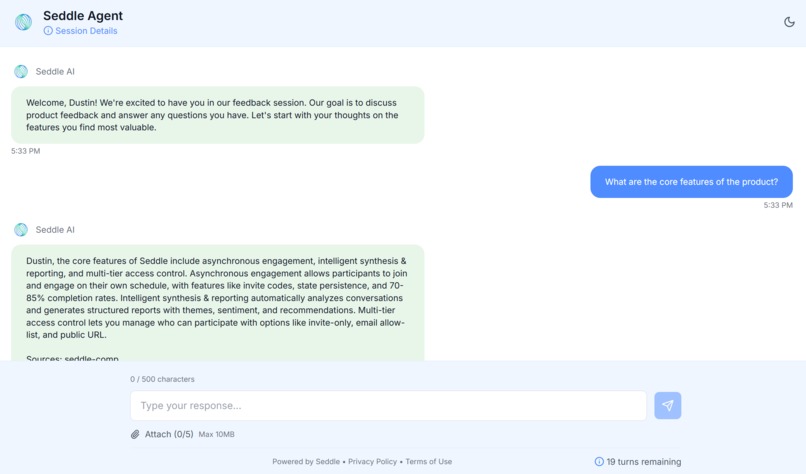
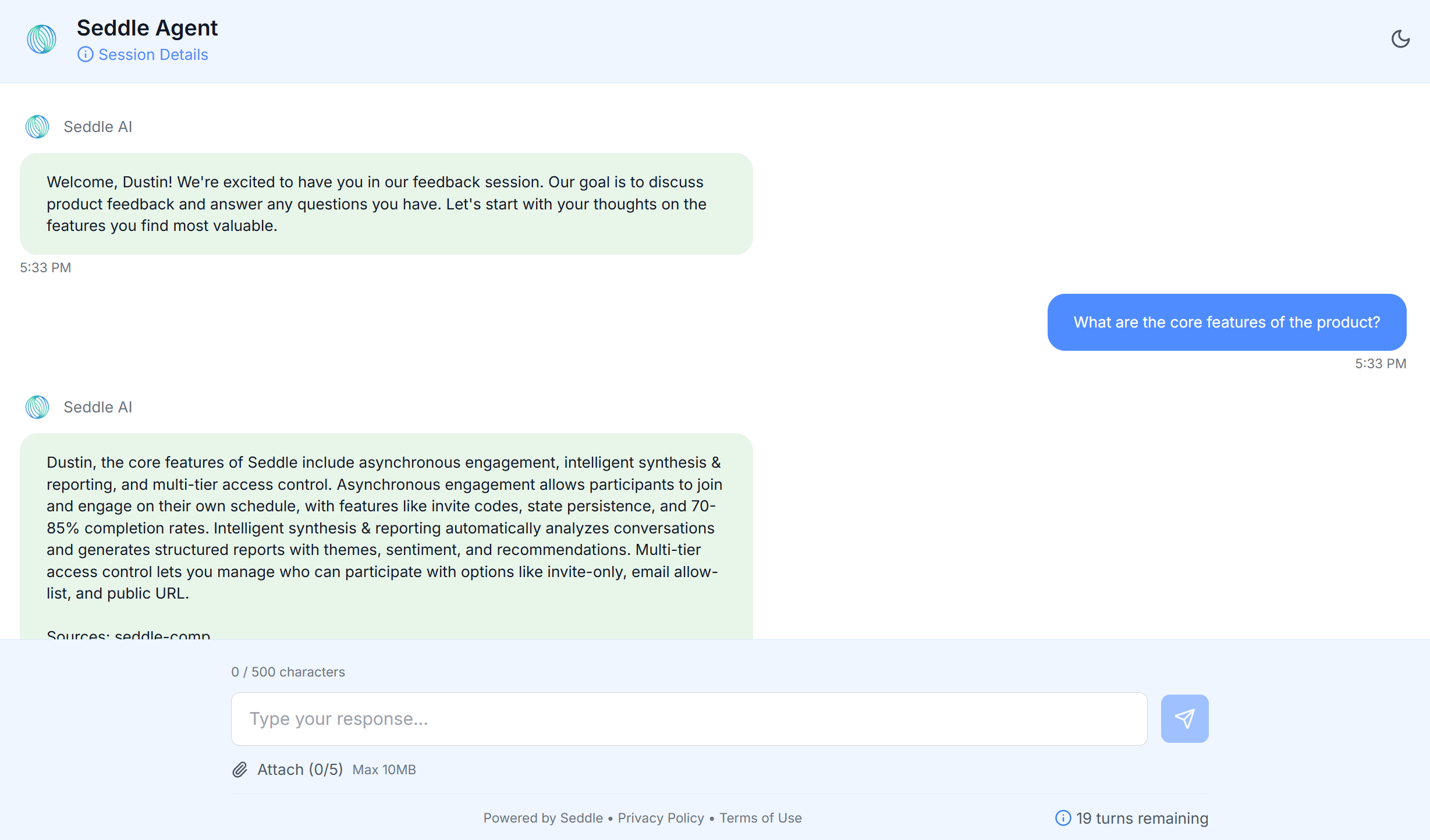
Seddle Agent Interactions, Customizable
-
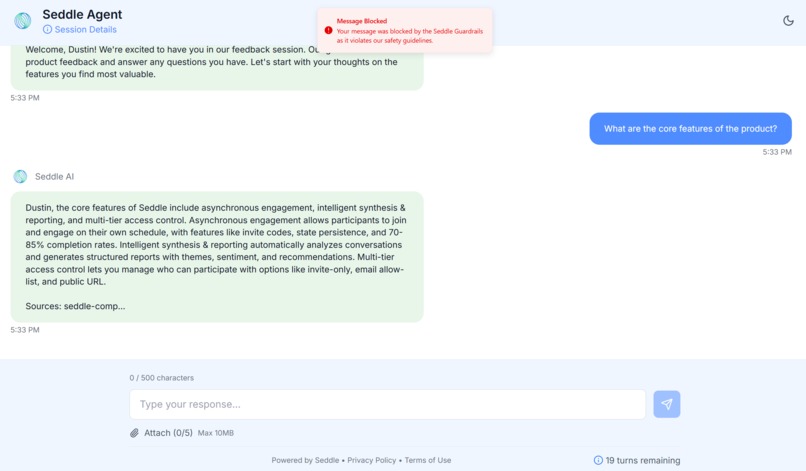
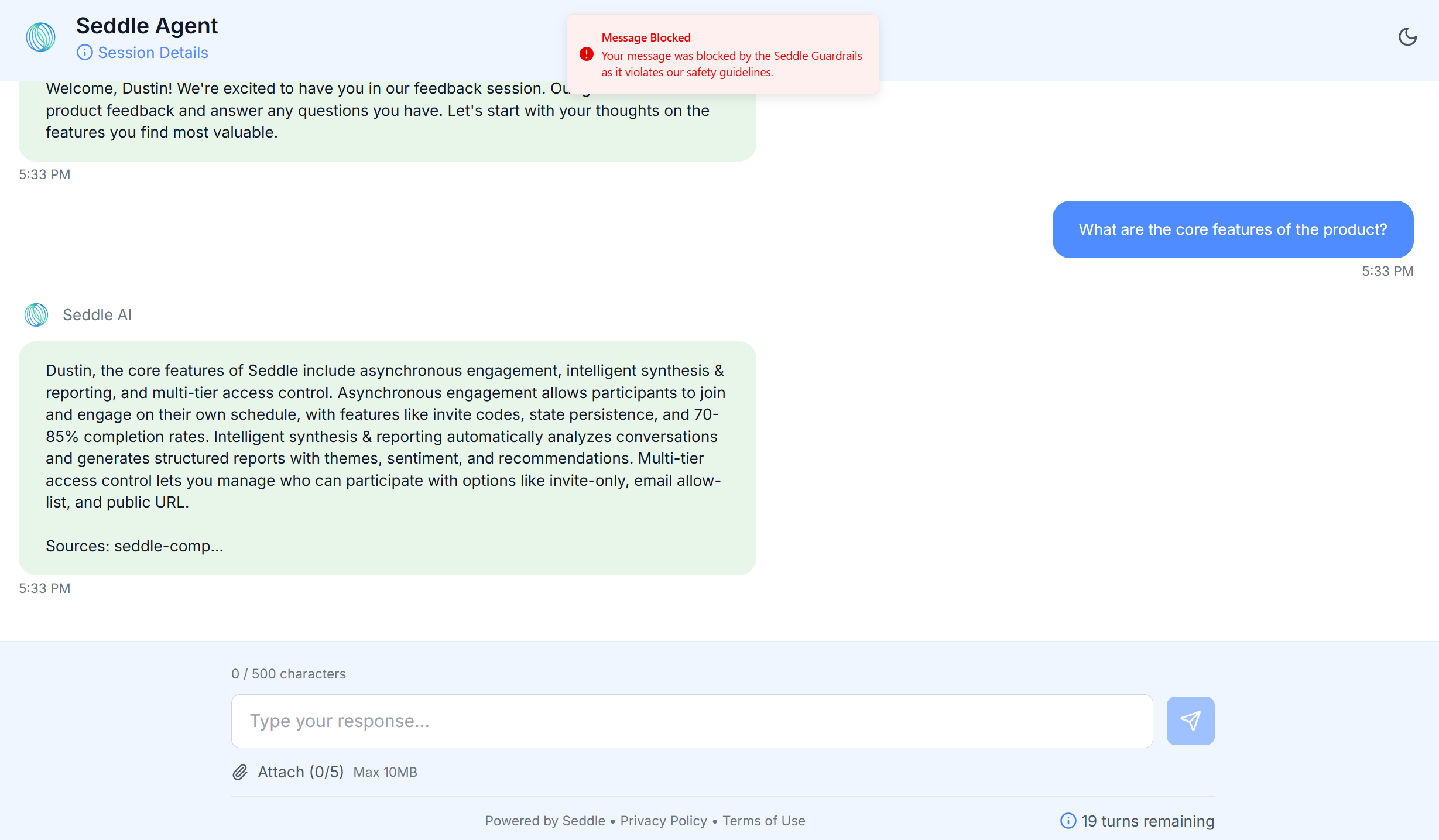
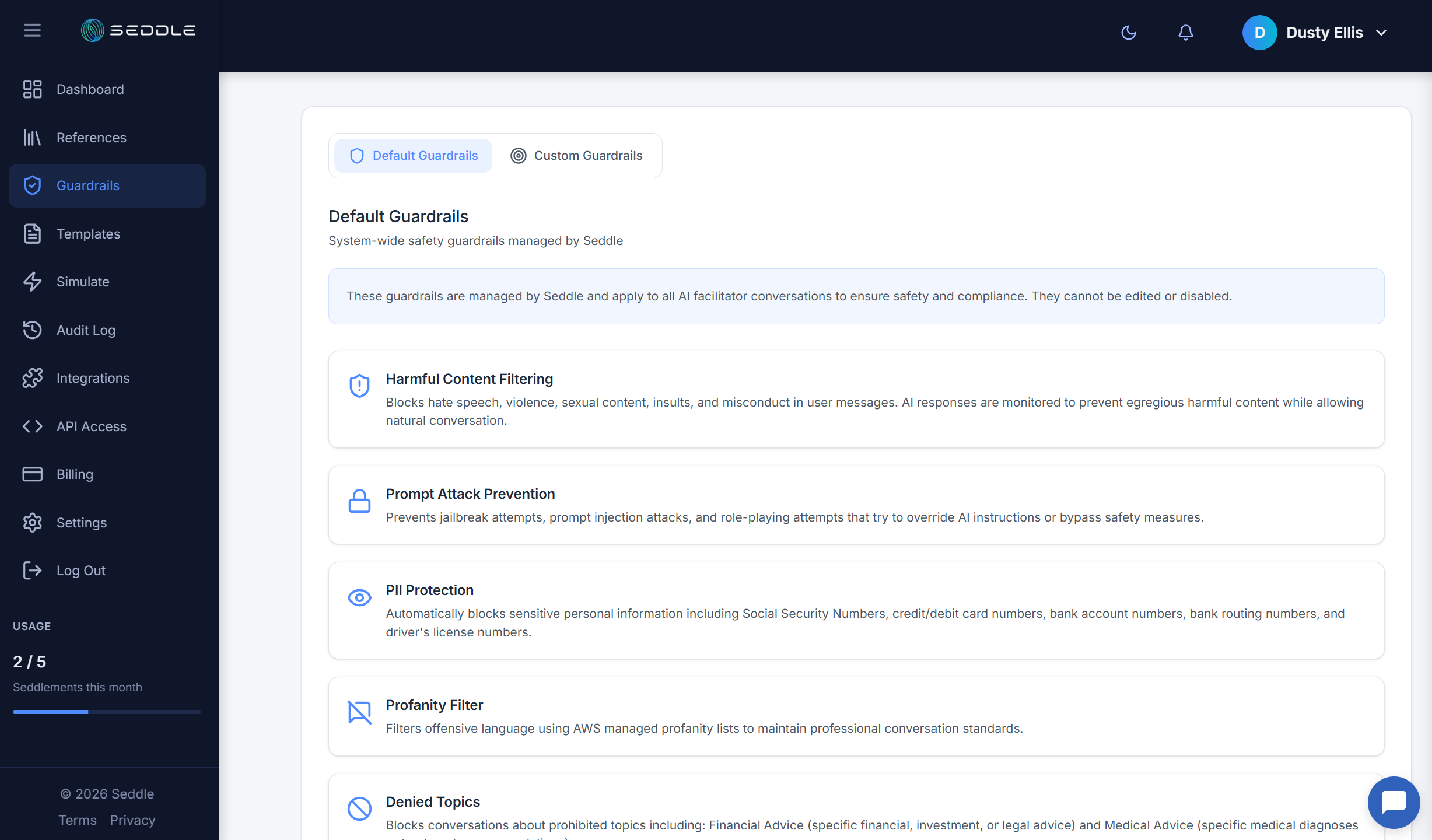
Global Guardrail Enforcement
-
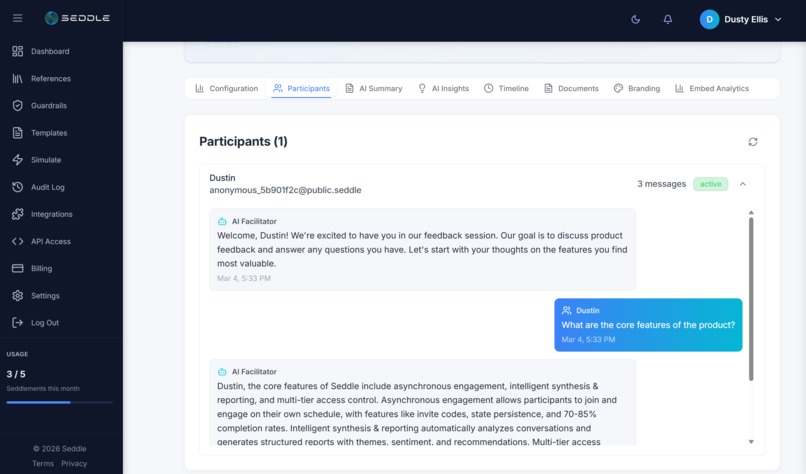
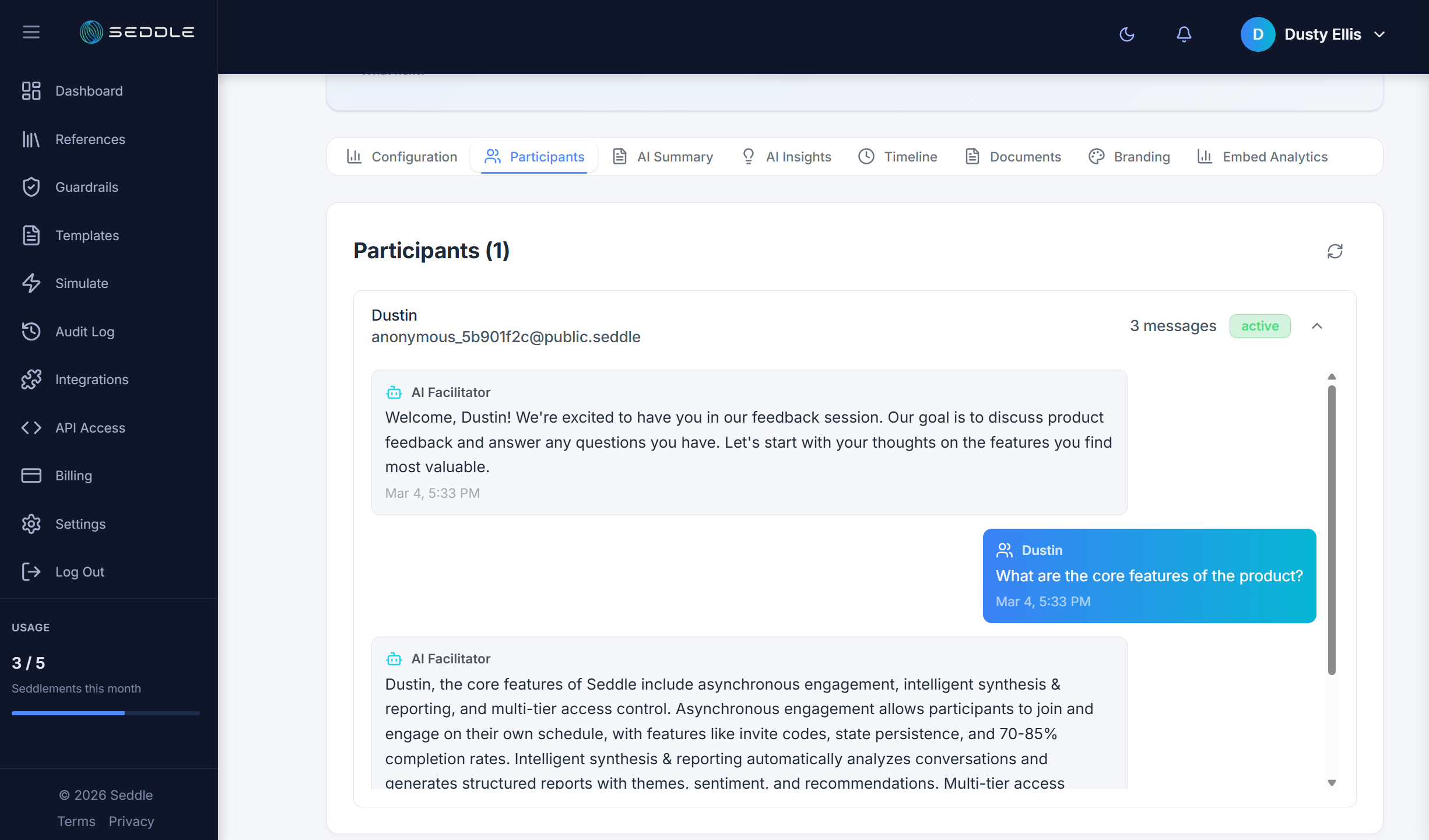
Live User Monitoring
-
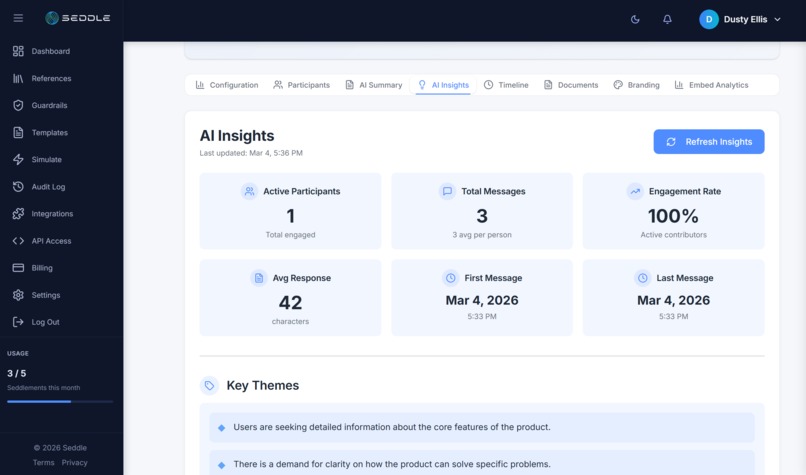
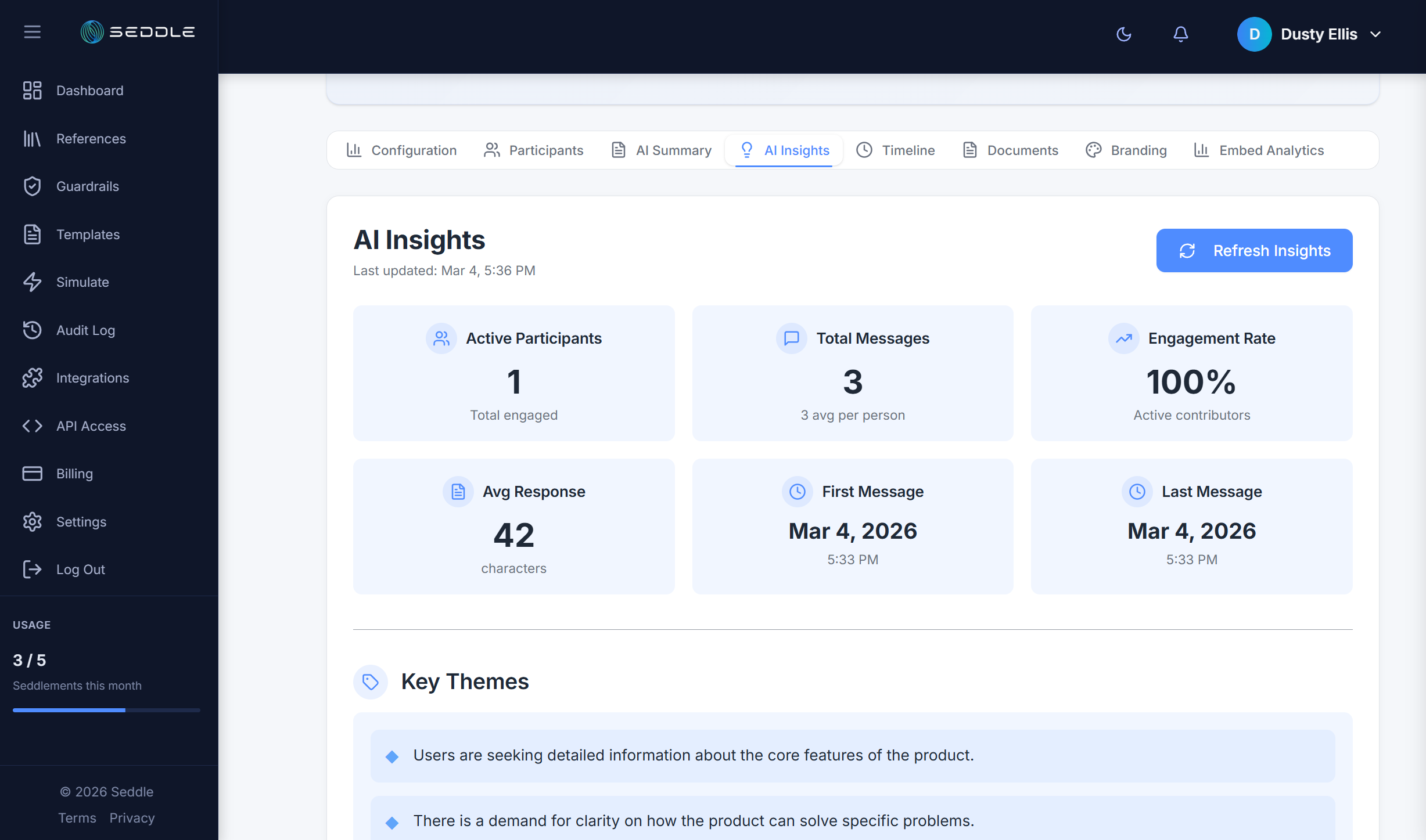
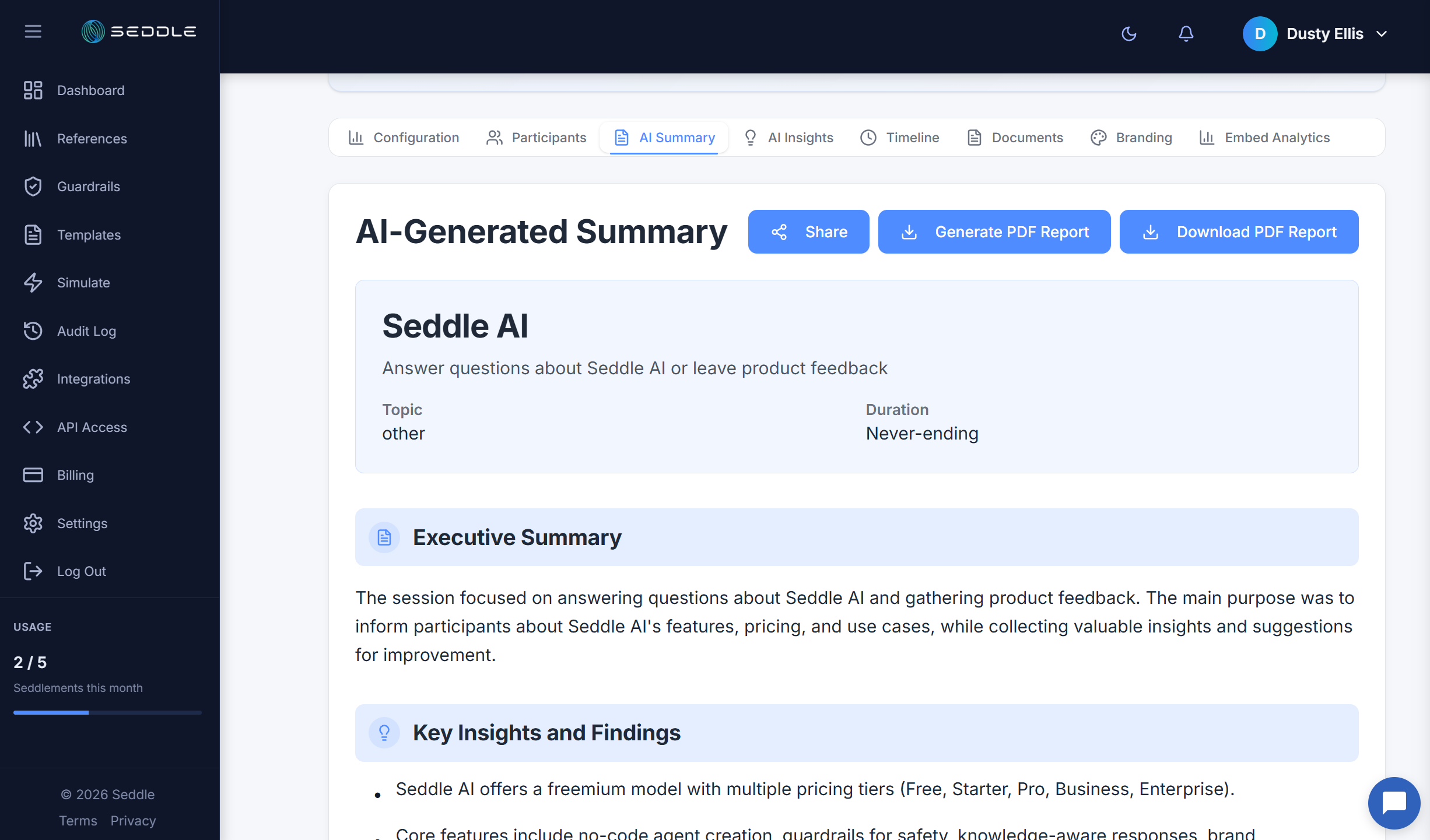
Real-time AI Insights
-
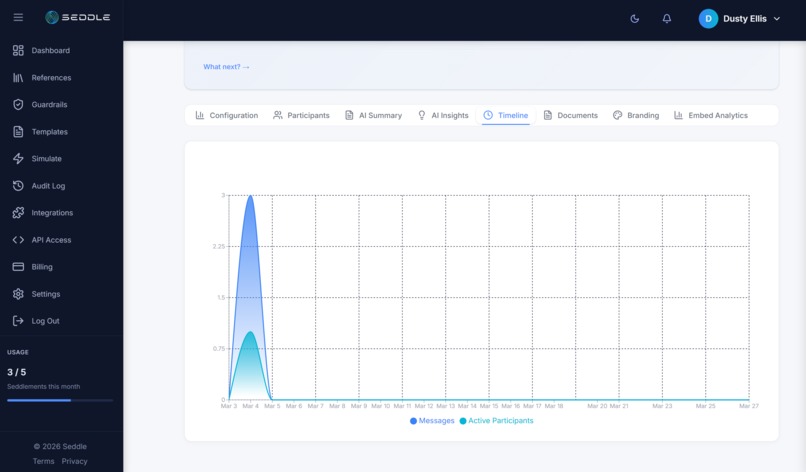
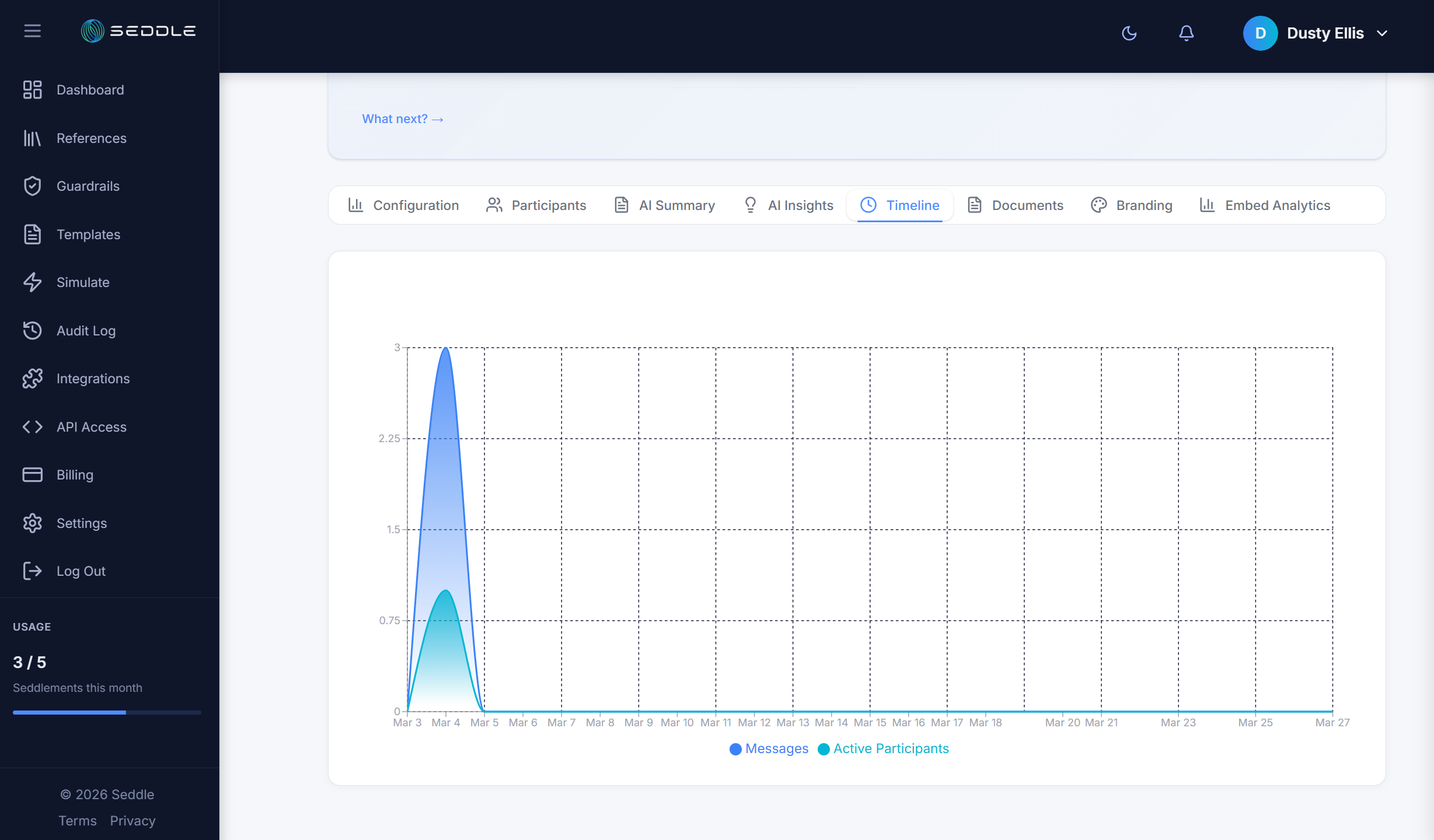
Agent Engagement Timeline
-
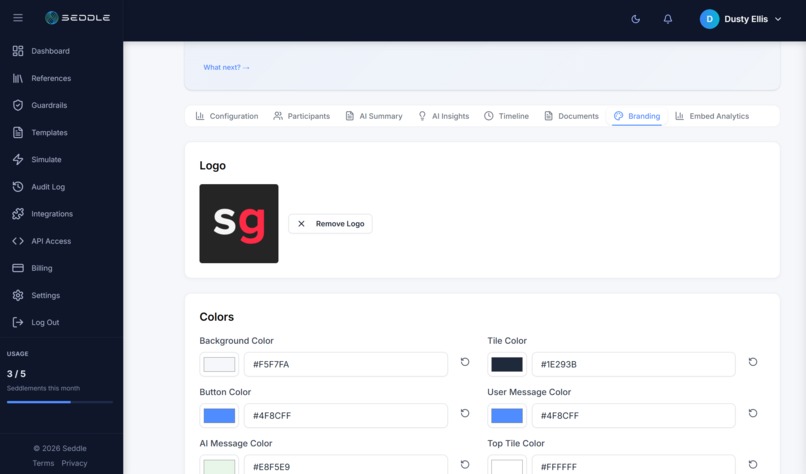
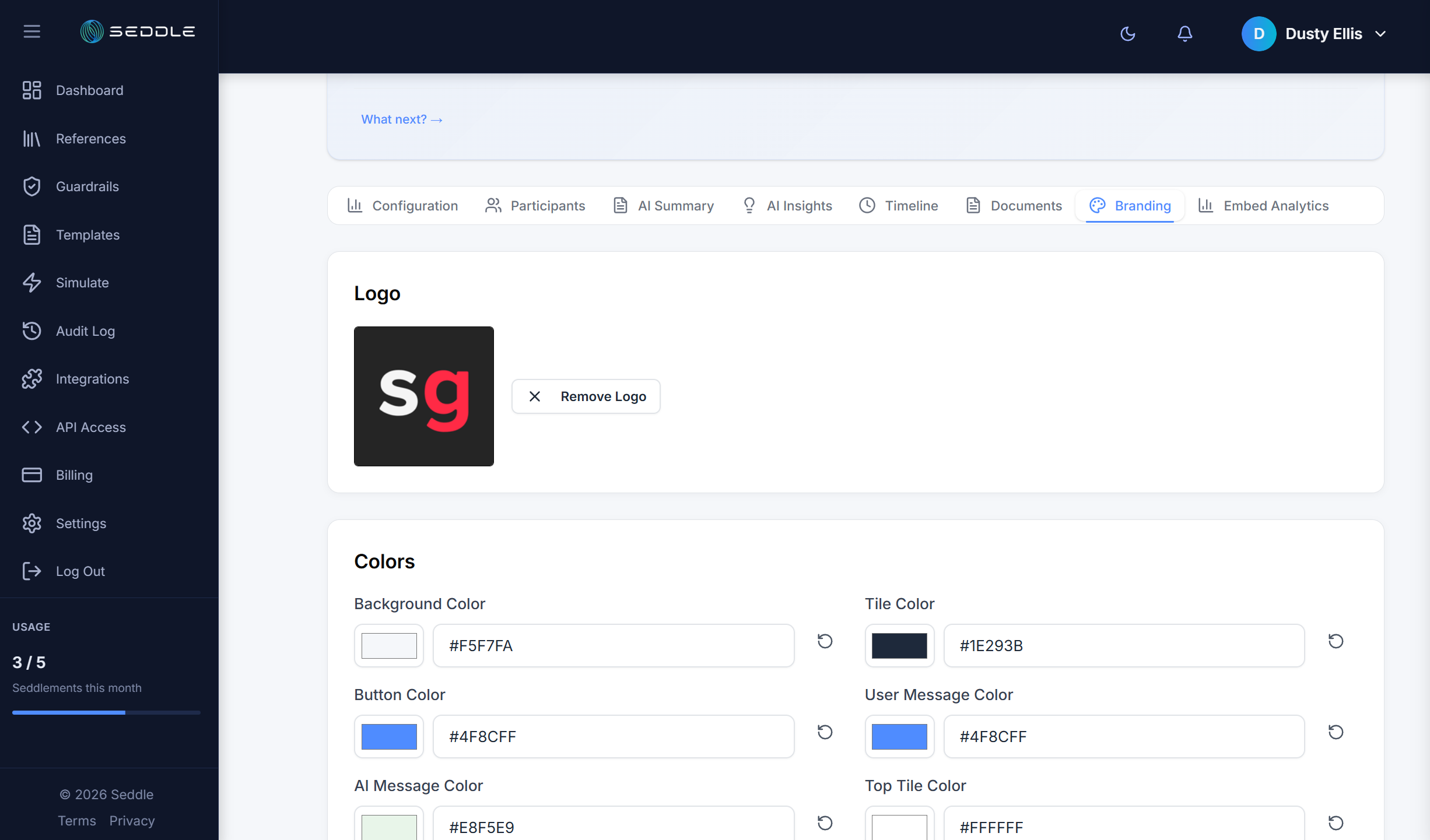
Custom Agent Branding
-
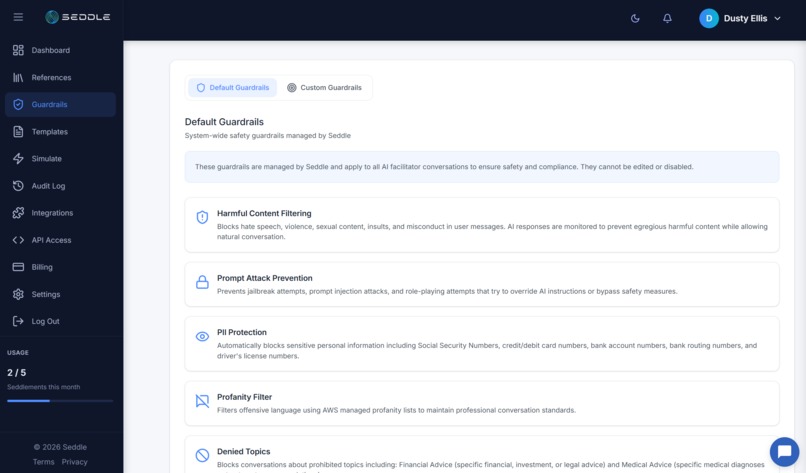
Global Guardrails
-
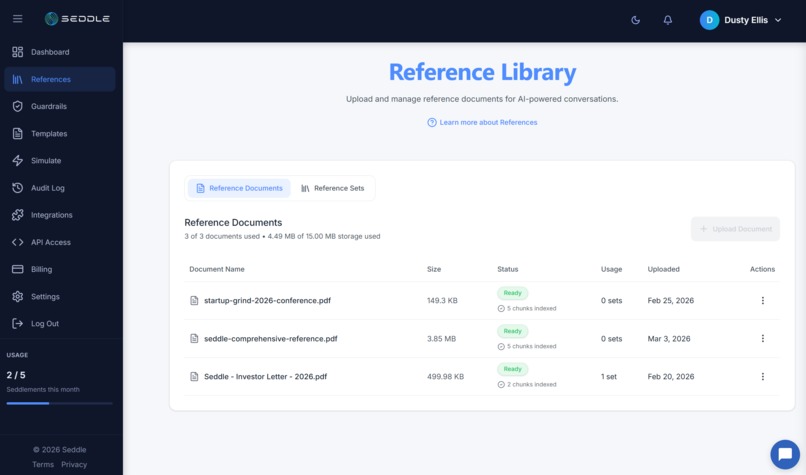
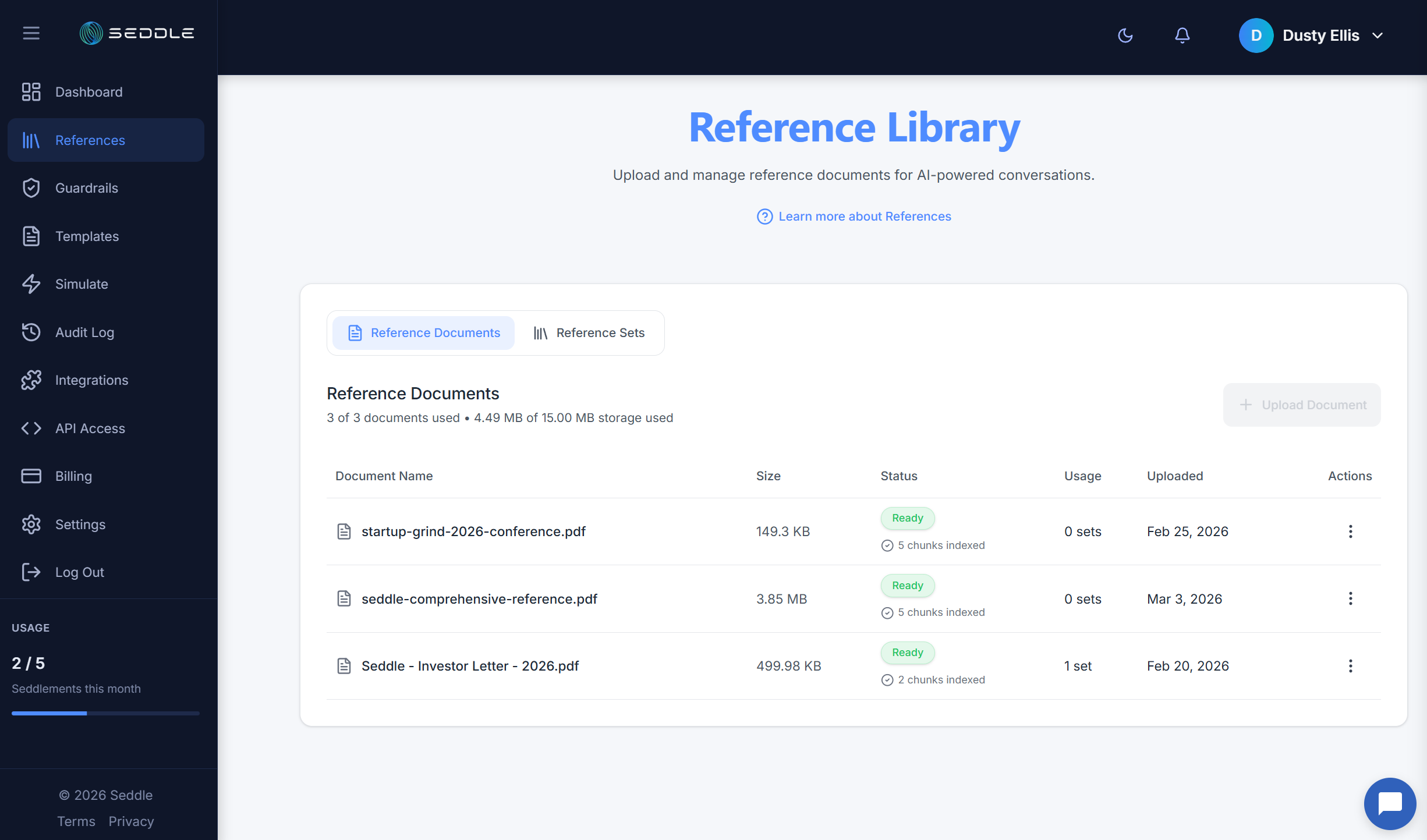
Reference Documents for RAG
-
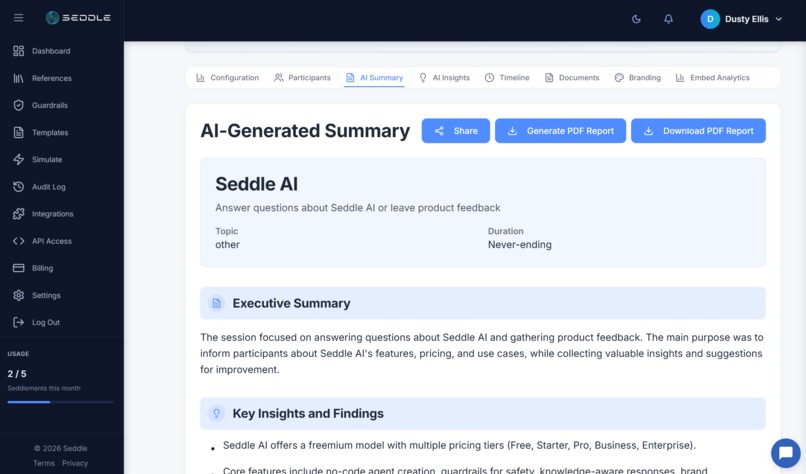
Custom, Brand Aligned Reports
Inspiration
Inspiration: Allow anyone to engage their audience with AI Agents. We founded Seddle in January 2026 with a bold vision: what if anyone could deploy AI agents for audience engagement without months of engineering work? While software engineering dominates 50% of AI agent activity (according to Anthropic's 2026 data ), audience engagement is a vertical that remains wide open. Organizations want to deploy AI agents that conduct personalized conversations with their audience at scale, but face significant barriers: infrastructure complexity, lack of AI expertise, and concerns about safety and compliance. After re:Invent 2025 we gathered as a team and asked ourselves a simple question: What if we built a no-code platform that enabled anyone to create, simulate, and engage their audience with no technical expertise required?
And thus, Seddle was born. Our founding team brings the right mix of technical depth and operational experience to tackle this challenge. Dustin Ellis (CEO/CTO) is a former AWS Senior Solutions Architect with 10 AWS certifications who spent 5+ years helping Fortune 500 companies build on the cloud. Brother Daniel Ellis (COO) is a MBA student and active-duty Special Operations Captain who understands organizational decision-making under pressure. Alex Branzburg (Head of GTM Strategy) is a former AWS Account Manager who knows how to bring products to market. Together, we're building a platform that makes AI agent deployment accessible to anyone who needs to engage an internal or external audience.
Seddle is an AWS Activate startup, member of Charleston Digital (a growing tech incubator in the Southeast), and building in public. Recently, Dustin shared his journey on the Charleston Tech Life Podcast, discussing how we're building on AWS from day one, participating in the Amazon Nova AI Hackathon, and documenting everything we've learned thus far building an AI startup.
What it does
Seddle is a no-code platform that enables anyone to deploy AI agents for audience engagement with no technical expertise required. We provide the complete infrastructure for AI agent deployment in a matter of minutes: you define your agent's purpose, constraints, knowledge base, and desired outcomes using an intuitive agent builder, while Seddle handles the LLM integration, vector search, guardrails, synthesis, and brand-aligned reporting (all the complex parts that would normally require specialized engineering talent). The platform is being built around three core capabilities:
Create : Build brand-aligned, knowledge-aware AI agents in minutes using our no-code interface. Define your agent's tone, guardrails, knowledge base, branding, and desired outcomes. Seddle handles the LLM integration, vector search, and underlying infrastructure.
Simulate: Stress-test your agent configuration against synthetic audience profiles before going live. Validate conversation quality, identify knowledge gaps, and pressure-test guardrails, all before a single real participant interacts with the agent.
Engage: Deploy agents that conduct personalized, asynchronous conversations at scale. Depending on the configured accessibility settings, users can share public URLs, QR codes or access codes with their audience, or use our Website Embedding feature to embed a live agent directly on their website in seconds with full brand alignment. Regardless of how you allow participants to interact with the agent, Seddle automatically synthesizes insights across all conversations and generates structured, brand-aligned reports with themes, sentiment, and actionable recommendations.
Key capabilities include:
- Configurable AI agents with custom tone, guardrails, and desired outcomes
- References Library with RAG-powered responses using uploaded documents
- Reference Sets for organizing knowledge into logical collections
- Embeddable widgets for deploying agents directly on your website
- Custom branding with logos, colors, and themes
- Automated insights with sentiment analysis, theme extraction, and quote identification
- Multi-tenant architecture with enterprise-grade security and isolation
Use Cases: Product feedback, customer research, employee engagement, community Q&A, event feedback, onboarding conversations, and more. We think Seddle is great anywhere you need to engage an audience at-scale with personalized AI conversations. See a full list of use cases on our website here.
How we built it
As a former AWS Solutions Architect who previously helped build and scale some of AWS' largest customer environments like Uber and Block, we built Seddle 100% on AWS leveraging the full power of cloud-native architecture. Our tech stack includes Amazon Bedrock with Nova and Claude for high-quality AI interactions for audience engagement, DynamoDB with a sophisticated single-table design for scalable data storage, AWS Lambda for serverless compute, API Gateway with Cognito for authentication, OpenSearch Serverless for vector search, and S3 + CloudFront for frontend delivery, to name a few. Even cooler: we developed the entire application using Amazon Kiro, AWS's AI-powered IDE, which accelerated our development velocity dramatically. We've been "building in public" since early January, publishing engineering blogs on Medium and LinkedIn and documenting our architectural decisions: why we chose DynamoDB's single-table design over traditional relational databases, how we built a production-ready Bedrock client with retry logic and model failover, and more. As AWS Activate Startup members (joined February 2026), we've leveraged AWS credits and technical support to rapidly iterate toward our late Q1 2026 launch, and learned a ton along the way that we'll continue to share with the engineering community. To-date, we have received over 20k+ impressions on our LinkedIn and Medium content, including from some of AWS' most senior AI/agentic leaders.
But the real magic happens in our AI infrastructure. We built Seddle on Amazon Bedrock, leveraging multiple model families to balance cost, latency, and quality. For conversational AI, we use Amazon Nova Pro as our primary model, with Amazon Nova Lite as a fast, cost-effective fallback, and Anthropic's Claude models for specialized tasks requiring deeper reasoning. This multi-model approach gives us resilience and flexibility. If one model is throttled or unavailable, we automatically fail over to another. For knowledge-enhanced responses, we integrated Amazon Bedrock Knowledge Bases with Amazon OpenSearch Serverless for vector search. Users upload documents to their References Library, and we process them asynchronously through an SQS queue, chunking and embedding them with Amazon Titan Embeddings. When an AI agent responds, it queries the Knowledge Base with semantic search, pulling in relevant context from the user's documents. Safety is non-negotiable, so we use Amazon Bedrock Guardrails to enforce content filtering, PII redaction, and prompt attack prevention at the API level. This isn't just prompt engineering. It's infrastructure-level enforcement that applies to every single AI invocation. Everything, every Lambda function, every DynamoDB table, every S3 bucket, is defined in Terraform. We can tear down and rebuild our entire infrastructure in less than an hour, which has been invaluable for testing, disaster recovery planning, and eventually supporting dedicated enterprise deployments.
Challenges we ran into
Building Seddle came with its share of technical challenges. Default Bedrock quotas were insufficient for even basic integration testing, forcing us to open AWS Support cases early to increase RPM and TPM limits. We learned quickly that Claude and Nova models use completely different API formats, requiring us to build abstraction layers that detect model type and format requests accordingly. DynamoDB's single-table design demanded careful key design with prefixed keys and upfront GSI planning to avoid collisions and enable efficient queries. We initially used access tokens for API authorization, only to discover that custom claims only appear in ID tokens, requiring us to reconfigure our API Gateway JWT authorizer. Finally, implementing an AI-powered SaaS application like Seddle required us to enforce multi-tenancy, which introduced challenges like metadata tagging and filtering. We decided to use the custom transformation Lambda feature in Bedrock Knowledge Bases to allow us to tag documents during the embeddings and ingestion process, which helps enforce tenancy during retrieval.
Accomplishments that we're proud of
We're incredibly proud of what we've built in less than 12 weeks. From concept to production-ready platform with enterprise-grade security, multi-tenancy, and AI capabilities, Seddle demonstrates what's possible when you leverage AWS managed services effectively. Our model router achieves 99.9%+ AI availability through intelligent failover, ensuring agents remain responsive even during throttling. We've maintained sub-3-second P95 latency for AI responses, meeting our conversational UX requirements. Our multi-tenant RAG system processes documents fairly across all users with metadata-based isolation in a shared OpenSearch collection. Every AWS resource is defined in Terraform, enabling reproducible deployments and disaster recovery. We've published 5 engineering blog posts documenting our journey, receiving over 20k impressions on Medium since January 2026. We've been accepted into the AWS Activate program, joined Charleston Digital as members of a growing Southeast tech hub, and we'll be exhibiting at Startup Grind 2026 in Silicon Valley this April (only 150 out of 1000s of startups accepted to exhibit and pitch their product to VCs). Most importantly, we're building in public, sharing every lesson learned with the developer community.
What we learned
Building on AWS taught us that serverless architecture isn't just about cost savings, it's about velocity and focus. By leveraging managed services like Bedrock, Cognito, and DynamoDB, we spent our time building unique value instead of managing infrastructure. We learned that AI application development requires rigorous testing, fallback strategies, and cost monitoring from day one; our Bedrock client includes retry logic, model failover, and detailed CloudWatch logging. We discovered that "building in public" through engineering blogs creates accountability, attracts talent, and establishes credibility with technical buyers. We learned that enterprise features like SSO and RBAC aren't nice-to-haves, they're table stakes for B2B SaaS. Most importantly, we learned that the best way to validate an idea is to ship fast, gather feedback, and iterate relentlessly. We will continue to publish our learnings online through engineering blogs as the product evolves and takes shape.
What's next for Seddle
We're launching Seddle Version 1 in late March 2026 with Free, Starter, Pro, and Business tiers, followed by our debut as an exhibiting startup at Startup Grind 2026 in Silicon Valley this April. Our roadmap includes several major features that will transform how organizations deploy AI agents. We're building role-based access control for team collaboration with granular permissions, single sign-on support with SAML 2.0 and OIDC for enterprise customers, and agent simulations that let users stress-test their configurations with synthetic participants before going live. We're particularly excited about our Integration Ecosystem, which will enable users to seamlessly set up MCP (Model Context Protocol) tools, equipping their AI agents with external capabilities for sophisticated workflows like CRM updates, calendar scheduling, and data retrieval. For enterprise customers, we're preparing dedicated AWS deployments with VPC isolation and custom SLAs. We'll continue building in public with more engineering blog posts covering prompt caching for cost optimization, streaming responses for reduced latency, multi-region active-active deployment, and advanced analytics. Every step forward, every architectural decision, every lesson learned will be documented and shared with the developer community.
Engineering Blogs
- Building Seddle with Amazon Nova: From Concept to Production AI Platform
- Spec-Driven Design with Kiro: Lessons from Seddle
- Building a Scalable Data Layer with DynamoDB: Lessons from Seddle
- Building Multi-Tenant AI Systems with Amazon Bedrock: Guardrails and Vector Search at Seddle
- Building Scalable Authentication with Amazon Cognito: Lessons from Seddle
- Building a Production-Ready Amazon Bedrock Client: Lessons from Seddle
Podcast
Happy Building!
Built With
- amazon-web-services
- bedrock
- cloudfront
- cognito
- css
- dynamo
- hcl
- html
- javascript
- kiro
- lambda
- nova
- opensearch
- react
- s3
- tailwind
- terraform
- typescript


Log in or sign up for Devpost to join the conversation.