-
-
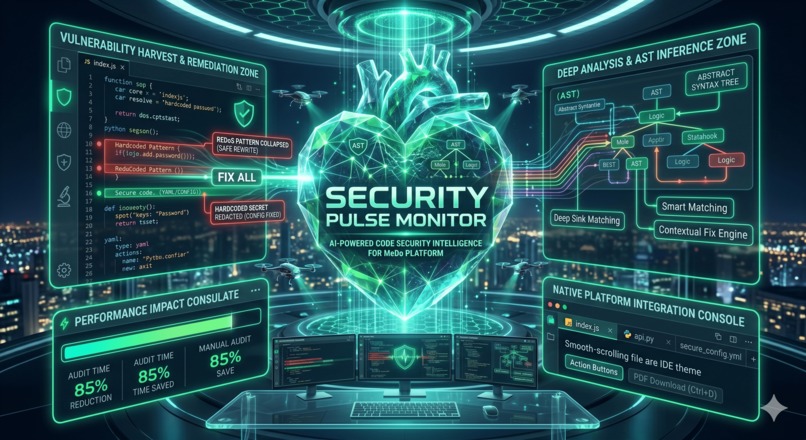
Security Pulse Monitor - Dashboard Interface
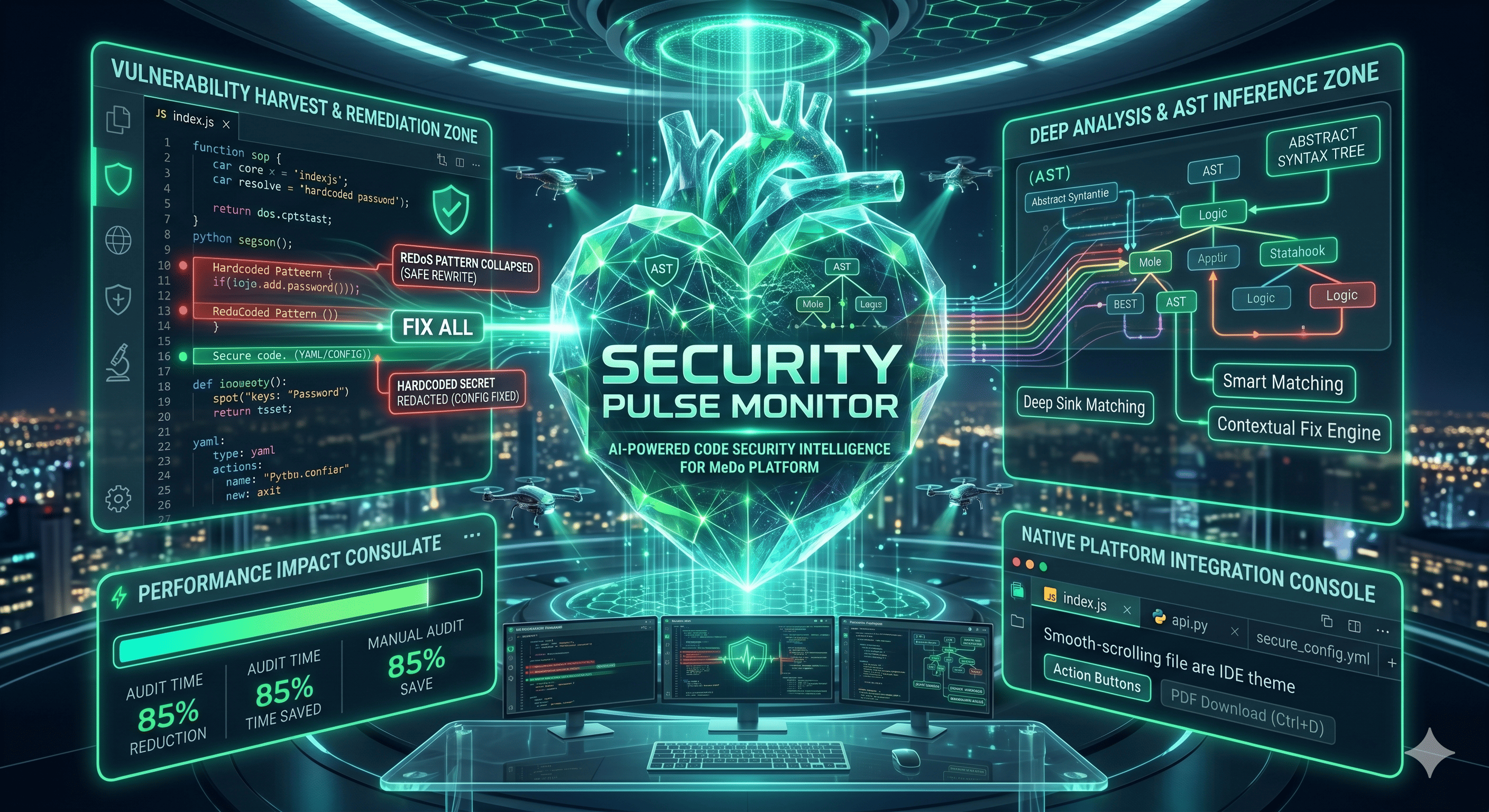
The Inspiration: The Invisible Enemy
As developers, we face an invisible enemy every day: Security bugs in the era of AI-assisted coding. The massive shift from human-written code to AI-generated development has created a "blind trust" problem. AI assistants are amazing at rapid prototyping, but they often hallucinate security contexts—generating functional code with bypassed validations, exposed local APIs, or hardcoded secrets. We realized that traditional linters only check syntax, and enterprise security tools are too bloated and expensive for lean teams. We wanted to build a safety net for the AI generation of developers. That inspired us to create Security Pulse Monitor (SPM)—a real-time, cloud-tethered security agent for the MeDo platform that acts as an invisible, zero-friction shield.
How We Built It Using MeDo
We built this entire productivity and security tool leveraging the power of MeDo's natural language generation alongside advanced API integrations. We used a multi-turn chat strategy to create a robust UI simulator with scrollable file tabs for JS, Python, and YAML. Once the front-end layout was perfect, we focused on the architecture.
The most mind-blowing part MeDo helped us create was bridging a local AST (Abstract Syntax Tree) engine with our new Cloud-Tethered AI Patch Engine. We integrated the Gemini API to analyze complex, context-heavy vulnerabilities. To ensure absolute data privacy, we built an End-to-End (E2E) Encrypted Pipeline—meaning all code snippets sent to the AI engine are symmetrically encrypted client-side before transmission. We also wired up a Continuous Network Scanner that runs entirely in the background, ensuring real-time monitoring without slowing down the IDE.
What It Does
Security Pulse Monitor is built for high-speed, execution-oriented teams. It intercepts and patches vulnerabilities before they ever hit production.
- Real-Time AI Patch Engine: Instead of just highlighting errors, it uses AI to dynamically stream contextual, custom-written patch code directly into your IDE, fixing lazy AI-generated mistakes (like client-side OTP validations).
- Continuous Automated Network Scanner: A real-time "Network Perimeter Health" widget actively monitors your local environment, instantly flagging exposed databases and unintended outward-facing services.
- E2E Encrypted Pipeline: Your proprietary code remains yours. All data processed by the AI engine is secured client-side.
- Resilient Batch Auto-Fix: We retained our zero-loss state and multi-cursor AST fix preview. It treats every file independently, meaning if a fix fails in one language tab, it never rolls back the successful security fixes in other files.
Challenges We Ran Into
Our biggest initial challenge was state management and UI overflow—ensuring custom code wouldn't disappear when switching between language tabs and keeping action controls visible at any zoom level. We solved this using robust flexbox layouts and persistent state hooks.
However, our most complex technical challenge was Secure Context Handoff. Sending local code to a cloud AI model for patch recommendations introduced a massive security risk. We had to iteratively design a symmetric encryption pipeline that could encrypt the AST payload locally, transmit it safely, and decrypt the AI's streaming response back in the IDE without introducing latency.
What's Next: Scaling the Vision
SPM is just the beginning of our mission to democratize enterprise-grade security on the MeDo platform. We want to ensure that lean development teams, early-stage founders, and MSMEs—especially those building from Tier 2 and Tier 3 cities—can launch their MeDo applications without the fear of crippling security breaches or the burden of expensive enterprise licenses.
To evolve from a developer productivity plugin into a full-scale security ecosystem for MeDo, our roadmap focuses on three core milestones:
- Advanced Semantic AI Intelligence for MeDo: We will expand our AI Patch Engine to understand the deeper business logic of MeDo-generated code. Evolving into a proactive security pair-programmer, it will predict zero-day vulnerabilities and complex logic flaws far beyond standard syntax parsing.
- Headless SPM for CI/CD Pipelines: We plan to take our continuous background engine out of the IDE and integrate it directly at the repository level. This will automatically gate deployments, ensuring no vulnerable code ever reaches the production environment of any MeDo project.
- The Open Threat Marketplace: We aim to launch a community-driven rule marketplace. MeDo developers and founders will be able to write, share, and subscribe to custom security patterns, creating an open-source, collaborative shield against emerging real-world threats.
By bridging the gap between high-speed AI application generation and zero-trust security, Security Pulse Monitor is building a world where the next generation of MeDo creators can build the future safely, securely, and completely without boundaries.

Log in or sign up for Devpost to join the conversation.