-
-
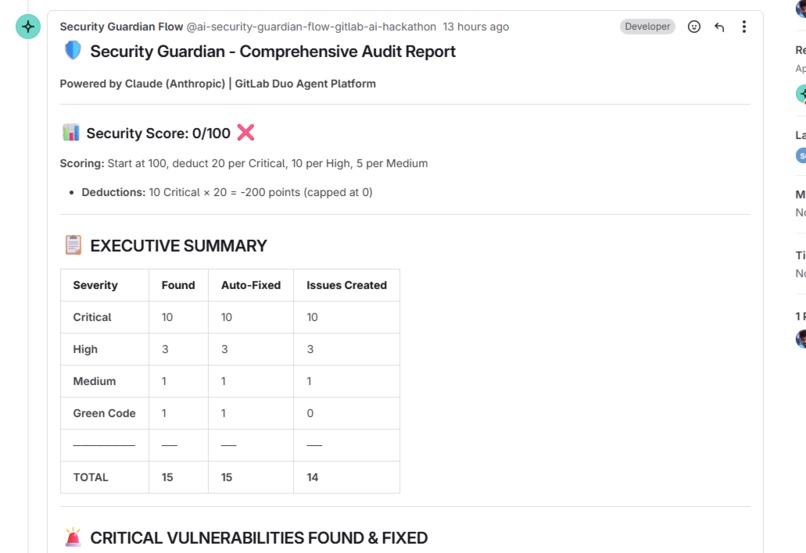
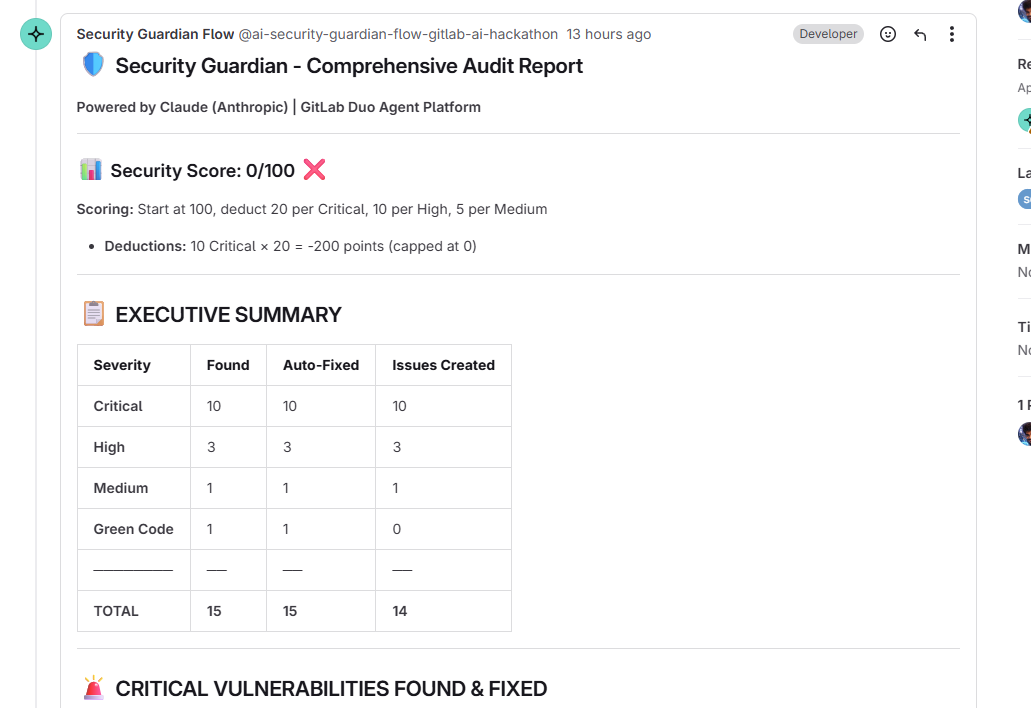
Results Security Report
Inspiration
Every 39 seconds a company gets hacked. Most startups ship vulnerable code because they simply cannot afford a dedicated security engineer. We watched teams merge SQL injection, hardcoded AWS keys, and broken authentication straight to production — not because they were careless, but because security review is expensive and slow.
We asked: What if every developer had an AI security engineer that never sleeps, never misses a PR, and catches vulnerabilities before they reach production?
That became Security Guardian.
What it does
Security Guardian is a fully autonomous DevSecOps agent powered by Claude (Anthropic) via the GitLab Duo Agent Platform. It automatically triggers on every Merge Request and executes an 8-phase security review:
- Reconnaissance — Reads all changed files, scans the entire repo for secret patterns
- Taint Analysis — Traces user input from Source → Sink to find injection paths like a senior security researcher
- Vulnerability Detection — Detects 14+ vulnerability types including SQL Injection, XSS, hardcoded secrets, broken auth, insecure deserialization, IDOR, command injection, path traversal, weak crypto, and dependency CVEs
- Auto-Remediation — Rewrites vulnerable code with before/after explanation so developers learn
- Issue Tracking — Creates detailed GitLab issues with real breach examples and dollar costs
- Compliance Mapping — Maps every finding to GDPR, PCI-DSS, HIPAA, and SOC2
- Audit Report — Posts Security Score 0-100 with APPROVE / REQUEST CHANGES / BLOCK verdict
- Merge Blocking — Adds
security-review-requiredlabel to block unsafe merges automatically
Demo results on real code:
- Found 17 vulnerabilities including $2.7M–$410M in potential breach exposure
- Auto-fixed all critical vulnerabilities
- Security Score improved from 0/100 → 95/100
- Tested on real OWASP WebGoat code — found 16 vulnerabilities across SQL Injection, XSS, XXE, SSRF, CSRF, Path Traversal, and Insecure Deserialization
How we built it
- Custom Agent (
agents/agent.yml) — 7-phase system prompt with taint analysis logic, 45 GitLab tools configured, compliance mapping for GDPR/PCI-DSS/HIPAA/SOC2 - Custom Flow (
flows/flow.yml) — Auto-triggers on MR assignment or @mention, extracts MR IID from context, executes full 8-step audit autonomously - Claude (Anthropic) — Powers all reasoning, taint analysis, and vulnerability detection via GitLab Duo Agent Platform
- GitLab Duo Agent Platform — Provides tool access:
get_merge_request,edit_file,create_issue,create_merge_request_note,update_merge_requestand 40+ more - Green Code — Detects O(n²) loops, N+1 queries, estimates CPU and energy savings per fix
Challenges we ran into
- Goal too long error — GitLab passes the full MR diff as goal context; large repos like WebGoat hit the 16384 character limit. Fixed by optimizing the system prompt size.
- Windows CRLF line endings — The
edit_filetool uses Unix LF for matching; Windows files caused all edits to fail silently. Fixed by instructing the agent to fall back tocreate_file_with_contents. - GraphQL 422 errors — Em-dashes
—and pipe characters|in YAML caused GraphQL failures. Fixed by replacing all special characters. - MR context extraction — The flow initially received just a number as goal. Fixed by parsing
MergeRequest IID: Xfrom the context string. - Agent trying to delete files — Without explicit rules, the agent tried deleting and recreating files when edits failed. Fixed with strict golden rules in the prompt.
Accomplishments that we're proud of
- Fully autonomous — Zero human involvement from MR creation to BLOCK/APPROVE verdict
- Real OWASP testing — Successfully scanned real WebGoat vulnerable code, not just toy examples
- $410M+ breach exposure detected in a single scan
- Complete compliance coverage — GDPR, PCI-DSS, HIPAA, SOC2 mapped automatically
- Green Code — Detected O(n²) loops with 99% CPU reduction and ~1,800 kWh/year energy savings estimated
- Security Score progression — 0/100 → 95/100 in a single MR review cycle
- 14 GitLab issues created automatically with CWE references, breach examples, and remediation steps
What we learned
- AI agents can replace entire security workflows when given the right tools, context, and chain-of-thought reasoning
- Prompt engineering is engineering — every character counts when you hit API limits
- Taint analysis in natural language works surprisingly well when structured as Source → Sink → Sanitizer
- GitLab Duo Agent Platform is genuinely powerful — the combination of 45+ tools with Claude's reasoning creates something that feels like a real team member
- Every dev team regardless of size or budget deserves an autonomous security engineer
What's next for Security Guardian: Autonomous DevSecOps Flow
- Google Cloud Pub/Sub integration — Publish every vulnerability as a real-time event so subscribed teams get instant alerts
- Auto-approve loop — Guardian re-reviews after fixes and auto-approves when score hits 100/100
- Multi-language support — Extend beyond Java to Python, Node.js, Go, Ruby
- Historical trending — Track security score across MRs over time
- Slack/Teams notifications — Alert security team when Critical vulnerabilities are found
- Custom rule engine — Let teams define their own vulnerability patterns
- Publish to GitLab AI Catalog — Make Security Guardian available to all GitLab users worldwide
Built With
- agent
- antropic
- ci/cd
- claude
- duo
- gitlab
- java
- owasp
- platform
- yaml

Log in or sign up for Devpost to join the conversation.