-
-
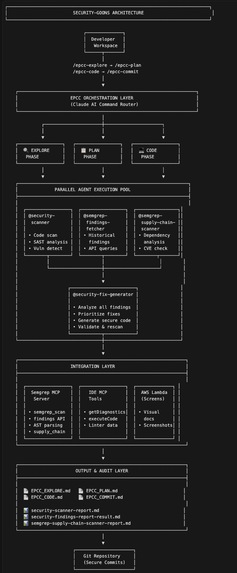
System Architecture Overview
Inspiration
I kept seeing the same problem at work: security reviews always happen too late. Code gets written, then right before shipping, security finds 50+ vulnerabilities. Everyone scrambles under deadline pressure, security becomes the bottleneck, and we ship late.
I thought—what if I could turn security expertise into AI agents that work during development, not after? Agents that explore, plan, code, and commit fixes just like a senior security engineer would.
What it does
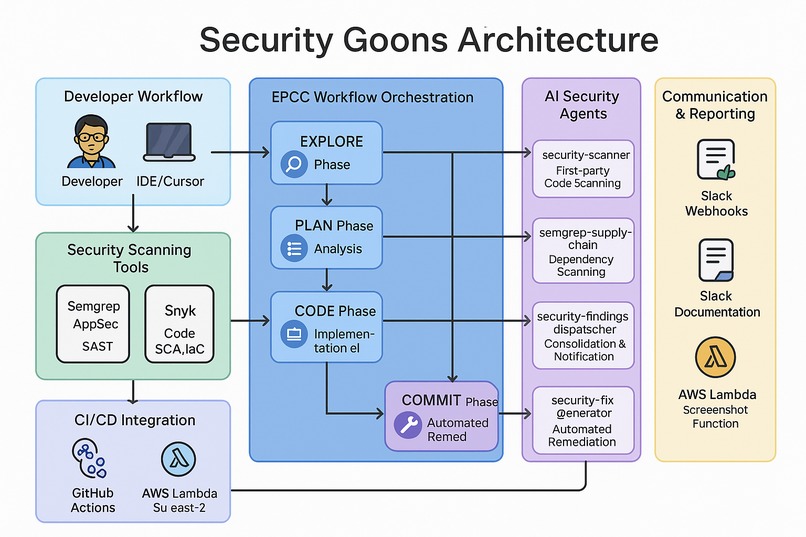
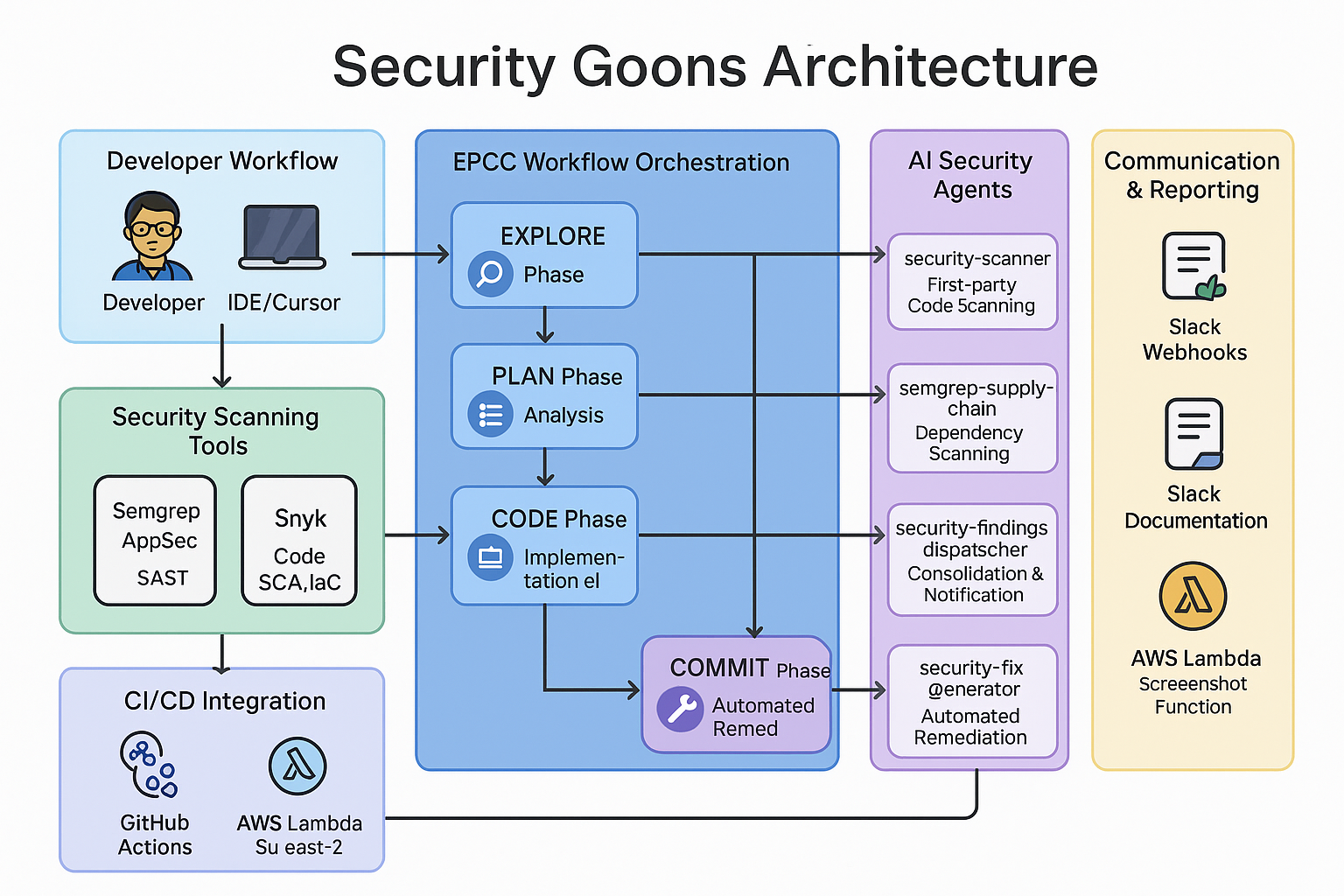
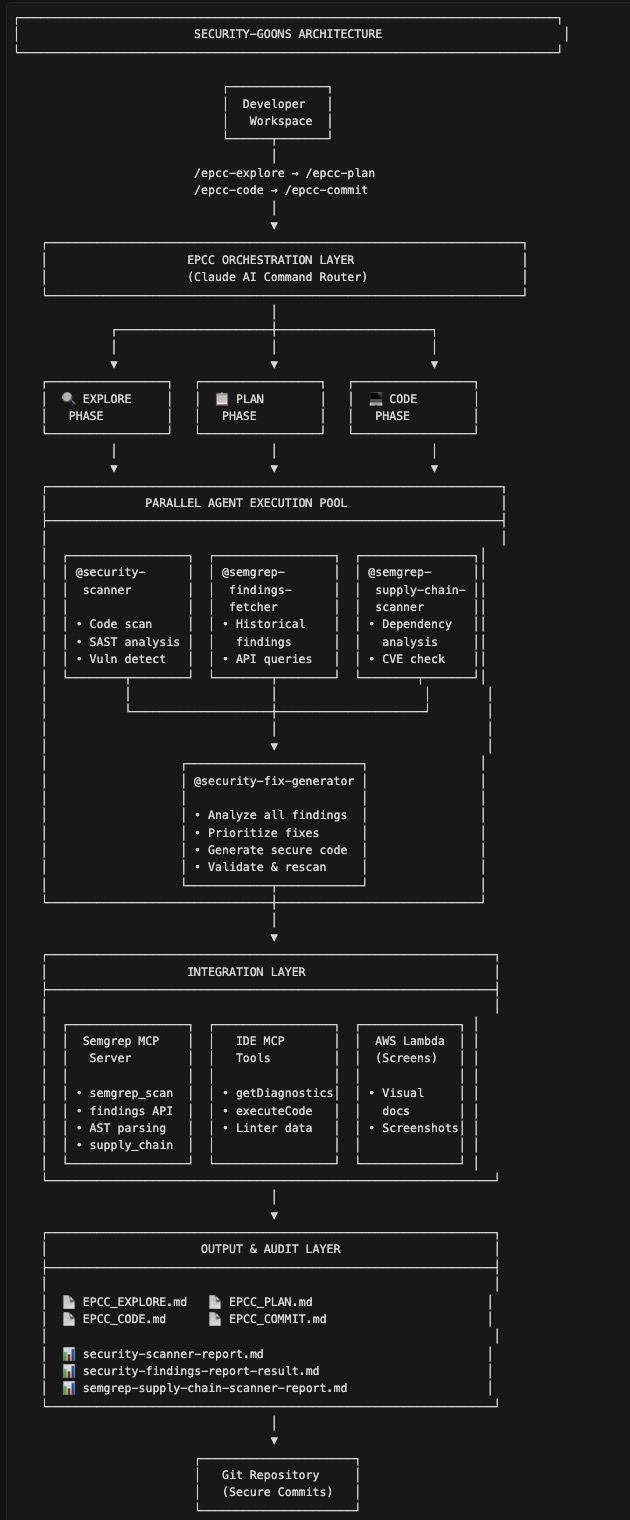
security-goons uses specialized AI agents following an Explore-Plan-Code-Commit (EPCC) workflow to catch and fix security issues before they reach code review:
Explore: Multiple agents run in parallel—
@security-scannerchecks code vulnerabilities,@semgrep-supply-chain-scanneranalyzes dependencies,@semgrep-findings-fetcherpulls historical issues. All findings go into a single report.Plan: The
@security-fix-generatoragent prioritizes everything (Critical → High → Medium → Low) and creates a fix strategy following OWASP guidelines.Code: It generates actual production-ready fixes—not just "fix this SQL injection" but the actual parameterized query code with proper error handling.
Commit: Final security scan to verify nothing was missed, then commits with full documentation.
Instead of weeks of back-and-forth, you get secure code in minutes.
How I built it
I built this around parallel agent orchestration:
Custom AI Agents: Each agent has a specific job—one fetches Semgrep findings, another scans code, another fixes vulnerabilities. They work simultaneously, not sequentially.
EPCC Commands: Created custom Claude commands (
/epcc-explore,/epcc-plan, etc.) that orchestrate the agents and generate structured markdown reports for traceability.Integrations:
- Semgrep MCP Server for static analysis and supply chain scanning
- IDE MCP tools for diagnostics
- AWS Lambda for screenshot documentation
Enforcement Loop: The system won't let you proceed until all vulnerabilities are fixed. It rescans after each fix to catch regressions.
Challenges I ran into
Getting agents to work together: When multiple agents analyze the same code simultaneously, they can generate duplicate findings or conflict. I solved this with structured outputs and a deduplication step in the fix-generator.
Context limits: Large security reports with hundreds of findings broke the AI's context window. I implemented hierarchical summarization—executive summary first, then drill into details only for high-priority items.
Fix quality: Fast automated fixes can break things. I added a multi-stage verification: generate fix → rescan for new issues → validate → commit. Quality gates at each phase.
Developer experience: Security tooling usually adds friction. I made it conversational—just type /epcc-explore and get production-ready fixes with explanations, not just error messages.
Accomplishments that I'm proud of
Built a parallel agent system where 4+ specialized agents work simultaneously—analysis that took hours now takes minutes
It doesn't just find bugs; it writes the actual secure code with explanations so developers learn
Complete audit trail in structured markdown files (EPCC_EXPLORE.md, EPCC_PLAN.md, etc.) for compliance
Automated enforcement—won't let code proceed until vulnerabilities are eliminated
Made security actually helpful instead of being "that thing that blocks my PR"
What I learned
Technical: Specialized agents beat general-purpose ones. An agent with one specific tool and clear mission (@semgrep-findings-fetcher only fetches findings) performs way better than a do-everything agent.
Security: Context matters for fixes. The same SQL injection needs different solutions in Django vs Spring Boot. Agents need to understand your codebase patterns first (that's why the Explore phase matters).
AI collaboration: When agents explain why a fix works (not just what to change), developers actually learn secure coding. The documentation becomes teaching material.
What's next for security-goons
Near-term:
- Real-time IDE integration—security warnings as you type
- Multi-language support (currently Java-focused)
- Security regression prevention using project history
Dream features:
@security-revieweragent that participates in PR reviews- Automated threat modeling during the Explore phase
- Self-healing security—detect production issues and auto-generate fixes
The vision: Make security invisible. Developers write code, AI ensures it's secure, teams ship faster. Security at machine speed.
Phase 1: EXPLORE (Scan & Discover)
→ @security-scanner
→ @semgrep-supply-chain-scanner
→ @semgrep-findings-fetcher
Phase 2: PLAN (Analyze & Notify) → @security-findings-dispatcher
Phase 3: CODE (Implement Fixes) → @security-fix-generator
Phase 4: COMMIT (Validate & Verify) → @security-scanner (rescan) → @semgrep-supply-chain-scanner (rescan)
Built With
- claude
- cursor
- python
- semgrep

Log in or sign up for Devpost to join the conversation.