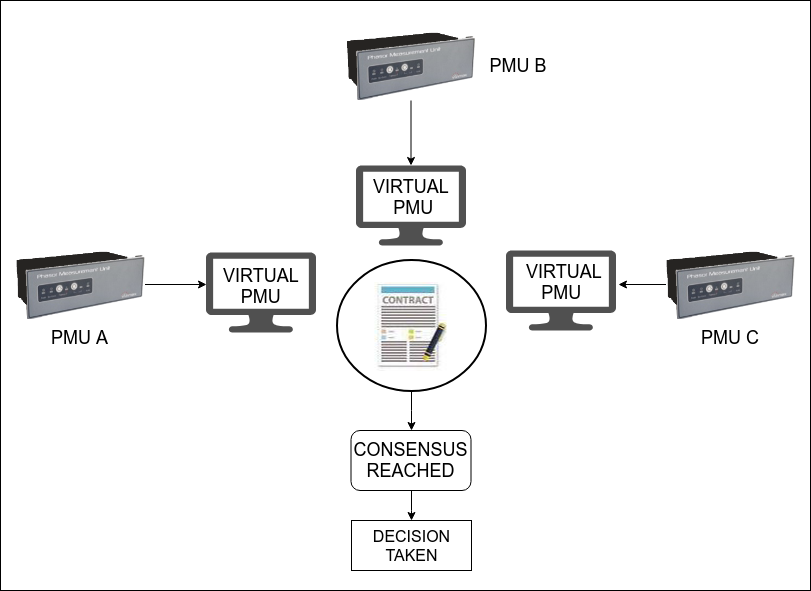

In past, various cyber attacks have proved smart grids to be vulnerable in nature. Various security measures are being taken to overcome it.Smart grids are in their developing stages, but it is going to impact the world soon. The more it influences us, the more it has a threat of being misused. Industrial Internet of Things(IIoT) is being extensively used in various smart grid based applications. IIoT has been an area for the cyber-attacks to drastically affect various industries and businesses. Existing technologies are just not enough to deal with the cyber-physical systems. Blockchain has surfaced as the possible solution for creating more secured and efficient IIoT systems. Blockchain assists in solving several complex problems related to securing the integrity and trustworthiness of rapid, distributed, complex energy transactions and data exchanges. Blockchain based smart contracts helps to remove the need to interact with third-parties, facilitating the adoption of decentralization and establishing a global truth across all the nodes. Efficiency can further be increased by logging only the most important events like faults in the system or injection of malicious data. We propose an innovative collective decision algorithm using blockchain to build a resilient network of Phasor Measurement Units(PMUs) for Wide Area Measurement(WAM) system. The algorithm not only identifies "malicious" nodes in the system but also takes the correct decision, even in their presence, to perform further action. Our proposed solution is validated on Hardware in Loop platform with hardware PMUs connected on IEEE 9 bus system. Our Prototype
Ethereum will be deployed with Proof of Authority in the prototype. Using Proof of Work would be too computationally expensive for this use case and offers no additional benefits. There should be no anonymity as each PMU must undergo proper verification and registration to keep track of measurements, location and for backtracking faults. Maintaining a distributed ledger imparts crash fault tolerance. To add byzantine fault tolerance, opinion of each PMU on the state of the network was considered. The collective state of the network is then formed from individual PMU opinions. Implementation of smart contracts provides security and establishes trust between two parties. It defines a set of rules by which the virtual PMU should operate. It allows us to not only mitigate cyber attacks between the PMU and virtual PMU, but also detect direct attacks on the virtual PMU. Additionally, the benefits of an immutable ledger can be further leveraged using weighted consensus, instead of a simple average of opinions. Weights for each PMU will be assigned using data stored on the blockchain.
Benefits of our solution
In past, various cyber attacks have proved smart grids to be vulnerable in nature. Various security measures are being taken to overcome it.
- Our solution tries to mitigate this situation through a "weighted voting-based collective decision algorithm" implemented in the smart contract. The result achieved through the consensus is then stored in the ledger of all the virtual PMUs and is also used to take appropriate control decision.
- Thus our solution leverages both the decentralization and the immutability to take correct decision even in the presence of malicious/compromised PMUs.
- Our solution helps to solve the problem of false data injection attacks in power grids which can lead to execution of incorrect decisions in the control system causing failures and blackouts, such as Northeatern grid failure of July 2012, which occured in India itself. It is the largest blackout in history to-date.
- Need for existing hierarchical structure of PDCs is eliminated.
The proposed solution tries to mitigate this situation through a "weighted voting-based collective decision algorithm" implemented in the smart contract. The result achieved through the consensus is then stored in the ledger of all the virtual PMUs and is also used to take appropriate control decision. Thus our solution leverages both the decentralization and the immutability to take correct decision even in the presence of malicious/compromised PMUs. The proposed solution helps to solve the problem of false data injection attacks in power grids which can lead to execution of incorrect decisions in the control system causing failures and blackouts. Our future work mainly aims at three major pillars :
- Decreasing the time at which the consensus is reached
- Using the chained data of the blockchain ledger to perform post-fault data analysis.
- Implementing the correct decision of the algorithm on a human in loop control action system.
Speed of transactions and scalability can be increased by adding our collective decision algorithm to a decentralized model to develop a custom blockchain platform optimized for securing smart grid infrastructure.
Built With
- css3
- ethereum
- golang
- html5
- hyperledger
- javascript
- solidity
- web3

Log in or sign up for Devpost to join the conversation.