-
-

AI-POWERED DIGITAL EVIDENCE INTEGRITY
-
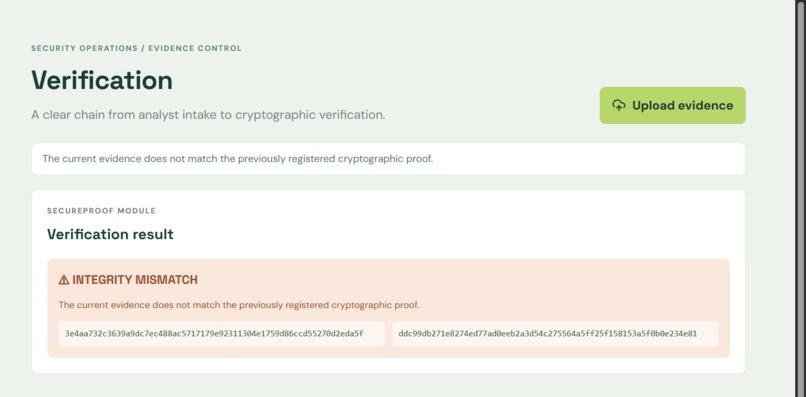
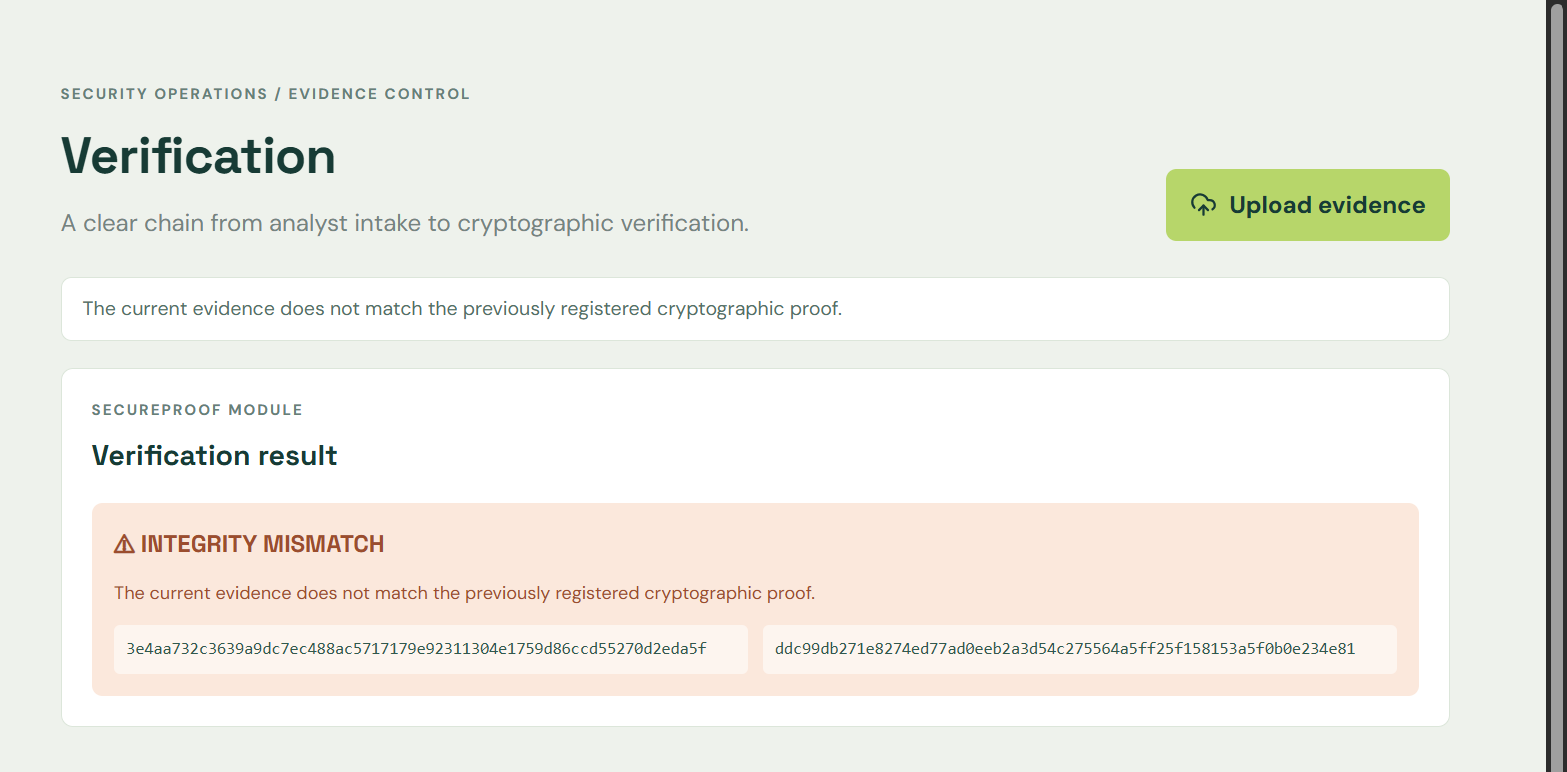
Modified evidence detected: SHA-256 hash changed and no longer matches the registered blockchain proof.
-

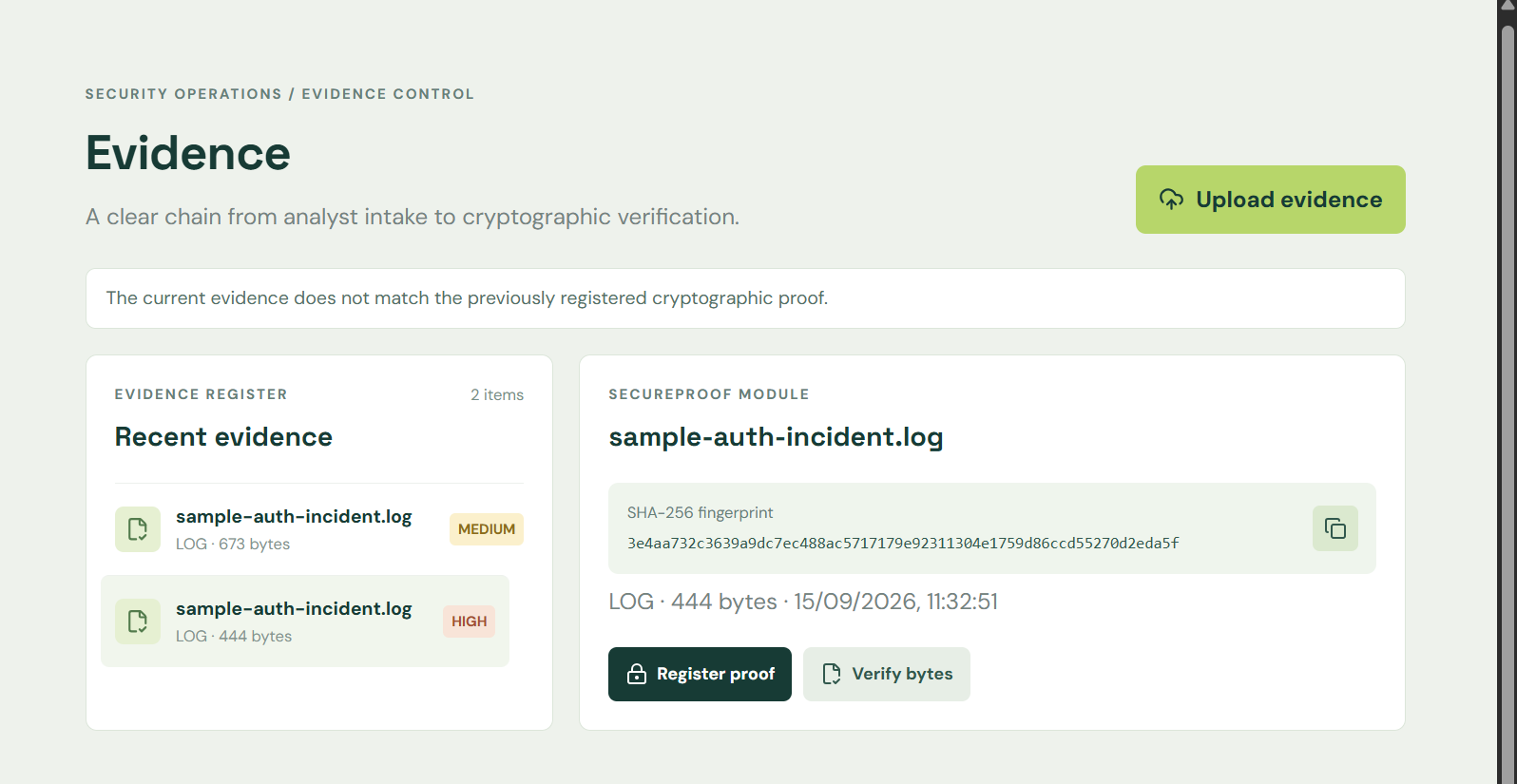
SHA-256 evidence fingerprint registered on blockchain while sensitive evidence remains off-chain.
-
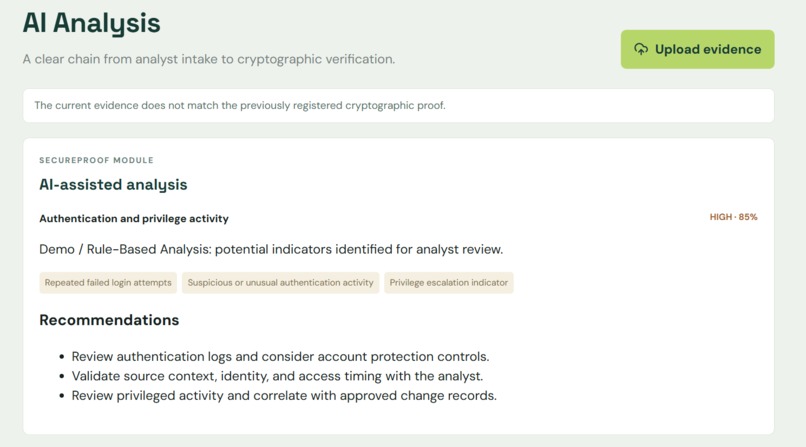
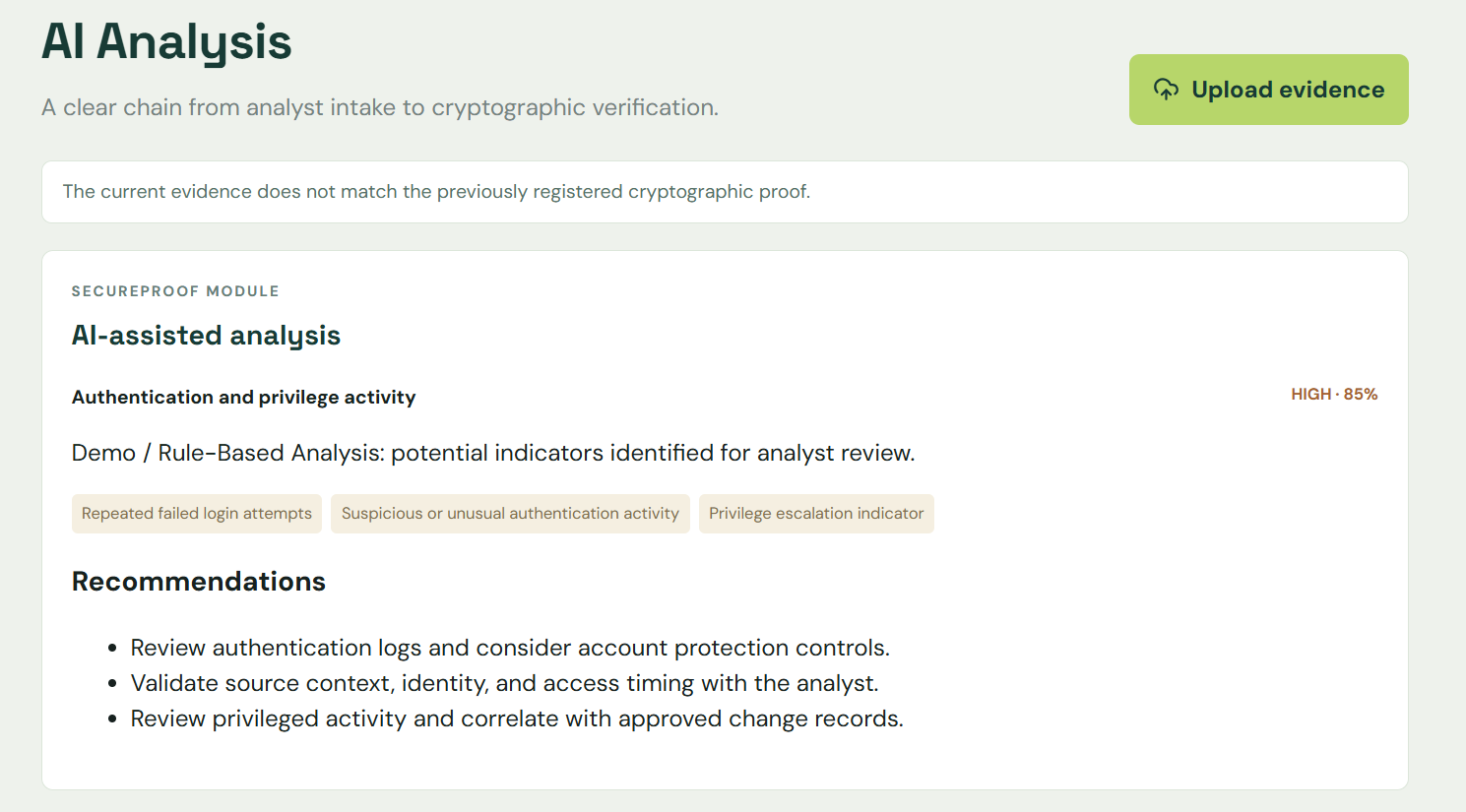
AI-assisted analysis identifies suspicious activity and helps classify cybersecurity risk.
-
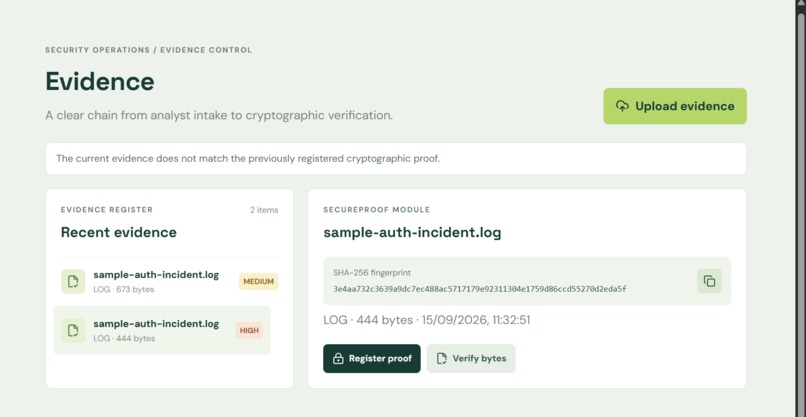
Original evidence verified: current SHA-256 hash matches the registered blockchain proof.
-
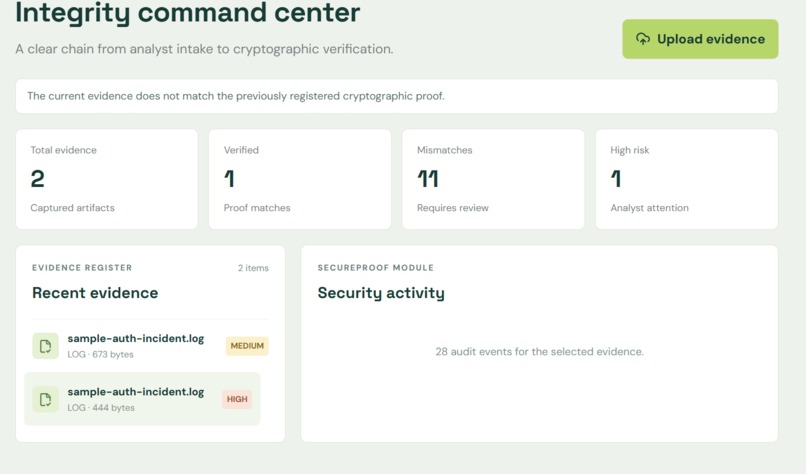
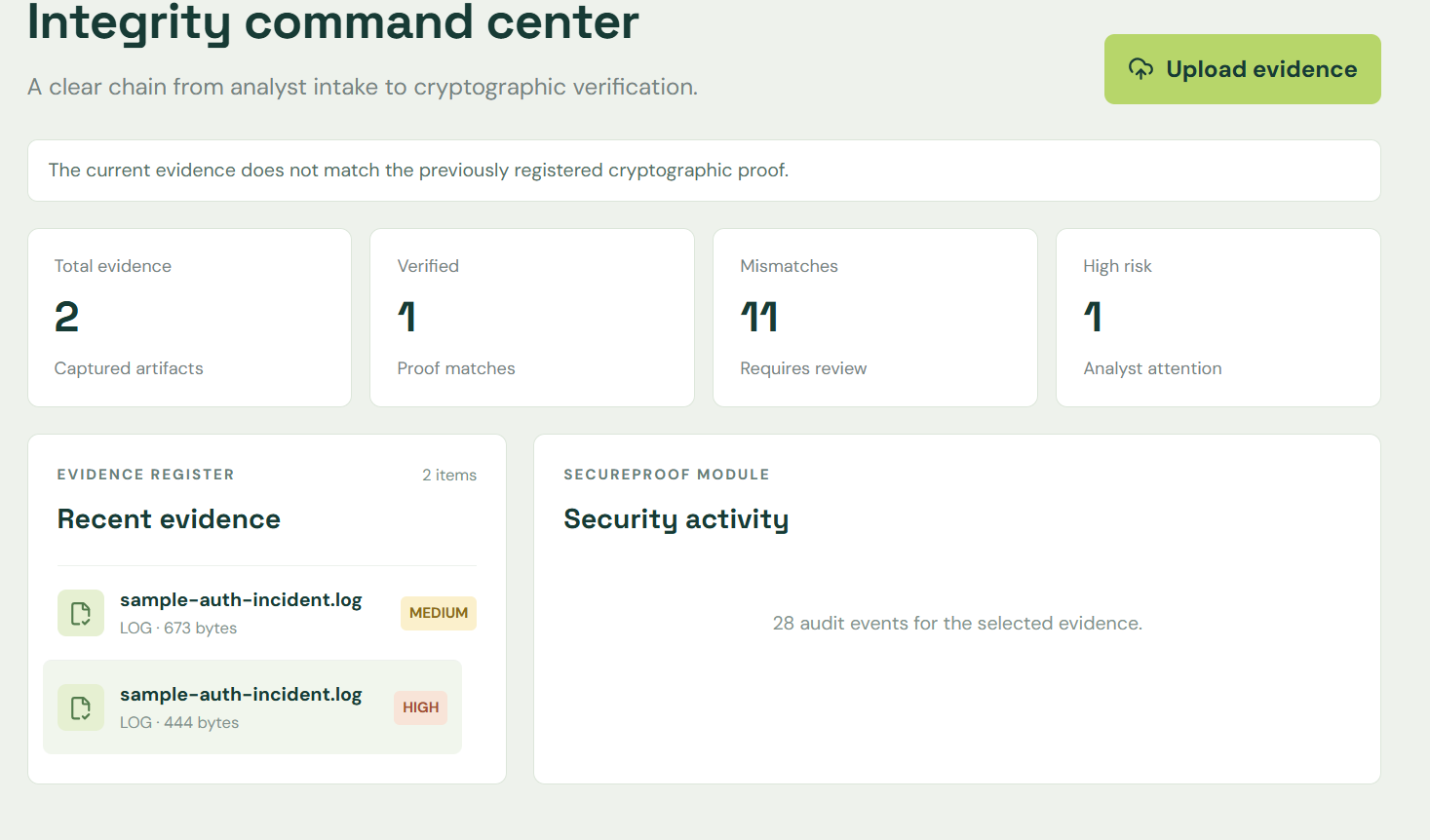
SecureProof dashboard for evidence integrity, AI analysis, blockchain proofs, verification, and audit activity.


SecureProof
Inspiration
Cybersecurity teams rely heavily on digital evidence when investigating suspicious activity and security incidents. Logs, incident records, and other evidence can become critical during investigation, response, and auditing. However, simply storing evidence in a centralized system does not provide a strong independent way to verify that a record has remained unchanged.
This inspired us to build SecureProof, a cybersecurity evidence integrity platform that combines AI-assisted security analysis, cryptographic hashing, and blockchain-backed verification.
The core idea is simple: instead of putting sensitive evidence on a blockchain, SecureProof creates a cryptographic fingerprint of the evidence and records that proof through a smart contract. When the evidence needs to be verified later, the platform calculates its hash again and compares it with the previously recorded proof.
If the hashes match, the evidence is shown as VERIFIED. If even a small part of the evidence has changed, the hash changes and SecureProof reports an INTEGRITY MISMATCH.
What We Built
SecureProof is a functional cybersecurity/Web3 MVP designed around an end-to-end evidence integrity workflow.
The implemented workflow is:
- Security evidence is uploaded to the platform.
- The evidence is validated and processed.
- A SHA-256 cryptographic hash is generated.
- AI-assisted analysis evaluates the incident information and helps classify its security risk.
- The evidence hash is registered through a blockchain smart contract.
- The original evidence can later be verified against the blockchain-backed proof.
- SecureProof displays the verification result and maintains an auditable timeline of relevant actions.
The blockchain stores the cryptographic proof and minimal metadata, not the raw security evidence. This design reduces unnecessary exposure of potentially sensitive information while still providing an independent integrity-verification layer.
Why Web3?
Blockchain is not being used as an extra feature or decoration. It provides a functional verification layer within the security architecture.
A file's SHA-256 hash acts as its digital fingerprint. If the contents of the evidence change, the resulting hash changes as well.
SecureProof therefore performs the following verification concept:
$$ H_{current} = SHA256(Evidence_{current}) $$
The current hash is compared with the previously registered blockchain proof:
$$ H_{current} = H_{registered} $$
If the values match, SecureProof reports VERIFIED.
If they do not match, SecureProof reports INTEGRITY MISMATCH and shows the relevant hash difference.
This demonstrates how Web3 can provide practical value in cybersecurity by creating a tamper-evident verification record without placing the underlying evidence directly on-chain.
Importantly, the blockchain proof does not by itself prove that evidence is truthful, prove authorship, or identify who modified a file. Its purpose is to provide a verifiable record of the cryptographic fingerprint that was registered.
AI Component
AI is integrated as a security decision-support component rather than as a replacement for a human analyst.
SecureProof uses AI-assisted analysis to help security teams interpret incident information, identify suspicious patterns, prioritize potential risks, and classify security activity.
For example, during the demonstration, a synthetic authentication incident containing repeated failed login attempts can be analyzed and classified as suspicious activity.
The AI assessment helps an analyst understand the evidence, while the cryptographic and blockchain layers provide the separate integrity-verification mechanism.
This separation is intentional:
AI helps analyze the evidence. SHA-256 fingerprints the evidence. Blockchain records the integrity proof. The human analyst makes the final security decision.
How We Built It
SecureProof was built as a hybrid Web2 + Web3 + AI cybersecurity application.
The application combines:
- React + TypeScript + Vite for the frontend
- FastAPI + Python for the backend API
- SQLite + SQLAlchemy for application data
- SHA-256 for evidence fingerprinting
- Solidity smart contracts for blockchain-backed proof registration
- Hardhat for the blockchain development environment
- ethers.js / Web3 tooling for blockchain interaction
- AI-assisted incident analysis
- A security-focused dashboard for evidence, analysis, blockchain proofs, verification results, and audit activity
The architecture intentionally keeps raw evidence off-chain while connecting the application layer to a blockchain proof layer.
The result is a workflow where cybersecurity evidence can move from upload → analysis → hashing → blockchain registration → verification → audit trail.
Demonstration
The MVP demonstrates the complete integrity-verification concept using synthetic cybersecurity evidence.
First, the original incident evidence is uploaded and analyzed. SecureProof generates its SHA-256 hash and registers the integrity proof on the blockchain.
The original evidence is then verified and produces:
VERIFIED
Next, a small modification is made to the evidence.
The file is hashed again and compared against the original blockchain-backed proof.
Because even a small modification produces a different SHA-256 hash, SecureProof reports:
INTEGRITY MISMATCH
This demonstrates the central security value of the project: a later investigator can detect that the evidence no longer matches the cryptographic proof that was previously registered.
What We Learned
Building SecureProof helped us understand that cybersecurity, AI, and Web3 solve different parts of the same problem and should not be treated as interchangeable technologies.
We learned how to design a workflow where:
- AI provides analysis and prioritization.
- Cryptographic hashing provides a deterministic integrity fingerprint.
- Blockchain provides an independent tamper-evident record.
- Off-chain storage protects sensitive evidence from unnecessary on-chain exposure.
- Human analysts remain responsible for investigation and final decisions.
We also gained practical experience integrating a cybersecurity workflow with a blockchain smart contract while maintaining a usable security-operations-style interface.
Challenges
One of the biggest challenges was designing the system so that blockchain was actually useful to the cybersecurity workflow rather than simply being added because the project required Web3.
Another challenge was protecting sensitive information. Storing complete evidence directly on-chain would be inefficient and could expose confidential data. We therefore designed SecureProof around storing cryptographic proof rather than raw evidence.
We also had to connect multiple technical layers — frontend, backend, cryptographic hashing, AI-assisted analysis, database storage, and blockchain interaction — into one coherent workflow.
Finally, building a functional cybersecurity MVP within the hackathon's limited development window required prioritizing the core workflow and ensuring that the most important security functionality could be demonstrated end-to-end.
Impact and Future Vision
SecureProof is designed for Security Operations Centers, incident responders, digital-forensics workflows, security teams, and organizations that require stronger evidence integrity and auditability.
The current MVP demonstrates the foundation of a larger evidence-verification platform.
Future development could include:
- Support for additional evidence formats
- Stronger evidence provenance and chain-of-custody workflows
- Role-based access control
- Enterprise identity integration
- Multiple blockchain networks
- Advanced forensic evidence management
- More sophisticated AI-assisted incident analysis
- Improved audit and compliance reporting
- Secure distributed evidence storage
The long-term vision is to provide cybersecurity teams with a trustworthy verification layer that helps answer an important question during investigations:
“Can we prove that this evidence has remained unchanged since it was registered?”
SecureProof uses AI for analysis, cryptography for integrity, and Web3 for independent verification — bringing these technologies together around a practical cybersecurity problem.
Built With
- ai
- css
- ethereum
- ethers.js
- fastapi
- hardhat
- python
- react
- sha-256
- solidity
- sqlalchemy
- sqlite
- tailwind
- typescript
- vite

Log in or sign up for Devpost to join the conversation.