-
-
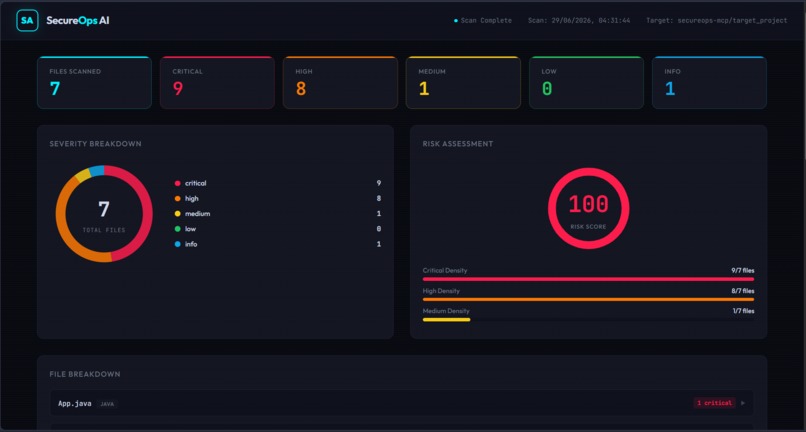
A Preview of the Mcp scan completed and findings
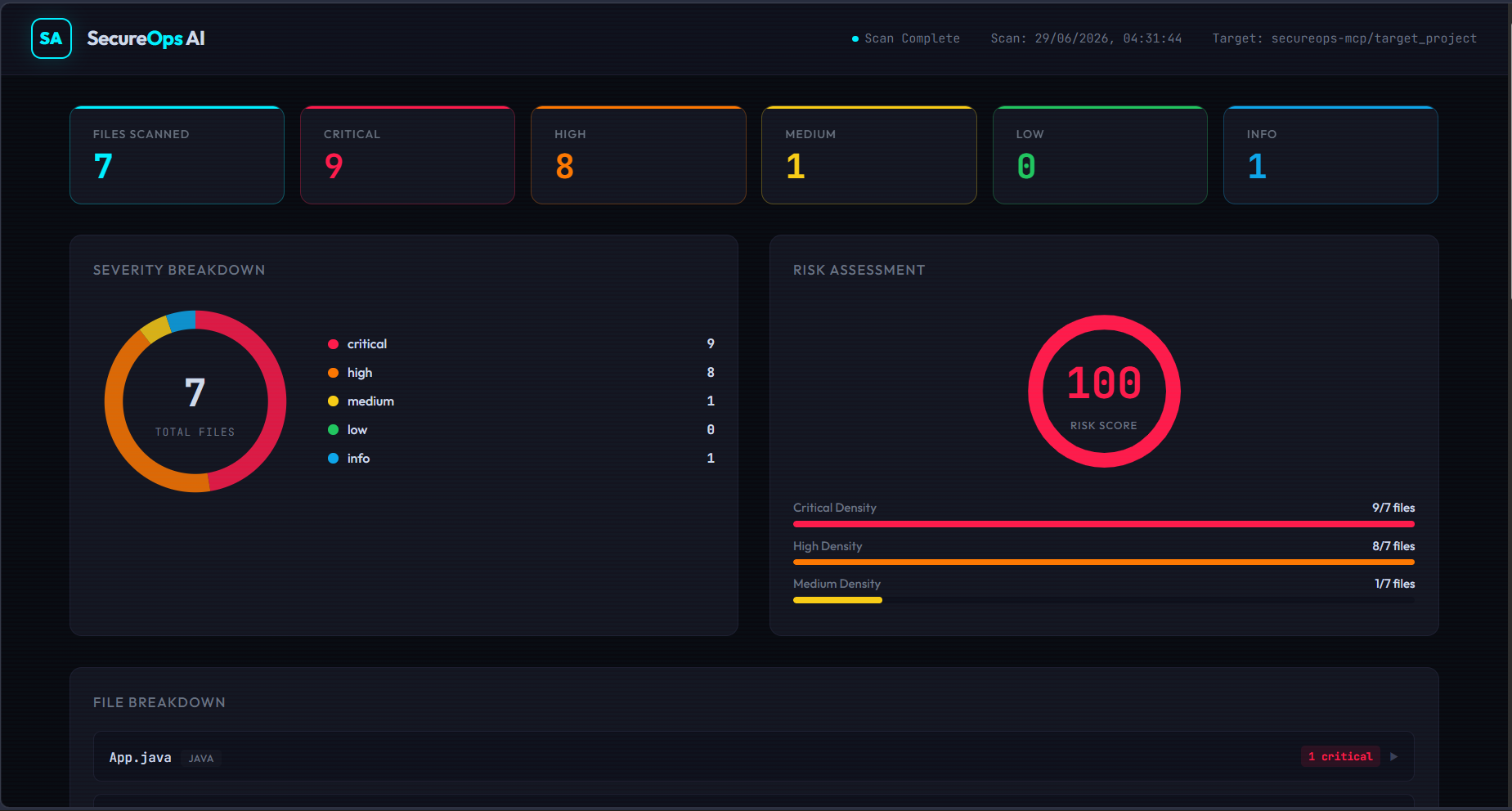
SecureOps AI — Privacy-First AI Security Auditing with MCP
Inspiration
As AI becomes an essential part of software development, one major concern remains: privacy. Most AI-powered code analysis tools require developers to upload proprietary source code to external cloud services, creating security and compliance risks for organizations.
I wanted to solve this problem by reversing the workflow. Instead of sending code to an AI, what if the AI could securely interact with tools running locally? This idea led us to build SecureOps AI, a privacy-first security auditing platform powered by the Model Context Protocol (MCP).
What it does
SecureOps AI enables developers to perform comprehensive security audits on local codebases without exposing source code to third-party AI services.
The platform provides:
- Multi-language vulnerability detection across numerous programming languages.
- Regex-based scanning for common security issues such as SQL Injection, Cross-Site Scripting, command injection, hardcoded secrets, and path traversal.
- Python Abstract Syntax Tree (AST) analysis for detecting dangerous functions like
eval(),exec(),os.system(), and insecure deserialization. - Intelligent detection of exposed secrets in
.envfiles and other sensitive configuration files. - Interactive HTML reports with severity breakdowns and risk scoring.
- SARIF export for seamless integration with GitHub and Visual Studio Code.
- Secure MCP tools that allow AI assistants to analyze projects while only accessing the minimum information required.
How I built it
The backend was built in Python using the FastMCP framework to expose secure auditing tools through the Model Context Protocol.
Our security engine combines multiple analysis techniques:
- Regex-based static analysis
- AST semantic analysis
- Sensitive file and secret detection
Results are exported as structured JSON, SARIF, and an interactive HTML dashboard for developers.
The MCP server exposes secure tools that allow compatible AI assistants to:
- Inspect project structure
- Run security audits
- Retrieve summaries
- Read only explicitly requested files with path traversal protection
This architecture allows AI to assist developers without requiring access to the entire codebase.
Challenges I ran into
One of the biggest challenges was balancing AI usefulness with privacy.
I wanted the AI to provide meaningful security recommendations while ensuring it never received unrestricted access to project files.
Building a flexible rule engine that worked across multiple programming languages while minimizing false positives also required significant tuning.
Another challenge was creating a secure file access mechanism that prevents directory traversal and limits what the AI can read.
Accomplishments that I'm proud of
- Built a complete MCP-powered local security auditing platform.
- Implemented three complementary vulnerability detection layers.
- Added secure file access with path traversal protection.
- Generated industry-standard SARIF reports.
- Created a modern interactive security dashboard.
- Enabled AI-assisted remediation without exposing entire repositories.
What I learned
This project reinforced that AI and privacy do not have to be competing priorities.
By combining local execution, structured tooling, and the Model Context Protocol, AI can provide powerful developer assistance while respecting the confidentiality of proprietary code.
I also gained valuable experience designing secure developer tooling, integrating MCP, and building scalable static analysis pipelines.
What's next for SecureOps AI
Our roadmap includes:
- Support for additional programming languages.
- AI-generated automated remediation pull requests.
- CI/CD integrations for GitHub Actions and GitLab.
- Incremental project scanning for large repositories.
- Enterprise policy management and custom rule packs.
- IDE plugins for real-time vulnerability detection.
- Expanded compliance reporting for enterprise environments.
I believe SecureOps AI demonstrates a practical approach to secure, privacy-preserving AI development and represents a step toward the future of local AI-assisted software security.


Log in or sign up for Devpost to join the conversation.