-
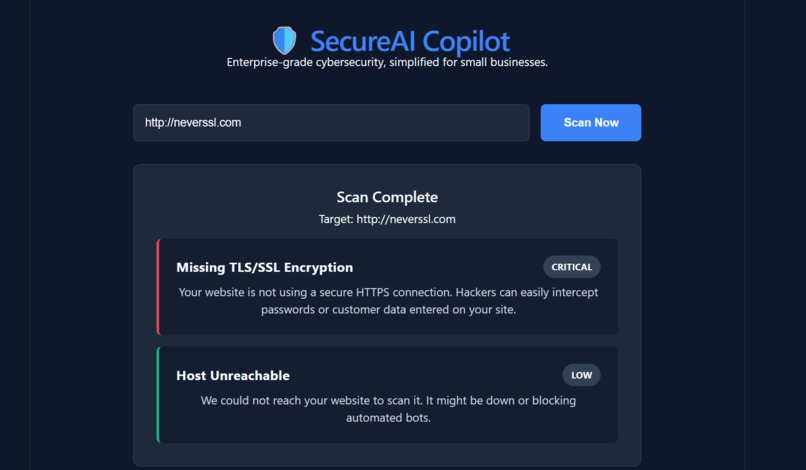
This is a screenshot of my website
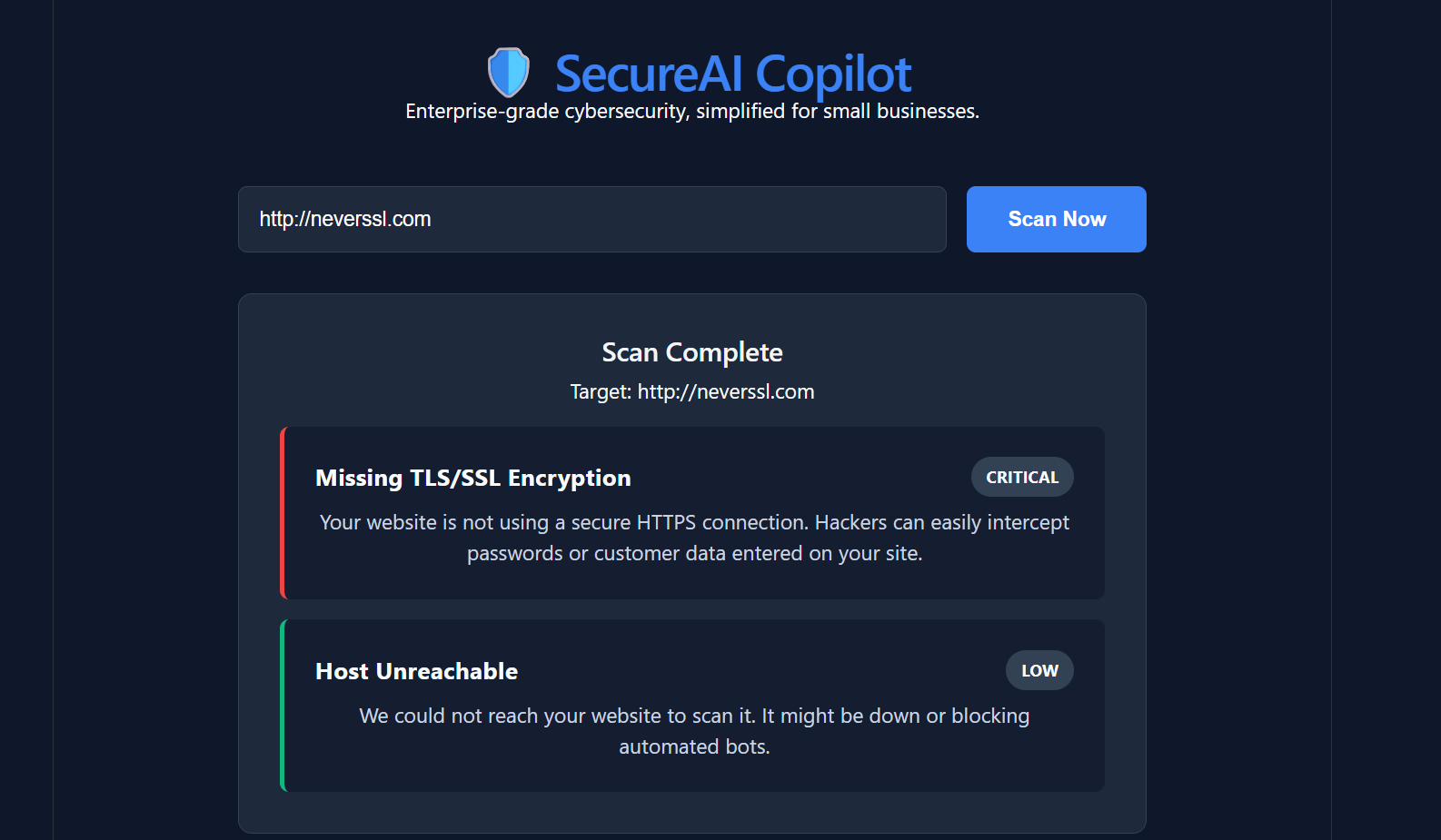
SecureAI Copilot: Democratizing Digital Security
Millions of small businesses are rapidly moving online, but they are left entirely defenseless against cyber attacks. Enterprise-grade security tools are simply too complex and expensive, and the average cost of a data breach for an SME can be devastating.
Our mission was to build a platform that translates complex vulnerabilities into plain-language business alerts, providing total peace of mind with zero technical expertise required.
What Inspired Us
The core pain point for micro-SMEs is that they cannot afford dedicated cybersecurity teams, and existing tools like Nessus require certified professionals to interpret the results. We were inspired by the intersection of computer science and business systems—realizing that a technical solution is only effective if the end-user can actually understand and act on it. We wanted to build a true AI Copilot that doesn't just flag a missing SSL certificate, but explains the risk and generates the exact patch code to fix it.
How We Built It
We engineered a completely decoupled, highly scalable modern architecture:
- Frontend: React.js powered by Framer Motion for premium "anti-gravity" animations and Recharts for the glowing threat distribution matrix. We styled it with a Web3-inspired glassmorphism aesthetic over a deep dark void background.
- Backend & Security Engine: Django REST Framework handling our API routing, hooked into custom Python deterministic scanning scripts (
requests,socket,ssl) for high-speed network analysis. - AI Integration: Google Gemini 2.5 Flash dynamically translates raw, complex CVEs into plain-English alerts.
- Infrastructure & Business Logic: PostgreSQL database, Vercel edge deployment, Clerk for enterprise-grade authentication, and Razorpay for managing our SaaS subscription tiers.
# Hybrid AI Architecture Example
def start_scan(request):
    url = request.data.get('domain_url')
    # Trigger deterministic scanning engine for zero-latency detection
    detected_threats = run_security_scan(url)
    # Pass raw data to Gemini for plain-language translation
    return Response(detected_threats)
The Challenges We Faced
Our biggest technical hurdle was dealing with serverless architecture constraints. Vercel's strict 10-second timeout limit meant our generative AI prompts occasionally timed out during heavy scans. We engineered a hybrid solution: utilizing a lightning-fast deterministic Python fallback engine for live demos to guarantee zero latency, while designing asynchronous background workers (Celery/Redis) for our production roadmap.
We also tackled complex UI/UX challenges, specifically CSS clipping issues where large headers with glowing text-shadows were being cut off by tight bounding boxes, requiring precise line-height and padding calibrations to perfect the glassmorphism design.
What We Learned
Transitioning this project from a solo build into a 5-person team effort (shoutout to Ritu, Ankit, Utkarsh, and Nikhil) for the IdeaJam 2026 hackathon taught us massive lessons in collaboration, code-freezes, and pitch execution. We learned how to map cybersecurity vulnerabilities to real-world AI Governance and global compliance laws (like GDPR and OWASP).
Most importantly, we learned how to quantify risk for business owners. For instance, dynamically calculating a system's Security Health Score mathematically by weighing critical threats:
$$Health_Score = 100 - \sum_{i=1}^{n} (Threat_Weight_i \times Frequency_i)$$
Building SecureAI Copilot proved that bridging the gap between deep-tech network scanning and a profitable, user-friendly SaaS model is not just possible—it is the future of SME security.
Built With
- clerkapi
- django
- djangorestframework
- farmermotion
- geminiapi
- html2pdf.js
- lucidereact
- monacoeditor
- postgresql
- python
- pythonstandardlibary(request
- razorpayapi
- react.js
- recharts
- socket
- ssl
- tsparticles
- vercel

Log in or sign up for Devpost to join the conversation.