-
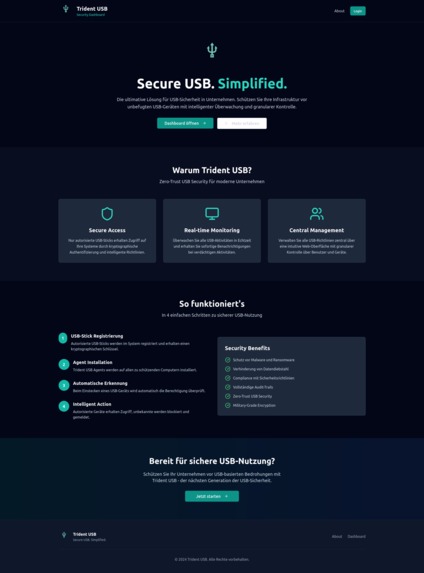
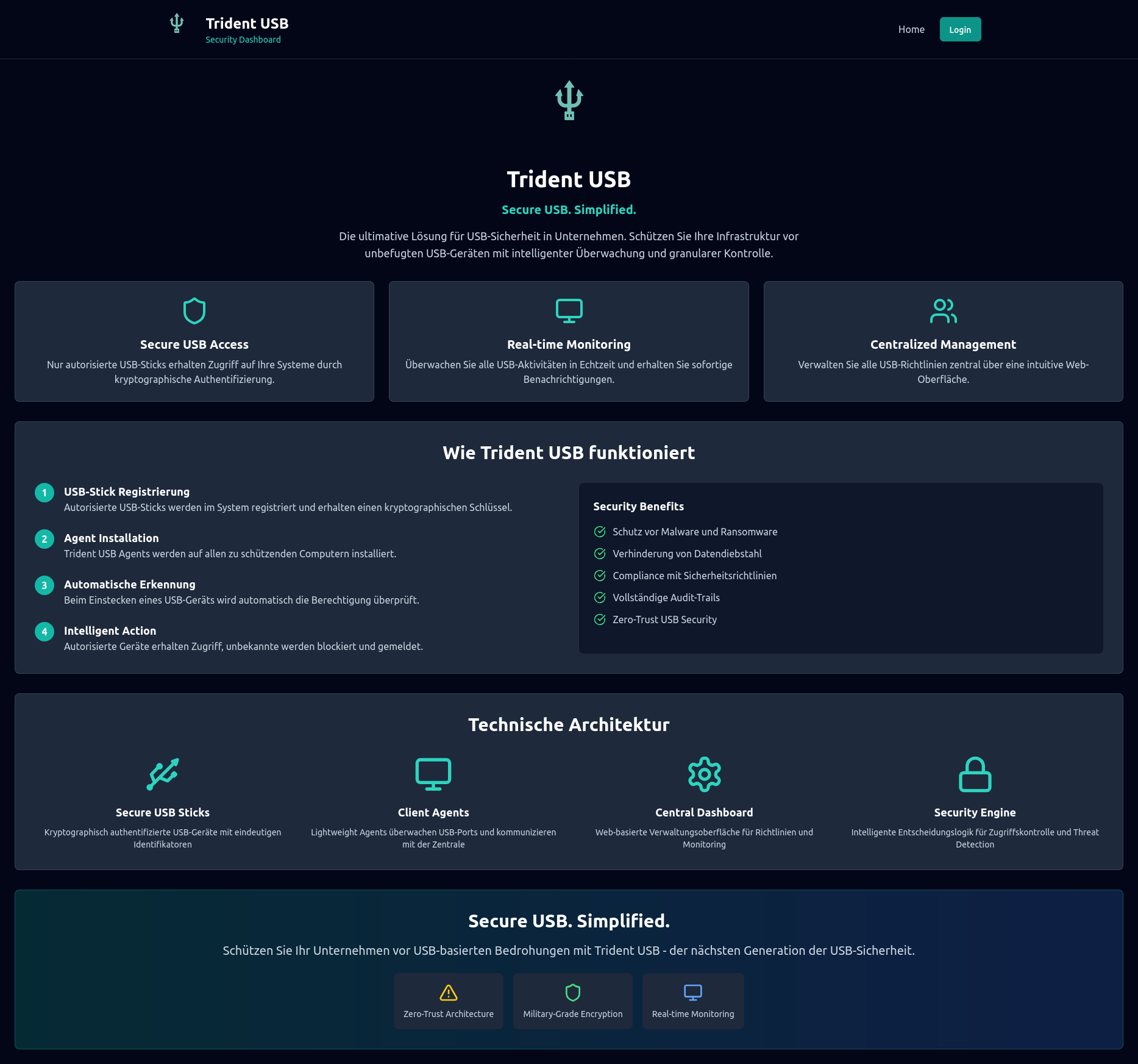
Landing Page
-
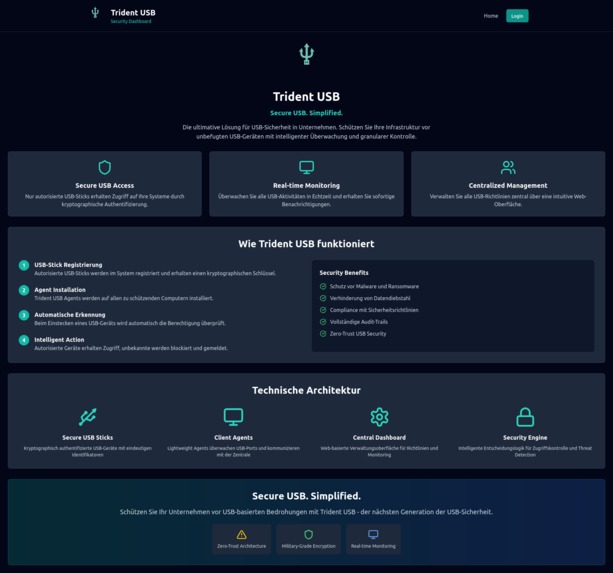
About Page
-

Authentication & User Management
-
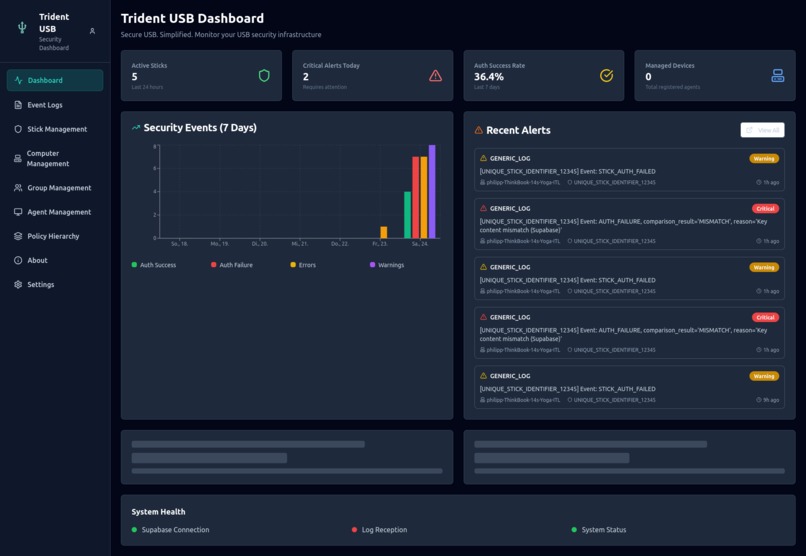
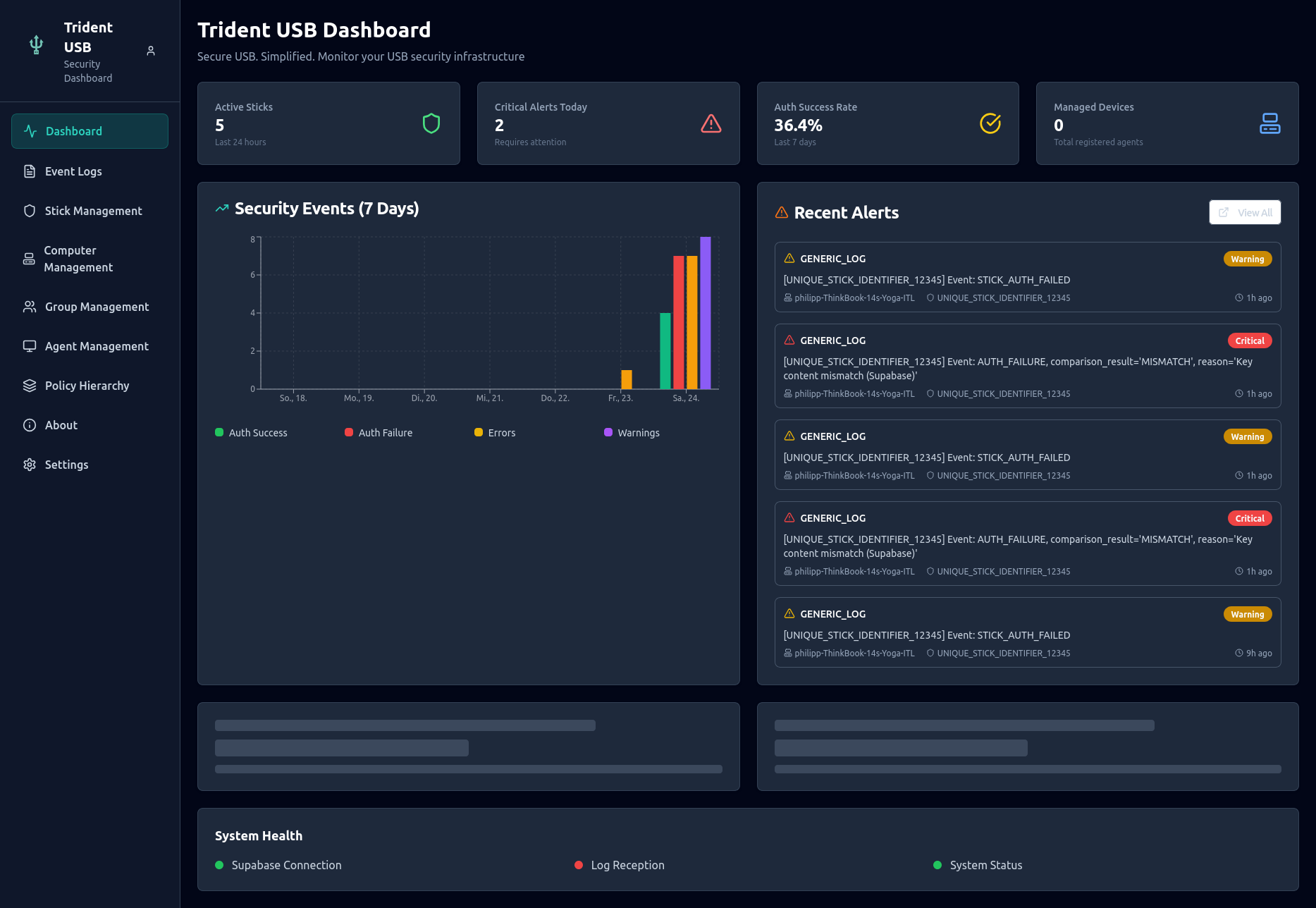
Dashboard
-
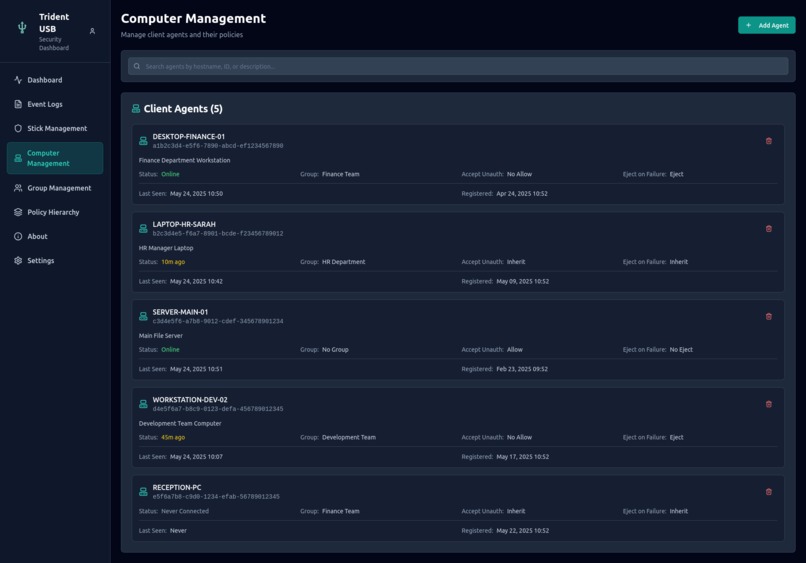
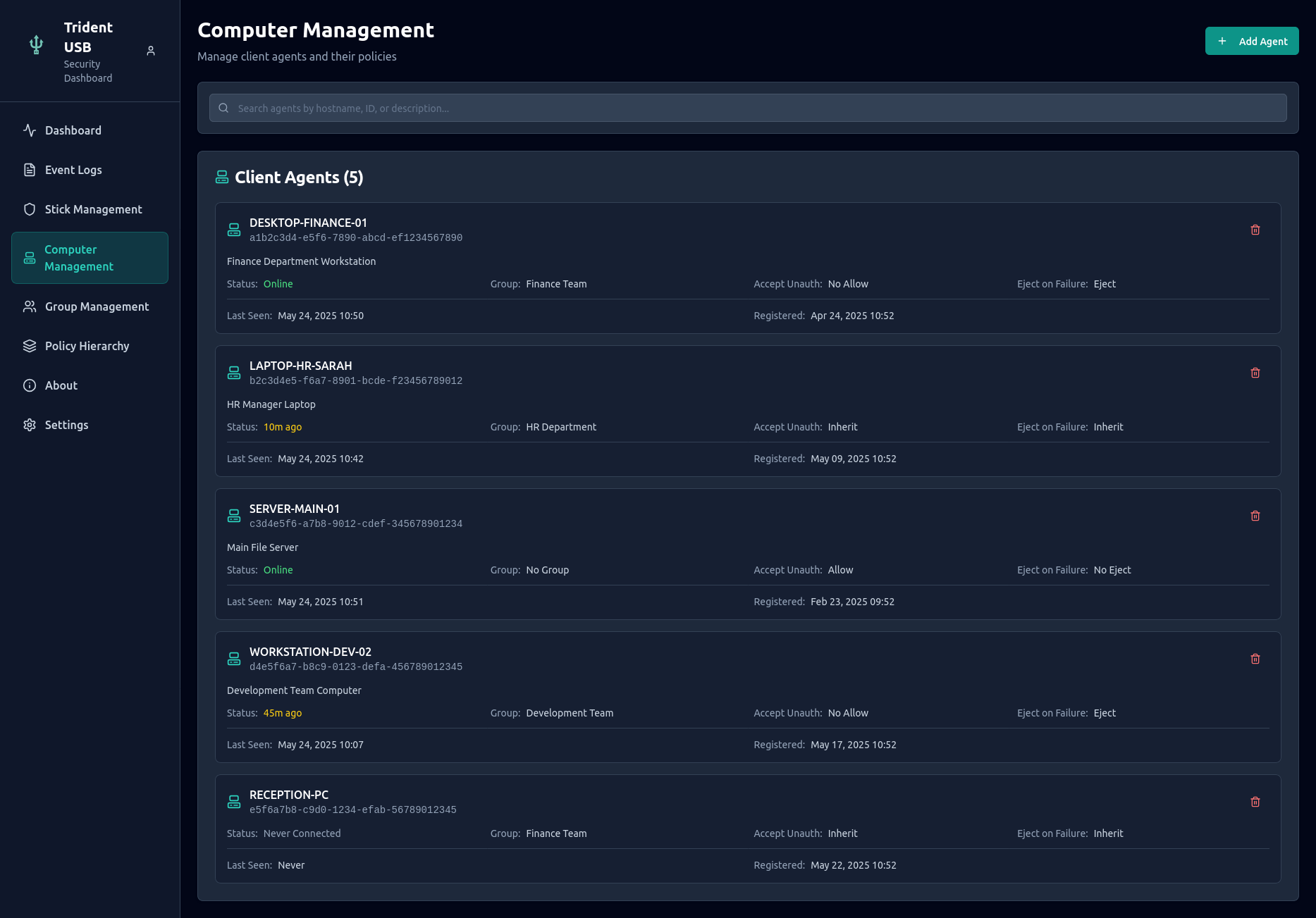
Computer Management
-
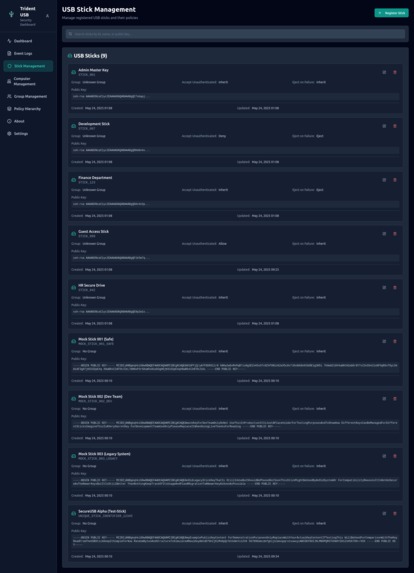
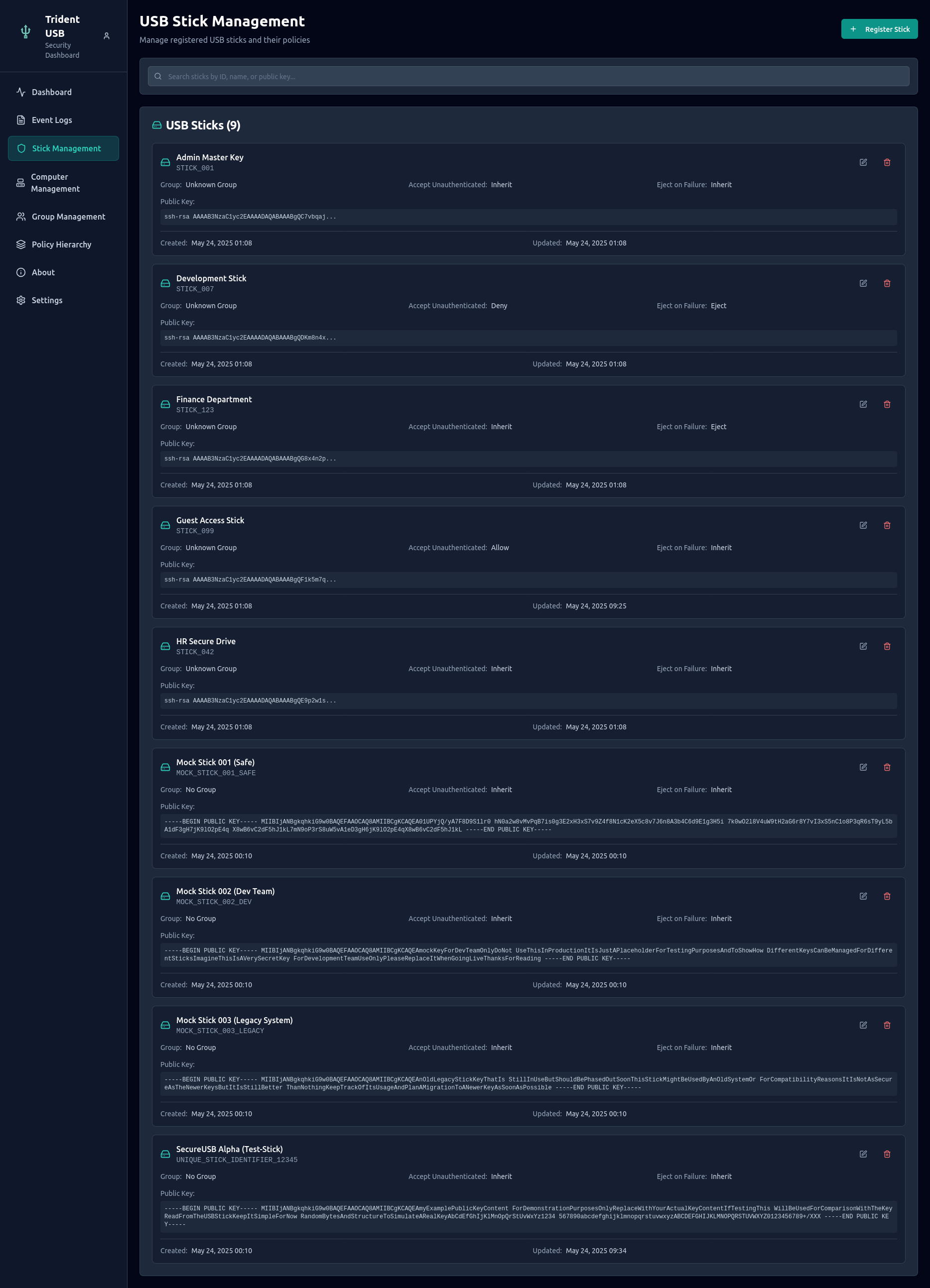
Stick Management
-
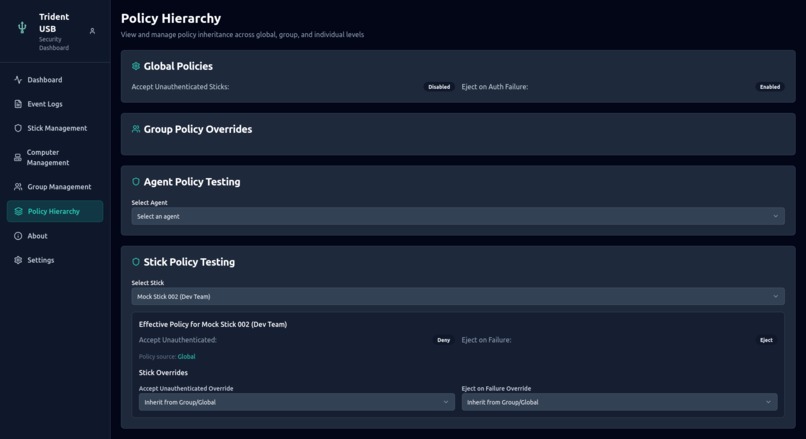
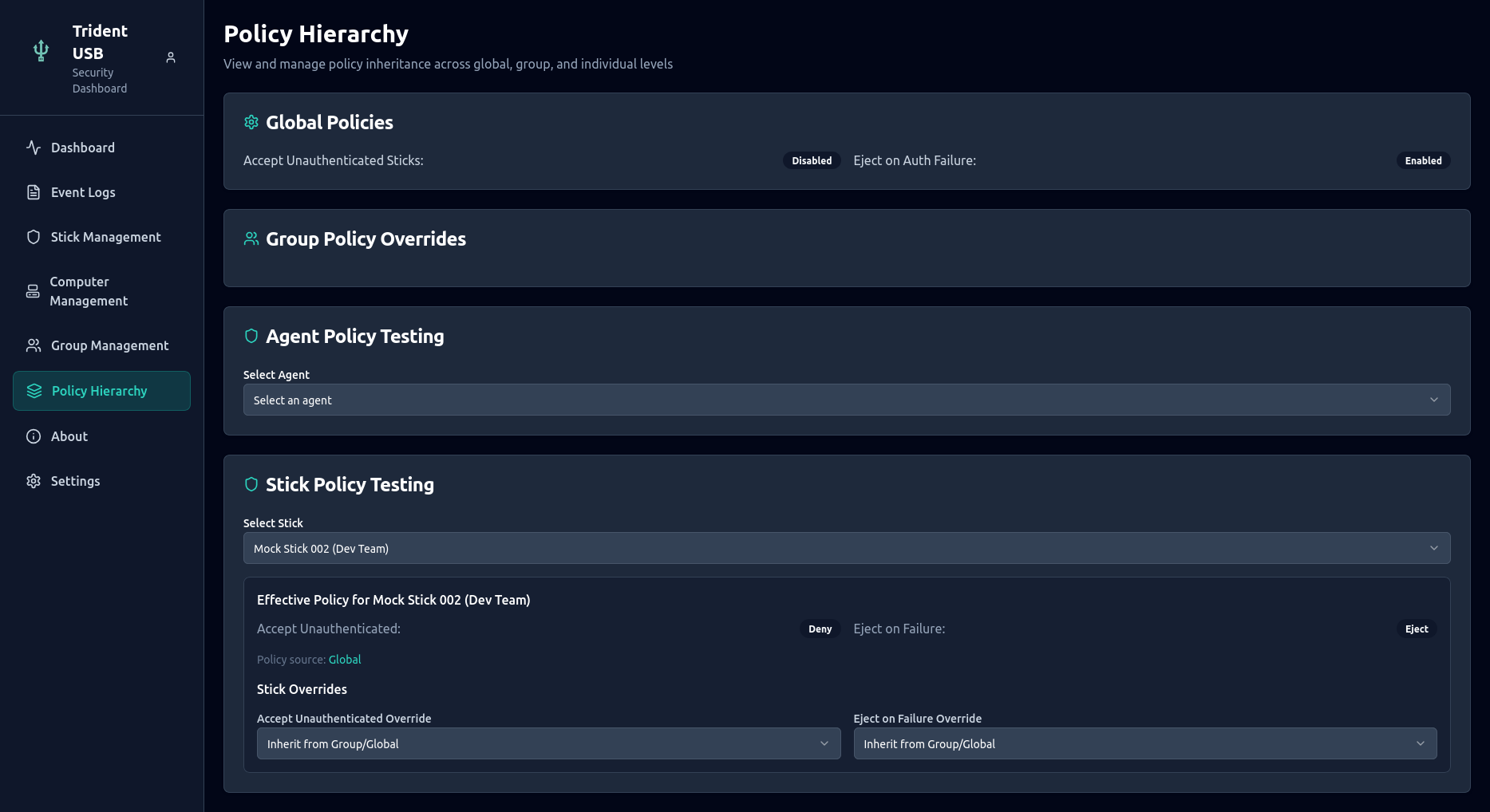
Policy Hierarchy
-
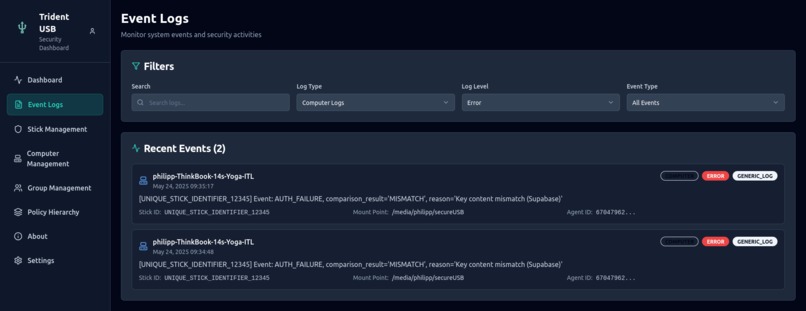
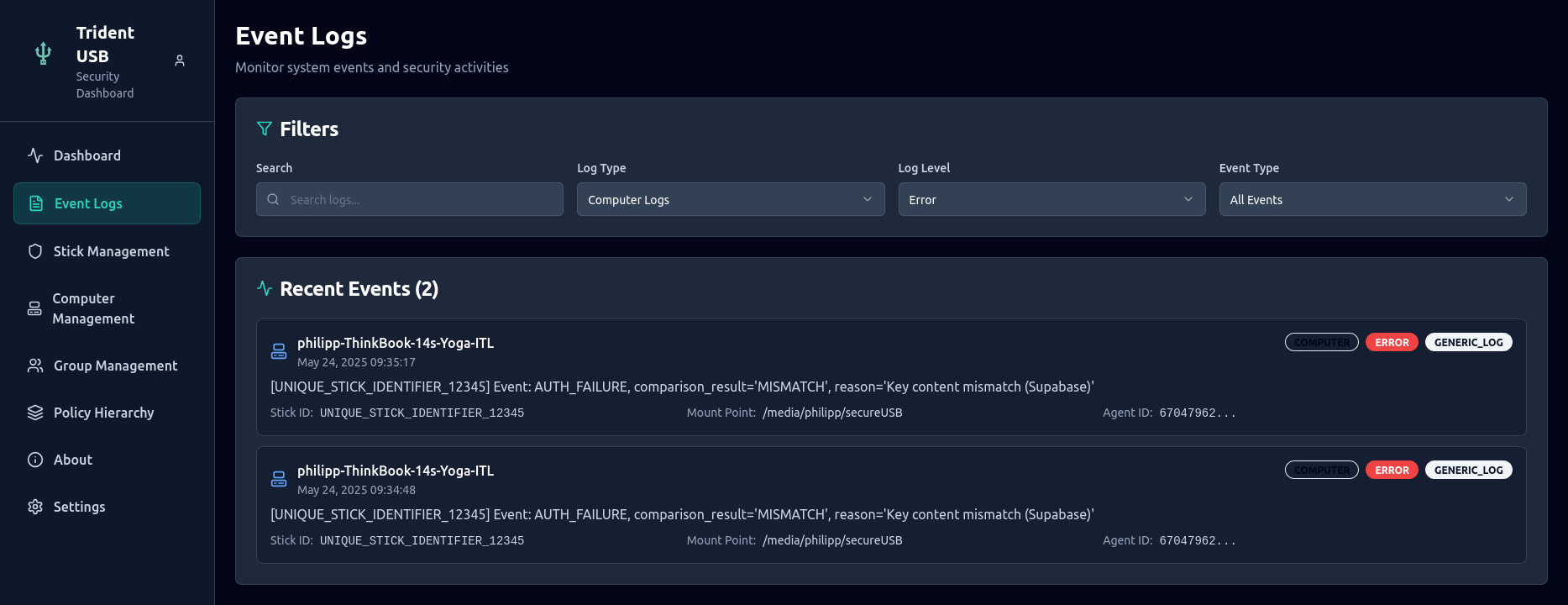
Event Logs
-
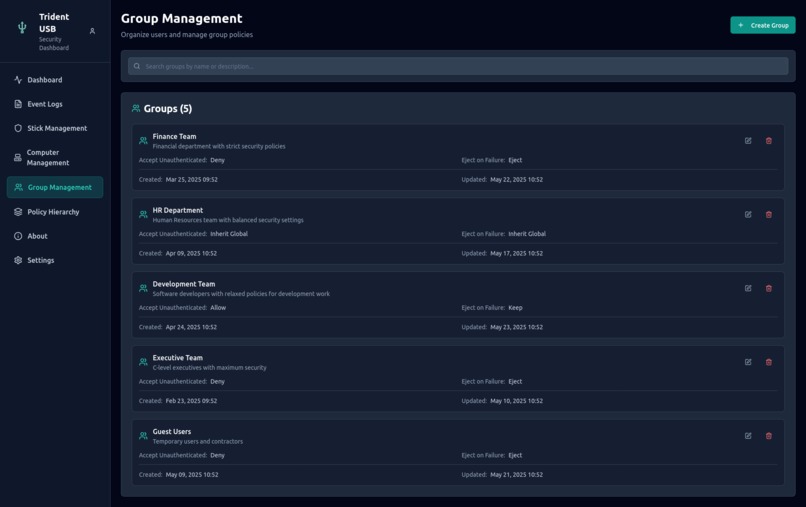
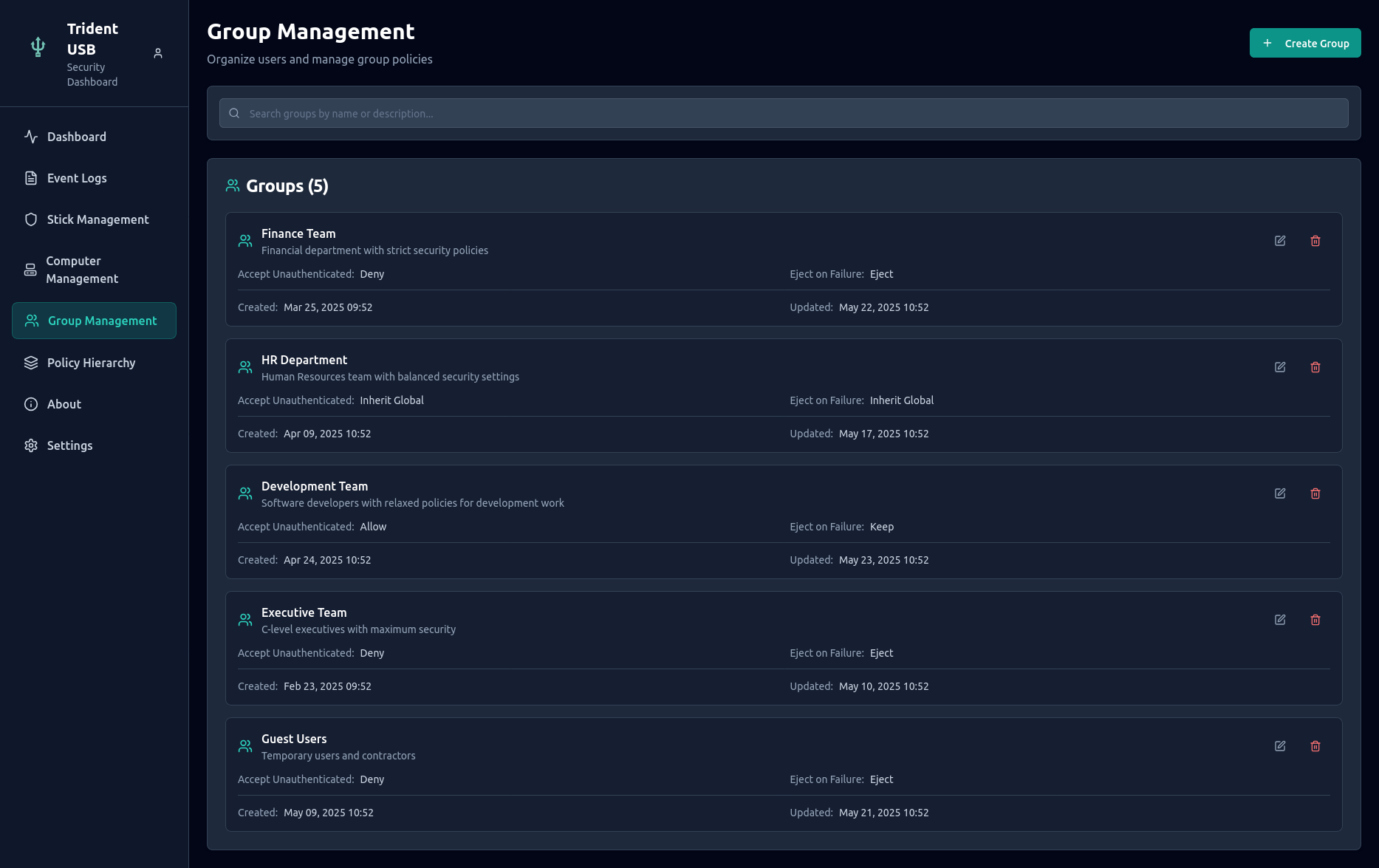
Group Management
-
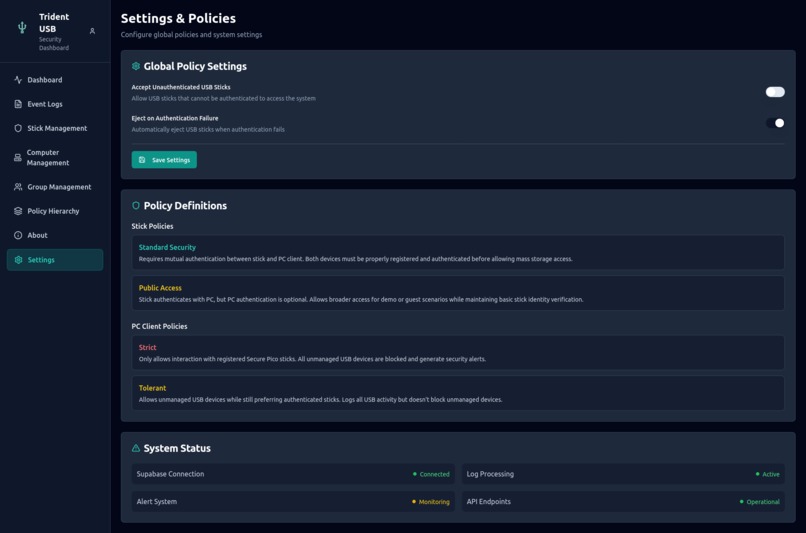
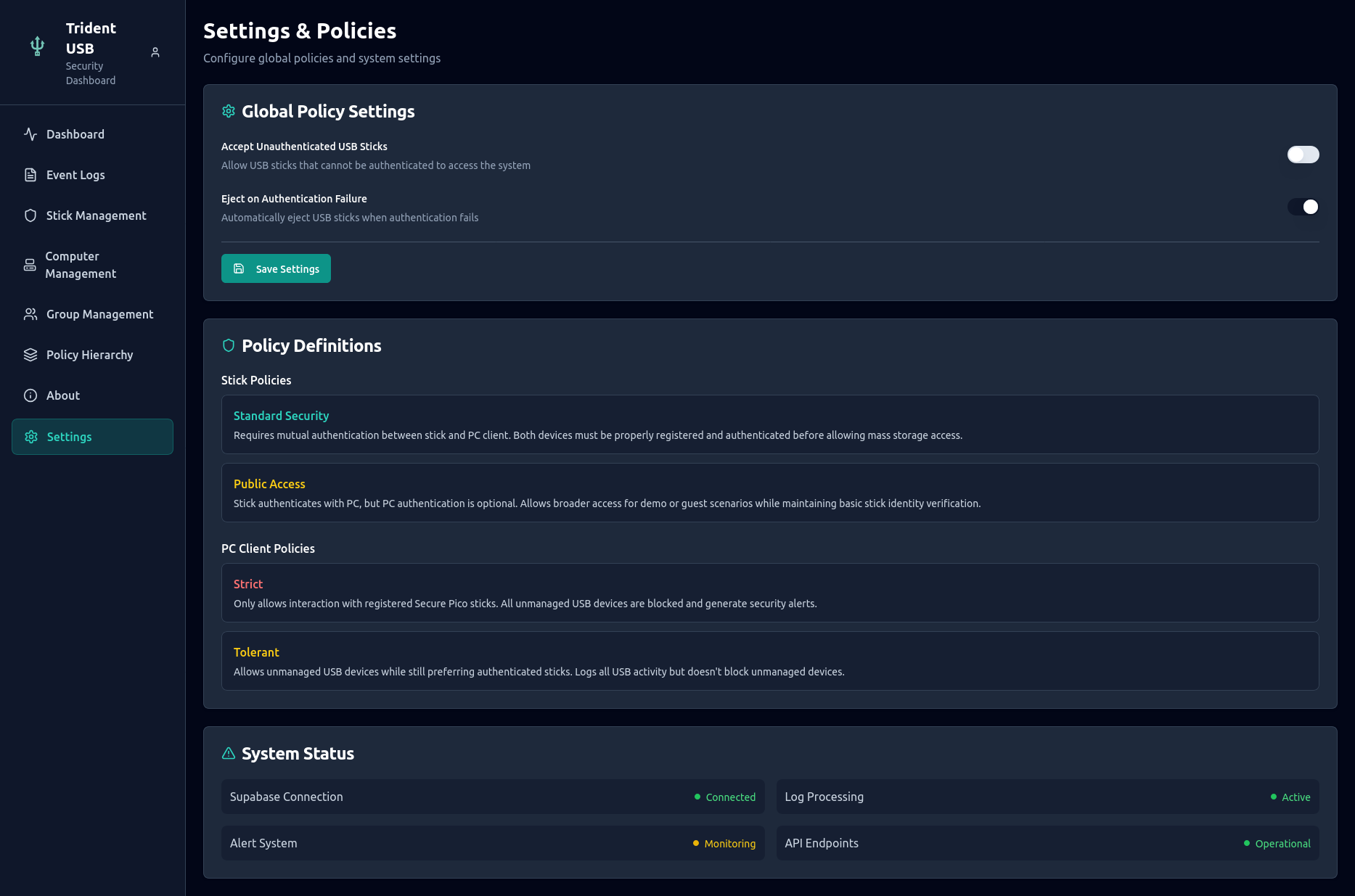
Settings
-
-

Trident USB: Turning USB Insecurity on its Head!
The Insecurity We're Tackling: USB drives are a double-edged sword. Essential for many workflows, yet a notorious gateway for malware, data theft, and unauthorized access. For non-technical users, secure alternatives are often cumbersome, while IT administrators lack effective, centralized control and visibility over USB usage. This gaping security hole is what Trident USB confronts.
Our Vision: Secure. Simplified. Imagine a world where using a USB stick is inherently secure. Users simply plug in an authorized stick into an authorized machine – no complex steps. Administrators, meanwhile, gain granular control, real-time monitoring, and a comprehensive audit trail from a central dashboard. This is the future Trident USB delivers.
What Trident USB Does: From Threat to Trust
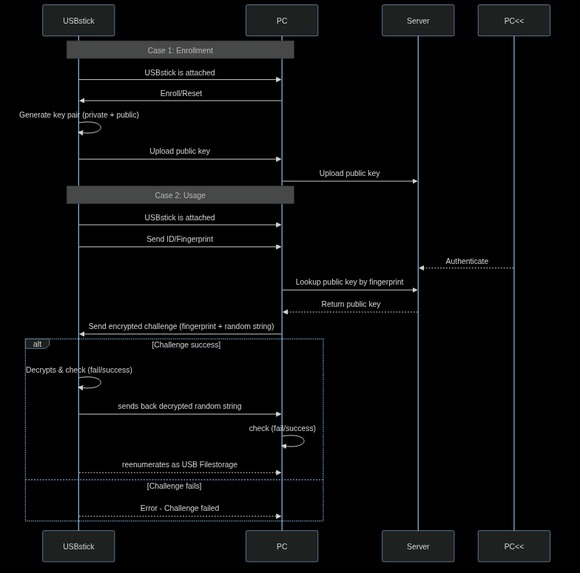
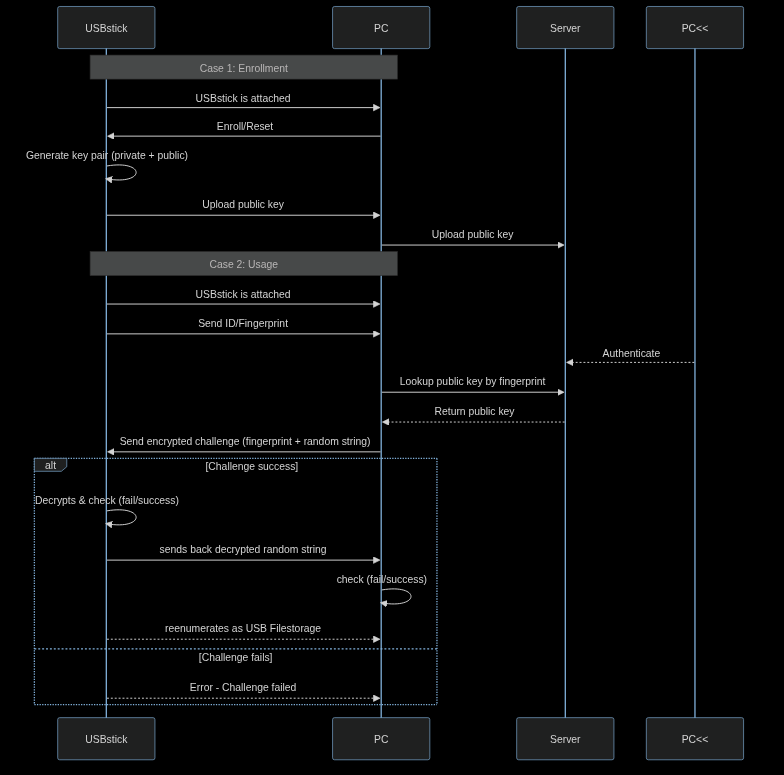
Trident USB transforms vulnerable USB ports into policy-enforced, monitored endpoints. Here's the core loop:
- Connection & Detection: A user plugs a Trident-managed USB stick into a machine running our lightweight Python agent.
- Mutual Authentication Challenge:
- The agent detects the new USB device (initially not as mass storage).
- It initiates a cryptographic challenge with the stick to verify its identity against policies stored in our central Supabase backend.
- The stick, in turn, can (in future iterations with more capable hardware) challenge the agent/host.
- Policy Enforcement via Supabase Edge Function: The agent queries a Supabase Edge Function (
fn_get_effective_policy) which resolves a hierarchical policy (Global -> Group -> Agent -> Stick specific overrides) to determine if access should be granted. - Secure Access or Denial:
- Authenticated & Authorized: The stick (if it's a specialized hardware stick, or a standard stick with our software-defined security) re-enumerates as a mass storage device, granting access.
- Authentication Failed / Unauthorized: Access is denied, and the agent can automatically eject the stick based on the effective policy.
- Comprehensive Logging: All events (connection, auth attempts, policy decisions, access granted/denied) are logged to Supabase for central auditing and appear in the dashboard. Logs can also be written to the stick itself if permitted by policy.
How We Built It: The Trident Ecosystem
Trident USB comprises three core, interconnected components:
1. The Secure USB Stick (Concept & Software Simulation):
- Hardware Vision: A microcontroller-based USB stick that initially presents as a serial device for the authentication handshake, then re-enumerates as mass storage upon successful authentication.
- Current Implementation (Hackathon Scope): For this hackathon, we simulate this behavior using standard USB sticks. The "authentication" is based on a
public_keyfile on the stick being validated against anexpected_public_keystored in Supabase, linked via a uniquestick_idin aconfig.fileon the stick. The "re-enumeration" is conceptually handled by the agent allowing or denying mount access.
2. The Python Client Agent:
- A robust Python script running on Linux endpoints (design is adaptable for other OS).
- Responsibilities:
- Detects USB connections and disconnections (
usb-monitor,psutil). - Manages a persistent
agent_identity(agent_setup.py). - Reads stick configuration (
config.file). - Performs authentication against Supabase (
auth.py,supabase_client.py). - Fetches and applies effective policies from Supabase Edge Functions.
- Executes actions like robustly ejecting unauthorized sticks (
usb_utils.py). - Handles detailed, contextual logging to local files and Supabase (
logger_setup.py,SupabaseListHandler).
- Detects USB connections and disconnections (
3. The Central Management Dashboard & Supabase Backend:
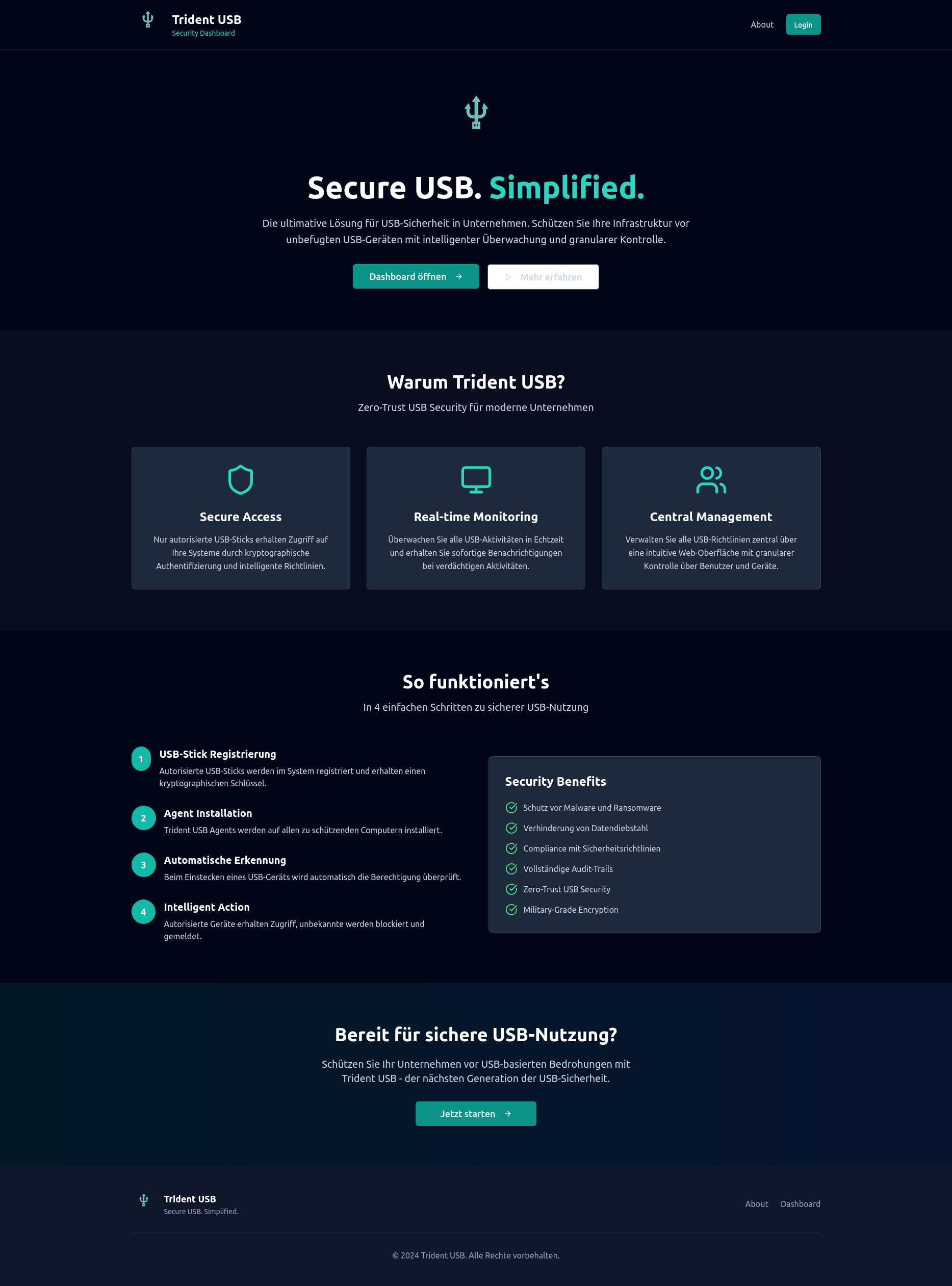
- Intuitive Web UI: (Screenshots provided) A comprehensive dashboard for:
- Registering and managing USB sticks, client agents, and user/computer groups.
- Defining a sophisticated policy hierarchy (Global, Group, Agent, Stick overrides).
- Viewing real-time event logs and security alerts.
- Monitoring system health and Supabase connectivity.
- Powerful Supabase Backend:
- PostgreSQL Database: Stores all entity data, policies, and logs.
- Authentication: Manages user access to the dashboard.
- Realtime APIs & REST APIs: Facilitate communication between agents and the dashboard.
- Serverless Edge Functions (Deno/TypeScript): The
fn_get_effective_policyfunction is the heart of our dynamic policy resolution, ensuring the correct policy is applied based on the specific agent-stick interaction. This keeps complex decision-making logic centralized and secure.
- Intuitive Web UI: (Screenshots provided) A comprehensive dashboard for:
Challenges We Navigated (and Conquered!)
- Designing a Robust Policy Hierarchy: Creating a flexible yet understandable system for policy inheritance (Global -> Group -> Agent -> Stick) and implementing its resolution efficiently via Supabase Edge Functions was a significant design challenge.
- Reliable Agent-Side USB Management: Developing a Python agent that consistently detects USB events, correctly identifies mount points across different Linux setups, and performs robust, multi-step ejections (
udisksctl unmount,udisksctl power-off,eject) required deep dives into system-level interactions. - Secure and Efficient Agent-Backend Communication: Ensuring that agents securely fetch keys and policies without compromising the system, and batching log uploads effectively.
- (Conceptual) Microcontroller & Re-enumeration Logic: While simulated for the hackathon, designing the theoretical flow for a hardware stick that changes its USB enumeration post-authentication involved careful consideration of USB protocols and HALs (Hardware Abstraction Layers).
- Contextual Logging for Actionable Insights: Implementing the
ContextualFormatterandSupabaseListHandlerto ensure logs are not just numerous, but rich with context (stick_id, agent_id, event_type) for easy filtering and analysis in the dashboard.
Accomplishments We're Proud Of
- The End-to-End Working System: From agent detection on a Linux machine to policy enforcement based on rules set in a web dashboard, and seeing those events logged back centrally – it all works!
- The Power of the Policy Engine: The
fn_get_effective_policyEdge Function truly centralizes and simplifies complex access decisions, making the system highly adaptable. (python client for Linux: https://github.com/philscheuerer/SecureUSB) - Intuitive UI/UX: Creating a dashboard (see screenshots) that makes complex security management accessible and visually clear. (react UI: https://github.com/philscheuerer/trident-usb) + simplified UI demo: (https://preview--trident-usb.lovable.app/)
- The Robustness of the Python Agent: It handles various scenarios gracefully, from initial stick detection to policy-driven ejection, with detailed logging every step of the way.
- Thinking Beyond Software: Conceptualizing the hardware-software co-design for the ideal "Trident Stick," even if simulated for now, pushes the boundaries of typical USB security solutions. (Firmware-Experiments for USB-side: https://gitlab.gamedevregensburg.de/jackik1/secure-usb)
What We Learned
- The Nuances of System-Level USB Interaction: There's a surprising amount of complexity in reliably detecting, identifying, and controlling USB devices programmatically across different environments.
- The Power of Serverless for Dynamic Logic: Supabase Edge Functions proved invaluable for offloading complex decision-making (like policy resolution) from the client agent, enhancing security and maintainability.
- The Importance of Iterative Design: Both the agent logic and the UI/UX evolved significantly as we encountered edge cases and sought clearer presentations of information.
- Cryptography is Hard, But Essential: While we simplified the crypto for the hackathon (key comparison), the process reinforced the need for robust cryptographic primitives in a production system.
- User Experience Matters, Even for Admin Tools: A powerful system is only effective if administrators can understand and use it efficiently.
What's Next for Trident USB: Expanding the Secure Perimeter
The current system provides a strong foundation. The future is exciting:
- True Microcontroller-Based Trident Sticks: Implementing the hardware vision for enhanced physical security and tamper-resistance.
- Cross-Platform Agent Support: Expanding agent compatibility to Windows and macOS.
- File-Level Control & DLP: Implementing policies to control what data can be read/written, based on file types, DLP tags, etc.
- Beyond Mass Storage: Extending Trident's protection to other USB device classes (e.g., serial devices, specialized hardware) ensuring only trusted peripherals can interact with critical systems. Imagine securing industrial control systems or medical devices.
- Offline Policy Caching & Sync: Allowing agents to enforce policies even with intermittent network connectivity.
- SIEM Integration & Advanced Analytics: Pushing logs to enterprise SIEMs and applying ML for anomaly detection in USB usage patterns.
- Embedded Trident: Integrating Trident's core security directly into other embedded devices or machines that need secure peripheral access.
Trident USB is more than just a project; it's a vision for a fundamentally more secure way to interact with the ubiquitous USB interface.
Built With
- python
- react
- rtic
- rust
- supabase
- tailwind
- typescript
- vite


Log in or sign up for Devpost to join the conversation.