-
-
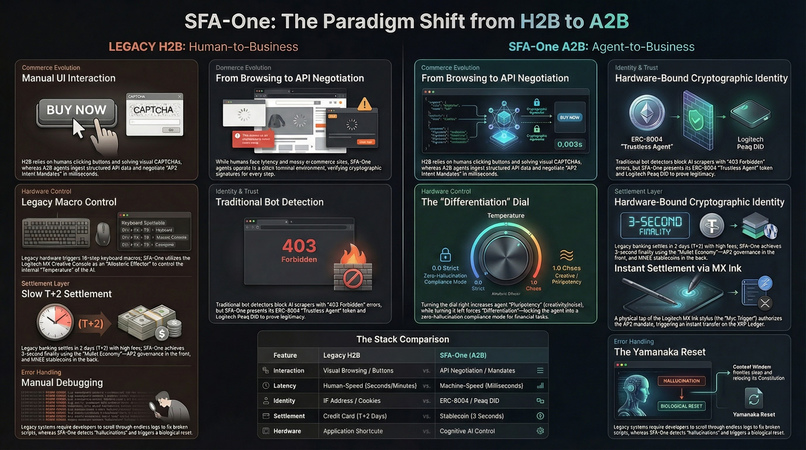
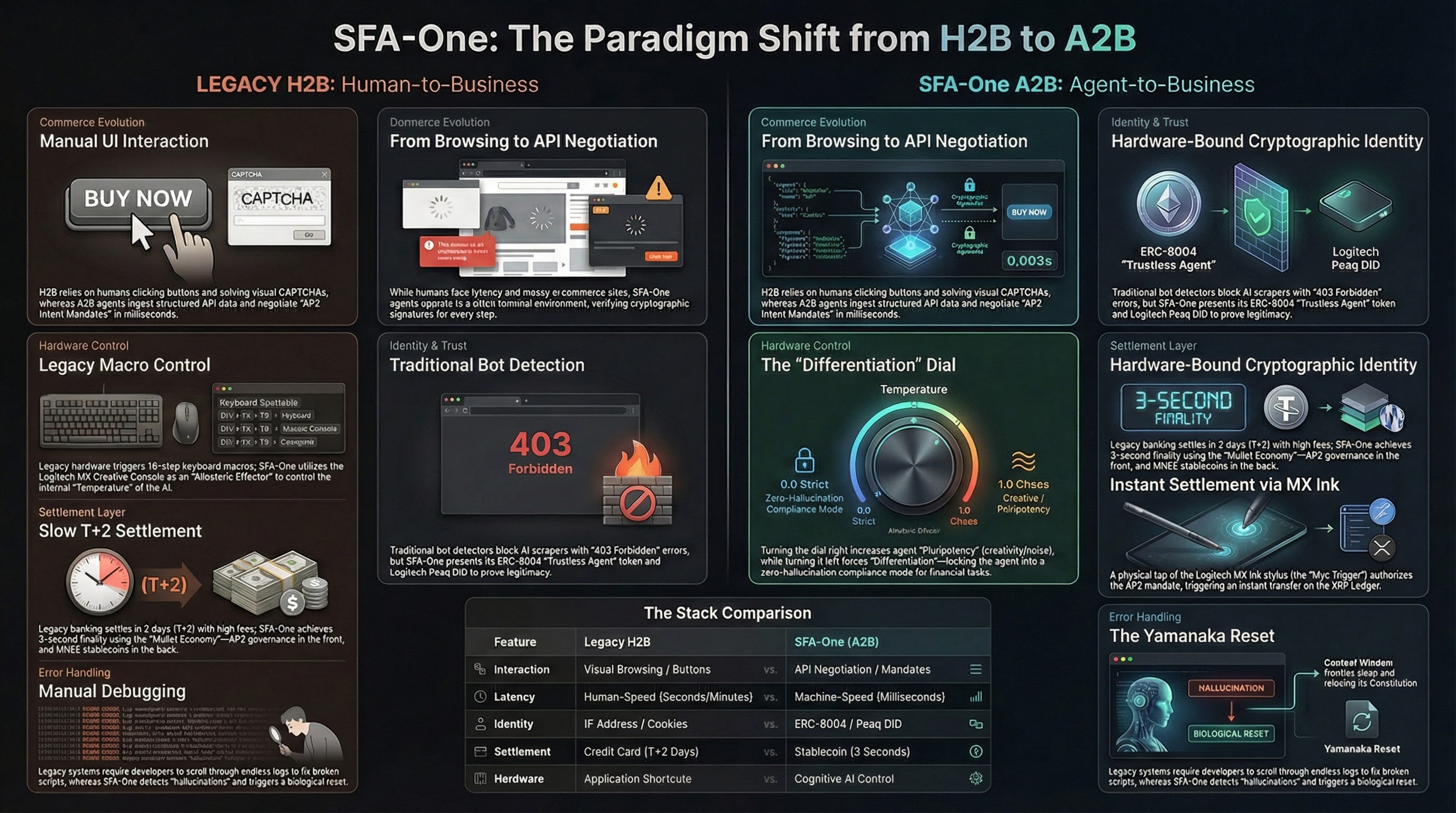
"Split Screen" concept. Visually showing the slow, manual human on the left next to the blazing fast, protocol-driven agent on the right
-
Inspiration
The inspiration for SFA-One stems from the "Accountability Problem" in agentic commerce—the critical gap where probabilistic AI reasoning fails to provide the deterministic proof required for financial and legal trust . Drawing on my background as a Water Treatment Engineer, I viewed digital data as an industrial "flow" that requires rigorous backwashing and filtration
What it does
SFA-One is a Live Multimodal Economic Organism that anchors digital AI reasoning in physical hardware triggers . It transforms the Logitech MX Creative Console into an "Allosteric Dial"—a tactile cognitive throttle that physically shifts the agent from a Pluripotent State (creative brainstorming) to a rigid Compliance Phenotype (zero-hallucination transactions) . It utilizes the MX Ink stylus as a "Myc Factor"—a physical haptic tap required to release cryptographic signatures for payments, ensuring that no autonomous agent can spend money without an explicit human signal
How we built it
We utilized Google Antigravity and Spec-Kit to engineer a 17-file bio-mimetic architecture powered by Gemini 3 Flash [306, 611, conversation history]. Governance: We implemented the Google AP2 Protocol, treating Intent, Cart, and Payment Mandates as "Synthetic Small RNAs"—the only data permitted to survive security context flushes to guide the agent after a reset . Settlement: We used PayRam to route transactions via MNEE stablecoins on the XRP Ledger for instant finality and "Epigenetic Fixation" . Immune System: We integrated Wazuh to monitor for PII leaks and trigger autonomous Yamanaka Factor resets if "pathogens" are detected
Challenges we ran into
A primary challenge was solving the risk of "Heritable Hallucinations"—where security flaws or prompt injections in an initial agent session are inherited by downstream sub-agents . We also faced the "Execution Gap" between the millisecond reasoning of AI agents and the T+2 day settlement lag of legacy banking rails . Bridging the Logitech Actions SDK with multimodal LLM parameters required precise interaction engineering to ensure the hardware and software states remained in homeostasis
Accomplishments that we're proud of
Tactile Interaction Mastery: Successfully mapping a physical dial to the model's temperature (T) parameter to create a "Physical Nervous System" for AI . Disposable Pixel UIs (DPUI): Designing generative interfaces that are discarded after use but versioned as first-class artifacts to satisfy the Audit Trail Mandate . The Mullet Economy: Successfully bridging Web2 governance (AP2) with Web3 settlement speed (PayRam/XRPL) to create a viable enterprise-grade commerce engine
What we learned
We discovered that Small RNAs (compact mandates) are far more effective for directing agents than massive, noisy chat histories, which often lead to agentic drift . We learned that in high-stakes commerce, the bottleneck is not intelligence, but deterministic accountability; trust is not built through text prompts, but through tactile haptic authorization [9, 793, conversation history]. Finally, we realized that Bio-Mimetic Architecture provides a superior framework for Self-Healing and Data Integrity in regulated environments
What's next for Secure Flow Architect
The roadmap for SFA-One involves moving from the cloud to the Peripheral Nervous System . Sensory Integration: Giving the agent "Ears" and "Eyes" via WhisperSpeech and NVIDIA Vision AI . Mitochondrial Sovereignty: Running local SLMs on AMD Ryzen AI or NVIDIA Jetson hardware to allow for private, off-grid inference . The Mycelial Network: Implementing Meshtastic protocols to enable agents to communicate and coordinate via LoRa mesh networks if the internet goes down
Built With
- including-modules-for-mandates-(intent-mandate.py)
- python
- settlement-(payram-client.py)

Log in or sign up for Devpost to join the conversation.