Inspiration
Daily commuting in Bengaluru is unpredictable and stressful. Existing navigation systems mainly optimize for ETA, but commuters often care about different priorities such as budget, comfort, safety, shortest distance, and reliability. We wanted to build an intelligent commute assistant that behaves more like a human travel advisor rather than a static map application.
What it does
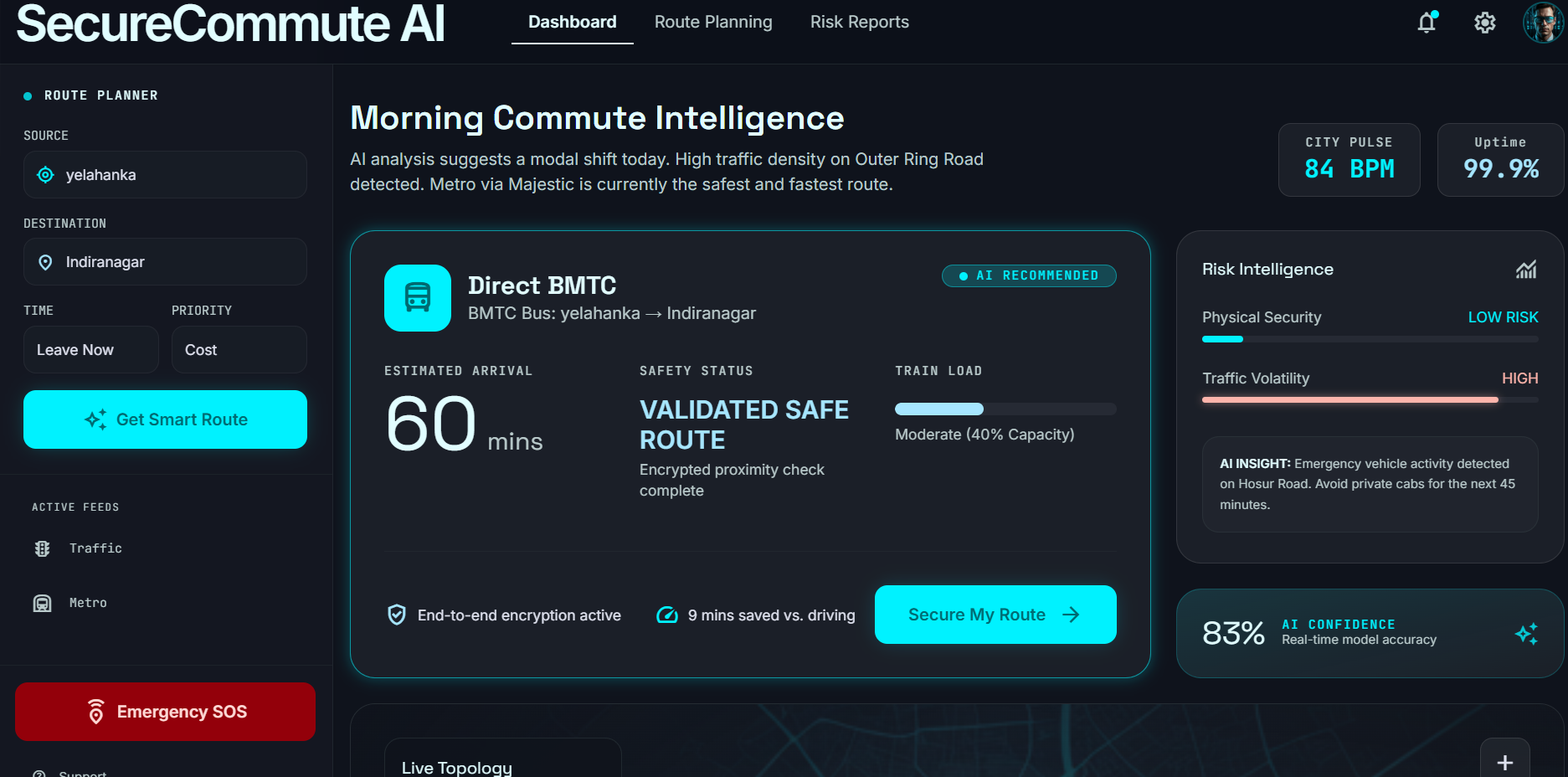
SecureCommute AI is an explainable AI-powered urban commute intelligence platform that generates personalized multi-modal travel recommendations.
The system:
- Accepts source, destination, time, and user priority
- Supports priorities like time, budget, comfort, safety, and shortest distance
- Generates ranked route recommendations
- Provides alternative commute options
- Compares routes based on ETA, cost, transfers, waiting time, and safety
- Performs security validation on recommendations
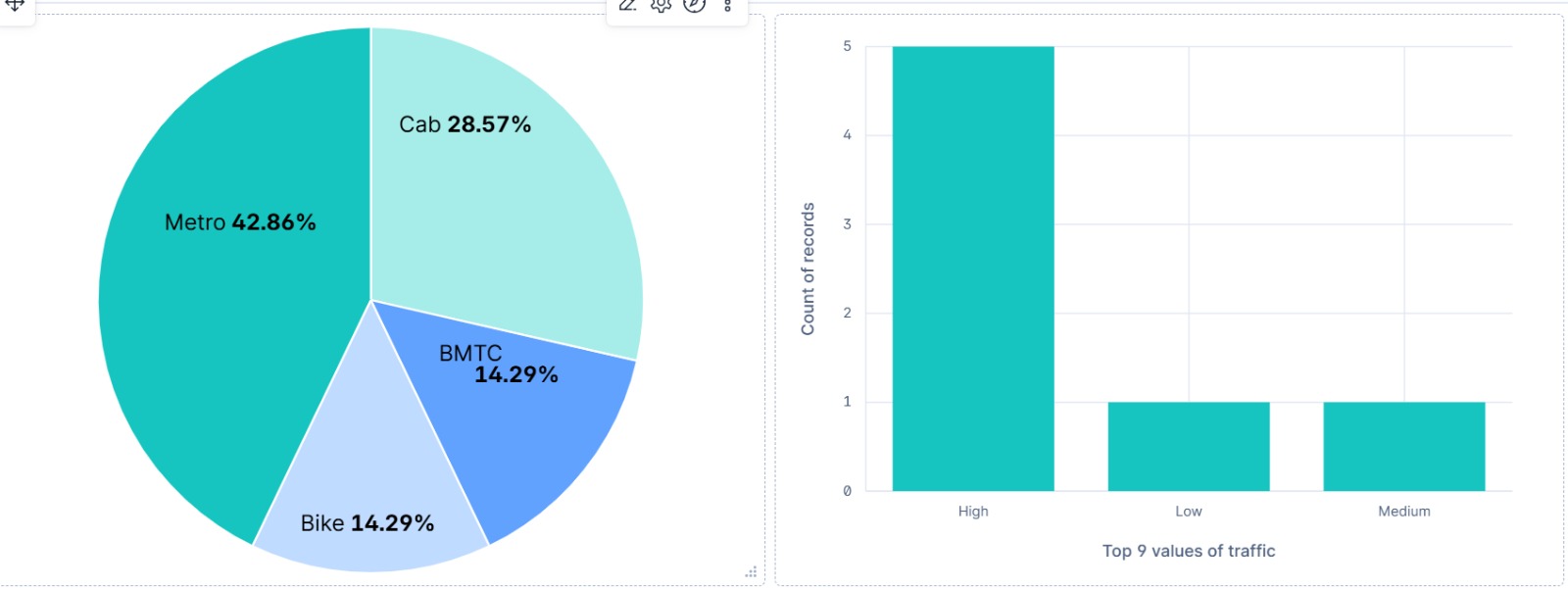
- Uses Elastic analytics for real-time observability and commute insights
Example: A budget-focused commuter may receive a BMTC + Metro route, while a time-focused commuter may receive a direct cab recommendation.
How we built it
We built the backend using FastAPI and Python with Kiro-assisted rapid backend development. The frontend experience was developed using Stitch for quick UI prototyping and integration.
Our architecture includes:
- FastAPI backend for intelligent recommendation generation
- AI reasoning engine for explainable route decisions
- Security validation layer for detecting unsafe or unrealistic recommendations
- Elasticsearch for logging commute analytics
- Kibana dashboards for observability and visualization
- AWS EC2 and Bedrock-inspired cloud architecture concepts for scalability and AI inference
The system dynamically evaluates:
- traffic conditions
- weather
- metro connectivity
- commute cost
- waiting time
- transfer count
- user preferences
Challenges we ran into
One of the biggest challenges was making route recommendations realistic for Bengaluru. We had to account for incomplete metro connectivity, hybrid transport strategies, and dynamic tradeoffs between time, cost, comfort, and safety.
Another challenge was integrating all components quickly within a hackathon timeline:
- backend APIs
- frontend integration
- Elasticsearch logging
- Kibana analytics
- multi-route recommendation logic
We also worked on making the AI explanations sound realistic and context-aware instead of returning static outputs.
Accomplishments that we're proud of
We are proud of building:
- a fully integrated end-to-end system
- personalized commute intelligence
- ranked alternative route generation
- explainable AI reasoning
- security-aware route validation
- Elastic-powered observability dashboards
We also successfully implemented multi-modal commute planning using combinations of BMTC, Metro, and Cab transport options.
What we learned
Through this project we learned:
- rapid AI-assisted backend development using Kiro
- integrating FastAPI with Elasticsearch and Kibana
- designing explainable AI systems
- building modular cloud-native architectures
- balancing real-world usability with hackathon execution speed
We also learned the importance of observability and safety validation in AI-powered systems.
What's next for SecureCommute AI
In the future, we plan to:
- integrate real-time BMTC and Metro APIs
- add live traffic and weather feeds
- implement route learning using historical commute patterns
- support voice-based commute assistance
- expand to other smart cities
- integrate real-time anomaly detection using Elastic AI capabilities
Our long-term vision is to build a scalable AI-powered smart mobility platform for urban transportation systems.
Built With
- ai-reasoning-engine
- amazon-bedrock
- aws-ec2
- elastic-stack
- elasticsearch
- fastapi
- github
- html/css
- json
- kibana
- kiro
- python
- rest-apis
- stitch
- swagger-ui