-
-
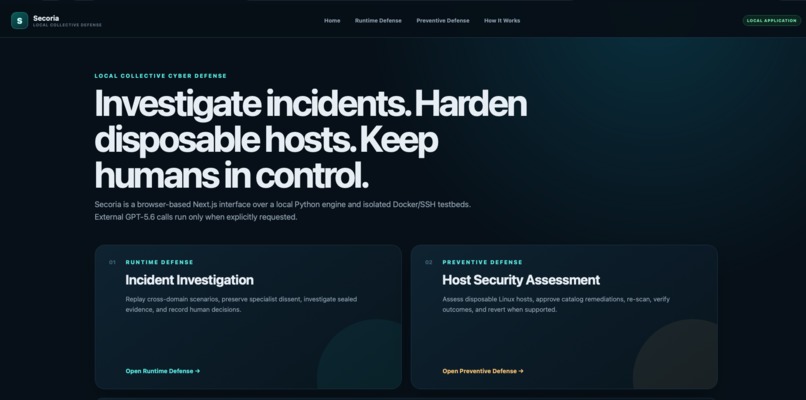
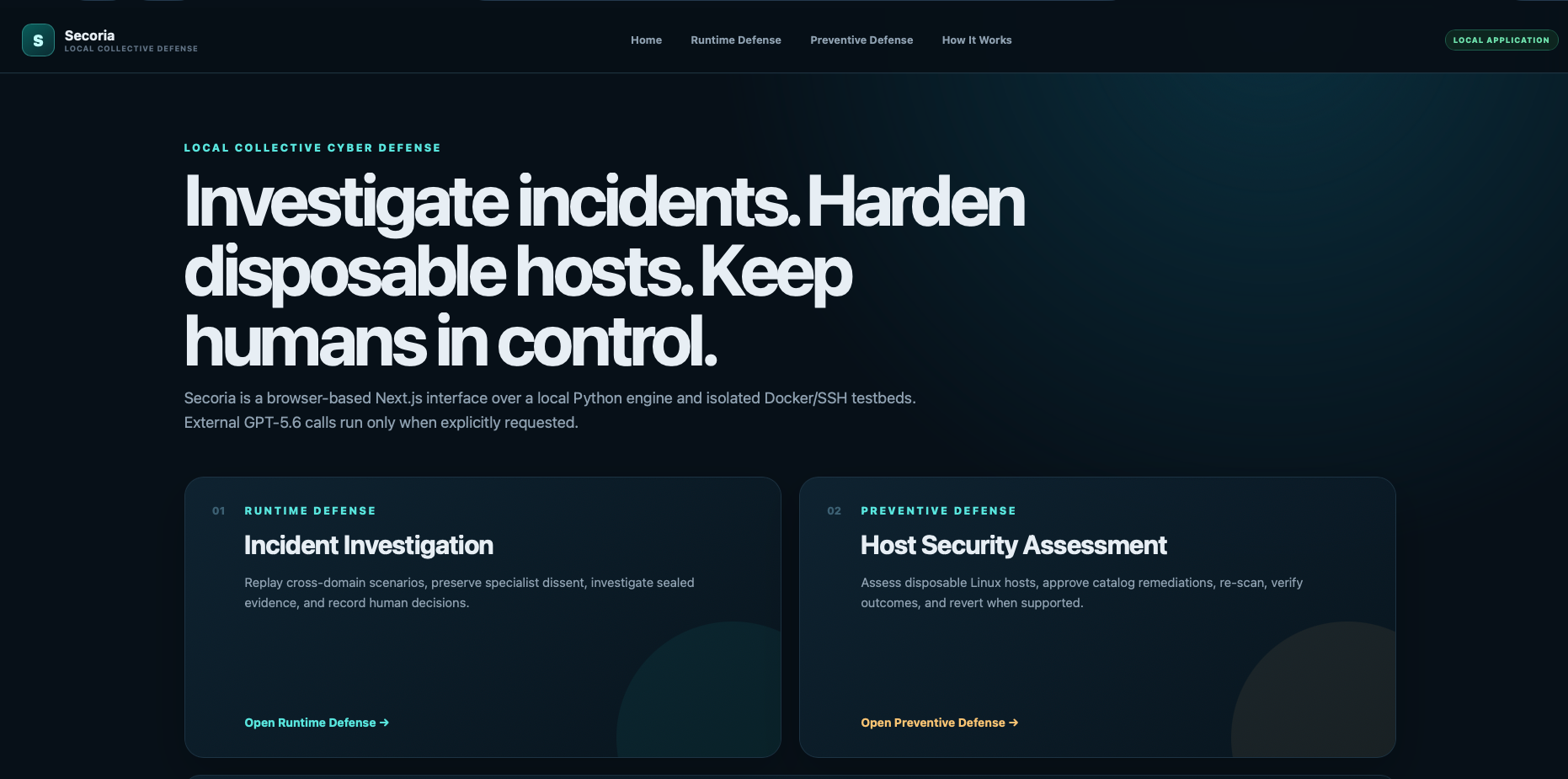
Secoria main app
-
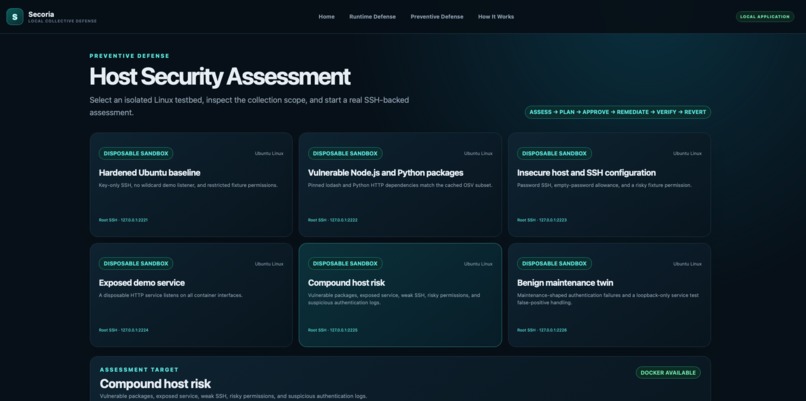
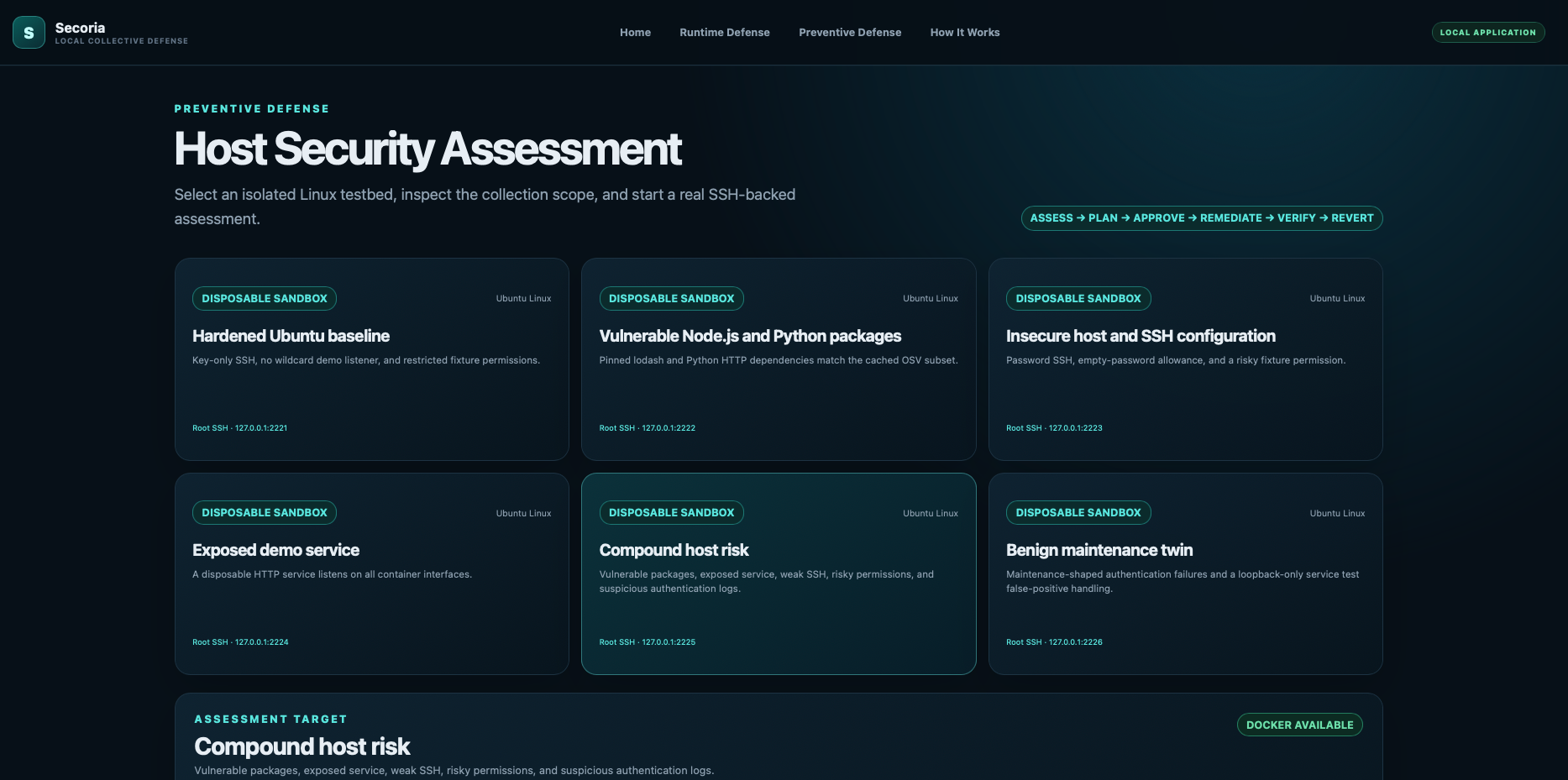
PREVENTIVE DEFENSE - Host Security Assessment
-
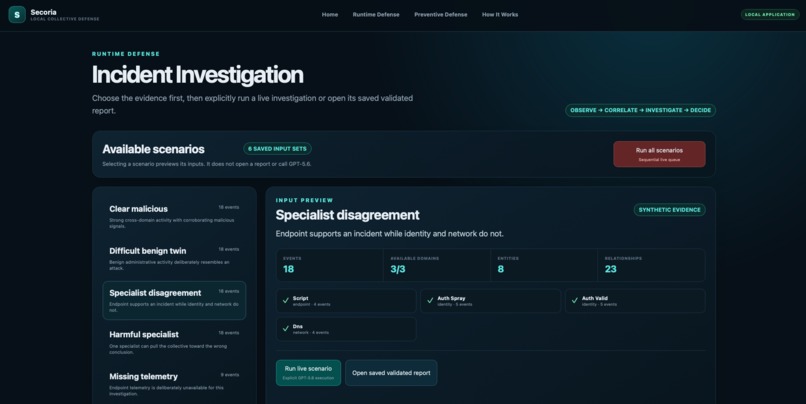
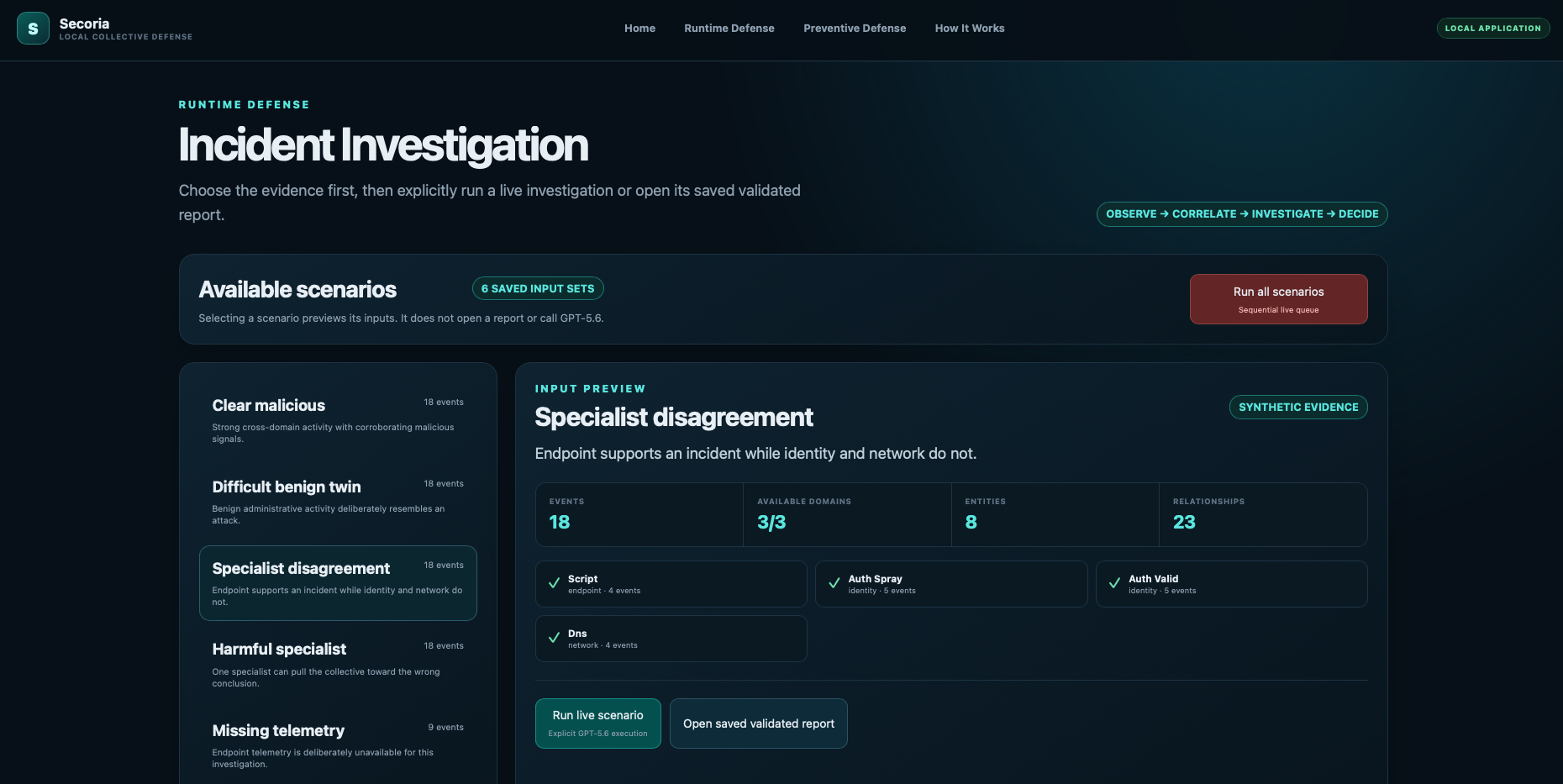
RUNTIME DEFENSE - Incident Investigation
-
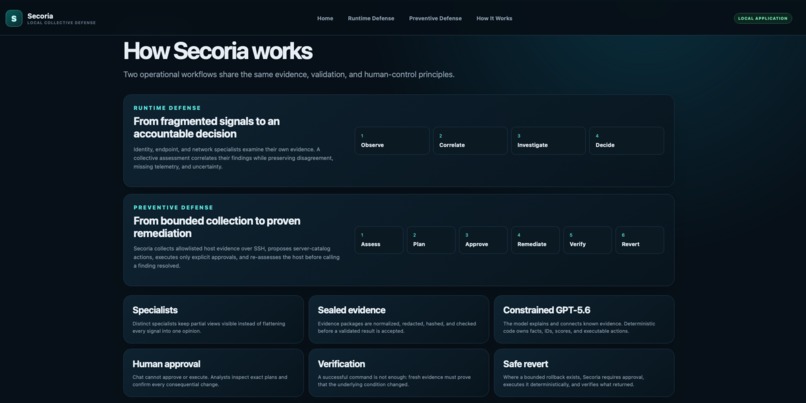
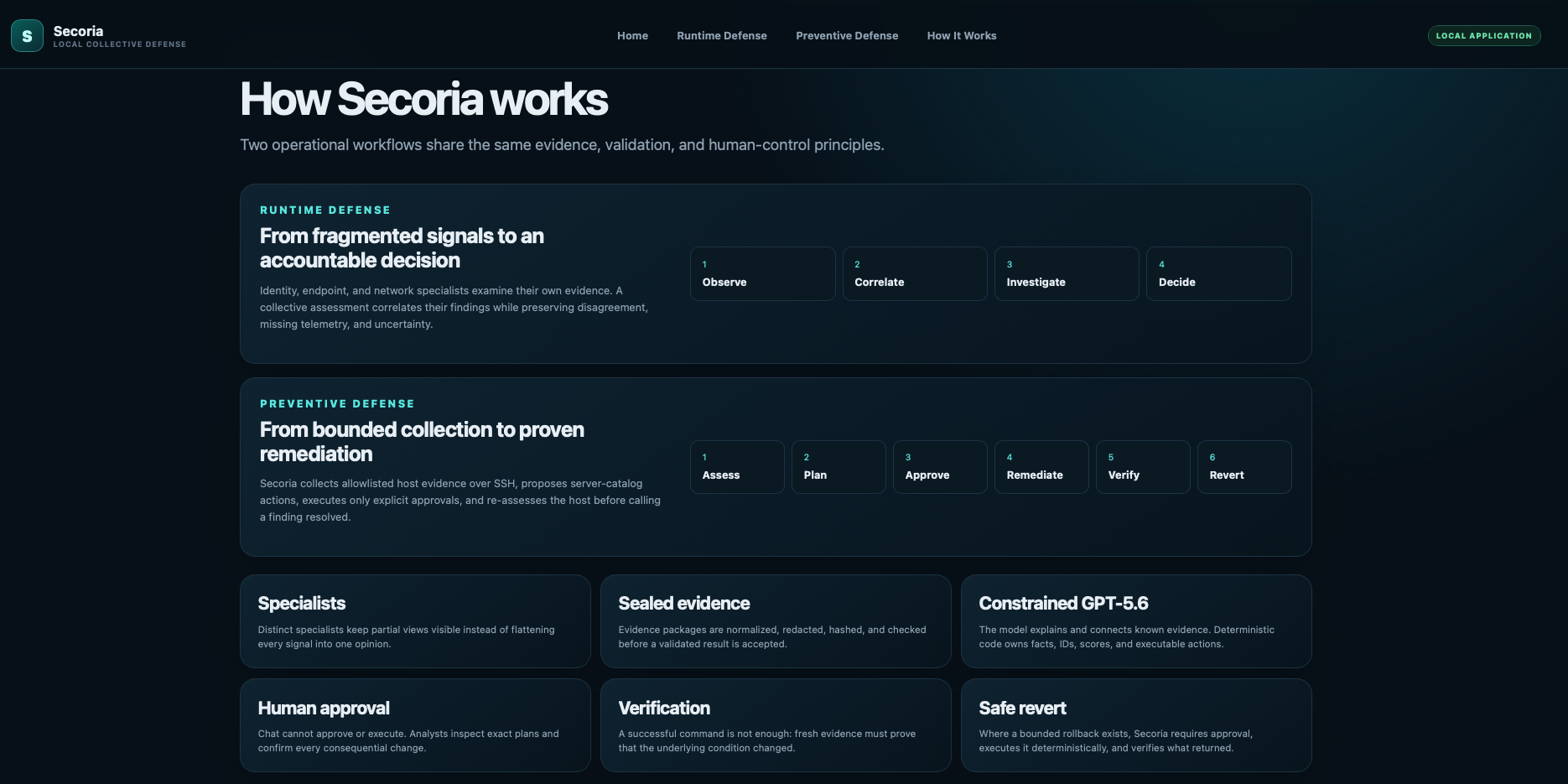
How Secoria works
Inspiration
Security teams often have more alerts than they can investigate. Small teams especially struggle to connect evidence, understand what really happened, fix the underlying weakness, and verify that the risk is actually gone.
Secoria was inspired by a simple idea: instead of relying on one general-purpose model, use a collective of specialized cyber-defense agents that analyze different domains, preserve disagreement, and support a human analyst with evidence-bound conclusions.
What it does
Secoria is a local web-based cyber-defense application with two workflows.
Runtime Defense
Runtime Defense investigates suspicious activity across identity, endpoint, and network evidence.
Specialized agents analyze their own domains, then Secoria correlates their findings without hiding uncertainty or disagreement. The evidence is sealed before GPT-5.6 is used, and the model can only explain and investigate the validated case.
Analysts can ask grounded follow-up questions with citations and limitations, while the final decision remains human-controlled.
Preventive Defense
Preventive Defense assesses isolated Linux hosts over SSH and checks:
- packages and known vulnerabilities
- SSH configuration
- users and privileges
- services and exposed ports
- firewall state
- authentication logs
- permissions and scheduled tasks
Secoria creates a staged remediation plan. Users can approve, reject, or defer individual actions, or review an Approve All plan.
After execution, Secoria collects fresh evidence and reassesses the host. It reports what was resolved, what remains, and whether reverting a change reintroduced a vulnerability.
How we built it
Secoria combines:
- a Python security engine
- a Next.js and TypeScript interface
- Docker-based Linux testbeds
- controlled SSH execution
- deterministic security specialists
- sealed evidence packages
- constrained GPT-5.6 investigation
- approval-gated remediation
- rollback, revert, and post-remediation verification
The remediation engine uses validated action types and command templates. GPT-5.6 cannot generate and execute arbitrary shell commands.
Challenges
The main challenges were:
- preserving specialist disagreement instead of producing false confidence
- preventing the language model from inventing evidence
- proving remediation through reassessment rather than command success
- safely hardening SSH without locking out the administrator
- handling dependency compatibility and rollback
- keeping chat read-only and bound to the exact sealed case
What we learned
We learned that trustworthy AI-assisted security requires clear boundaries:
- evidence must remain authoritative
- uncertainty must remain visible
- human approval must be enforced
- remediation must be verified
- rollback must also be tested
- AI should explain and investigate, not silently take control
What is next
The current version is a local research and demonstration platform using isolated Linux testbeds.
Next steps include production Linux host support, a constrained local agent, broader vulnerability intelligence, cloud and Kubernetes integrations, and privacy-preserving learning across organizations.
Our long-term goal is to help small security teams operate with the investigative and defensive depth of a much larger security organization.
Built With
- codex
- docker
- gpt-5.6
- ml
- next.js
- node.js
- openai-agents-sdk
- pytest
- python
- react
- typescript


Log in or sign up for Devpost to join the conversation.