Inspiration
Scams are no longer just suspicious emails or poorly designed websites. They have evolved into sophisticated acts of psychological manipulation, exploiting trust, urgency, fear, and sometimes even kindness.
What made this problem personal was seeing a relative become the target of a social engineering scam. It was a reminder that falling for a scam isn't necessarily about lacking technological knowledge. Even cautious, educated people can be vulnerable when someone knows exactly how to manipulate their emotions and decisions.
And that raised a question:
Why do most fraud protection systems focus on detecting suspicious transactions when the manipulation often begins long before the payment?
A scammer doesn't need to hack your account if they can convince you to willingly send money.
We built SecondSense around this insight: the most important moment to prevent a scam is often the moment just before someone decides to pay.
Our goal was to give people a second perspective when pressure, fear, or excitement might be clouding their judgment.
What it does
SecondSense is an AI-powered pre-payment safety layer designed to help people recognize social engineering and make informed payment decisions.
Rather than simply checking whether a transaction looks unusual, SecondSense examines the context surrounding a payment.
Users can submit suspicious messages, shopping links, or payment requests for analysis. SecondSense looks for potential manipulation tactics, including:
- Artificial urgency: Pressure to act immediately or risk losing an opportunity.
- Authority impersonation: Someone claiming to represent a bank, government agency, or trusted organization.
- Fear-based manipulation: Threats involving account suspension, legal consequences, or financial loss.
- Suspicious payment instructions: Requests to transfer money through unusual or potentially risky channels.
- Emotional exploitation: Appeals designed to override careful decision-making.
Instead of presenting a mysterious fraud score, SecondSense aims to explain why something deserves attention, highlight relevant evidence, and acknowledge uncertainty.
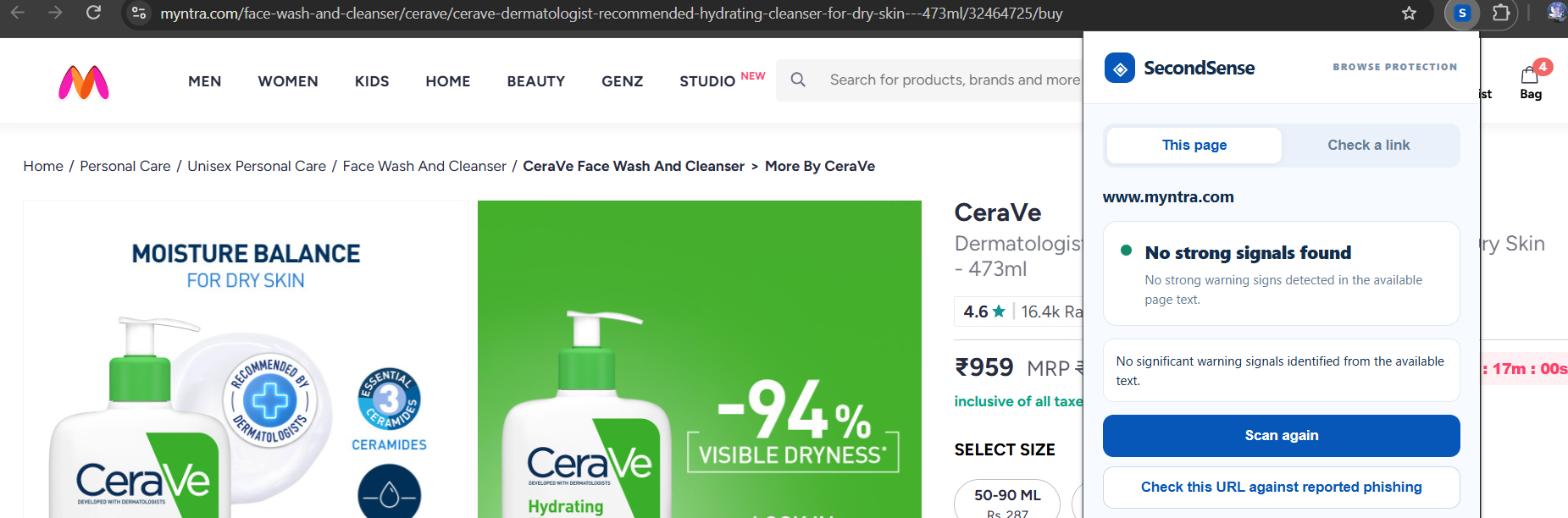
The platform also explores merchant reputation signals and provides a browser extension for checking suspicious online shopping experiences.
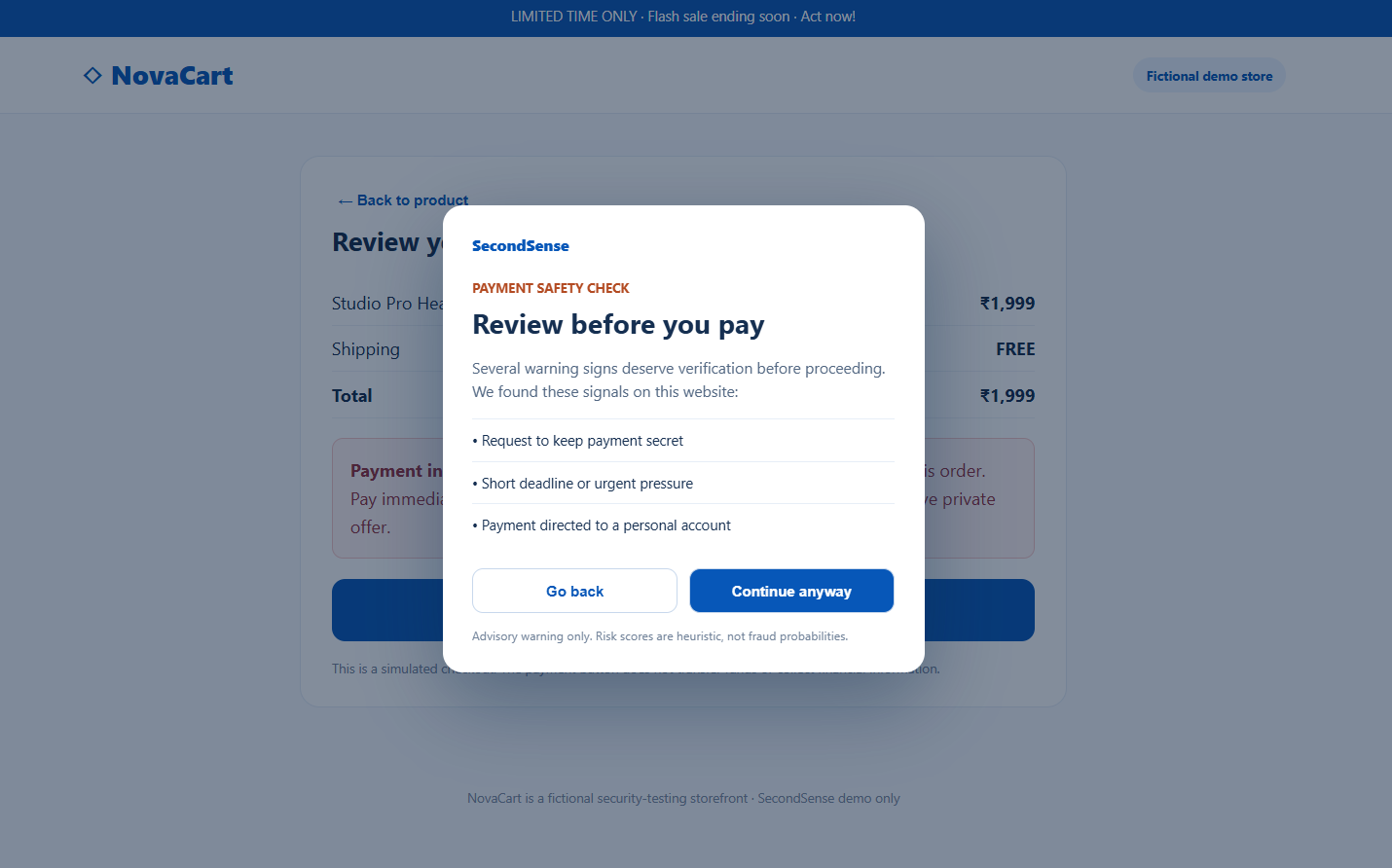
For payment demonstrations, SecondSense integrates PayPal Sandbox into a risk-aware checkout workflow, allowing users to review potential warning signs before deciding whether to proceed.
SecondSense doesn't make the decision for you. It helps you make a better-informed one.
How we built it
We developed SecondSense as a full-stack application combining payment infrastructure, contextual risk analysis, and a user-facing protection experience.
Frontend: Next.js, React, and TypeScript power the interactive interface, including risk assessments, explanations, payment workflows, and investigation views.
Backend: Python and FastAPI handle analysis requests, session management, risk assessment, and payment-related operations.
Risk analysis: A heuristic-based detection engine evaluates potential social engineering indicators and produces explainable risk assessments. The system distinguishes detected signals from limitations and uncertainty rather than treating every suspicious phrase as proof of fraud.
PayPal integration: We integrated PayPal Sandbox to demonstrate how a pre-payment safety check can fit into a merchant checkout flow. The integration uses a sandbox environment rather than real-money transactions.
Browser extension: A browser-based interface allows users to examine suspicious shopping pages and links without relying entirely on a separate web application.
Merchant reputation research: We integrated the YouTube Data API to retrieve potentially relevant public videos and search results. These are presented as contextual research rather than verified customer complaints or conclusive evidence of fraud.
Investigation interface: We began integrating AG Grid to support structured exploration of risk assessments and investigation records, including filtering and evidence inspection.
Our architecture separates the analysis layer from the payment layer, making it possible to develop stronger detection capabilities without unnecessarily interfering with payment processing.
Challenges we ran into
1. Distinguishing legitimate persuasion from manipulation
One of our biggest challenges was avoiding false positives.
Legitimate businesses frequently use phrases such as "limited-time offer" or "buy now." Those phrases alone don't establish fraudulent intent.
We discovered that simple keyword-based detection could incorrectly flag legitimate shopping experiences while missing more subtle scams.
This pushed us toward a more contextual, evidence-driven approach that considers combinations of signals rather than isolated words.
2. Building explainable risk assessments
A risk score is easy to display, but difficult to justify.
We wanted users to understand what triggered a warning, what evidence supported it, and what remained unknown.
The challenge was making the explanation useful without creating a false sense of certainty.
3. Integrating safety checks without disrupting checkout
Payment experiences are designed to be fast and frictionless. Scam prevention sometimes requires slowing down.
Finding the right balance between convenience and protection was a central design challenge.
We explored risk-aware friction, where stronger warning signals can trigger additional opportunities for reflection before a payment proceeds.
4. Evaluating online merchant reputation
Public search results can provide context, but they can also be misleading.
A video mentioning a merchant isn't necessarily a genuine customer experience, and an unfamiliar seller isn't automatically fraudulent.
We had to be careful about the distinction between retrieved information and verified evidence.
5. Connecting multiple components
Building a consistent experience across the Next.js frontend, FastAPI backend, browser extension, risk engine, and PayPal Sandbox required careful integration and debugging.
Accomplishments that we're proud of
Turning a personal concern into a working technical prototype.
What began as a question about social engineering became a functioning system for evaluating payment-related manipulation signals.
We're particularly proud of:
- Building an explainable risk assessment workflow rather than relying exclusively on opaque warnings.
- Integrating PayPal Sandbox into a pre-payment protection experience.
- Developing a browser extension that brings safety checks closer to where users encounter suspicious offers.
- Incorporating external merchant research while explicitly communicating the limitations of unverified sources.
- Designing a system that preserves user choice instead of automatically declaring every flagged payment fraudulent.
- Creating a foundation that can evolve from heuristic detection toward more sophisticated, evidence-grounded AI analysis.
Most importantly, we focused on a form of fraud that is often overlooked: transactions where the user technically authorizes the payment, but does so under manipulation.
What we learned
Building SecondSense changed how we think about financial security.
We learned that a transaction can be technically authorized and still be the result of deception.
Traditional payment security and human-centered scam prevention solve different, complementary problems.
We also learned that:
- Fraud detection must consider context, not just keywords.
- Explainability is essential when asking users to trust a warning.
- False positives can damage confidence just as false negatives can expose users to harm.
- AI-generated conclusions must be separated from independently verified evidence.
- Good security doesn't always mean blocking an action; sometimes it means helping someone recognize a risk before making their own decision.
Perhaps our biggest takeaway was that financial safety is not only about protecting accounts. It's also about protecting human judgment.
What's next for SecondSense
Our next priority is to make the core pre-payment analysis more accurate, reliable, and accessible.
We plan to:
- Strengthen contextual AI analysis to better recognize sophisticated social engineering while reducing false positives.
- Expand evidence-grounded investigations by incorporating stronger source verification and searchable scam-pattern intelligence.
- Complete the investigation experience using AG Grid to make supporting evidence and risk signals easier to inspect.
- Refine PayPal-integrated checkout protection so that risk-aware warnings are clear, proportionate, and actionable.
- Evaluate the system against realistic scam and legitimate-payment scenarios to measure detection quality, explainability, and user experience.
Longer term, we envision SecondSense becoming a trusted safety companion across online shopping and digital payments.
Because the future of payment security shouldn't only be about detecting fraud after money moves.
It should also be about helping people recognize manipulation before they press Pay.
Add a clear demo walkthroughMake the opening more emotionally immediate
Built With
- ag-grid
- api
- channel3
- chrome
- css
- fastapi
- html
- javascript
- next.js
- paypal
- paypal-sandbox
- python
- react
- rest
- typescript
- youtube-data-api
