-
-
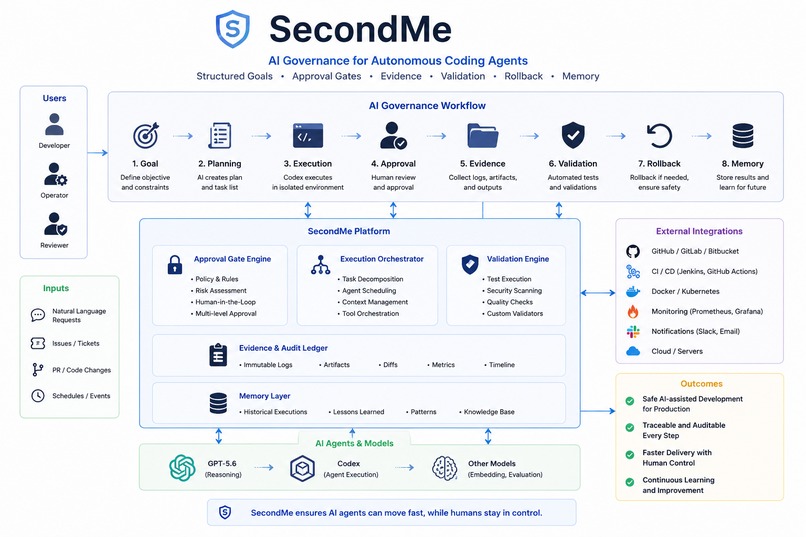
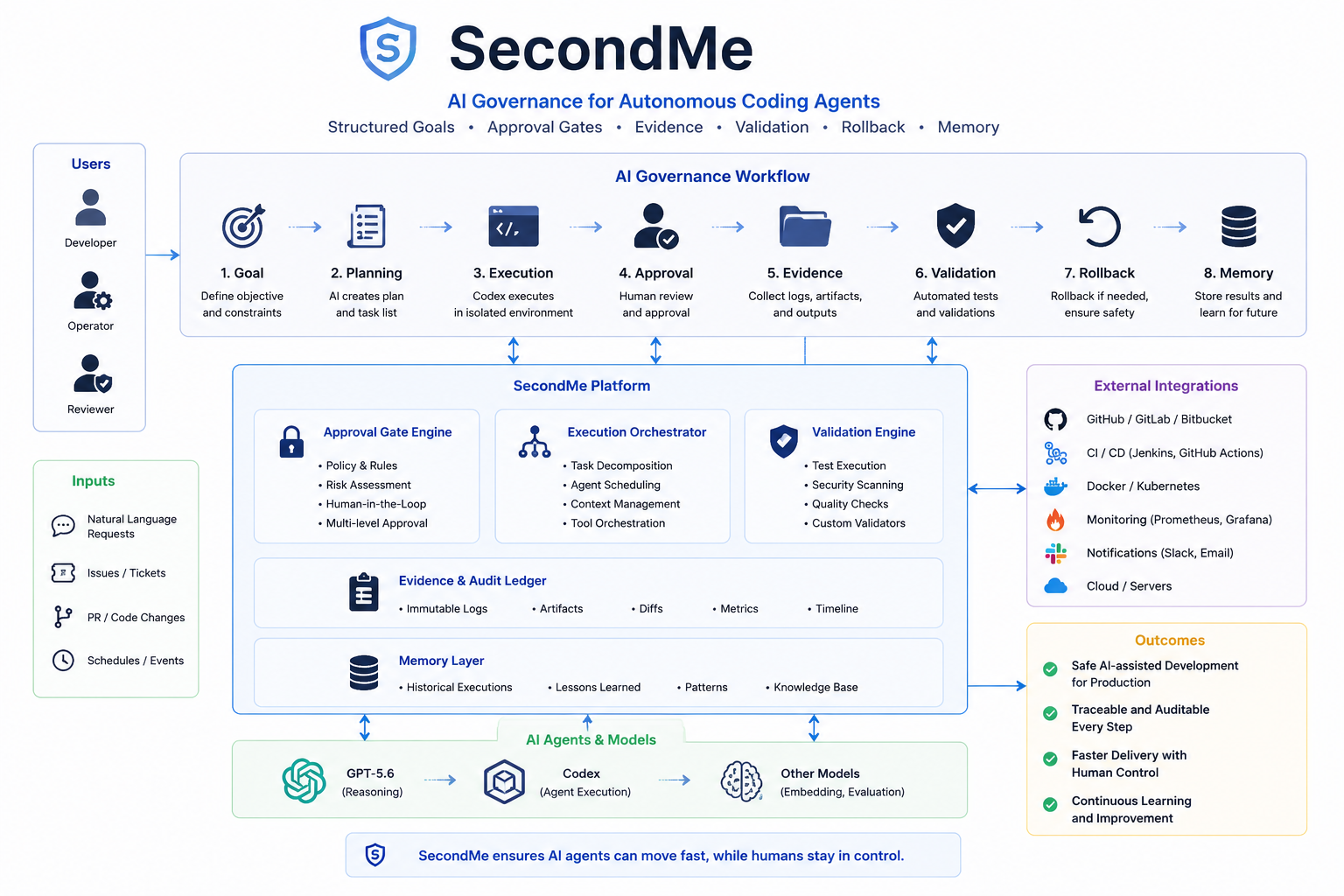
SecondMe architecture: an AI governance layer coordinating GPT-5.6, Codex, human approval,validation,evidence,and long-term execution memory
Inspiration
AI coding agents can now generate large amounts of code, but software that reaches real users still requires trust, review, and accountability.
We started asking a simple question:
How can AI move faster without sacrificing production safety?
Instead of building another coding assistant, we focused on the layer between AI and production systems. That became SecondMe—a governance platform that coordinates autonomous AI agents while keeping humans responsible for important decisions.
What it does
SecondMe provides an AI governance workflow for autonomous coding agents.
Instead of allowing an AI agent to directly modify production systems, every task follows a structured lifecycle:
Goal
↓
Planning
↓
Execution
↓
Approval
↓
Evidence
↓
Validation
↓
Rollback (if necessary)
↓
Memory
This allows AI agents to remain productive while making every important action observable, reviewable, and traceable.
Current capabilities include:
- Structured execution goals
- Human approval gates
- Evidence collection
- Validation workflow
- Rollback-oriented execution
- Long-term execution records
How we built it
SecondMe combines GPT-5.6 for reasoning and planning with Codex-assisted implementation.
The system is built using:
- Python
- FastAPI
- PostgreSQL
- Linux
- Systemd
- Nginx
During Build Week we focused on refining the governance workflow itself instead of adding more autonomous behaviors.
We continuously used Codex to accelerate implementation, review changes, and improve the execution pipeline.
Challenges we ran into
The biggest challenge was finding the balance between autonomy and safety.
Giving AI unrestricted access makes development faster, but production systems require human responsibility.
Instead of limiting AI capability, we designed a governance workflow where AI can execute tasks efficiently while humans remain in control of critical decisions.
Another challenge was organizing long-running engineering work into repeatable workflows that can evolve over time instead of becoming isolated one-off tasks.
Accomplishments that we're proud of
We're proud that SecondMe demonstrates a practical governance workflow rather than another standalone AI assistant.
The project shows that autonomous coding agents and human oversight can work together instead of replacing one another.
We also established a reusable execution lifecycle that can scale across future AI agents and different language models.
What we learned
Building better AI systems is not only about generating better code.
Trust, governance, validation, evidence, and long-term maintainability become increasingly important as AI agents gain more autonomy.
We learned that the future of AI development is not simply autonomous execution—it is governed collaboration.
What's next for SecondMe
Our long-term vision is to evolve SecondMe into a governance platform for multiple AI agents rather than a single coding assistant.
Future work includes:
- Multi-agent collaboration
- Cross-model governance
- Runtime policy management
- Human-in-the-loop decision support
- Long-term execution memory
- Robot and embodied AI integration
- Enterprise deployment

Log in or sign up for Devpost to join the conversation.