-
-
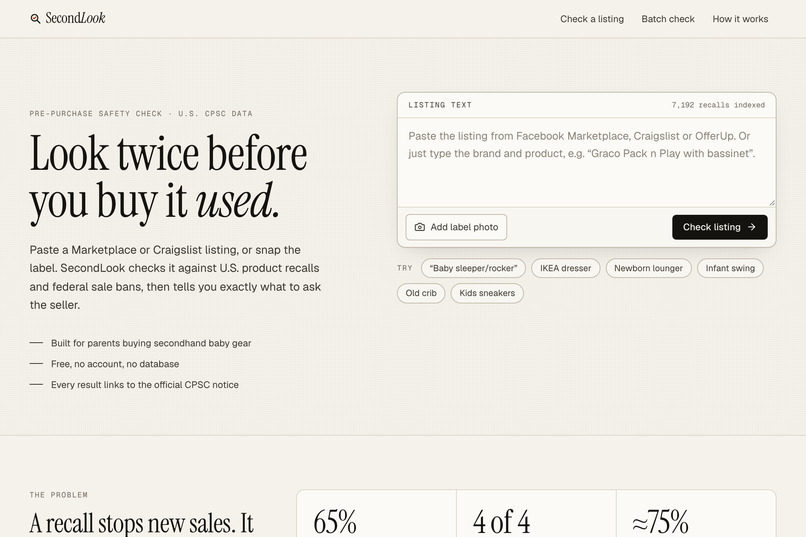
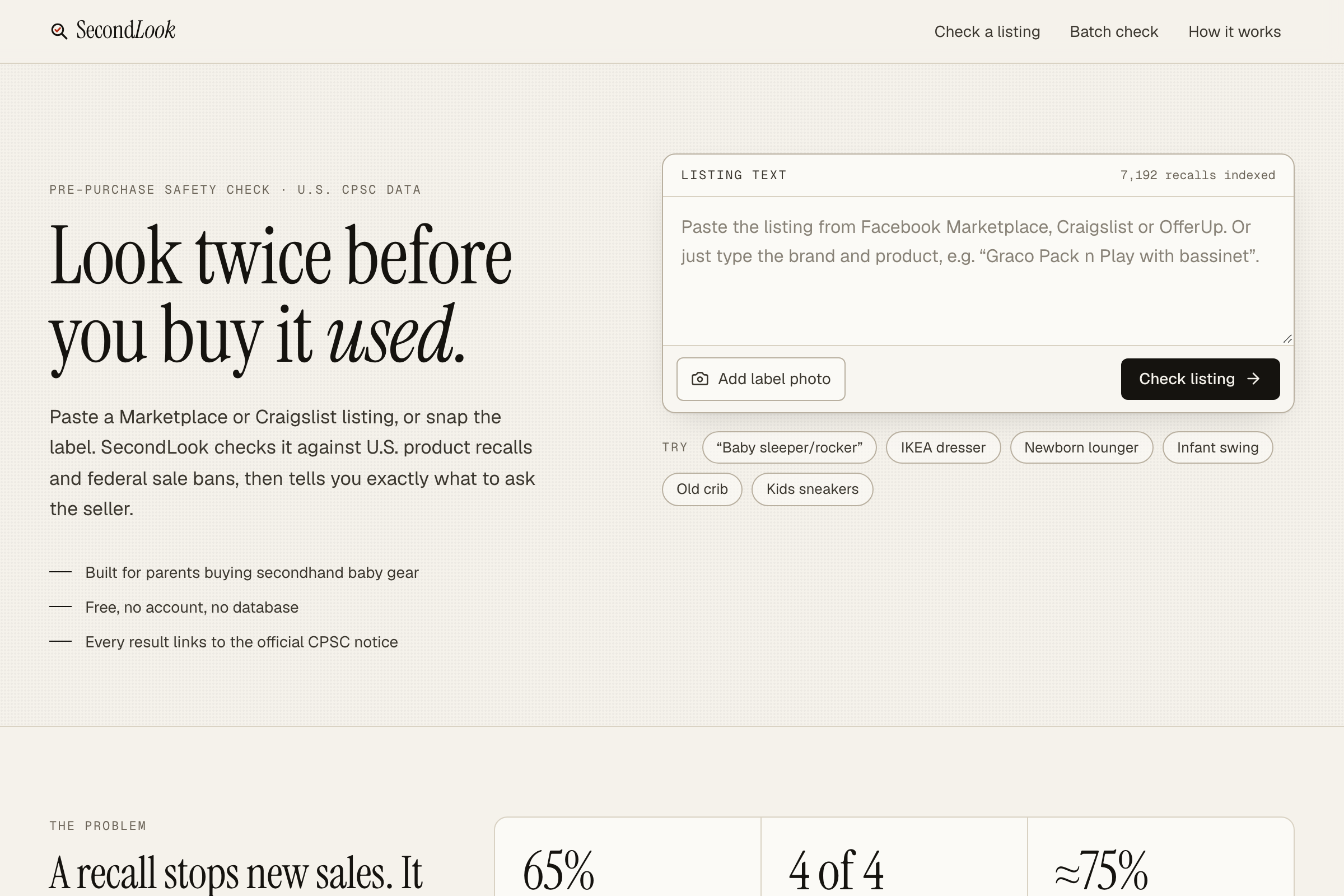
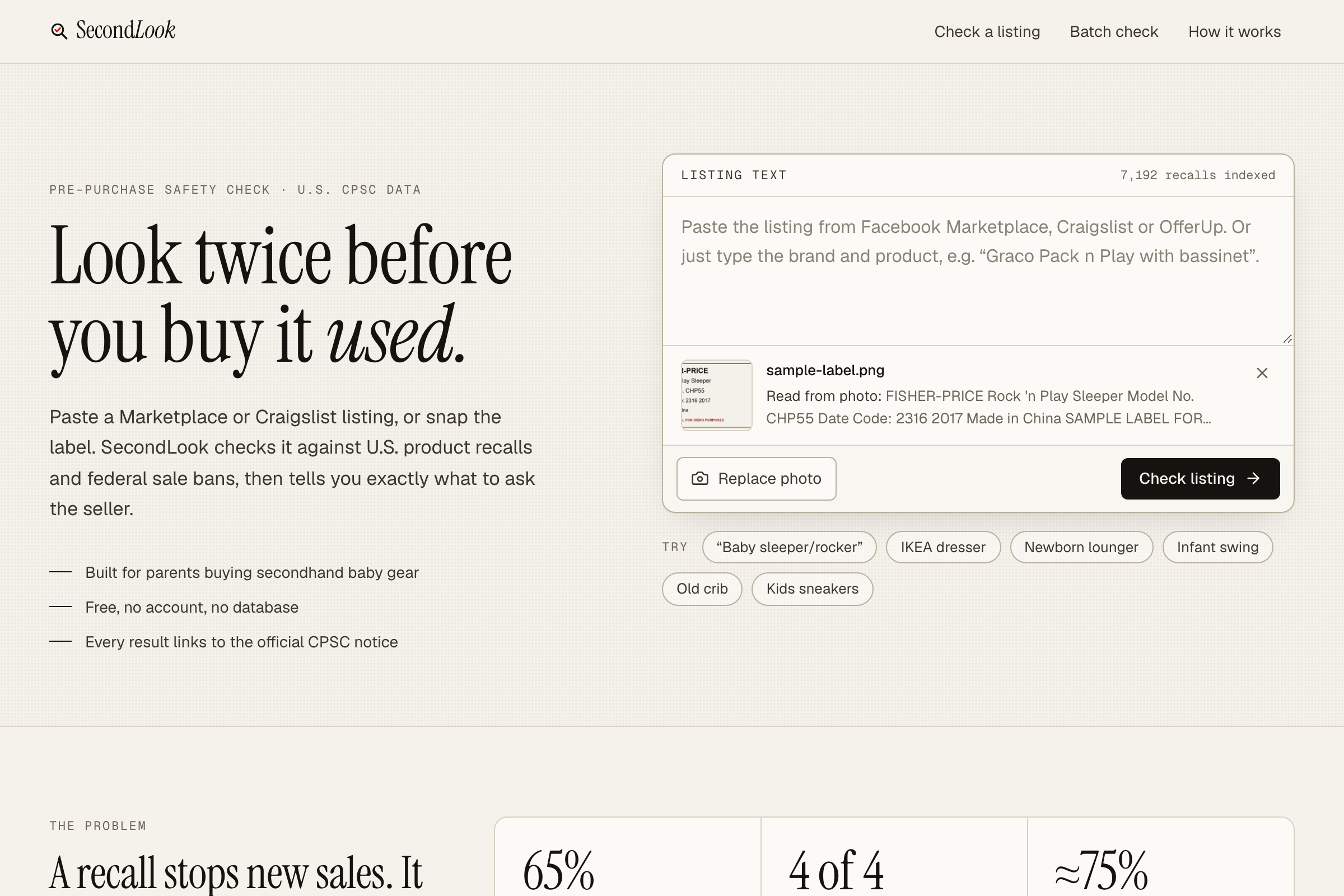
Paste a secondhand listing or upload a label photo. Check product safety before you buy.
-
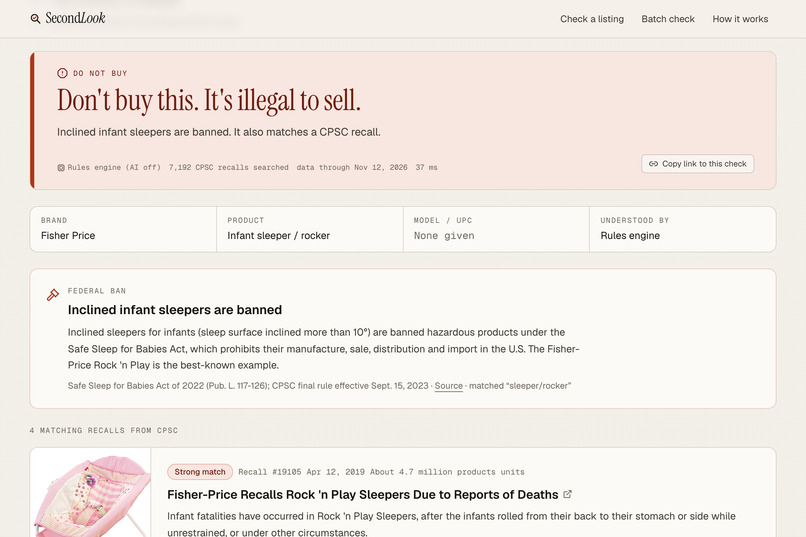
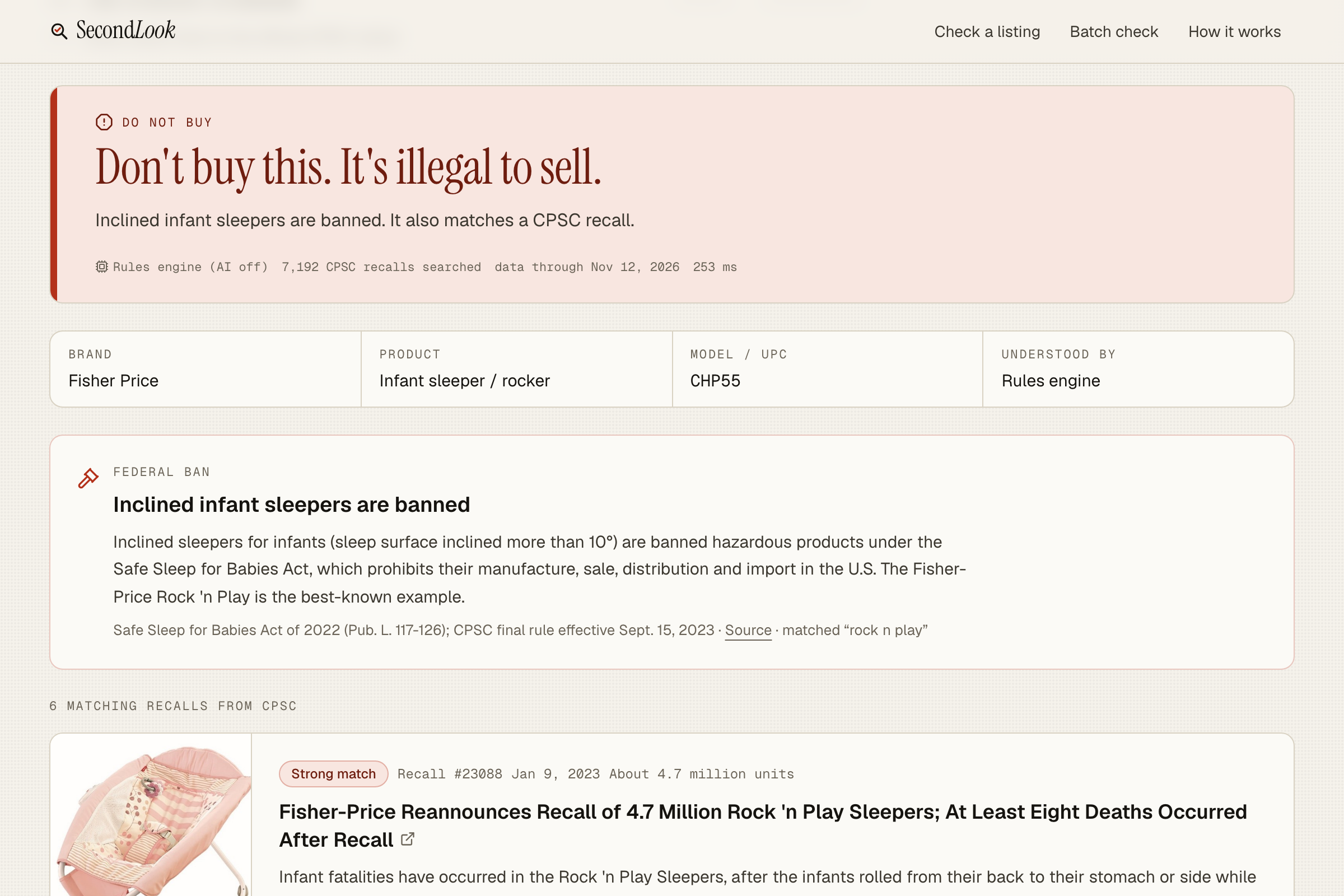
Finds the hidden risk: flags an inclined sleeper ban and matching CPSC recall, even when the listing never says “Rock ’n Play.”
-
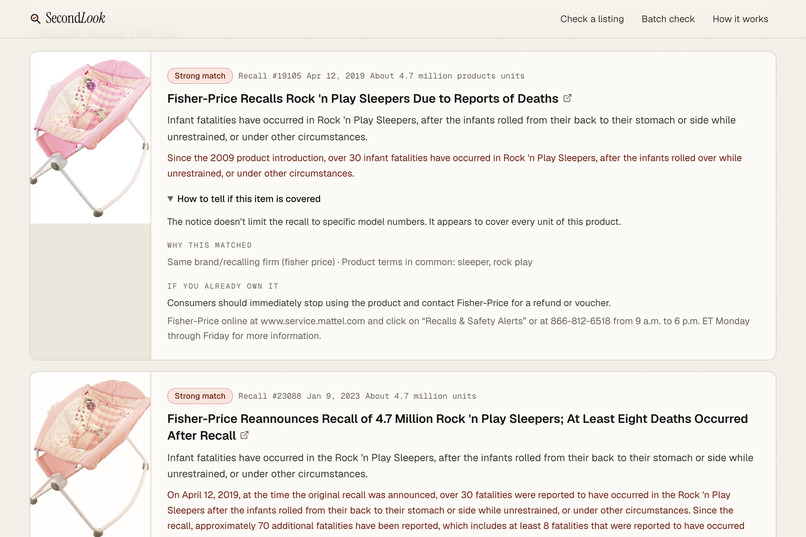
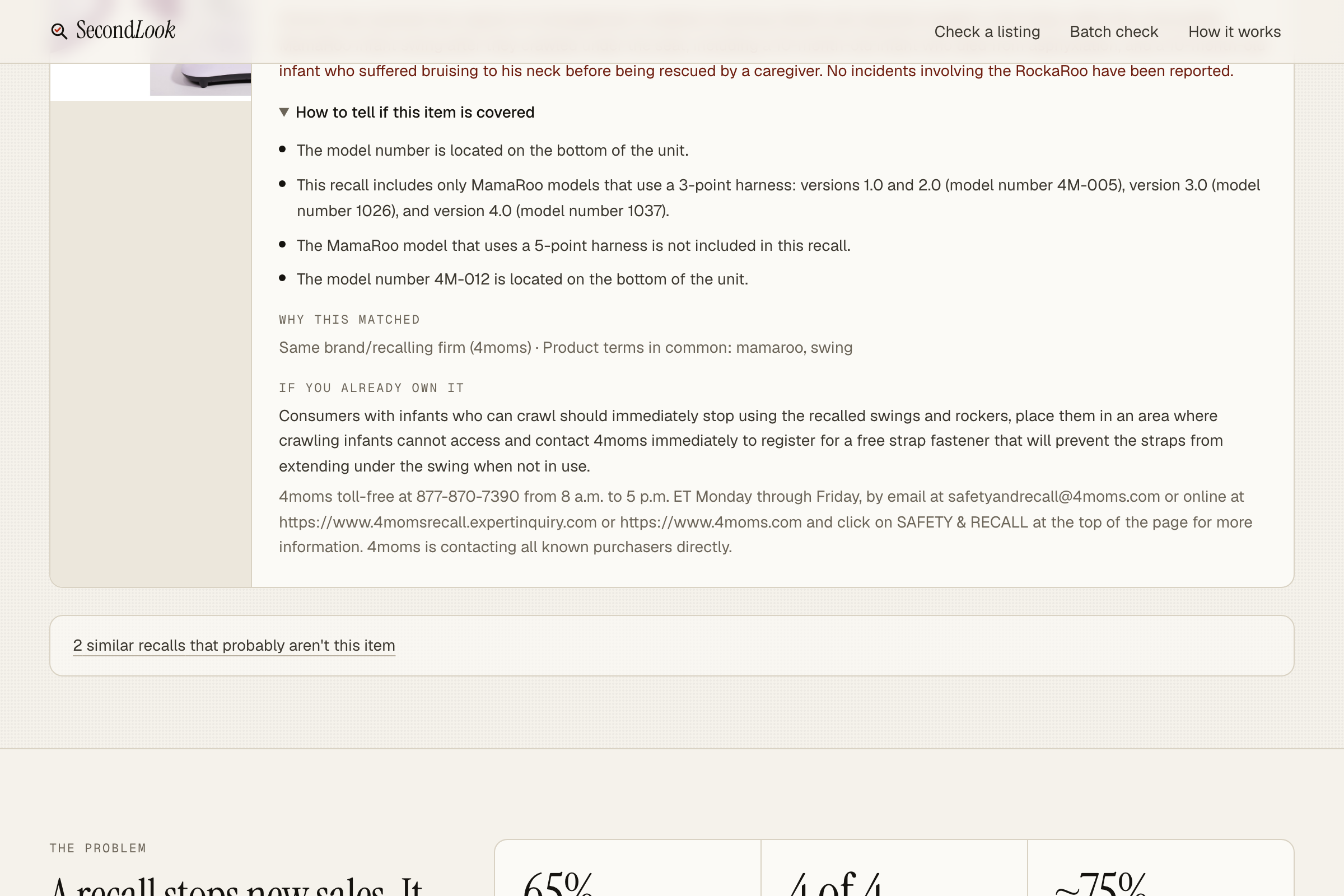
Official recall evidence at a glance: product image, hazards, injuries, affected units, remedy and CPSC notice.
-
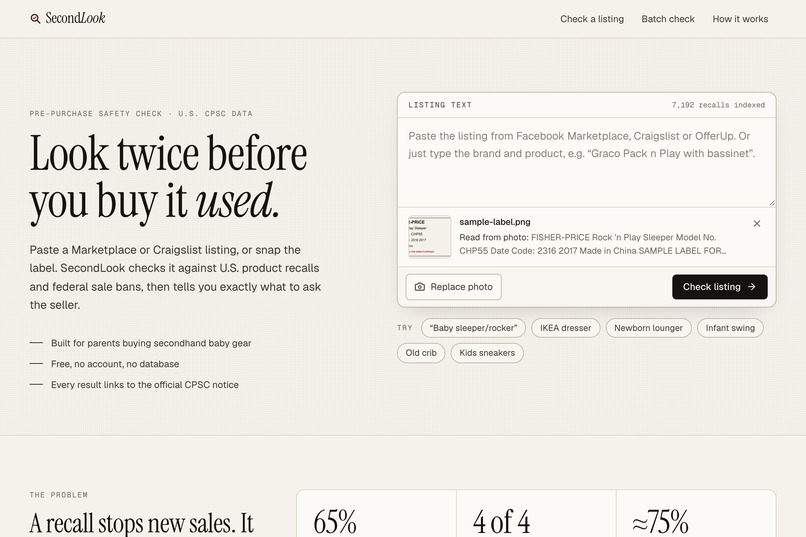
Upload a product-label photo. Tesseract.js reads identifying details in your browser; the image stays on your device.
-
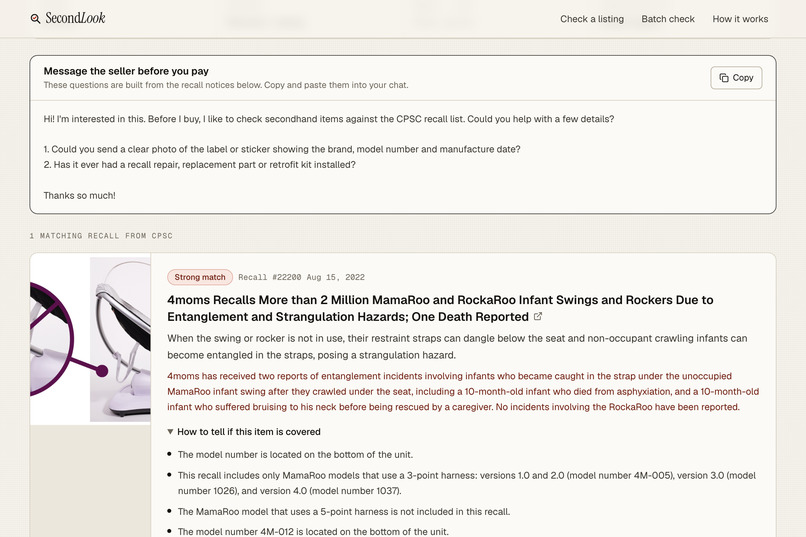
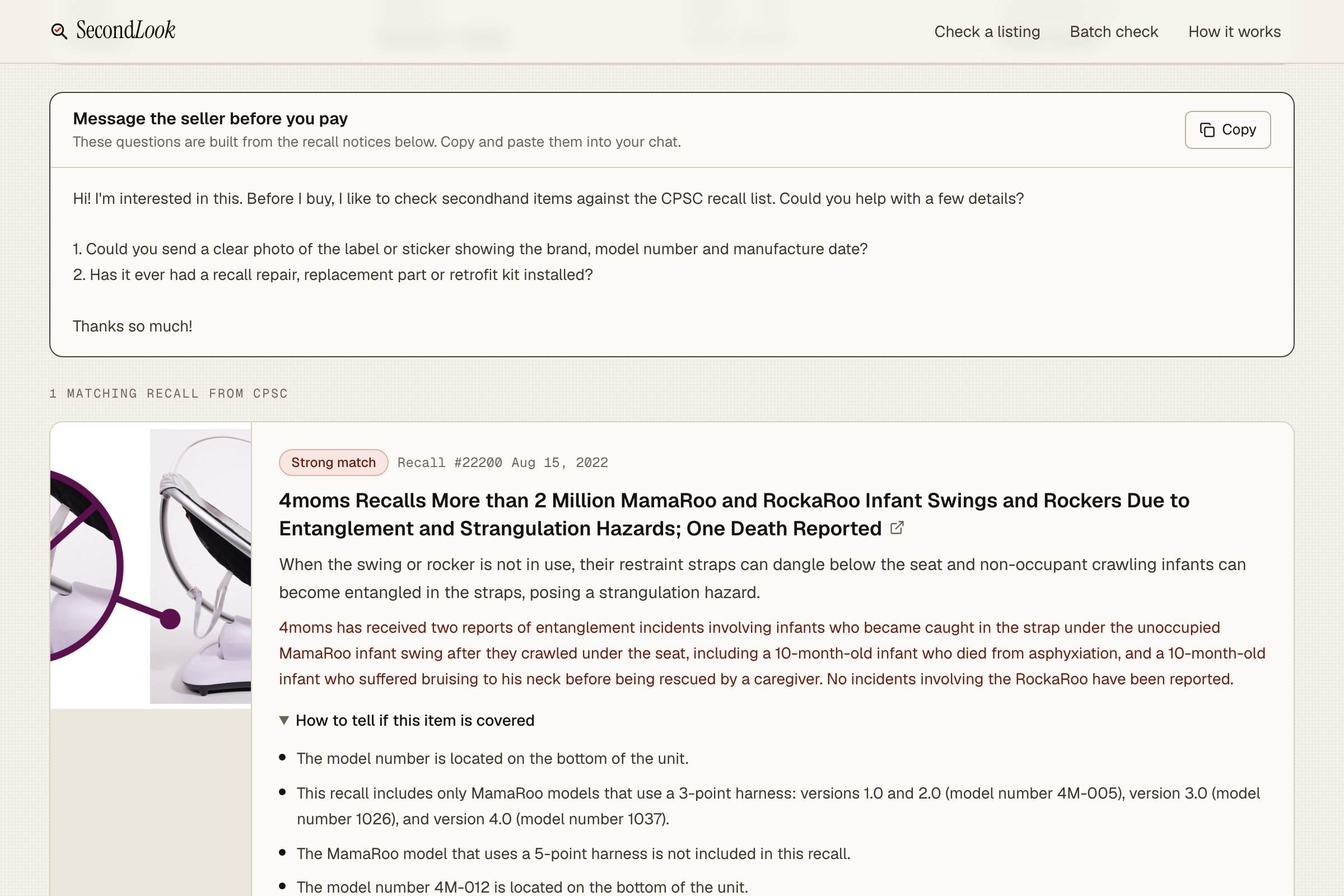
Turn recall findings into action with seller questions tailored to the notice and the product's model details.
-
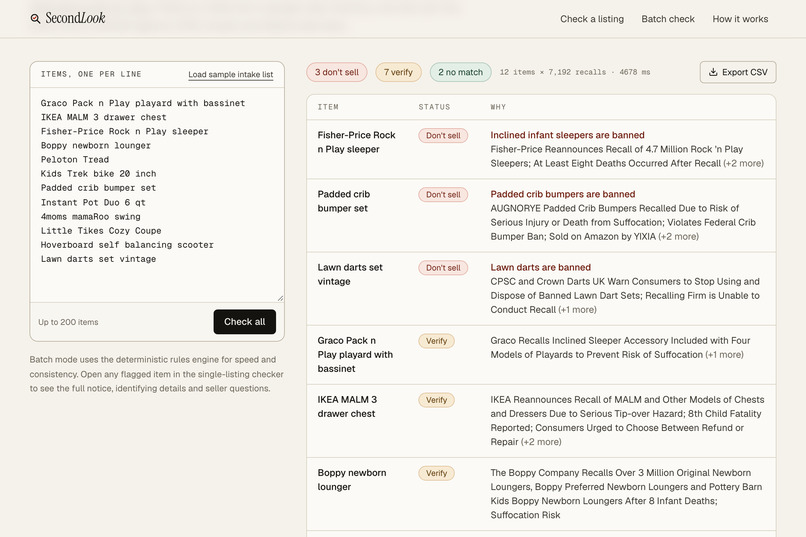
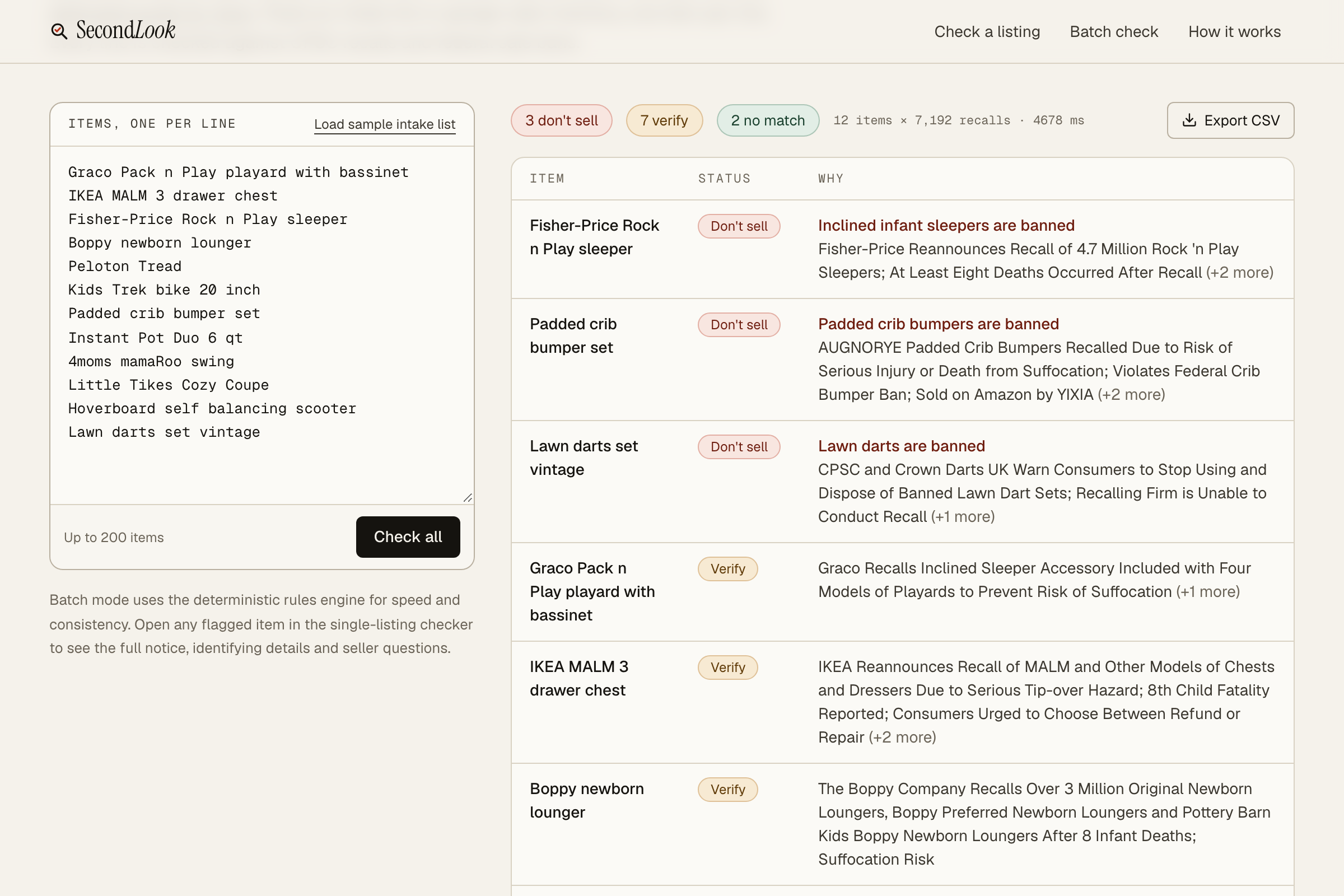
Screen 12 products at once, sort results by risk and export a CSV for thrift stores, donation drives and resellers.
-
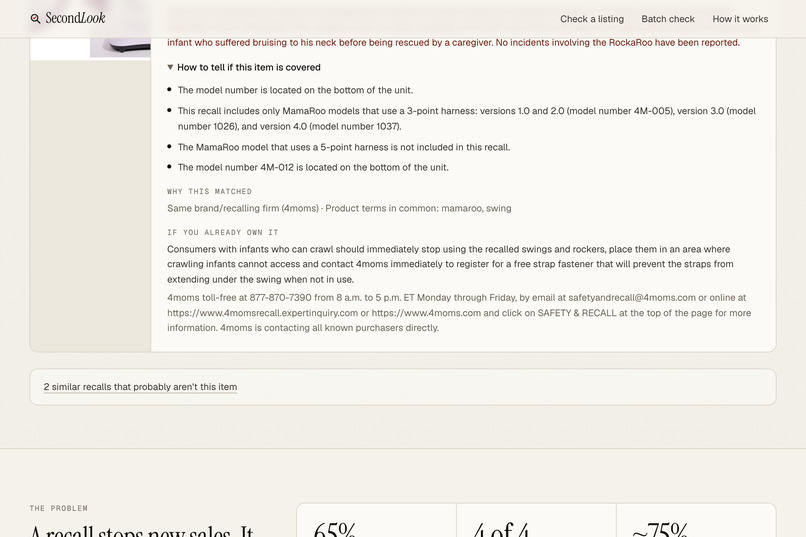
Precision matters: distinguishes affected from unaffected variants and identifies which 4moms mamaRoo models are recalled.
-
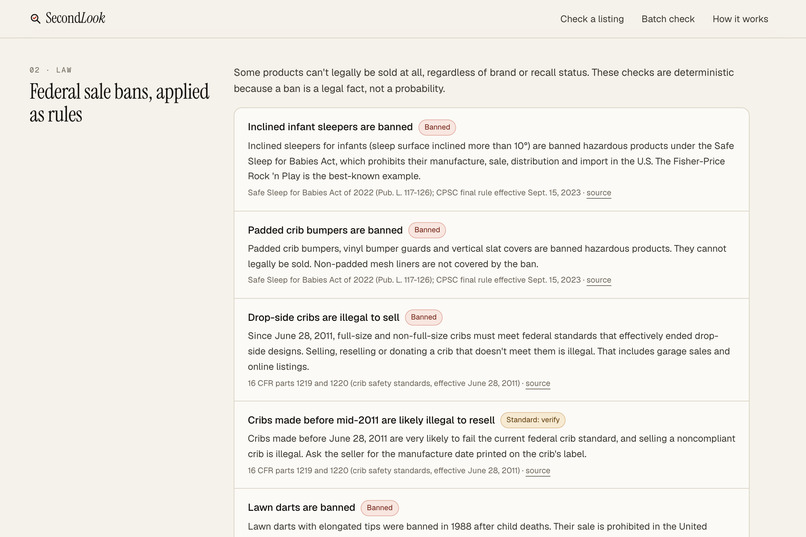
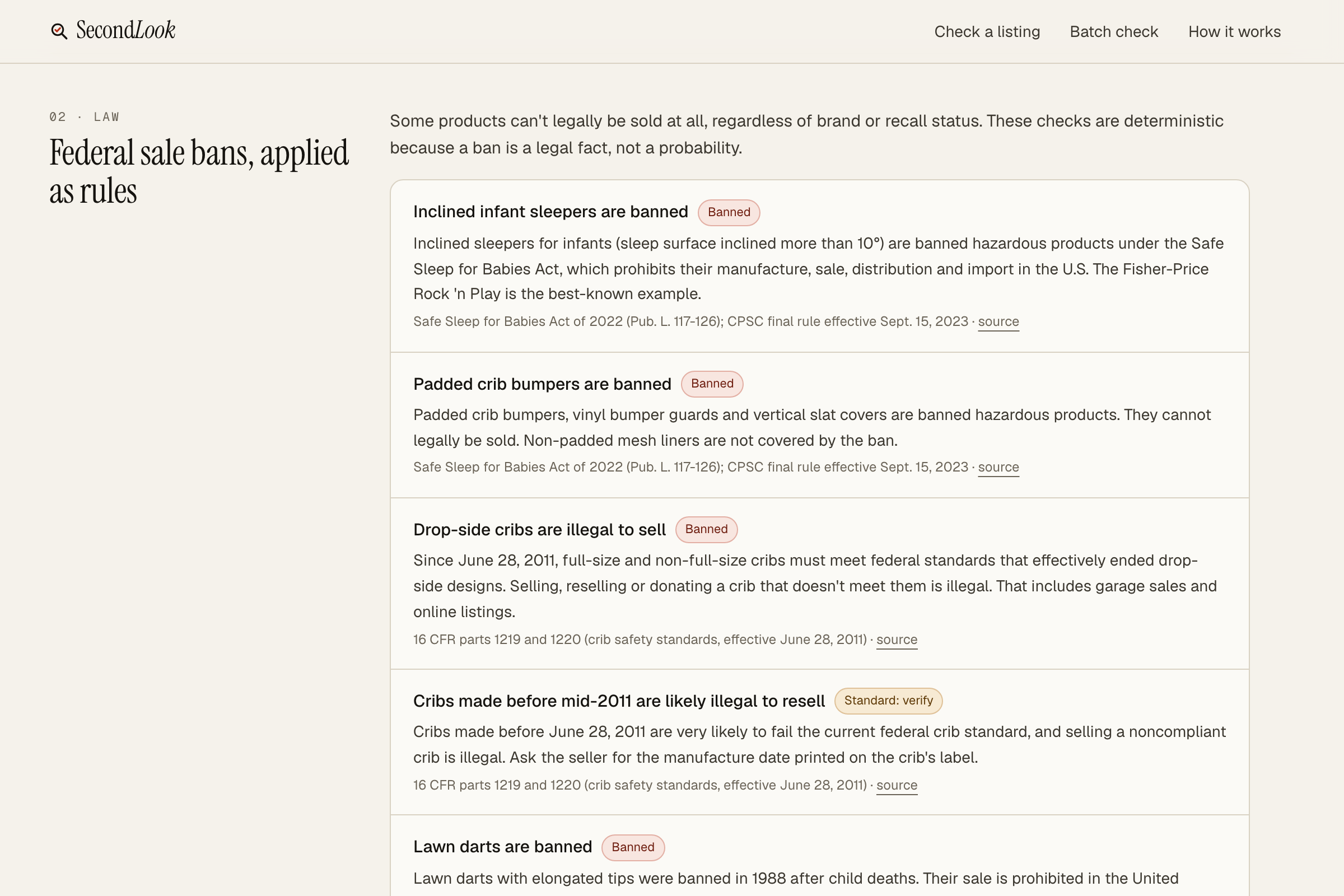
Beyond recalls: transparent, deterministic federal sale-ban checks, each backed by legal references.
-
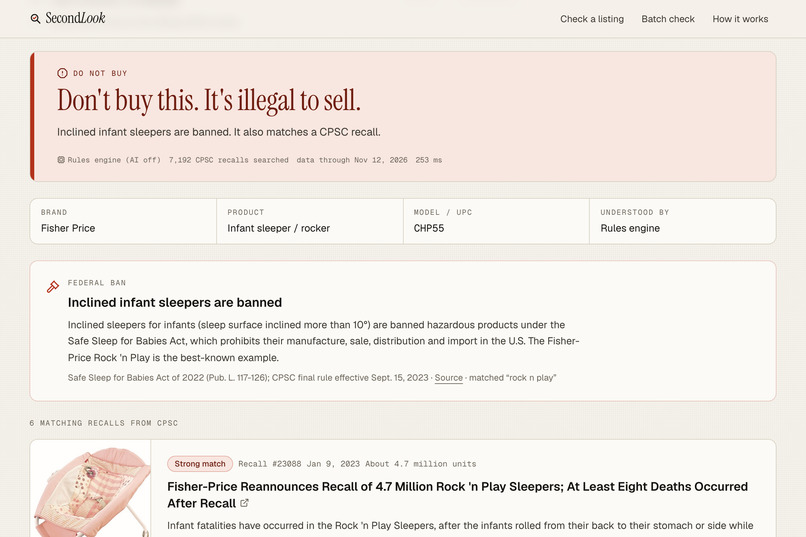
From label to actionable result. OCR-extracted brand and model information is carried directly into the product-checking workflow.
Inspiration
A recall stops new sales, but it doesn't automatically reach the products already in people's homes. CPSC staff reported a 65% overall correction rate across 865 closed Section 15 cases from FY 2014–2016, a figure that counts corrections by manufacturers, distributors, retailers and consumers together. Recalled products that stay in circulation can resurface on Facebook Marketplace, Craigslist or a garage-sale table.
In 2026, Consumer Reports looked for four kinds of banned infant products on resale sites (inclined sleepers, drop-side cribs, padded crib bumpers and in-bed sleepers) and found listings on Facebook Marketplace, eBay, Mercari and Craigslist. It also showed why a buyer can't easily catch this: the recalled Fisher-Price Rock 'n Play was listed as "baby sleeper/rocker", "floor cradle" and "bassinet". Official recall search works best when you already know the product's exact name or model number. A secondhand listing usually gives you neither.
The moment that matters is the few minutes between seeing a listing and handing over cash. That's the moment SecondLook is built for.
What it does
SecondLook screens a secondhand listing before you buy.
- Paste the listing exactly as the seller wrote it, or add a photo of the product label. The label is read with OCR right in your browser.
- Federal sale-ban check. Some product categories are restricted by federal law regardless of brand, and each rule shows its citation:
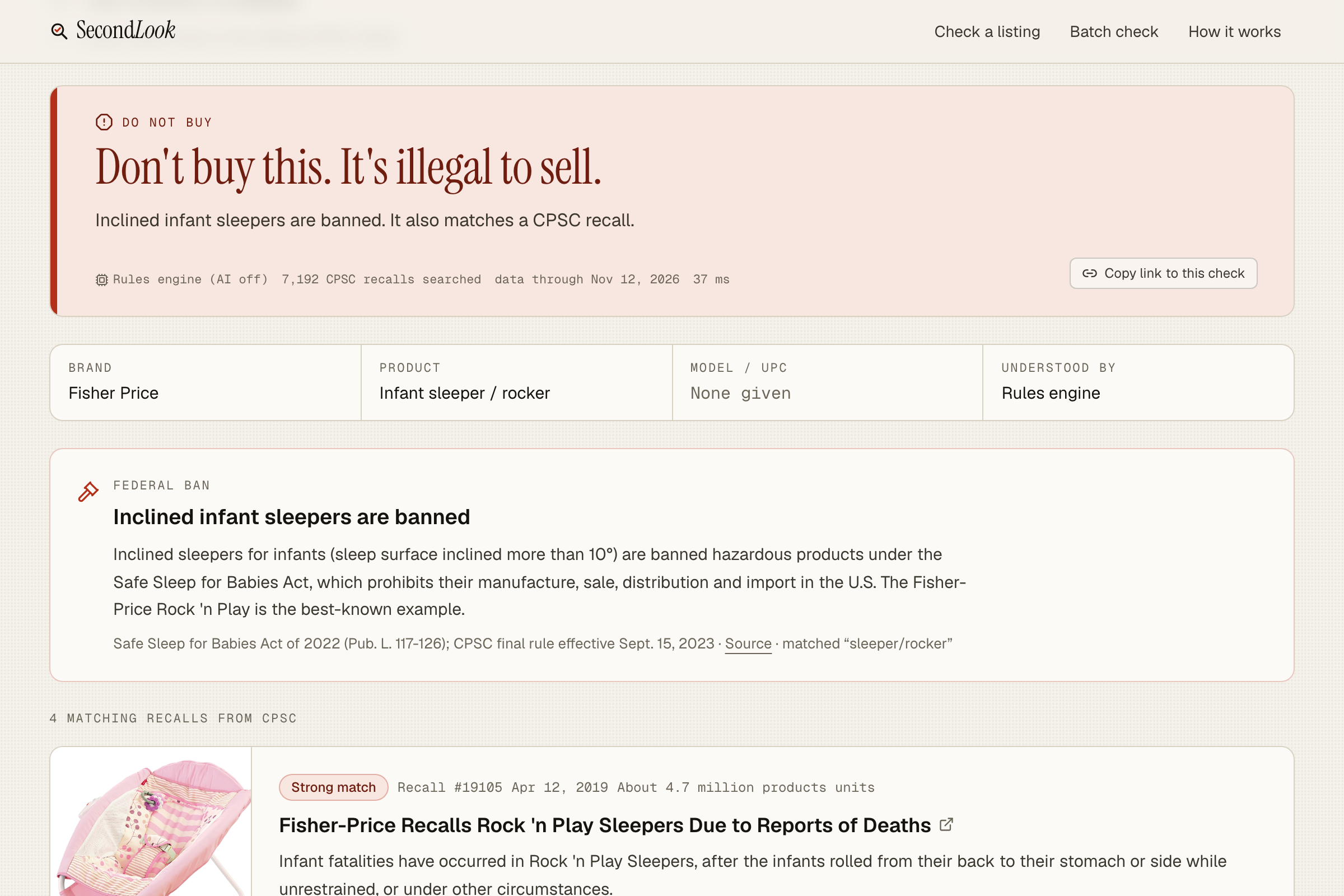
- Inclined sleepers for infants (sleep surface inclined more than 10°) and crib bumpers (padded bumpers, vinyl bumper guards and vertical slat covers; non-padded mesh liners are excluded). The Safe Sleep for Babies Act of 2022 (Pub. L. 117-126) made both banned hazardous products, prohibiting their manufacture, sale, distribution and import.
- Lawn darts: banned since 1988 (16 CFR 1306).
- Cribs: since June 28, 2011, cribs sold or resold in the U.S. must meet the federal crib standards (16 CFR 1219/1220). CPSC's guidance for resellers says drop-side cribs can't meet them.
- "Verify" warnings, not bans: cribs that may predate mid-2011, and infant sleep products such as in-bed sleepers that fall under the infant sleep products rule (16 CFR 1236).
- Recall search. Ranked matching against 7,192 CPSC recalls since 2005, plus anything published after that snapshot, which the server checks for on the public CPSC API.
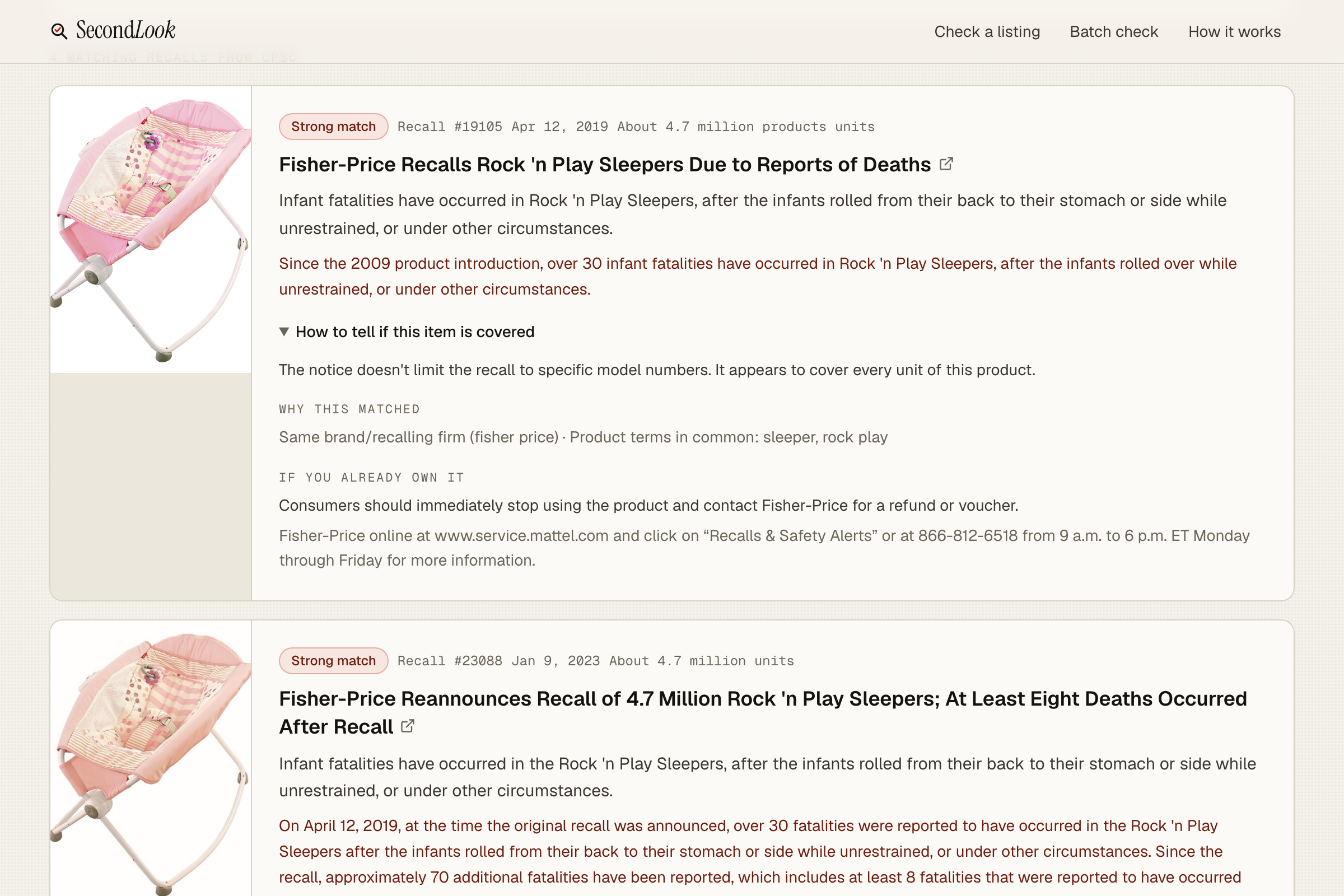
- A clear verdict: Don't buy, Verify first or No matching recall. Every flagged result comes with its evidence: the official recall photo, the hazard, reported injuries, units affected, the remedy, and a link to the notice on cpsc.gov.
- What to verify. Many recalls cover only certain models or date codes, so SecondLook pulls those identifiers out of the notice ("How to tell if this item is covered") and turns them into a ready-to-send message for the seller.
- Batch mode for thrift stores, donation drives and sellers: paste up to 200 items, get a sorted flag table, and export it as CSV.
- Shareable checks: every text check has its own link.
No account is needed. SecondLook has no database: the app doesn't save the listings you check, and label photos are read in your browser rather than uploaded. A shareable link does carry the listing text in its URL.
What makes it different
Most recall tools start with things you already own: you register a product or import a receipt, and you get alerted later. A secondhand buyer is in a different position. They have a vague listing, maybe a photo, and a few minutes to decide. SecondLook is built around that listing-first, pre-purchase moment:
- It works on the input buyers actually have, not exact model numbers.
- It treats legal sale bans as separate from recalls, because a banned category is a hard "no" whatever the brand.
- It ends with an action, the questions to send the seller, rather than just a list of search results.
How we built it
- Next.js 16 (App Router) + React 19 + TypeScript + Tailwind CSS v4, deployed on Vercel. Two server routes do the work:
/api/checkfor single listings and/api/batchfor lists. - Recall data. A build script normalizes the CPSC Recalls REST API into a compact snapshot of 7,192 recalls (products, model numbers, UPCs, hazards, remedies, injuries, retailers). At runtime, the server requests every recall published after the snapshot date and merges it in, with a 6-hour cache. If CPSC is unreachable, the snapshot still serves.
- Matching engine (custom TypeScript, no external search service):
- Vocabulary bridge. 23 product concepts map listing language ("pack n play", "sleeper/rocker", "dresser") to how recall notices are written ("play yard", "inclined sleeper", "chest", "tip-over").
- Field-weighted BM25 over titles, product names, product types, firms and descriptions, including two-word phrases, so "Rock 'n Play" outranks a generic "play".
- Brand resolution against recalling firms and licensed brand names mined from notice text ("Sharper Image-branded… recalled by Allstar").
- Exact model-number and UPC matching from the listing or the OCR'd label.
- Strength grading (strong / possible / weak) with a plain "why this matched" for every candidate. Within a tier, exact product-line phrases rank first, then recalls involving deaths or injuries.
- Federal ban rules: deterministic pattern rules with citations, including exemptions (non-padded mesh crib liners aren't banned).
- OCR: Tesseract.js runs in the browser, so the label photo never has to leave the device.
- Decision-making is deterministic. The live app runs entirely on the rules engine, and every result is labelled "Rules engine (AI off)". We also wrote an optional Claude integration (structured-output listing understanding and recall adjudication), but it is not enabled in the deployment and makes no decisions in the live product.
Challenges we ran into
- The vocabulary gap cuts both ways. Expanding "sleeper/rocker" into recall terms found the Rock 'n Play, but concept words alone also pulled in unrelated recalls (a Graco stroller for a Pack 'n Play listing). The fix: expansions can support a match but never create one without a term from the listing itself.
- Brands hide behind licensees. Sharper Image fire pits were recalled by Allstar, so firm names alone missed them. We mine "X-branded" and "sold under the X brand" phrases from notices.
- Short identifiers collide. "TR02" substring-matched an unrelated bicycle recall. Short identifiers now need an exact token match, and a model-number hit only counts as strong when the brand agrees.
- Ranking what matters. A 2013 mold-inspection notice was outranking the 2019 Rock 'n Play recall tied to infant deaths. Ranking now puts exact product-line phrases first, then hazard severity.
- Generic words as brands. "Vintage" was being read as a brand because some company has it in its name. A generic-word list fixed it.
- Serverless cold starts. The page-load status request goes to the same function that serves checks, so the 7,192-recall index is already warm when the user submits.
Accomplishments that we're proud of
These are real results from the live app:
- Vague listing: "Fisher Price baby sleeper/rocker, barely used" → Don't buy. It flags the inclined-sleeper ban and ranks the 2019 Rock 'n Play recall (#19105, about 4.7 million units) first, without the listing ever naming the product.
- Label photo: OCR in the browser reads "Model No. CHP55" off a label, and the check runs with brand and model filled in.
- Narrow recall: "4moms mamaRoo infant seat swing" → Verify first. The app quotes from the notice that only 3-point-harness models are covered (4M-005, 1026, 1037), not the 5-point-harness version, and writes the questions to send the seller.
- Recent data: a Sharper Image tabletop fire pit listing matches a recall CPSC published on Nov 12, 2026, three days before the deadline.
- Batch: a 12-item intake list is sorted into 3 "don't sell", 7 "verify" and 2 "no match", with CSV export.
What we learned
- Many recalls are conditional (model ranges, date codes), so "matches a recall" is often not the whole answer. The most useful output is what to verify.
- Public federal data is rich enough to build a real product on, but most of the work is normalizing it and bridging how ordinary people describe things.
- Legal facts belong in deterministic, citable code. We kept every product-safety decision explainable.
What's next for SecondLook
- A browser extension that checks Marketplace and Craigslist listings in place
- More official sources: NHTSA (car seats), Health Canada and other national recall databases
- Better product identification from photos, and more product concepts
- Check-by-photo over SMS for people without a laptop
- Accessibility and language support, starting with Spanish
- Intake tooling for thrift stores and donation drives
Built with AI assistance (disclosure)
SecondLook was built during IceHacks 2026 by a solo developer, with substantial help from Claude Code (Anthropic's AI coding assistant). It was used for research, design, most of the code, the demo-film production and documentation. I directed and reviewed the work and can explain every part of it.
In the product, every verdict comes from the deterministic rules engine. The only machine-learning component running live is browser-based Tesseract.js OCR, which reads label photos on the device. The optional Anthropic (Claude) integration in the codebase is disabled in the deployment and makes no decisions. In the demo video, the narration is synthetic (Kokoro-82M, generated locally), the music is original, and every product shot is real screen capture of the live app.
Credits: recall data and product images from the U.S. Consumer Product Safety Commission (public domain). Consumer Reports' 2026 investigation is cited. Open-source libraries are listed in the README.
Built With
- bm25
- claude-code
- cpsc-recalls-api
- ffmpeg
- hyperframes
- javascript
- lucide
- nextjs
- node.js
- ocr
- playwright
- python
- react
- rest-api
- tailwindcss
- tesseract.js
- typescript
- vercel
- zod