Inspiration
Every day, people struggle with what to do with used items. They’re unsure of the most responsible or impactful way to handle them.
Imagine you have a pile of old cardboard boxes: instead of tossing them, you could redesign them into small bookshelves.
Or think about the clothes you no longer wear: with the right guidance, they could be resold or donated in a way that reduces waste and even earns you a tax deduction.
Even a simple plastic bottle doesn’t have to end up in the trash. It could become a holder, a toy car, or a measuring vessel.
There are creative, impactful second-life options for so many items: they just need to be made visible, accessible, and easy to act on. That's what inspired us to build SecondLife.
What it does
SecondLife AI is an intelligent platform that helps individuals, communities, and companies reuse, redesign, or responsibly dispose of used items, all powered by AI.
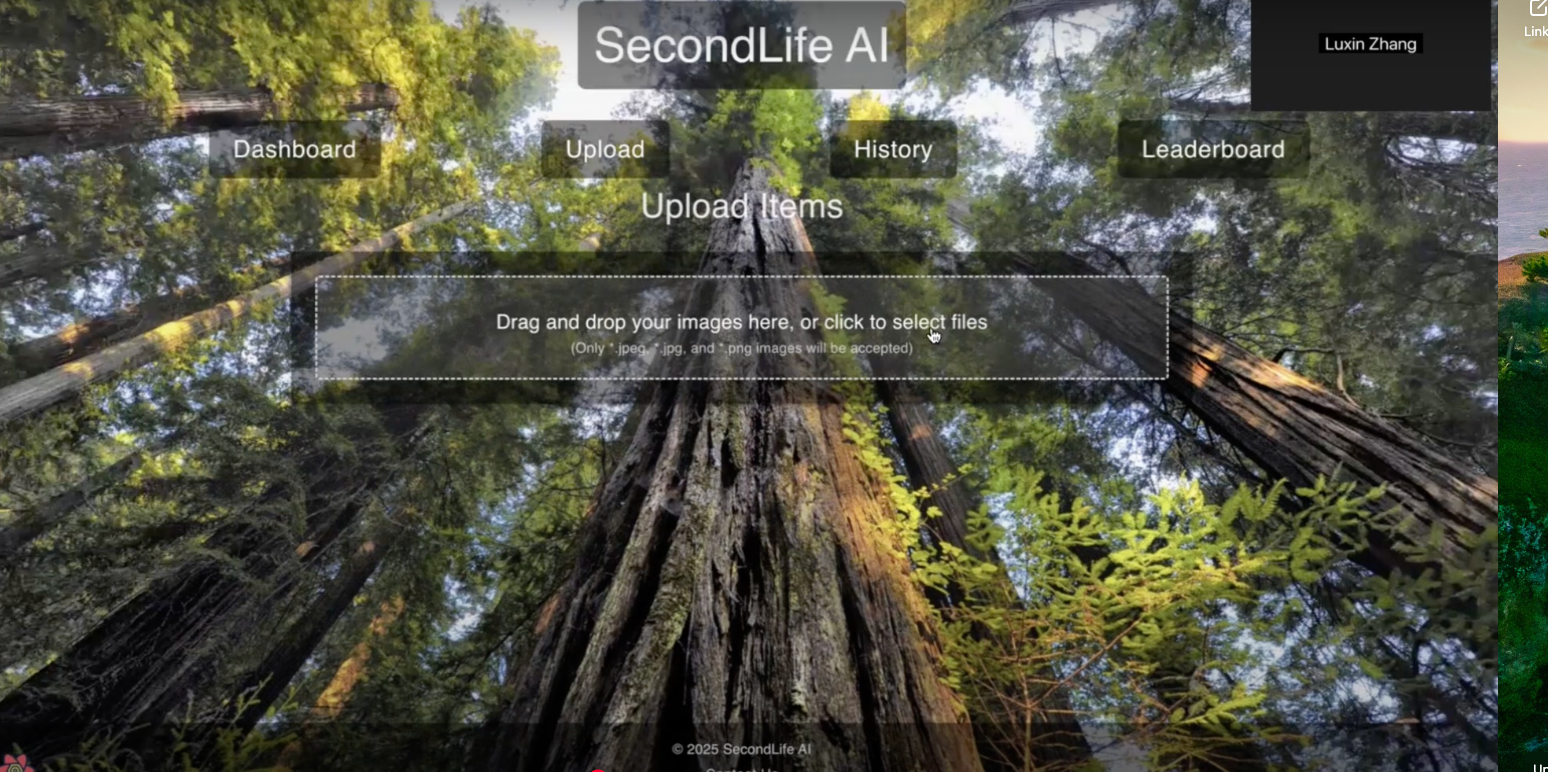
By simply uploading a photo, users receive personalized suggestions on how to decorate, donate, or sell the item, or where to properly dispose of it if reuse isn’t viable.
The platform is designed to support global Sustainability Goals, particularly: - Goal 11: Sustainable Cities and Communities – promoting inclusive, resilient, and eco-conscious living. - Goal 13: Climate Action, enabling individuals and businesses to take small, meaningful steps to reduce waste and carbon impact.
Each action is rewarded with an ECO Score, calculated using public environmental datasets. Whether it's turning a plastic bottle into a storage holder or donating clothes, SecondLife AI quantifies your positive impact, making sustainability visible, measurable, and rewarding.
SecondLife makes it effortless: just snap a photo, and let AI guide your item to its second life.
How we built it
I built the backend using Ruby on Rails, and the frontend with Vite + TypeScript (including Node.js, HTML, and CSS). I integrated the OpenAI GPT-4o API to generate smart suggestions based on uploaded images, which are stored securely using Google Cloud Storage. I used GitLab for version control and CI/CD to manage code submissions and deployments.
Challenges we ran into
Uploading Images to the OpenAI API Initially, I encountered errors when trying to send image files directly to the OpenAI API — the form submission wasn't supported. To resolve this, I converted the images to Base64, uploaded them to Google Cloud Storage, and then used a public URL for API analysis to ensure compatibility.
Handling Video Links for Suggestions Many video links suggested by the AI were broken, region-restricted, or age-restricted. To overcome this, I refined the prompt to filter out problematic sources and implemented a pre-validation step to test video links before displaying them to users.
Accomplishments that we're proud of
I am proud to have built a platform where users can upload an image of a used item, get it classified by AI, and receive personalized suggestions — from creative reuse ideas and redesign videos to donation and resale options. It’s a meaningful step toward making sustainability accessible and actionable for everyone.
What we learned
- How to use and manage Google Cloud Storage effectively
- How to work proficiently with GitLab for version control and CI/CD
- How to upload and process images as prompts for the OpenAI API
What's next for Secondlife AI
Next, I’ll refine our AI prompts for smarter, more accurate item suggestions. I plan to partner with recycling centers to expand responsible disposal options.
SecondLife AI will begin onboarding users, starting with individuals and apartment communities to encourage sustainable habits at the grassroots level.
I’ll also collaborate with artists and designers to inspire creative item redesigns, and build a vibrant community where users can share their own reuse and DIY ideas.


Log in or sign up for Devpost to join the conversation.