Inspiration
Virtual try-on is built for clean catalogue images. Resale listings never have them. A one-of-one garment on a peer-to-peer marketplace is photographed once, with a phone, crumpled on a patterned duvet, half in shadow, sometimes with a hanger or a hand in the shot. Sent straight to a try-on endpoint, a photo like that spends API credits and can come back as a render failure, but to the buyer is looks like it's reliable. The seller gets no guidance on what to fix. The buyer gets no signal about how much to trust what they see.
What it does
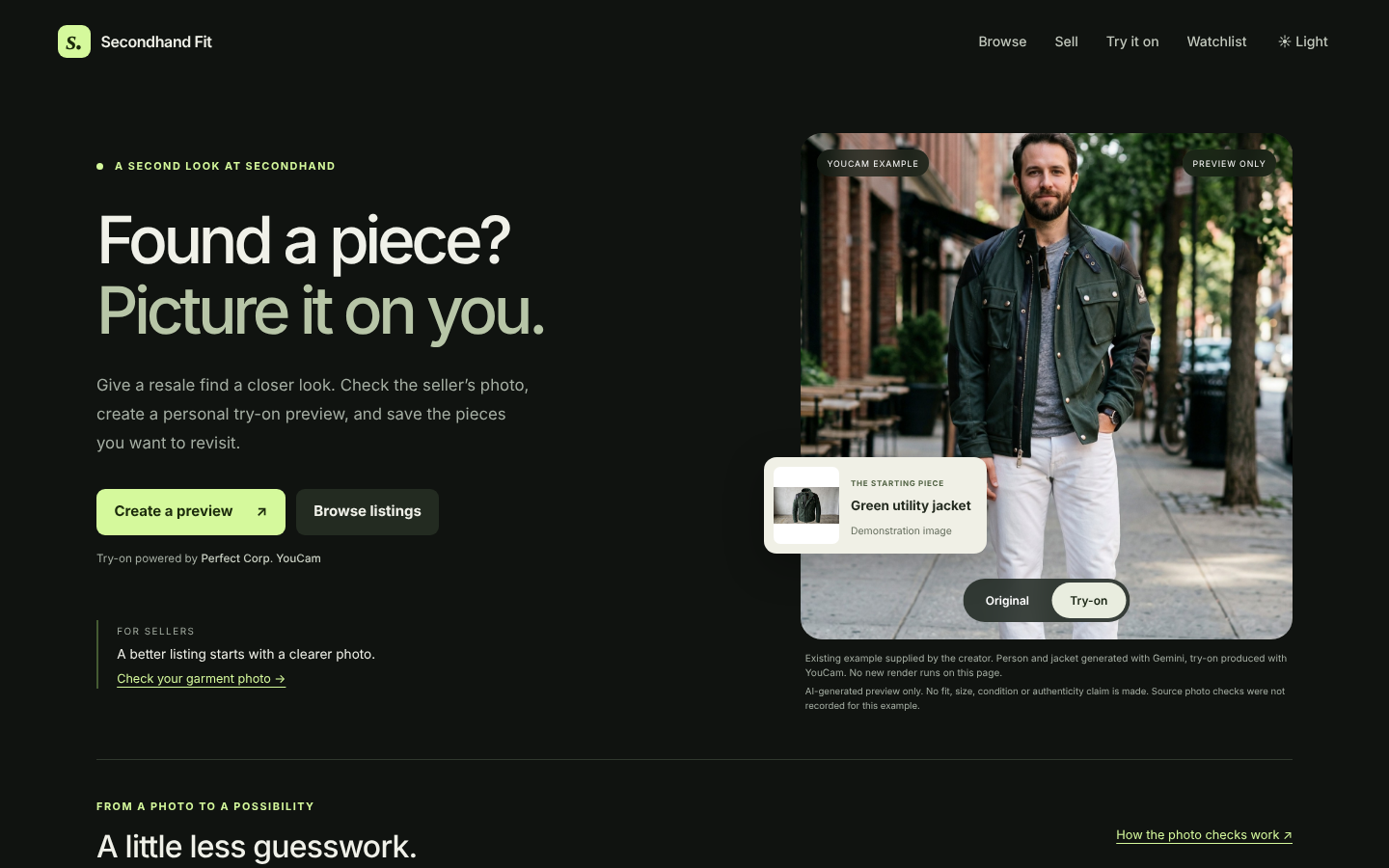
Secondhand Fit puts a pre-flight check in front of the Perfect Corp. YouCam API — Apparel Virtual Try-On, and an honesty layer behind it.
For the seller
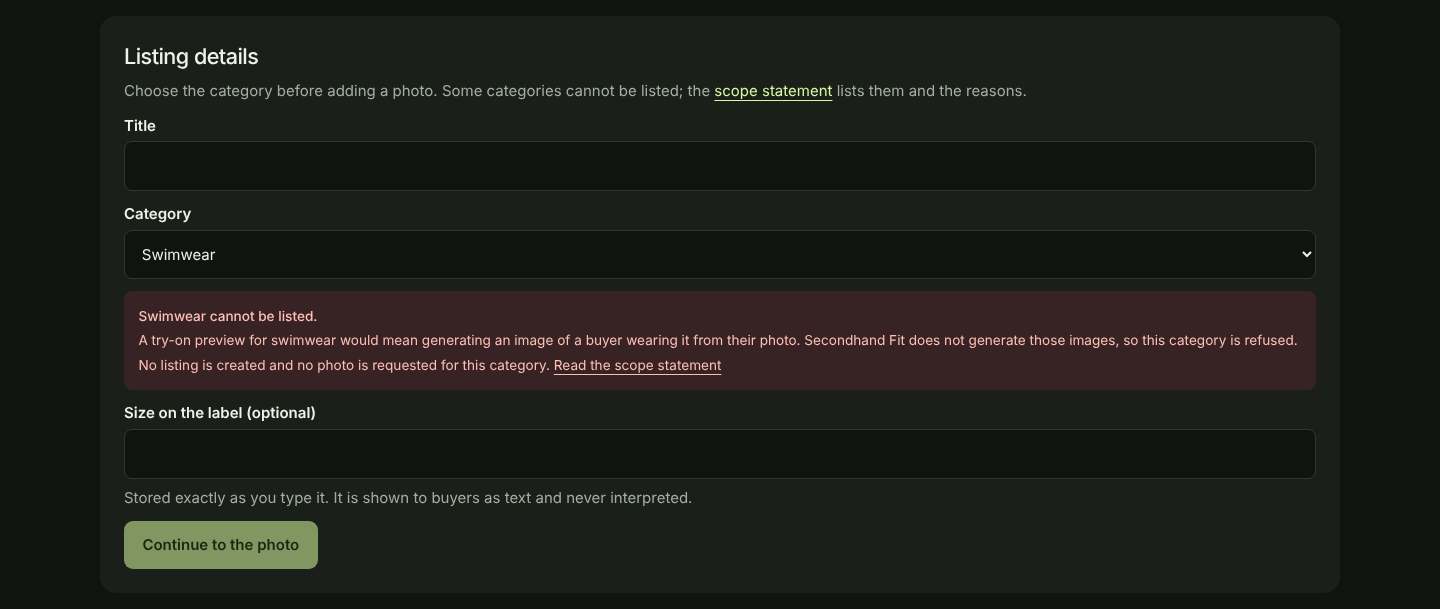
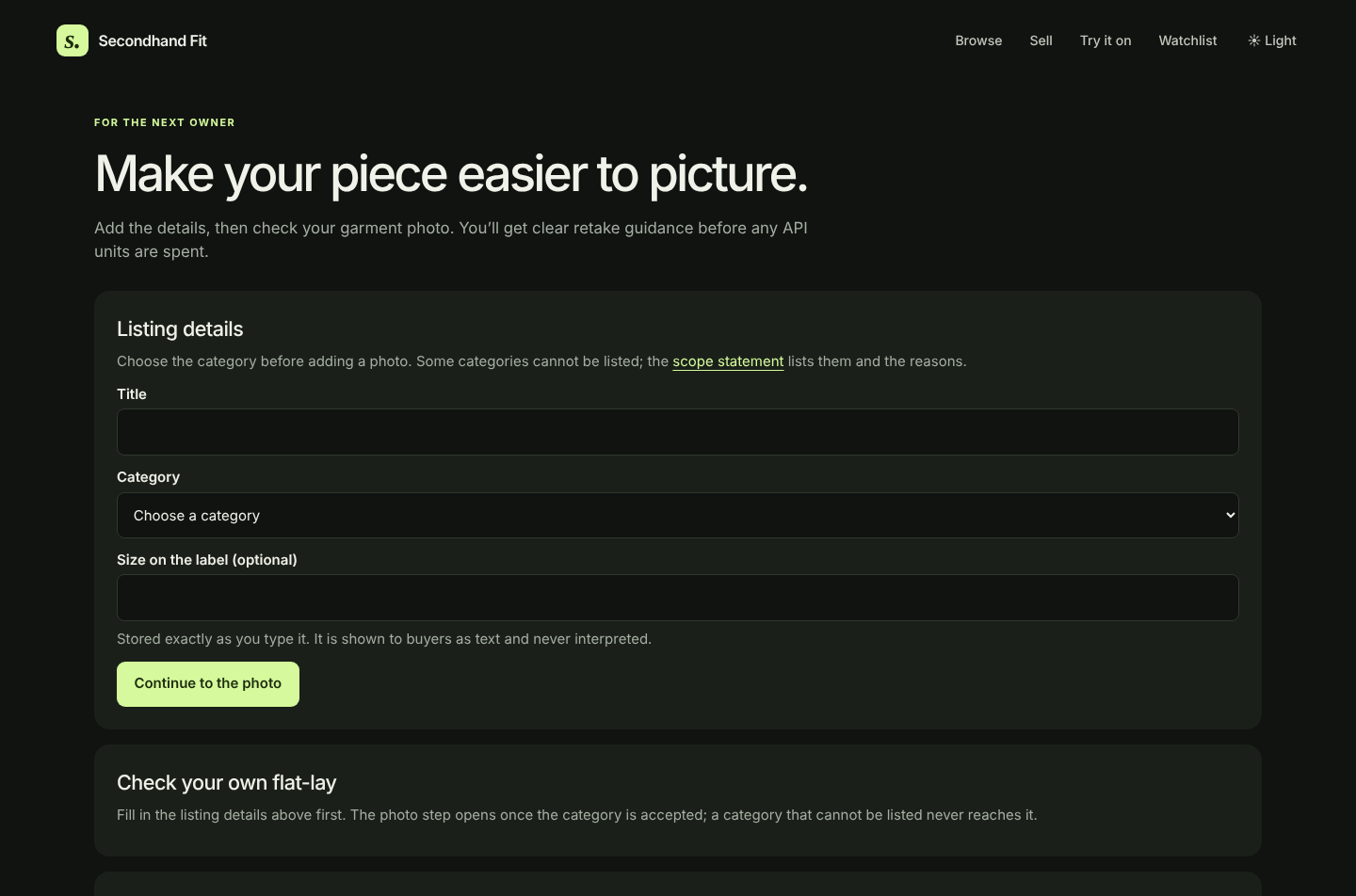
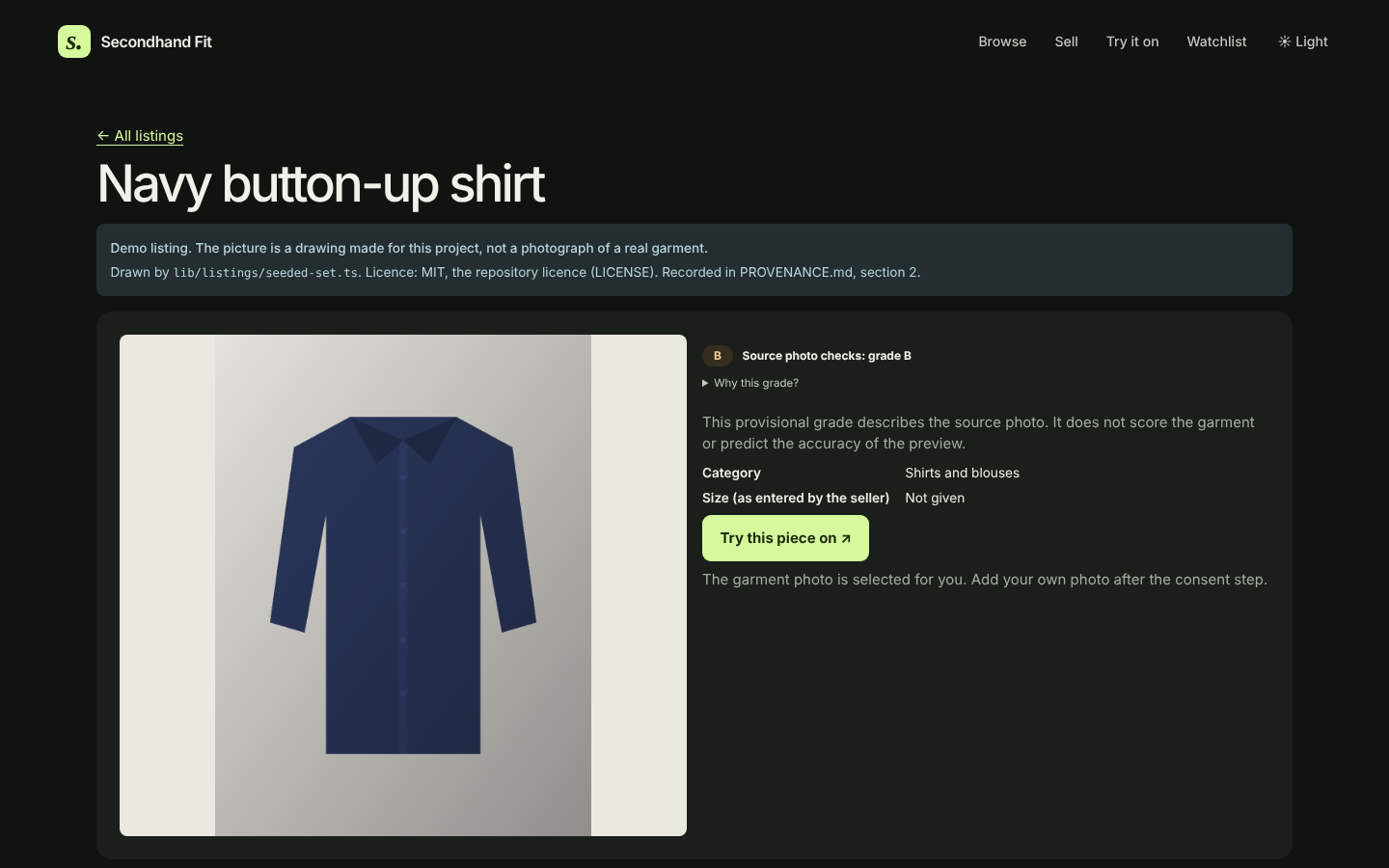
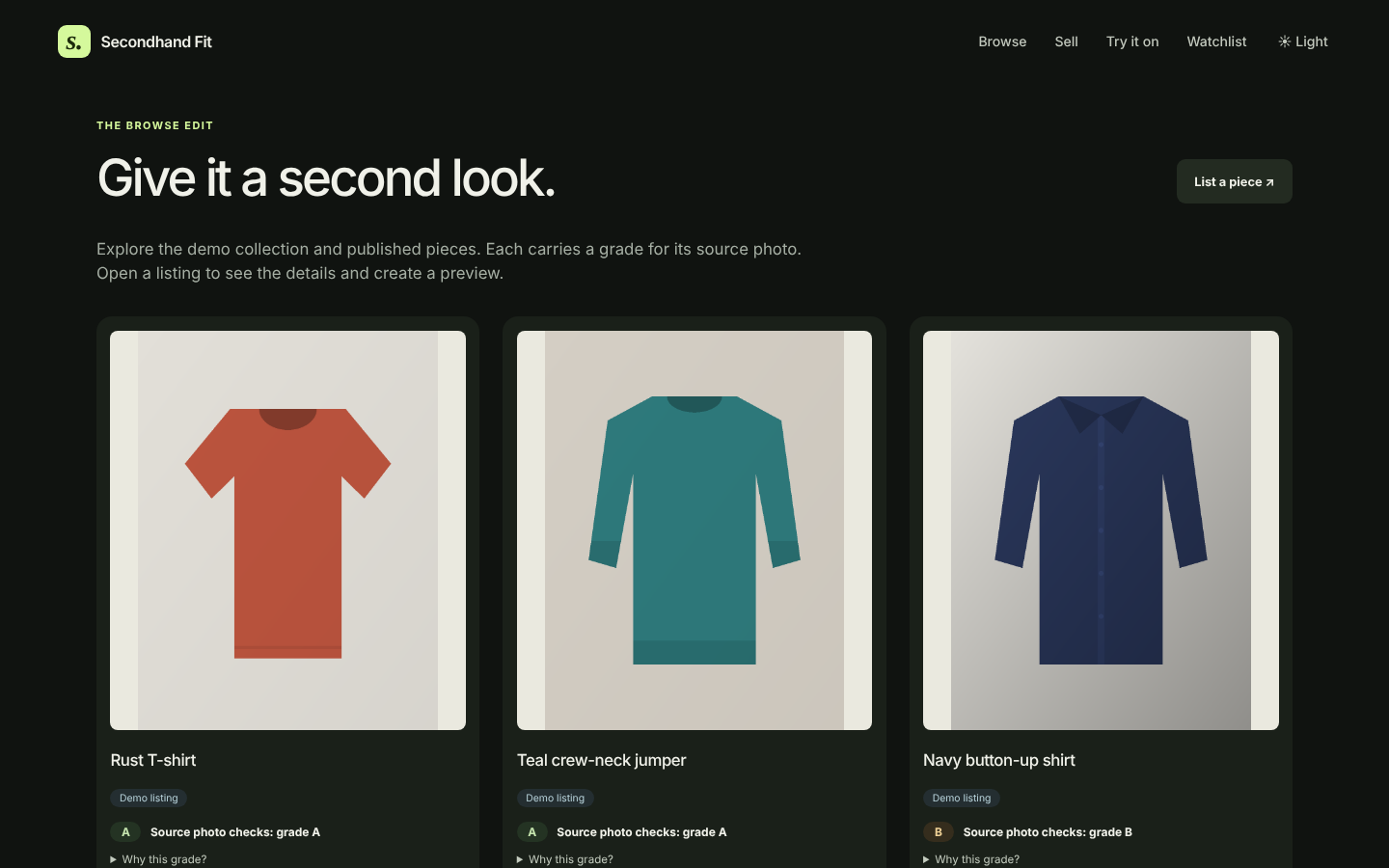
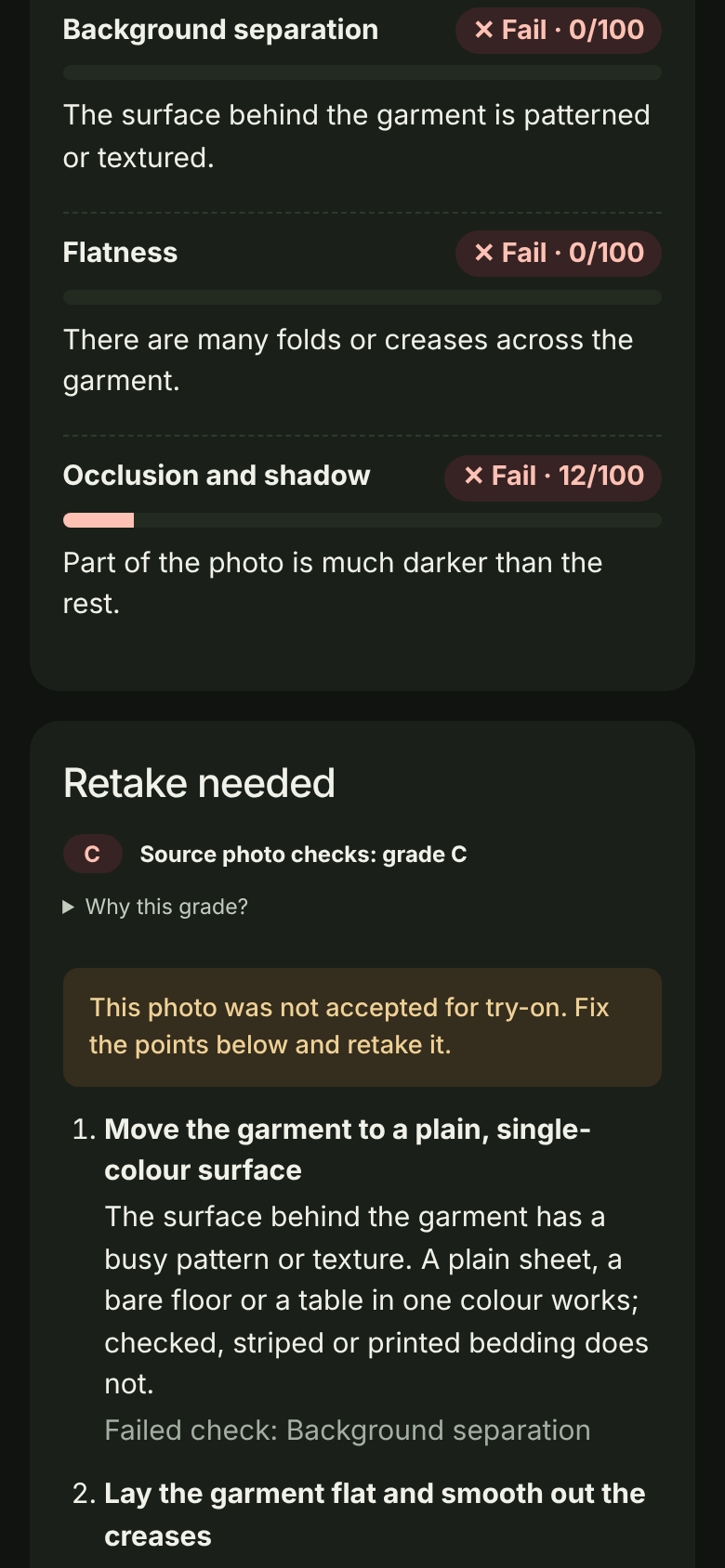
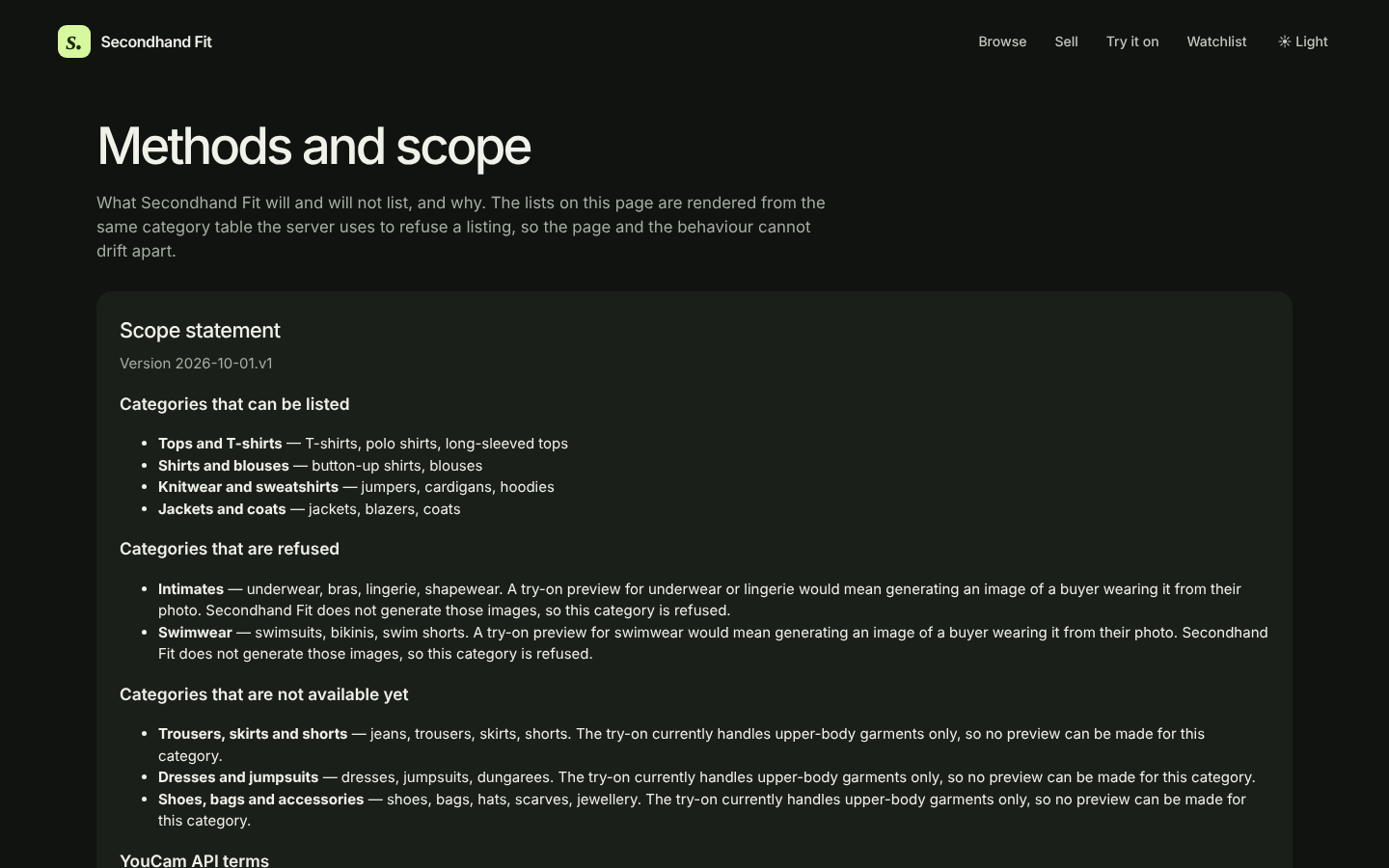
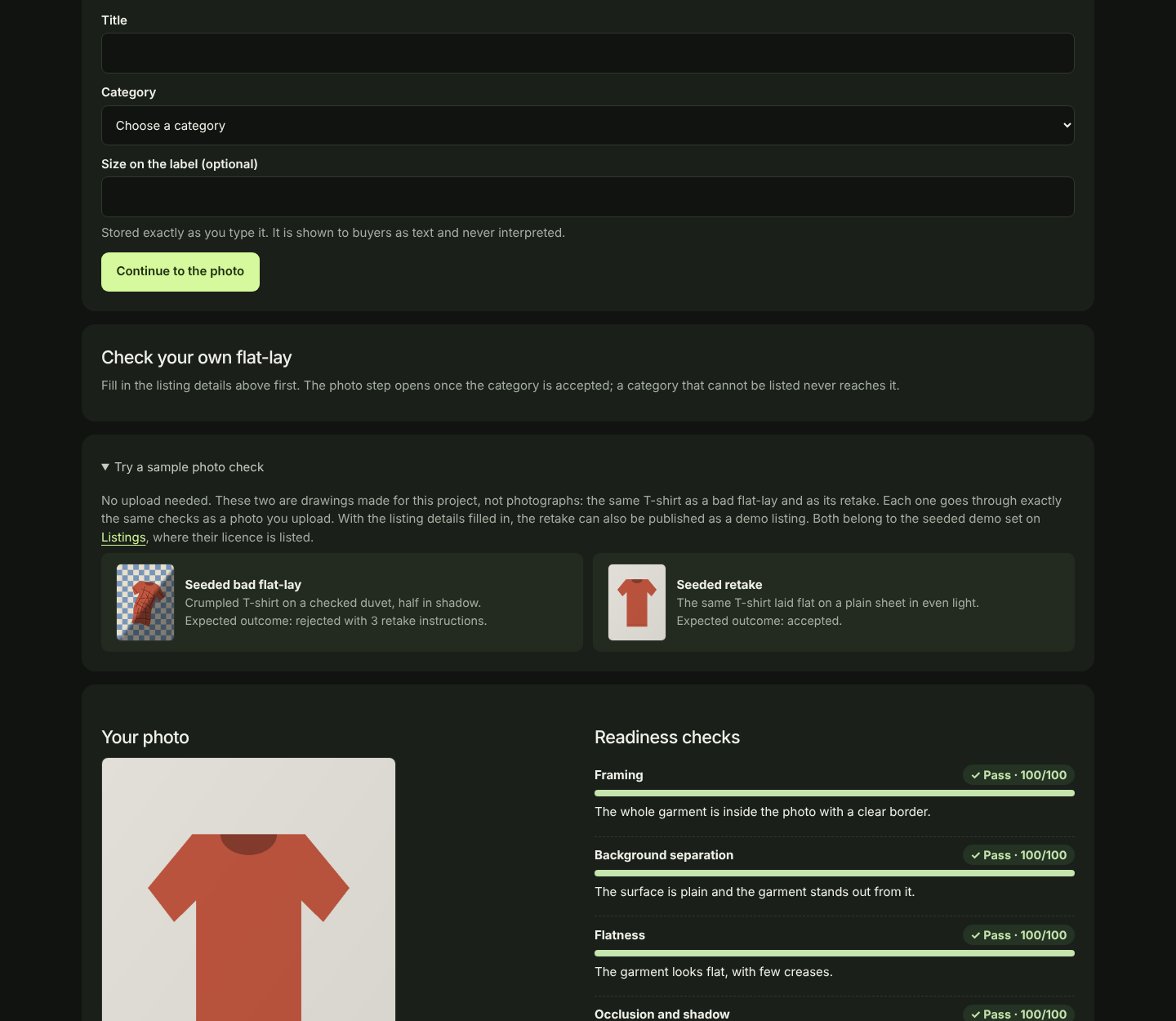
Photo checks before any API call. The garment photo is checked in the browser for framing, background separation, flatness and occlusion/shadow. Each check gives a score out of 100 and a pass, warn or fail verdict. Specific retake instructions. A photo with a failing check is rejected, and the seller gets up to three ordered, concrete instructions ("Move the garment to a plain, single-colour surface", "Lay the garment flat and smooth out the creases", "Even out the light…") instead of a generic error. No API unit is spent on a photo that would not work. Server-side preparation. An accepted photo is prepared on the server: turned upright, metadata removed, cropped to the garment with padding, plain background flattened only where the match is confident, and sized within the try-on API's input limits. The seller sees a before/after slider and a list of exactly what changed. A grade on every listing. Each published listing carries a source-photo grade (A, B or C) with the reason it is not higher. The grade follows the weakest check, so one failing check cannot be averaged away, and a photo with a failing check cannot be published. Refused categories. Intimates and swimwear are refused when the listing is created, before a photo is requested, with the reason shown and a link to the published scope statement. Lower-body garments, dresses and accessories are refused for now because the try-on handles upper-body garments only. For the buyer
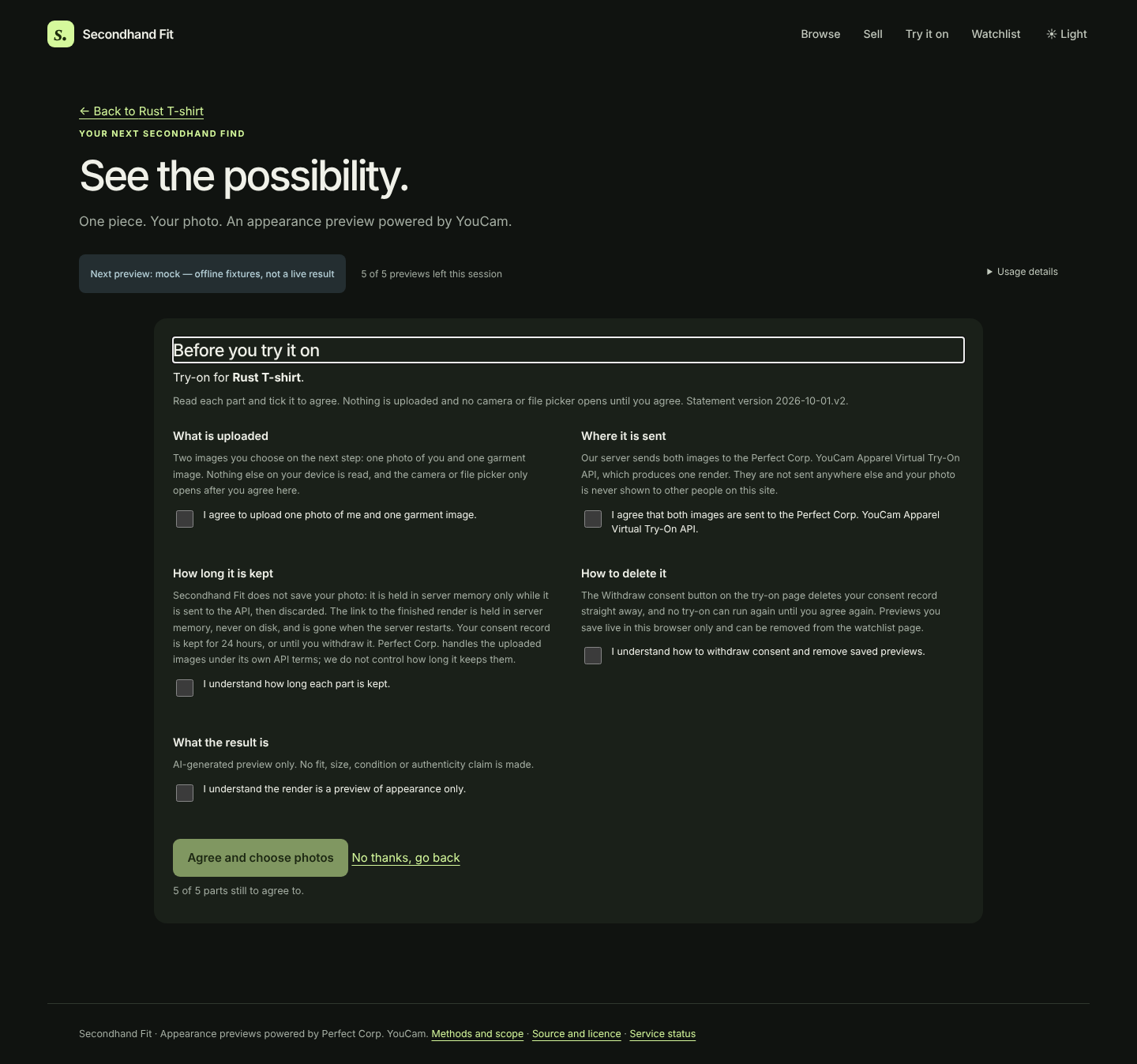
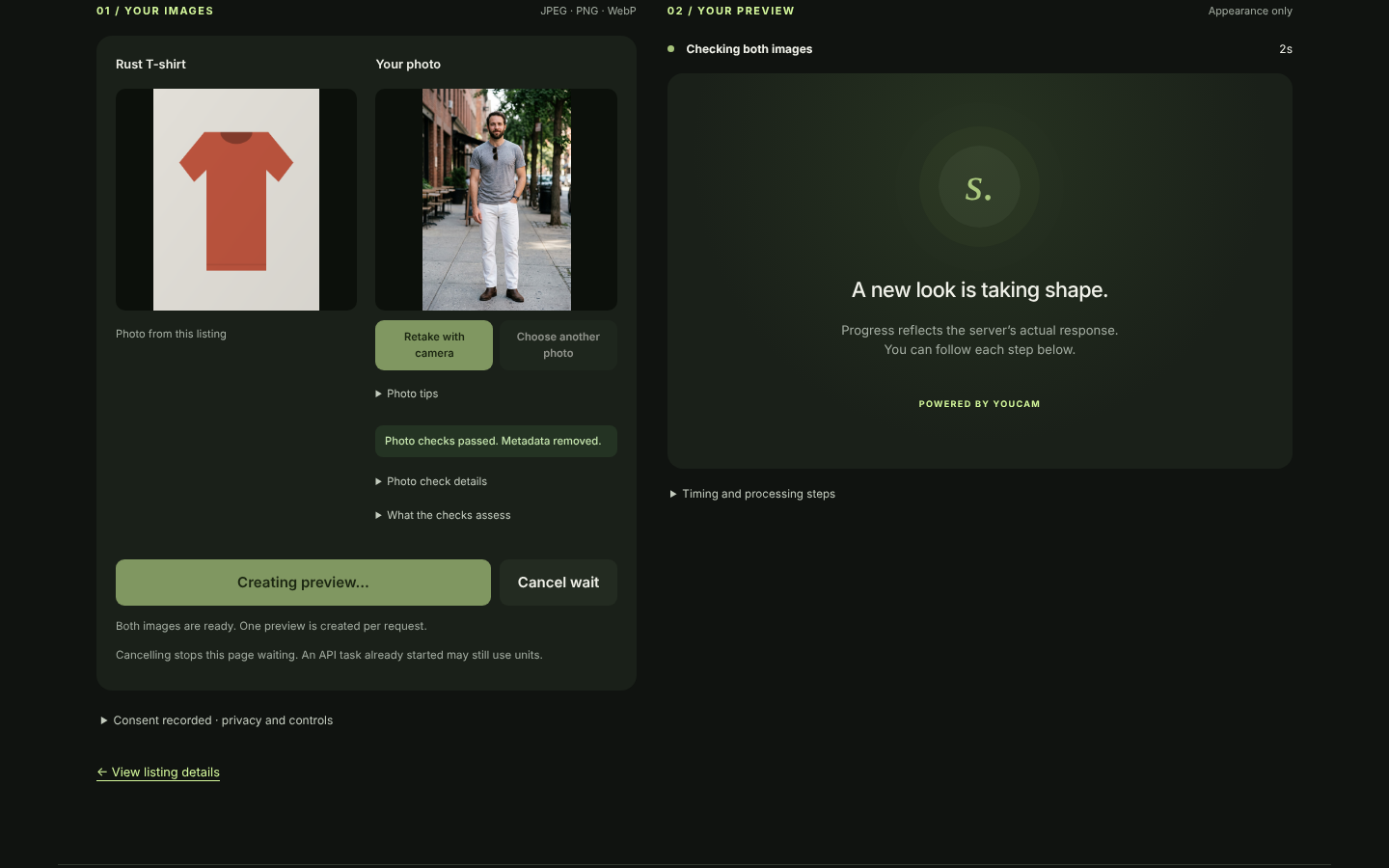
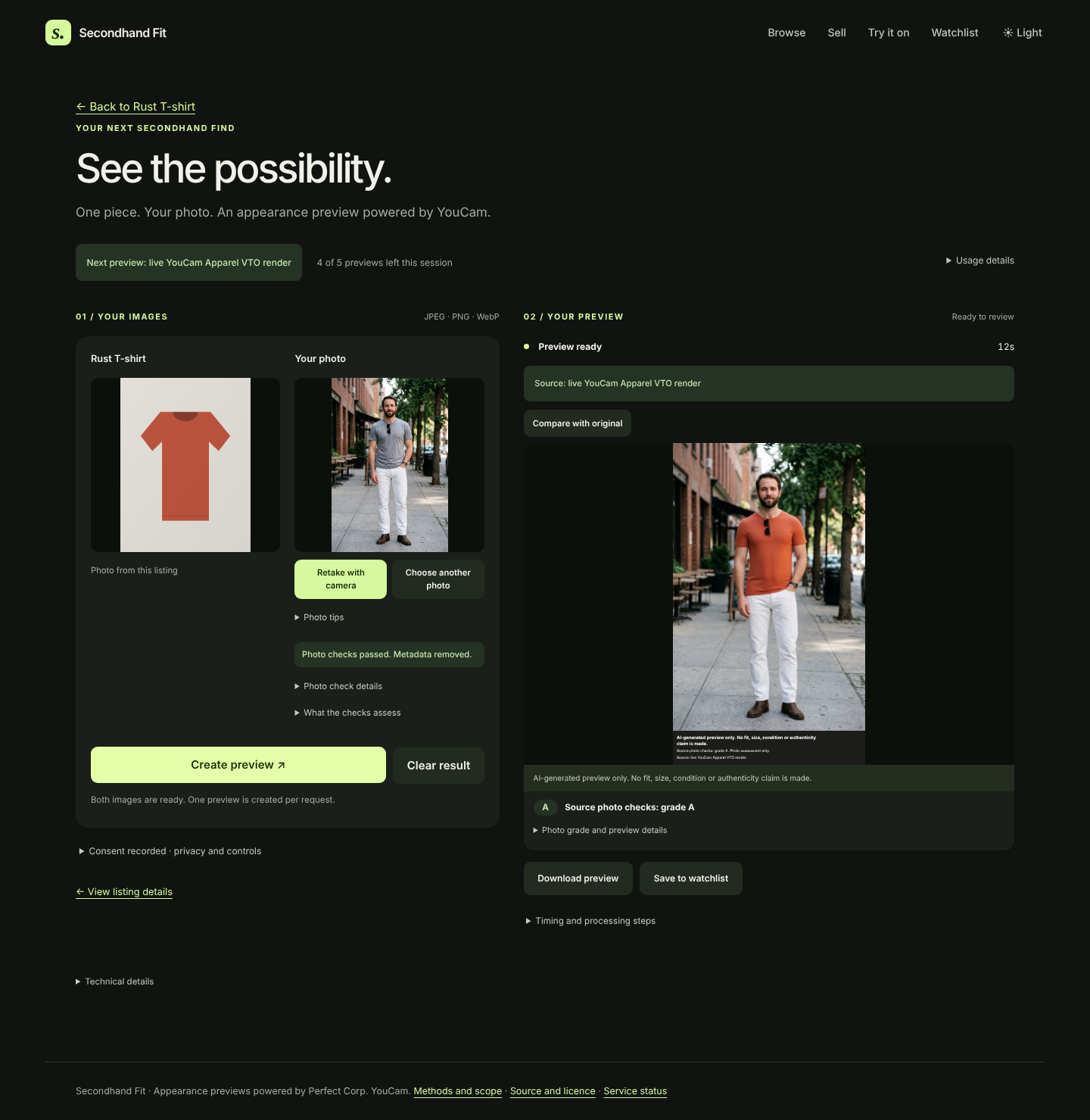
Consent first, enforced by the server. The try-on starts with a plain-language statement of what is uploaded, where it is sent and when it is deleted. The server refuses any try-on request without a current consent record, before any API call. Consent can be withdrawn at any time. One render, honest progress. The server uploads the listing's prepared garment image and the buyer's photo to the YouCam Apparel VTO API, creates the task and polls it with a hard timeout. The progress stages on screen are the server's real state transitions, not a timer. A render that does not finish in time says so. Preview only, always. Every render carries the label "AI-generated preview only. No fit, size, condition or authenticity claim is made." with the garment photo's grade. Both are burned into the image itself, so the watchlist and any downloaded copy keep them. A copy-guard script in the repository fails the build check if product copy makes a fit, size, condition or authenticity claim. Watchlist. Buyers can save previews, which keep their label, grade and a link back to the listing. For whoever pays for the API
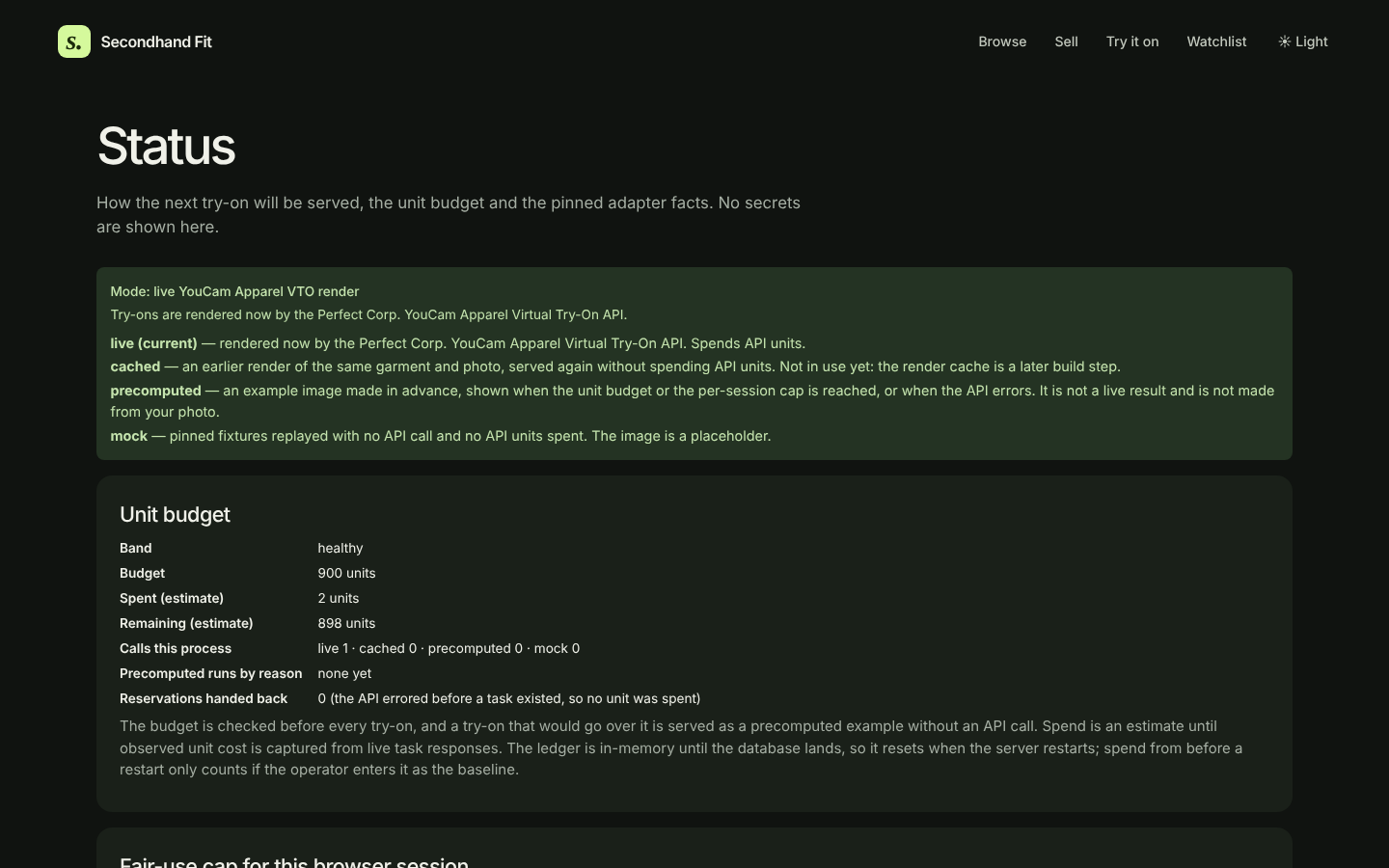
A unit budget that fails closed. Every call is recorded in a usage ledger. When the budget is reached or a browser session reaches its daily cap, no API call is made and a stored example is offered, labelled "Not a live result". It is never passed off as a live render. Offline mock mode. With no API key the whole flow runs from pinned fixtures and makes no outbound request, so anyone can run it from a clone.
How we built it
Secondhand Fit is a Next.js 15 and TypeScript web app, written during the Submission Period as a new build.
YouCam integration. One server-side adapter (lib/youcam/adapter.ts) runs the whole flow against the YouCam API V2 over REST: check both images against the API's input limits (scaling, converting or refusing as needed), upload the garment, upload the buyer photo, create the cloth try-on task, poll with a bounded timeout and limited retries, and fetch the result. The API key is read from a server-only environment variable. The browser never receives a credential or a provider URL; the result image is served through a same-origin proxy that burns in the label. Each documented API error code has its own plain-language message. Readiness checks. Four deterministic image heuristics run on a canvas in the browser, with every threshold in one file. The server scores the same analysis grid with the same code. The readiness path never imports the YouCam adapter, so it cannot spend a unit. Normalisation. sharp handles orientation, metadata removal, cropping, conservative background flattening and resizing. Verification. 32 unit tests for the adapter, an offline end-to-end script covering consent, blocked categories, publishing, labelled renders, the budget cap and withdrawal, a copy-guard lint, and a clone check that fails if a fresh clone would need anything the README leaves out.
Challenges we ran into
Working backwards from the endpoint. The seller checks only make sense if they reflect what the try-on endpoint needs, so the endpoint paths, field names and input limits are pinned in one place and the app shows on /status whether a live render has confirmed them. Not overclaiming. A try-on render says nothing about how a garment fits, and product copy easily implies that it does. The preview-only label is one shared constant, and a lint enforces the wording across the app. Honest fallbacks. It is tempting to show a stored example when a live call fails. Secondhand Fit offers it only on request and labels it as not live.
Accomplishments that we're proud of
A judge can reproduce the whole seller story, from the rejected flat-lay to the accepted retake, a before/after and a graded listing, without uploading anything and without spending an API unit. Every render, everywhere it appears, says what it is and what it is not.
What we learned
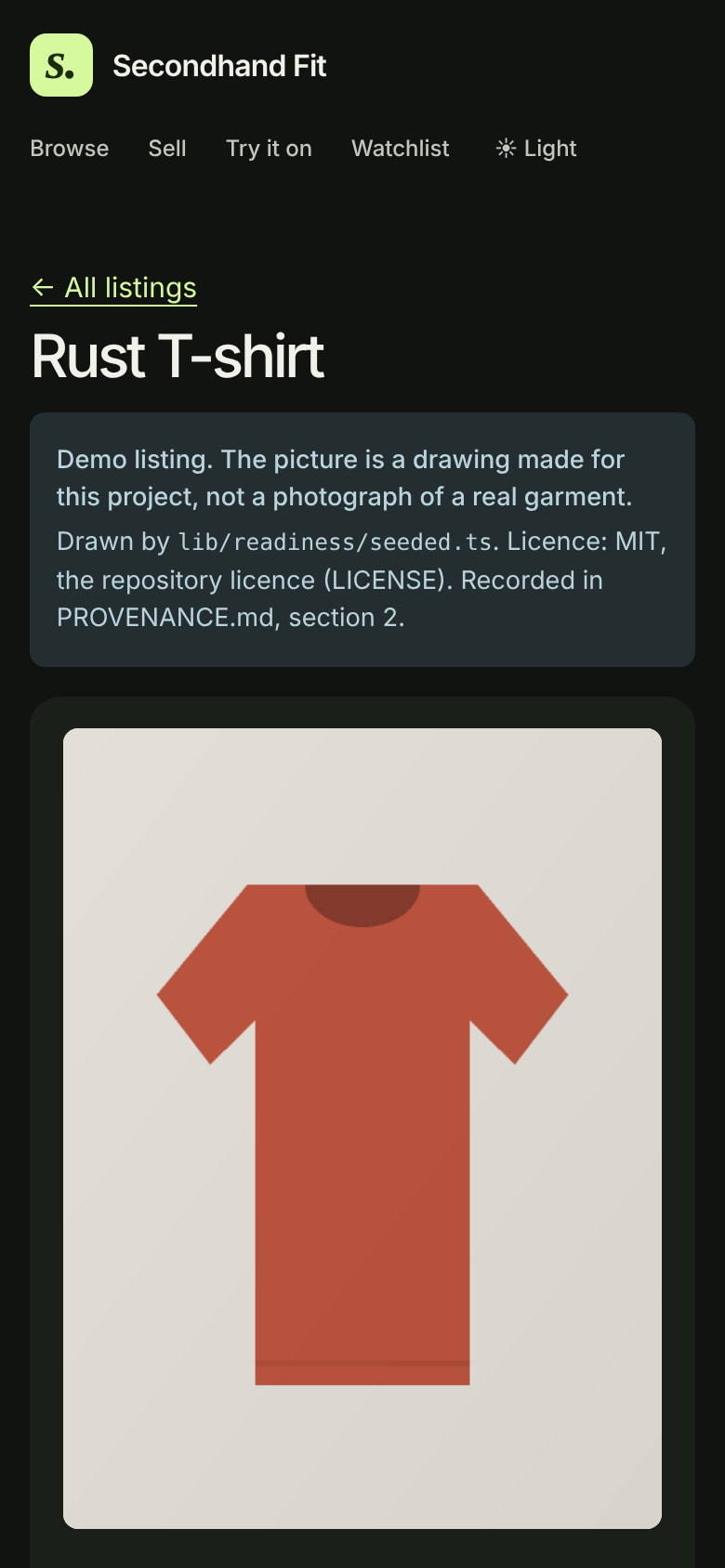
Most of the work in a dependable try-on product sits before and after the API call: deciding when not to call it, and being clear about what comes back. Known limitations Flatness is an edge-density proxy, so a bold print or stripe also lowers the score. Background colours are learned from the border of the photo, so a garment that covers most of the border is reported as "garment edges not found". Thin hangers, and shadows that fall only on the garment, are not reliably detected. The try-on handles upper-body garments only. The readiness thresholds are provisional. They have not been calibrated against a large set of live API runs on degraded photos. Listings, consent records and the ledger are kept in server memory in this prototype, so a restart clears listings published by visitors. The seeded demo listings are rebuilt on every start. The demo listing garments are drawings generated by the project's own code, not photographs, so the project owns them outright.
What's next for Secondhand Fit
Seller insights: try-on counts and grade history per listing, with rates hidden at small sample sizes. Calibrating the thresholds against live renders, and flagging renders that quietly returned the original clothing. Durable storage and seller accounts. An embeddable try-on button or listing import for existing resale marketplaces. Garment categories beyond the upper body.
Built With
- next.js
- node.js
- perfect-corp.-youcam-api-(apparel-virtual-try-on)
- react
- rest
- sharp
- typescript

Log in or sign up for Devpost to join the conversation.