Inspiration
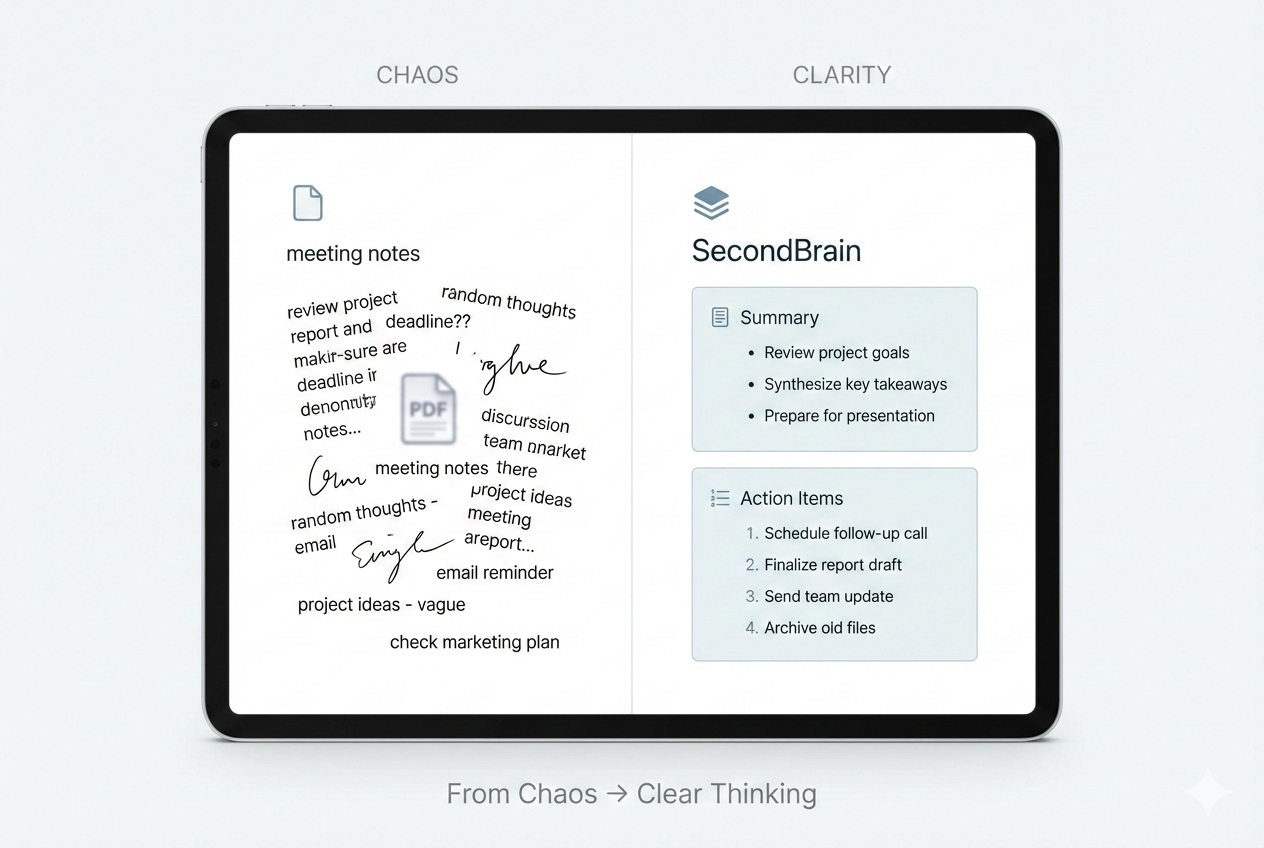
We are constantly surrounded by information—notes, PDFs, screenshots, messages—but very little clarity. I often found myself collecting content without actually understanding what to do with it. The inspiration for SecondBrain came from this gap between information overload and clear thinking.
Instead of building another chatbot that simply answers questions, I wanted to create a system that helps people think better.
What it does
SecondBrain acts as a personal cognitive assistant. Users can input messy, unstructured data such as raw notes, documents, screenshots, or ideas. Using Gemini 3’s multimodal understanding and reasoning capabilities, the system transforms this chaos into concise summaries, prioritized action items, and clear next steps.
The goal is not more content, but better decisions.
How I built it
The project is built around the Gemini API, focusing on long-context understanding and reasoning rather than simple Q&A. Inputs are structured through carefully designed prompts that guide Gemini to analyze, synthesize, and organize information into meaningful outputs. The interface is kept intentionally minimal to emphasize clarity over complexity.
Challenges I ran into
One of the main challenges was preventing the AI from behaving like a generic chatbot. This required prompt engineering that encouraged structured reasoning, actionable outputs, and consistent formatting. Balancing simplicity for users with powerful AI capabilities was another key challenge.
What I learned
This project taught me how powerful Gemini is when used as a reasoning engine rather than just a conversational tool. Multimodal inputs combined with long-context understanding unlock entirely new ways of interacting with information.
Built With
- gemini-api
- google-ai-studio
- html
- javascript
- multimodal
- prompt-engineering

Log in or sign up for Devpost to join the conversation.