-
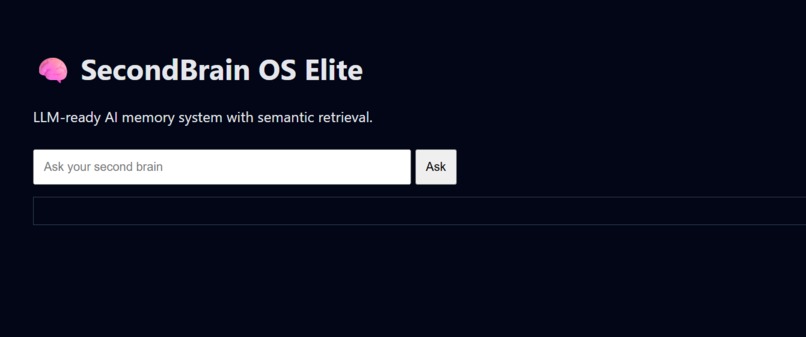
Front end
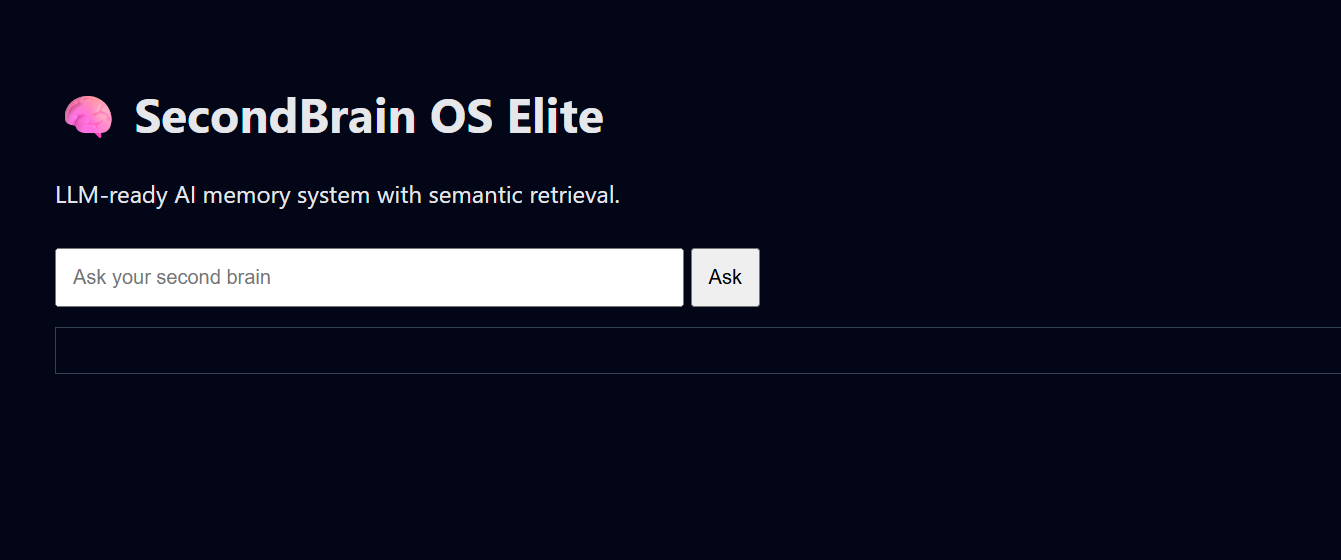
Inspiration
In today’s digital world, information is everywhere—notes, documents, ideas, and research are scattered across files and platforms. While we store more knowledge than ever, retrieving meaningful insights from it remains difficult. SecondBrain OS was inspired by the idea of giving individuals a personal AI-powered memory—a system that doesn’t just store information, but understands it and helps users reason over their own knowledge.
What it does
SecondBrain OS is an AI-powered personal knowledge system that allows users to upload their notes and documents and interact with them using natural language. Instead of searching through files manually, users can simply ask questions, and the system retrieves the most relevant information using semantic understanding and generates accurate, context-aware responses.
How we built it
SecondBrain OS is built using a Retrieval-Augmented Generation (RAG) inspired architecture. Documents are ingested and converted into vector representations using semantic embeddings. When a user asks a question, the system performs vector similarity search to retrieve the most relevant memory and uses it to generate a meaningful response.
The backend is implemented using FastAPI, while the frontend provides a clean and simple interface for interacting with the AI system. The architecture is designed to be modular, scalable, and ready for integration with advanced LLMs.
Challenges we ran into
One of the main challenges was designing a system that could meaningfully retrieve relevant information rather than relying on simple keyword matching. Balancing simplicity with technical depth was also a challenge—ensuring the system remained easy to demo while still demonstrating real AI and ML concepts such as semantic search and retrieval pipelines.
Accomplishments that we're proud of
Building a fully working AI-powered knowledge system within the hackathon timeline
Implementing semantic retrieval instead of traditional search
Designing a clean, understandable AI architecture that judges and users can easily grasp
Creating a project that feels like a real, extensible product rather than a prototype
What we learned
Through this project, we gained deeper hands-on experience with retrieval-based AI systems, vector similarity search, and designing AI architectures that balance usability with technical rigor. We also learned how important storytelling and clarity are when presenting complex AI systems in a hackathon environment.
What's next for SecondBrain OS
Future plans include integrating large language models for richer responses, adding automatic insight generation, supporting multiple data types such as PDFs and web links, and improving the user interface into a full-featured dashboard. SecondBrain OS has the potential to evolve into a powerful personal AI assistant for learning, research, and productivity.
Built With
- cosine-similarity
- css
- fastapi
- git
- html
- javascript
- numpy
- python
- rest-apis
- retrieval-augmented-generation-(rag)
- scikit-learn
- semantic-embeddings
- tf-idf
- uvicorn
- vector-similarity-search


Log in or sign up for Devpost to join the conversation.